
You’ve just closed your third acquisition this quarter. The deal went smoothly—terms were favorable, the valuation made sense, and your investors are happy. Then you sit down with your operations team and realize you’re now managing three different payroll systems, three benefits brokers, three sets of state compliance obligations, and three distinct employee handbooks.
This is the reality of roll-up execution that nobody talks about in the deal memos.
Roll-up strategies succeed on operational synergy. The entire thesis depends on consolidating fragmented markets, eliminating redundancies, and creating a platform that’s worth more than the sum of its parts. But HR integration is where that thesis quietly falls apart. You can merge the P&Ls on paper, but if you’re still running parallel HR infrastructure across every acquisition, you’re not capturing the operational leverage you promised your investors.
A PEO can accelerate this consolidation. It gives you a single employer of record, unified benefits, and standardized compliance across every company you acquire. But it’s not the right answer for every roll-up scenario—especially if you’re building toward a strategic exit or operating in industries where co-employment creates friction.
This guide breaks down when a PEO makes roll-up execution operationally smoother, when it creates problems, and how to structure the relationship if you decide it fits your integration playbook.
The Compounding HR Problem Roll-Ups Create
Every acquisition adds legacy systems. That’s the part most operators underestimate.
You’re not just acquiring revenue and customer relationships. You’re inheriting payroll platforms, benefit plans, workers’ comp policies, state registrations, and compliance obligations that were built for a standalone business—not a portfolio company inside a larger platform.
The first acquisition feels manageable. You might keep their existing HR setup running while you figure out integration. But by the third or fourth deal, you’re managing a patchwork of vendors, contracts, and processes that make it nearly impossible to get a clean view of total headcount, benefits costs, or compliance exposure.
This creates real operational drag. Your finance team is reconciling payroll data from multiple systems. Your benefits broker is managing separate renewals for each entity. Your compliance risk is multiplying because each state registration, workers’ comp classification, and tax filing exists in a different system with different deadlines.
The speed pressure makes it worse. Most roll-ups operate on tight integration timelines—typically 90 days to start capturing synergies. But HR consolidation doesn’t move that fast when you’re harmonizing legacy systems. Migrating payroll takes planning. Benefits renewals are locked to annual cycles. Compliance filings can’t be rushed without creating risk.
So you end up in a holding pattern. You keep the old systems running longer than you planned, which means you’re paying for duplicate vendor relationships, administrative overhead, and inconsistent employee experiences across portfolio companies. The synergies you modeled in the deal don’t materialize because you’re still operating like three separate businesses.
This is where the hidden costs pile up. It’s not just vendor fees—it’s the time your team spends managing complexity instead of focusing on growth. It’s the compliance penalties you didn’t catch because obligations were scattered across systems. It’s the employee frustration when acquired teams are on different benefit plans with different coverage and different costs.
The compounding problem is real. Each new acquisition doesn’t just add headcount—it adds another layer of operational complexity that slows down the entire platform.
How PEOs Compress Integration Timelines
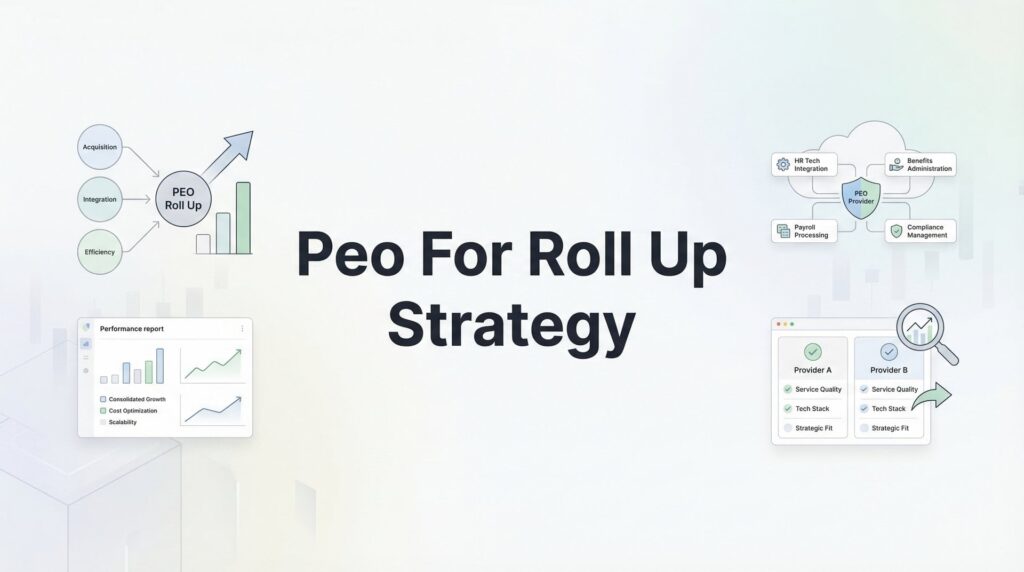
A PEO solves this by giving you a single employer of record across all acquisitions.
That’s the core value proposition. Instead of harmonizing multiple payroll platforms, benefits brokers, and compliance systems, you migrate every acquired company onto the same PEO infrastructure. One payroll system. One benefits plan. One compliance framework.
The integration speed is real. When you acquire a new company, you’re not rebuilding HR infrastructure from scratch. You’re onboarding employees into an existing system that’s already set up to handle multi-state operations, benefits administration, and compliance filings. Most PEOs can complete onboarding in 2-4 weeks—fast enough to fit inside your standard 90-day integration window.
Multi-state compliance becomes automatic. This matters when your roll-up strategy spans geographic markets. Each state has different registration requirements, tax obligations, and employment regulations. If you’re acquiring companies in new states, you’d normally need to register as an employer, set up state tax accounts, and figure out local compliance rules. A PEO already has that infrastructure in place. You get immediate compliance coverage without building it yourself.
The standardized onboarding process is the other advantage. Once you’ve migrated your first acquisition onto the PEO, every subsequent deal follows the same playbook. You’re not reinventing the process each time. Your team knows the steps, the timelines, and the handoffs. That consistency speeds up integration and reduces the operational drag that typically comes with serial acquisitions.
Benefits consolidation happens faster too. Instead of managing separate renewals, plan designs, and carrier relationships for each acquired company, you’re bringing everyone onto the same group plan. Employees get consistent coverage. Your finance team gets predictable costs. And you eliminate the administrative overhead of managing multiple benefits brokers.
This matters for employee retention. When you acquire a company, the HR transition is one of the first things employees notice. If the new benefits are worse, the payroll system is clunky, or the onboarding process feels chaotic, you risk losing the talent you just acquired. A PEO gives you a clean, professional transition that reduces friction and keeps acquired teams focused on the business instead of worrying about their paychecks and health insurance.
The operational leverage compounds as you scale. By the time you’ve completed five or six acquisitions, you’re running a unified HR platform that can absorb new companies without adding proportional administrative burden. That’s the synergy roll-ups are supposed to create—and it’s hard to achieve when you’re managing parallel HR systems across portfolio companies.
The Real Cost of Parallel HR Systems
Let’s talk about what you’re actually paying to keep legacy systems running.
Most operators focus on the obvious vendor fees—payroll processing, benefits broker commissions, workers’ comp premiums. But the real cost is administrative overhead. Someone on your team is managing multiple vendor relationships, reconciling data across systems, and tracking compliance obligations in different platforms. That time adds up.
Then there’s the compliance risk. When obligations are scattered across systems, things get missed. State tax filings. Workers’ comp audits. Benefits reporting deadlines. Each mistake carries penalties that are often more expensive than the cost of consolidation.
Duplicate vendor relationships create inefficiency too. You’re paying separate fees to multiple payroll providers, multiple benefits brokers, and multiple workers’ comp carriers. Those fees don’t scale—they’re fixed costs that multiply with each acquisition. A PEO consolidates those relationships into a single fee structure.
PEO pricing typically runs as a percentage of payroll or a per-employee-per-month fee. The exact number depends on headcount, industry, and services included. As your headcount scales through acquisitions, per-employee costs often decrease because you’re spreading fixed infrastructure costs across more employees.
The break-even analysis depends on what you’re replacing. If you’re running lean HR operations with minimal vendor costs, a PEO might increase your total spend. But if you’re managing parallel systems across multiple entities with duplicate vendor fees and high administrative overhead, the PEO often pencils out—especially when you factor in avoided compliance penalties and faster integration timelines.
Here’s what matters: quantify your current state. Add up payroll processing fees, benefits broker commissions, workers’ comp premiums, and the fully loaded cost of internal HR time spent managing complexity. Then compare that to consolidated PEO pricing. The math will tell you whether consolidation saves money or adds cost. A PEO ROI calculation can help you structure this analysis.
Don’t forget the opportunity cost. Every hour your team spends reconciling payroll data or managing vendor relationships is an hour they’re not spending on growth initiatives. Roll-ups succeed when you can quickly integrate acquisitions and redeploy resources toward revenue-generating activities. If HR complexity is slowing that down, you’re leaving value on the table.
The financial case for a PEO gets stronger as you scale. The first acquisition might not justify the switch. But by the third or fourth deal, the cost of maintaining parallel systems often exceeds the cost of consolidation—and that gap widens with each additional acquisition.
When PEOs Create More Problems Than They Solve
A PEO isn’t the right answer for every roll-up. There are scenarios where co-employment creates friction instead of solving it.
Exit planning is the first consideration. If you’re building toward a sale to a strategic buyer, co-employment can complicate due diligence. Some acquirers prefer clean HR structures where the target company is the direct employer. They don’t want to inherit PEO relationships or unwind co-employment agreements during integration. If your exit timeline is 12-18 months, adding a PEO now might create work you’ll need to reverse later.
Industry limitations matter too. PEOs struggle in certain sectors. High workers’ comp industries—construction, manufacturing, transportation—often face higher PEO pricing because of elevated risk classifications. Union environments create complications because collective bargaining agreements may not transfer cleanly under co-employment. Highly regulated sectors like healthcare or financial services sometimes face restrictions on co-employment structures.
Scale thresholds change the math. At a certain headcount, building internal HR infrastructure becomes more cost-effective than paying PEO fees. That threshold varies by industry and complexity, but many operators find that once they cross 200-300 employees, the economics start favoring in-house HR teams with dedicated payroll and benefits specialists. If your roll-up strategy is targeting that scale within 18-24 months, a PEO might be a short-term solution that you’ll outgrow quickly.
Contract rigidity is another red flag. Some PEO agreements lock you into multi-year terms with limited flexibility for headcount changes or entity additions. If you’re planning rapid serial acquisitions, you need a contract that accommodates growth without penalties or renegotiation. Rigid agreements create friction when your business model depends on speed and flexibility.
Control preferences matter too. Some operators want direct relationships with benefits carriers, payroll vendors, and compliance advisors. They don’t want a PEO intermediary. If maintaining those direct relationships is strategically important—either for pricing leverage or vendor selection—a PEO might not fit your operating model.
The decision comes down to your specific situation. A PEO works when speed, multi-state complexity, and administrative consolidation are priorities. It doesn’t work when exit planning, industry limitations, or scale economics point toward building internal HR capabilities instead.
Building PEO Relationships That Support Serial Acquisition
If you decide a PEO fits your roll-up strategy, structure the relationship to accommodate growth.
Contract flexibility is critical. You need terms that allow rapid headcount changes without penalties or renegotiation. Most standard PEO agreements assume stable headcount with modest annual growth. But roll-ups don’t grow that way—you’re adding 20, 50, or 100 employees at a time through acquisitions. Make sure your contract accommodates that volatility.
Pricing should scale predictably. Understand how per-employee costs change as headcount increases. Some PEOs offer volume discounts that kick in at certain thresholds. Others maintain flat pricing regardless of scale. Know what you’re paying now and what you’ll pay after your next three acquisitions. A PEO cost forecasting approach can help you model these scenarios.
Entity additions need to be straightforward. Your PEO agreement should allow you to add newly acquired companies without starting from scratch. The onboarding process should be standardized so you can plug new entities into the existing infrastructure quickly. If each acquisition requires custom contracting or prolonged negotiations, the PEO isn’t built for your business model.
Build PEO transition into your acquisition playbook. Due diligence should include mapping the target company’s current HR setup—payroll provider, benefits plans, compliance obligations—so you can estimate the effort required to migrate them onto your PEO. Integration timelines should account for PEO onboarding, which typically takes 2-4 weeks but can stretch longer if the acquired company has complex benefits or multi-state operations.
Timing the switch matters. Some operators migrate acquired companies immediately post-close to accelerate integration. Others batch transitions quarterly to reduce administrative burden and align with benefits renewal cycles. There’s no universal right answer—it depends on integration priorities, employee communication preferences, and operational capacity.
Immediate migration works when speed is the priority. You want unified systems, consistent employee experience, and fast synergy capture. The tradeoff is higher short-term administrative effort and potential disruption for acquired employees who are adjusting to new systems quickly.
Quarterly batching works when you’re balancing multiple acquisitions and want to consolidate transitions. You reduce the number of times your team is managing onboarding, and you can align migrations with natural breakpoints like benefits renewals or fiscal quarters. The tradeoff is longer periods of operating parallel systems.
The key is having a plan. Don’t let PEO transitions happen reactively. Build the process into your standard integration checklist so every acquisition follows the same playbook.
What to Look for in a PEO Partner
Not all PEOs are built to support roll-up strategies. Here’s what matters when you’re evaluating partners.
Multi-state expertise is non-negotiable. If your roll-up spans geographic markets, you need a PEO for multi-state companies with established infrastructure in every state where you’re acquiring companies. That means existing state registrations, tax accounts, and compliance knowledge. Ask specifically about their coverage footprint and how quickly they can add new states if your acquisition strategy expands geographically.
Scalability is the second requirement. The PEO needs to handle rapid headcount growth without breaking. Ask about their largest clients, how they’ve supported other PE-backed roll-ups, and what their onboarding capacity looks like. If they’re used to working with stable 50-employee companies, they might struggle when you’re adding 100 employees in a quarter through multiple acquisitions.
Integration speed separates good PEOs from average ones. You need a partner who can complete onboarding in 2-4 weeks, not 8-12 weeks. Ask about their standard timeline, what drives delays, and how they’ve compressed timelines for acquisition-heavy clients. If their process is slow, it doesn’t fit your business model.
Experience with PE-backed companies matters. PEOs for rapid growth companies understand the speed requirements, exit considerations, and operational priorities that drive roll-up strategies. They know how to structure contracts for flexibility and how to support rapid integration timelines. Ask for references from other PE-backed clients and understand how they’ve supported similar growth trajectories.
Red flags to watch for: rigid contracts that don’t accommodate headcount volatility, slow onboarding timelines that don’t align with your integration windows, and limited geographic coverage that forces you to use multiple PEOs across different markets. Any of those create friction instead of solving problems.
Questions to ask during selection: How quickly can you onboard a newly acquired company? What’s your process for adding new entities to an existing client relationship? How does pricing change as headcount scales? What’s your experience supporting roll-up strategies in our industry? Can you provide references from PE-backed clients with similar growth profiles?
The right PEO partner becomes an operational advantage. The wrong one creates administrative burden that slows down your roll-up execution.
Making the Decision for Your Roll-Up
The right answer depends on your specific situation.
A PEO makes roll-ups operationally smoother when you’re managing multi-state complexity, moving fast on integration timelines, and dealing with administrative overhead from parallel HR systems. It compresses integration timelines, reduces compliance risk, and gives you unified infrastructure that can absorb acquisitions without rebuilding HR processes each time.
It creates friction when you’re building toward a strategic exit where co-employment complicates due diligence, operating in industries where PEOs struggle with workers’ comp or regulatory requirements, or approaching scale where in-house HR becomes more cost-effective than PEO fees.
The decision framework is straightforward. Map your current portfolio HR costs—vendor fees, administrative overhead, compliance risk. Compare that to consolidated PEO pricing. Factor in your exit timeline, industry characteristics, and scale trajectory. The math will tell you whether consolidation makes sense.
If you’re early in your roll-up strategy with 2-3 acquisitions planned over the next 12-18 months, a PEO can accelerate integration and reduce operational drag. If you’re late in your hold period building toward exit, the timing might not work. If you’re operating in a high workers’ comp industry or approaching 300+ employees, the economics might favor building internal capabilities instead.
The practical next step is quantifying the cost of your current state. Add up what you’re paying across all portfolio companies for payroll, benefits, workers’ comp, and internal HR time. Then get consolidated PEO pricing based on your total headcount and growth projections. That comparison will tell you whether the switch pencils out for your specific roll-up.
Before you sign that PEO renewal, make sure you’re not leaving money on the table. Many businesses unknowingly overpay because of bundled fees, hidden administrative markups, and contracts designed to limit flexibility. We give you a clear, side-by-side breakdown of pricing, services, and contract terms—so you can see exactly what you’re paying for and choose the option that truly fits your business. Reach out to us
