
Commercial construction companies operate in a world of moving parts—crews that scale up and down with project cycles, workers’ comp costs that can make or break your bid margins, job sites that cross state lines, and safety regulations that never sleep. It’s a lot to manage when you’re trying to run actual projects and win new work.
PEOs pitch themselves as the solution to all of it. One relationship handles your payroll, benefits, workers’ comp, and compliance headaches. Sounds straightforward enough.
But the reality for contractors isn’t quite that clean. PEOs can genuinely solve expensive problems for some construction companies—particularly around workers’ comp and multi-state compliance. For others, they introduce friction that outweighs the benefits. The difference usually comes down to your specific operation: your trade classifications, your existing safety record, your workforce structure, and whether you’re dealing with union requirements or prevailing wage projects.
This isn’t about whether PEOs are “good” or “bad” for construction. It’s about understanding where they actually help and where they create new complications you didn’t have before.
The HR Burden That Makes Contractors Consider PEOs
Construction HR doesn’t look like other industries. You’re not managing a stable office team with predictable headcount. You’re managing a workforce that expands when you land a big project and contracts when it wraps. That volatility makes traditional HR infrastructure expensive and awkward.
Every new hire triggers onboarding, I-9 verification, benefits enrollment, and payroll setup. Every layoff means COBRA administration and unemployment claims. When you’re cycling through 20-30 people across multiple projects, that administrative load adds up fast. Small contractors often handle this with a bookkeeper and a lot of manual spreadsheet work. It functions, but it’s fragile.
Then there’s workers’ comp. Construction trades carry some of the highest classification codes in the insurance industry. Roofing, structural ironwork, demolition—these aren’t desk jobs. Your experience modification rate becomes a direct input into your bidding competitiveness. If your mod rate climbs above 1.0, you’re at a disadvantage against every competitor with better loss history. One bad claim can follow you for three years.
The compliance layer makes it worse. If you’re running projects in multiple states, you’re dealing with different workers’ comp requirements, different unemployment rules, different withholding calculations. A project in Illinois has different certified payroll requirements than one in Indiana. Davis-Bacon prevailing wage work adds another level of reporting complexity that most small contractors aren’t set up to handle cleanly.
This is the context that makes PEOs attractive. The promise is simple: offload all of this to someone who does it at scale, get access to better workers’ comp rates through their master policy, and stop worrying about compliance mistakes that could cost you a contract or trigger an audit.
For some contractors, that promise delivers. For others, it creates problems they didn’t anticipate.
Where PEOs Actually Solve Real Problems
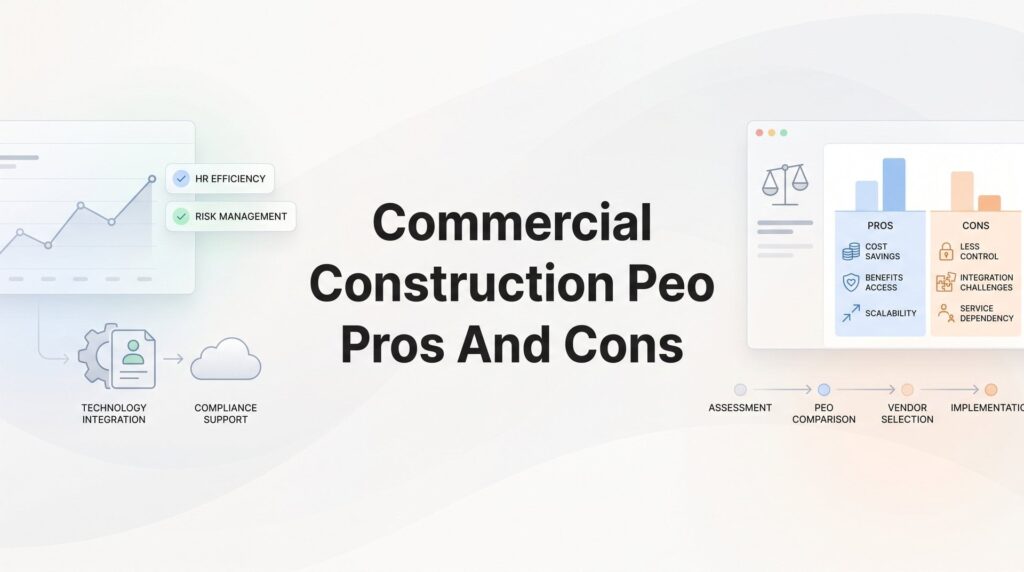
Workers’ Comp Cost Reduction: This is the big one. PEOs maintain master workers’ comp policies that pool risk across hundreds of client companies. If you’re a smaller contractor with limited claims history—or worse, one significant claim that spiked your mod rate—joining a PEO’s master policy can reset your cost structure.
Instead of being underwritten individually based on your three-year loss history, you’re placed into the PEO’s broader risk pool. That pool includes contractors with better safety records, which can bring your effective rate down. For a 15-person framing company that had a serious fall injury two years ago, this can mean the difference between a 1.4 mod rate and something closer to 1.0. Understanding how PEOs handle high insurance mod rates is critical before making this decision.
The benefit is most pronounced for high-risk trades. Roofing contractors, demolition companies, and structural steel operations often struggle to find affordable coverage in the standard market. PEOs with construction experience already have relationships with carriers willing to write these classifications at scale.
Payroll Complexity Reduction: Certified payroll reporting for prevailing wage projects is tedious and error-prone. You’re tracking base wages, fringe benefits, overtime calculations, and job classifications for every worker on covered projects. Then you’re filing weekly or monthly reports that need to match specific formatting requirements.
PEOs that specialize in construction already have systems built for this. They handle the certified payroll filings, maintain the documentation for audits, and flag compliance issues before they become problems. If you’re running multiple Davis-Bacon jobs simultaneously, that administrative lift is real.
Multi-state payroll gets similarly easier. The PEO manages the state registrations, calculates the withholding, files the unemployment taxes, and handles the local nuances you’d otherwise need to track manually. For contractors working across state lines regularly, this removes a persistent headache.
Benefits Access for Recruiting: Skilled tradespeople have options. When labor markets tighten, your ability to offer competitive benefits matters. A one-person HR operation at a 20-employee contractor can’t negotiate the same health insurance rates or retirement plan options that a PEO brings through their scale.
This isn’t theoretical. When you’re trying to keep a good superintendent or attract experienced journeymen, being able to offer a solid benefits package without administrative complexity gives you an edge. The PEO handles enrollment, manages the carrier relationships, and deals with COBRA and ACA compliance through comprehensive benefits administration services.
For contractors who’ve been offering weak benefits or none at all, the upgrade is noticeable in recruiting conversations.
Where PEOs Create Friction You Didn’t Expect
Loss of Claims Control: When you move to a PEO’s master workers’ comp policy, you’re giving up direct management of your claims. The PEO’s carrier handles the adjusting, the return-to-work programs, and the settlement decisions. You become a participant in someone else’s process rather than controlling your own.
For contractors with strong safety cultures and established claims management practices, this is frustrating. You’ve invested in modified duty programs, you have relationships with your medical providers, and you know how to manage claims aggressively to minimize costs. Under a PEO arrangement, those practices get subordinated to the PEO’s carrier protocols. Understanding how PEO workers compensation management works helps set realistic expectations.
The impact shows up in your long-term mod rate trajectory. If you’re serious about safety and claims management, you want every small claim handled perfectly to protect your experience rating. When someone else controls that process, you lose the ability to optimize it.
Union and Collective Bargaining Conflicts: If you operate under collective bargaining agreements, PEOs introduce complications. Union contracts typically specify who administers benefits, how payroll is processed, and what HR practices apply. The co-employment structure of a PEO can conflict with those negotiated terms.
Some unions explicitly prohibit PEO arrangements. Others require specific contract language that many PEOs won’t agree to. Even when it’s technically permissible, the union may view the PEO relationship as an attempt to undermine the collective bargaining agreement.
Prevailing wage projects add another layer. The certified payroll requirements interact awkwardly with PEO fee structures. You need to clearly separate the actual wages paid to workers from the administrative fees you’re paying the PEO. If that separation isn’t clean, you risk audit findings that question whether you’re meeting prevailing wage obligations.
Bonding and Licensing Complications: Surety companies that issue your performance and payment bonds care about your business structure. When you enter a co-employment arrangement with a PEO, that changes how your company looks on paper. The PEO becomes the employer of record for many purposes.
Some sureties have no problem with this. Others get nervous about the shared employment relationship and want additional documentation or higher bonding rates. In extreme cases, it can affect your bonding capacity—which directly limits the size of projects you can bid. These are among the real PEO risks and drawbacks that contractors must evaluate carefully.
Contractor licensing creates similar questions. Some states require the licensed contractor to be the direct employer of workers on the job site. The co-employment structure may not fit cleanly into those requirements. You’ll need legal clarity before signing a PEO contract if your state has strict licensing rules.
When the Cost Math Actually Works
PEO pricing for construction isn’t straightforward. You’re typically looking at a percentage of payroll (often 3-8%) or a per-employee-per-month fee, plus the actual cost of workers’ comp and benefits. The value proposition depends entirely on what you’re paying now and what problems you’re solving.
If your current workers’ comp mod rate is 1.3 or higher, and the PEO can get you into their master policy at an effective rate closer to 1.0, the savings on workers’ comp alone might cover the PEO’s administrative fees. For a contractor with $2 million in annual payroll and high-risk classifications, that delta can be $50,000-$80,000 annually. Learning how PEOs actually cut workers’ comp costs helps you evaluate whether those savings are realistic for your situation.
The break-even math gets harder if you already have a good mod rate. Let’s say you’re at 0.85 because you’ve run a tight safety program for years. The PEO’s master policy might actually increase your workers’ comp cost because you’re now pooled with riskier contractors. Even if the administrative services have value, you’re starting from a cost disadvantage.
Company size matters significantly. Very small contractors—say, under 10 employees—often find PEOs expensive relative to their total payroll. The per-employee fees hit harder when you’re only running a handful of people. Mid-sized contractors in the 15-50 employee range tend to see the best value proposition, assuming they have workers’ comp challenges or multi-state complexity.
Hidden costs show up in the contract details. Some PEOs charge setup fees, some charge separately for each state registration, some mark up the workers’ comp premium beyond the base rate. You need to model the total cost—not just the headline percentage—against your current fully loaded HR and insurance expenses. A thorough understanding of PEO pricing and cost structure prevents surprises down the road.
The honest answer is that the math works when you have expensive problems the PEO solves. If your problems are primarily workers’ comp costs and compliance complexity, and the PEO can demonstrably reduce those, the fees make sense. If you’re already running efficiently with good rates and simple operations, you’re probably adding cost without proportional value.
When You Shouldn’t Use a PEO
Strong Union Presence: If your workforce is heavily unionized with established collective bargaining agreements, a PEO creates more problems than it solves. The co-employment structure conflicts with union contracts, and you’ll spend more time managing the relationship friction than you’ll save on administrative work.
Even if the union technically allows it, the practical reality is complicated. You don’t want to introduce a third party into an already complex labor relationship.
Favorable Workers’ Comp Position: Contractors with experience mod rates below 1.0 and strong safety programs should think hard before joining a PEO’s master policy. You’ve earned that favorable rate through disciplined safety practices and claims management. Giving up that advantage to join a risk pool doesn’t make financial sense unless you’re getting substantial value elsewhere.
If your primary motivation is payroll administration or benefits access, there are alternatives that don’t require sacrificing your workers’ comp position. Traditional payroll providers can handle certified payroll. Benefits brokers can negotiate competitive group rates without co-employment.
Bonding Capacity Concerns: If you’re bidding large commercial projects that require substantial bonding, introduce the PEO conversation to your surety before you sign anything. Some sureties view PEO arrangements as increasing their risk exposure because the contractor no longer has direct employment relationships.
The last thing you want is to sign a PEO contract and then discover it limits your bonding capacity right when you’re trying to bid a significant project. Reviewing PEO contract liability risks before signing protects you from these scenarios.
Licensing Restrictions: States with strict contractor licensing requirements that specify direct employment relationships need legal review before you enter a PEO arrangement. The co-employment structure may not satisfy the licensing board’s interpretation of who qualifies as the employer.
This isn’t common, but it’s expensive to discover after the fact. Check with your attorney and your state licensing board before committing.
Questions to Ask Before You Sign
If you’re seriously evaluating a PEO, these are the questions that matter for construction operations:
What percentage of your client base is construction, and what trades do you currently cover? You want a PEO with actual construction experience, not one that’s primarily serving professional services firms and trying to expand into construction. Ask for references from contractors in your specific trade classification.
How does your master workers’ comp policy handle my trade classifications, and what’s the effective rate I’ll pay? Get specifics. Don’t accept vague promises about “competitive rates.” You need to see how your actual classifications will be priced within their master policy, and you need to understand how your claims history will be factored in.
What control do I retain over workers’ comp claims management and safety programs? Understand exactly what happens when an injury occurs. Who manages the claim? What input do you have on return-to-work decisions? Can you continue using your preferred medical providers? How does the PEO’s safety program integrate with yours? Knowing what PEO risk management and liability support actually covers helps frame these conversations.
How do you handle prevailing wage and certified payroll requirements? If you run Davis-Bacon work, the PEO needs to demonstrate competence with certified payroll reporting. Ask to see sample reports and understand their audit support process.
What are the contract terms for termination, and what happens to my workers’ comp history if I leave? Exiting a PEO means rebuilding your workers’ comp experience rating from scratch. You need to understand the financial impact of that transition and what notice periods apply if you want to leave. Having a clear understanding of how to leave your PEO before you join gives you leverage in negotiations.
How does your co-employment structure interact with contractor licensing and bonding requirements in my states? This is where you need specifics, not generalizations. The PEO should be able to articulate exactly how the relationship works for licensing and bonding purposes, ideally with documentation you can share with your surety.
Don’t rush this decision based on a sales pitch. Get multiple proposals, compare the total cost modeling, and talk to other contractors who’ve used the PEO for at least a full year.
Making a Grounded Decision
PEOs can genuinely solve expensive problems for commercial construction companies. If you’re struggling with high workers’ comp costs, drowning in multi-state payroll complexity, or losing good people because your benefits can’t compete, a PEO with real construction experience might be worth the cost.
But they’re not a universal solution. If you’ve built strong safety practices and earned a favorable mod rate, you’re probably better off keeping direct control. If you operate under union agreements or need maximum bonding flexibility, the co-employment structure creates friction that outweighs the administrative convenience.
The decision comes down to your specific situation. What problems are you actually trying to solve? What’s the total cost of your current approach versus the fully loaded PEO cost? What control are you giving up, and does that tradeoff make sense for your operation?
Before you sign that PEO renewal, make sure you’re not leaving money on the table. Many businesses unknowingly overpay because of bundled fees, hidden administrative markups, and contracts designed to limit flexibility. We give you a clear, side-by-side breakdown of pricing, services, and contract terms—so you can see exactly what you’re paying for and choose the option that truly fits your business.
