
Most advice about the employee handbook for small business gets the sequence wrong. It starts with a template, a mission statement, and a list of standard policies. That approach produces a document, but not a management tool.
A small business handbook has to do harder work than a big-company handbook. It has to set expectations, support managers who may not have deep HR training, and hold up when an employee dispute exposes the gap between what leadership says and what the company does. That tension gets sharper when a PEO is involved, because now the handbook has to fit both the employer's culture and the PEO's compliance framework.
That's why generic templates fail so often. They flatten real operating decisions into legal boilerplate. For teams that want a starting point before they customize, it can help to streamline HR with this handbook, but the template is only the draft. The primary work is deciding which policies belong to the company, which belong to the PEO, and where a mismatch could create exposure. Liability questions often start there, especially in co-employment models discussed in PEO handbook liability considerations.
Table of Contents
- Why Your Employee Handbook Is More Than a Legal Chore
- The Foundational Policies Every Small Business Needs
- Customizing Your Handbook to Reflect Your Culture
- Aligning Your Handbook with a PEO or ASO
- Rolling Out and Maintaining Your Handbook
- Your Handbook Is a Management Tool Not a Document
Why Your Employee Handbook Is More Than a Legal Chore
Treating the handbook like a legal formality is expensive. It leads to a rushed document, weak manager adoption, and policy language that doesn't survive contact with daily operations.
The better view is simpler. The handbook is one of the few places where compliance, culture, and management discipline all meet. That matters because companies with updated employee handbooks are one-third more likely to experience growth than those without them, according to Asure's review of handbook impact on small business growth. That statistic shouldn't be read as “the handbook caused growth by itself.” It should be read as a sign that disciplined employers usually document expectations, communicate clearly, and update policies before problems become expensive.
A weak handbook creates two predictable failures. Employees don't know what rules apply, and managers improvise. Once that happens, “policy” turns into memory, personality, and who happened to approve the last exception.
Practical rule: If managers apply policy from habit instead of from the handbook, the business doesn't have a handbook. It has folklore.
For a small employer, the handbook also becomes the operating bridge between founders, department heads, payroll, and HR support. In a PEO relationship, that bridge has to carry more weight. Benefits eligibility, leave administration, and payroll processes may sit inside the PEO's framework, while attendance, conduct, and performance management still sit with the client. If the handbook ignores that split, employees get conflicting answers.
The businesses that handle this well don't write bigger handbooks. They write clearer ones. They decide what the company promises, what remains discretionary, and what must mirror the PEO's rules exactly.
The Foundational Policies Every Small Business Needs

The most common mistake is waiting too long. A lot of owners assume the handbook becomes necessary once the company feels “big enough.” That's backward.
Start earlier than most owners think
HR guidance recommends creating a handbook as soon as the business hires its first employee, and it should be built for scale. A company with 12 employees should already anticipate policies such as FMLA that trigger at larger headcounts, according to SixFifty's handbook guidance for small businesses. That advice matters because rewriting a handbook under pressure is far harder than building it correctly at the start.
A practical example helps. A founder-led services firm with a small office and a few remote hires may not yet be covered by every leave rule that will matter later. But if the handbook already distinguishes eligibility, leave request procedures, documentation expectations, and manager escalation rules, the company won't need to reinvent its process during a growth surge or PEO transition.
For teams building from scratch, curated free HR and IT policy resources can help frame the document. They should be treated as working materials, not final language. Before release, policy approvals should run through a defined internal policy workflow so HR, finance, operations, and legal aren't fixing contradictions after employees have already signed.
The policies that deserve precise drafting
Some sections carry much more legal weight than others. They deserve tighter review, cleaner language, and fewer promises.
At-will employment language
This is not the place for casual wording. If the business intends to preserve at-will status where allowed, that disclaimer must be consistent in the handbook and in the acknowledgment form. Mixed language creates arguments that the company promised progressive discipline or guaranteed employment steps.Anti-discrimination and anti-harassment policy
This policy needs actual reporting paths, not generic statements about respect. Employees should know who can receive a complaint, what happens after a report, and that retaliation is prohibited. A vague statement about professionalism won't help when a manager mishandles a complaint.Leave administration Many small employers create accidental inconsistency in this area. Leadership may want flexibility, while payroll or the PEO needs defined eligibility and tracking. If the handbook says one thing and the leave administrator follows another, the employee sees two systems.
Wage, hour, and attendance rules
The handbook should explain how employees report time, handle breaks, and raise pay questions. These rules don't need to read like a statute, but they do need to match actual payroll practice.
A short handbook with accurate rules protects the company better than a polished handbook full of promises nobody can administer.
What belongs in the handbook and what does not
A useful handbook is employee-facing. It covers rules, benefits, rights, and expectations. It should not become a manager playbook or a process manual.
That distinction matters because small employers often jam approval chains, disciplinary scripting, and internal workflows into the employee version. Then the document becomes bloated, hard to update, and impossible to enforce consistently.
Use this divide instead:
- Put employee obligations in the handbook. Attendance, conduct, reporting paths, leave requests, confidentiality, remote work expectations.
- Put manager mechanics elsewhere. Coaching steps, documentation standards, investigation sequencing, escalation paths.
- Put system-specific instructions in operating documents. Payroll cutoffs, platform steps, onboarding checklists.
When these categories get mixed, the handbook ages fast. Every process change forces a handbook revision, and employees end up receiving policy updates that aren't really policy updates at all.
Customizing Your Handbook to Reflect Your Culture

Culture doesn't live in the welcome letter. It shows up in the policies where managers make judgment calls.
Research on small-business handbook mistakes points to a core problem: handbook content often drifts away from workplace reality because stakeholders never aligned on how the business operates. That same guidance notes that a focused, employee-facing handbook of 20 to 40 pages is usually more effective than a long generic document, as outlined in CBRI's discussion of costly HR pitfalls.
A remote policy should match real operations
Consider two employers.
A software company hires across states, collaborates online, and measures output by deadlines and customer delivery. Its handbook can support flexible scheduling if it also defines response-time expectations, data handling, meeting attendance standards, and equipment rules.
A light manufacturing company can't copy that language. It needs sharper attendance expectations, call-out procedures, shift coverage rules, and safety obligations for any off-site administrative work. If it publishes a “work from anywhere” tone while managers still require on-site coverage, the policy undermines trust before it attracts talent.
The handbook should describe the company the employee joins, not the brand the company wants to project.
PTO language signals how the company actually manages
PTO is another place where culture and risk collide.
A generic template often says employees should give “reasonable notice” and that approval depends on business needs. That sounds harmless, but it leaves managers wide discretion with no common standard. One supervisor approves long weekends casually. Another denies them unless the request comes weeks ahead. Employees call that unfair, and they're usually right.
A better policy doesn't need to be rigid. It needs to be usable. It should state how requests are submitted, who approves them, what happens during peak periods, and whether the company reserves discretion to limit overlapping absences.
A few culture choices belong here too:
- Professional development can be described as manager-approved and role-relevant, rather than a broad promise that every employee will receive formal training.
- Social media conduct should reflect the company's reputation risk. A customer-facing brand usually needs clearer external communication rules than a local back-office operation.
- Dress and workplace presentation should fit the worksite. Office employees, field technicians, and warehouse teams don't need the same standard.
The strongest custom language is plain and specific. It doesn't try to sound progressive or strict. It tells employees what the company expects on an ordinary Tuesday.
Aligning Your Handbook with a PEO or ASO
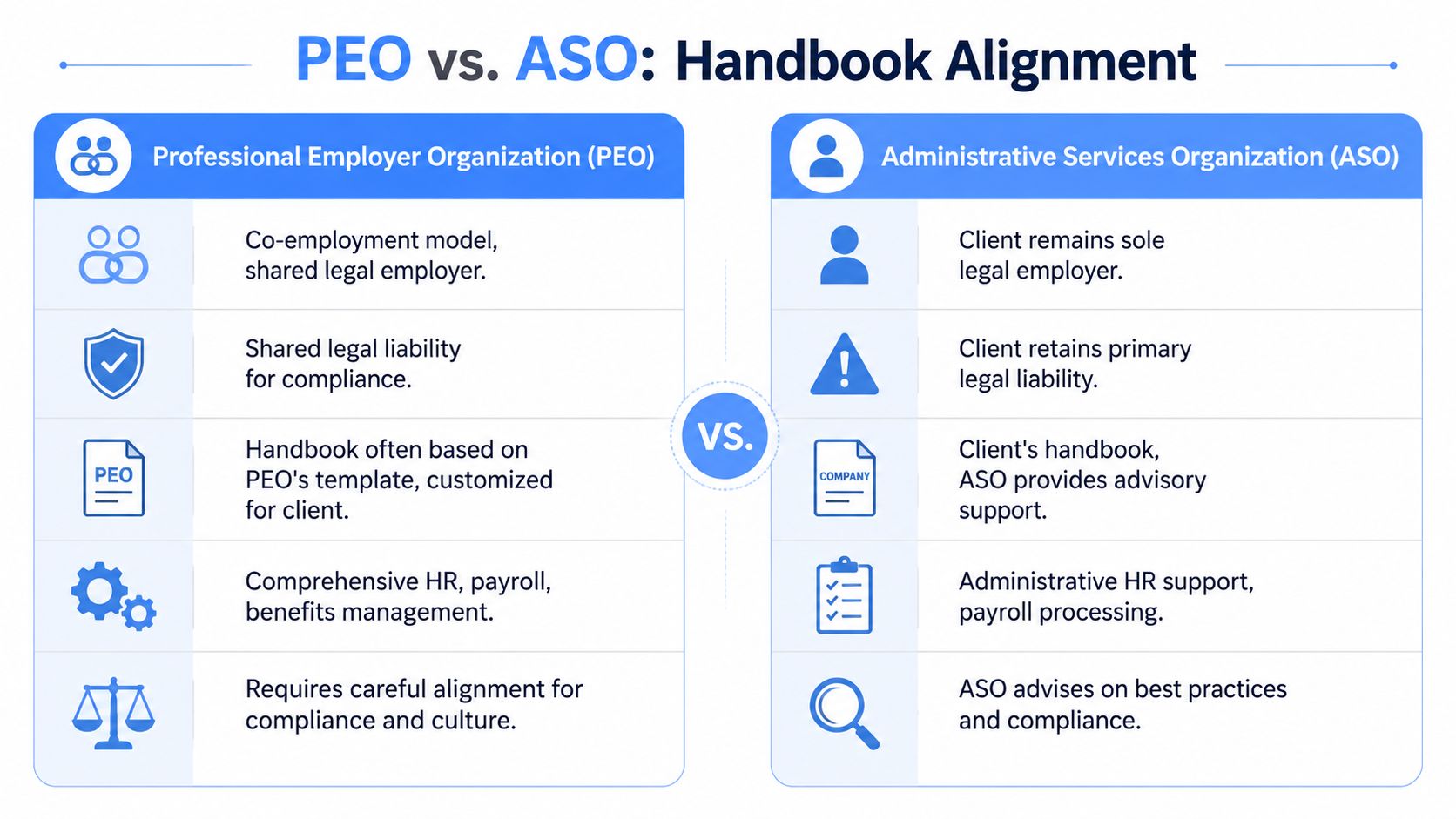
Most handbook guidance breaks down at this point. It explains what a handbook should include, but not how a small employer should reconcile that handbook with a PEO's policies, plans, and administrative controls.
That gap is not theoretical. Guidance on small-business handbooks often fails to address how an internal handbook should align with a PEO's master policies for benefits, payroll, and compliance, which can leave employers with conflicting rules on leave and benefits eligibility, as noted in TCI's discussion of employee handbooks and profitable small-business practices. Businesses that use an ASO have a different setup, but the same discipline applies. Somebody has to own each policy area, and that ownership has to match the service agreement.
Where handbook conflicts usually start
The first conflict usually appears in one of these areas:
Benefits eligibility
The company handbook says employees become eligible under one schedule. The PEO's plan documents define a different trigger or waiting period.Leave rules
HR wants a culture-friendly leave policy. The PEO needs an administrable process that matches legal requirements and payroll coding.Holiday schedules and payroll timing
Leadership promises a paid holiday practice that doesn't line up with the payroll system or the PEO's standard holiday treatment.Discipline and termination language
Managers want discretion. The handbook accidentally reads like a guaranteed disciplinary sequence.
A clean alignment process starts with a shared-responsibility map. If the provider can't clearly explain which policy areas they control, the client is likely to discover the answer during a dispute. A structured HR shared responsibility matrix helps leadership compare what sits with the employer, what sits with the provider, and what requires joint review.
Handbook Policy Ownership DIY vs PEO Model
| Policy Area | Managed by Small Business (DIY) | Managed by PEO (Co-Employment) | Key Consideration |
|---|---|---|---|
| Workplace conduct | Yes | Sometimes advisory only | Keep culture and discipline standards company-specific |
| Attendance and scheduling | Yes | Usually no | Make sure payroll consequences match policy language |
| Benefits eligibility | Sometimes | Often yes | Handbook should not override plan documents |
| Leave administration | Shared | Shared or PEO-led | Approval, tracking, and notice rules must align |
| Payroll practices | Internal payroll team | Often yes | Timekeeping rules and pay procedures must match actual system setup |
| Harassment reporting process | Shared | Shared | Reporting channels should account for both employer and provider contacts |
| Workers' compensation reporting | Shared | Often coordinated by PEO | Employees need one clear incident-report path |
A DIY employer can usually write policy first and build administration around it. In a PEO model, that sequence often reverses. Administration may already sit inside the provider's framework, so handbook language has to fit the operating reality.
Questions to push through before approval
Before any handbook is distributed under a PEO or ASO arrangement, leadership should resolve a short set of practical questions:
Which policies must mirror provider documents exactly
Benefits, leave, and payroll-related language often can't be customized freely.Where is client discretion allowed
Attendance, remote work, conduct, and performance language usually allow more room, but only within the compliance rails of the service model.Who approves revisions
If HR changes the handbook without provider review, one sentence can create a conflict with plan administration.What happens when headcount changes
Small-business handbook guidance also points out that policies around benefits eligibility and remote work security should be future-proofed as PEO service layers change with growth, as discussed in Handbook Hub's view on scaling handbook design.
If the handbook promises flexibility that the PEO cannot administer, employees will blame the employer, not the vendor.
A strong handbook in a co-employment environment doesn't try to hide the split. It manages it. It tells employees where company policy governs, where plan documents govern, and how questions are escalated when those two layers meet.
Rolling Out and Maintaining Your Handbook

A finished handbook sitting in a shared drive doesn't reduce risk. Rollout matters because acknowledgment, manager training, and version control are what make the document defensible.
Rollout needs process not just distribution
The cleanest rollout has three parts.
First, distribute a final controlled version through the system employees already use. That may be the HRIS, a secure document portal, or the onboarding platform. Second, train managers on the policies they'll enforce. Third, collect acknowledgments in a way that can be tracked later. Teams that need a practical digital workflow often use tools built for eSignature for HR handbooks so they can tie signatures to a named document version and date.
A short rollout checklist keeps this disciplined:
Finalize one version
Don't let supervisors circulate PDFs with local edits or old attachments.Pair the launch with manager guidance
Managers need talking points on attendance, leave requests, complaint reporting, and escalation.Collect acknowledgments centrally
Signed forms stored in email chains are easy to lose and hard to audit.Tie rollout to onboarding
New hires should receive the handbook through the same implementation flow used for payroll and benefits setup, especially in a PEO environment with a structured onboarding implementation process.
Maintenance should follow business triggers
Most employers know they should update the handbook. Fewer maintain a real cadence.
One practical method is to tie review to business events rather than treating it as a generic annual task. A handbook should be reviewed when the company enters a new state, changes benefit structures, shifts remote work expectations, changes payroll systems, adopts a PEO, or renegotiates service terms with a current provider.
That matters even more for growth-stage employers. Small-business handbook guidance notes that policies around benefits eligibility and remote work security need to stay aligned with PEO service tiers as the company scales. If the handbook doesn't evolve alongside those thresholds and services, the document becomes an artifact of the old company.
An outdated handbook doesn't just miss new laws. It often preserves old operating assumptions that the business no longer follows.
The maintenance standard should be simple: every policy owner knows when review is required, who approves edits, and how revised acknowledgments are captured.
Your Handbook Is a Management Tool Not a Document
The strongest employee handbook for small business is not the longest, the friendliest, or the most lawyerly. It is the one managers can apply consistently, employees can understand quickly, and leadership can update before friction turns into claims.
That's even more important with a PEO or ASO. The handbook has to translate shared responsibility into clear employee-facing rules. When it does that well, it becomes the operational bridge between culture and compliance. When it doesn't, the company ends up with conflicting instructions, ad hoc exceptions, and policy enforcement that depends on who answered the question that day.
A disciplined handbook supports hiring, onboarding, manager judgment, and growth. It also exposes where governance is weak. Teams that want to tighten that governance across policy ownership, provider alignment, and decision rights can use a broader workforce governance playbook to pressure-test the gaps before renewal or implementation.
If a company is comparing PEOs, switching providers, or renegotiating an existing contract, PEO Metrics helps HR and finance teams evaluate pricing, service models, compliance support, contract terms, and handbook-related responsibility gaps side by side. That kind of analysis is useful when the handbook looks settled on paper, but the operating rules underneath it still aren't aligned.
