
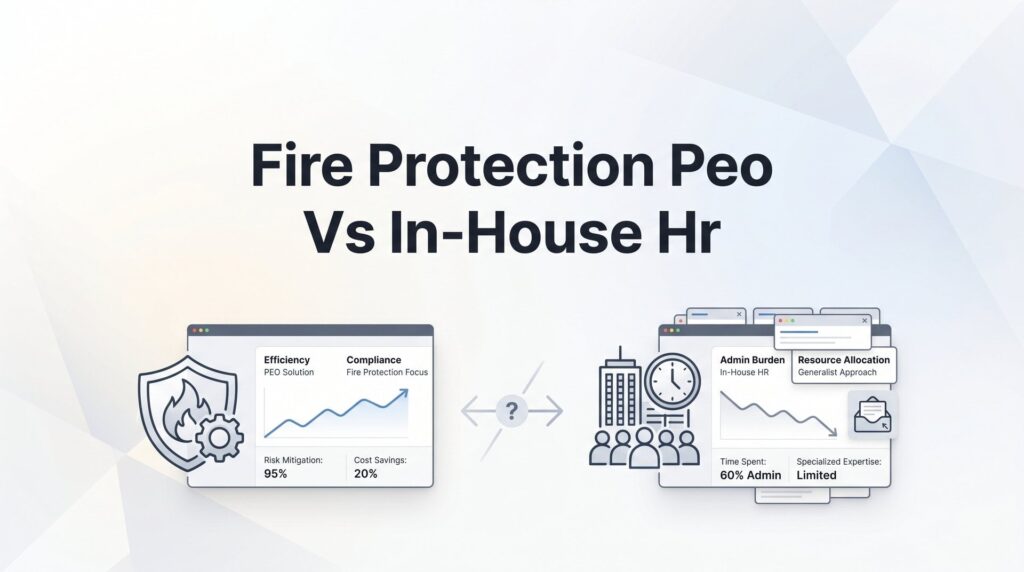
Fire protection companies operate in a regulatory and risk environment that makes HR decisions more consequential than in most industries. Between OSHA compliance for confined space entry and hot work permits, workers’ comp classifications that can swing wildly based on job type, and the challenge of managing certified technicians across multiple job sites, the HR function in fire protection isn’t a back-office afterthought. It’s operationally critical.
So when you’re weighing whether to keep HR in-house or partner with a PEO, generic pros-and-cons lists won’t cut it. The decision hinges on factors specific to your trade: your claims history, your mix of sprinkler fitters vs. alarm technicians vs. inspection staff, your geographic footprint, and how fast you’re scaling.
This guide walks through seven decision strategies grounded in the realities of fire protection work. Each one isolates a specific factor where the PEO vs. in-house calculus shifts depending on your company’s situation. The goal isn’t to convince you one way is better. It’s to help you evaluate both options using the criteria that actually move the needle for fire protection contractors.
1. Audit Your Workers’ Comp Exposure Before Anything Else
The Challenge It Solves
Workers’ comp is where the financial stakes are highest in fire protection, and it’s also where the most confusion lives. Sprinkler installation carries substantially higher class code rates than fire alarm installation or inspection and testing work. If your company runs all three, you may have a complex multi-code comp structure that looks very different from a general contractor’s exposure profile.
Before you can evaluate whether a PEO’s master policy saves you money, you need a clear picture of where you actually stand.
The Strategy Explained
Pull your current experience modification rate and break down your payroll by class code. Sprinkler fitters working on active installation projects carry meaningfully different risk profiles than technicians doing NFPA 25 inspections on existing systems. A PEO’s master policy pools risk across its entire client base, which can help companies with high insurance mod rates. But if your mod is already clean and your broker has built a competitive program around your specific class code mix, a PEO may not improve your position at all. Some fire protection contractors actually find their rates go up inside a PEO’s pooled structure because they’re subsidizing worse performers in unrelated industries.
Implementation Steps
1. Request a full loss run report from your current carrier covering at least three years of claims history.
2. Identify your current experience mod and compare it against the industry average for your primary class codes.
3. Ask any PEO you’re evaluating to provide their master policy rates for your specific class codes, not a blended estimate.
4. Have your independent broker model the difference side-by-side before drawing any conclusions.
Pro Tips
Don’t let a PEO sales rep do this analysis for you. They have an incentive to present the comparison favorably. Bring your own broker into the room or use an independent resource to verify the numbers. The comp question alone can make or break the financial case for a PEO in this industry.
2. Map Your OSHA and NFPA Compliance Burden Honestly
The Challenge It Solves
Fire protection contractors operate under a layered compliance framework that most PEO safety teams aren’t built for. You’re dealing with OSHA standards for confined space entry (29 CFR 1910.146), hot work permitting (29 CFR 1910.252), and fall protection requirements — layered on top of NFPA 13 installation standards, NFPA 25 inspection and maintenance requirements, and state fire marshal licensing rules that vary by jurisdiction. That’s a different animal from general construction compliance.
The Strategy Explained
Most PEOs offer safety support as part of their service package. The question is whether that support is genuinely useful for your trade or just a liability shield dressed up as a benefit. A safety consultant who knows OSHA 1926 construction standards but has never worked through NFPA compliance obligations isn’t going to help you build a better confined space entry program for your sprinkler crews. Ask directly: does the PEO have consultants with fire protection or mechanical trades experience? Can they support compliance reporting requirements in the states where you operate? If the answer is vague, assume the support is generic.
Implementation Steps
1. List every active compliance obligation your company manages: OSHA standards, NFPA codes, state fire marshal requirements, and any local AHJ (Authority Having Jurisdiction) requirements.
2. Ask each PEO candidate to describe specifically how their safety team would support each category.
3. Request references from other fire protection or mechanical trades clients in their portfolio.
4. Compare that capability against what you’d get from a dedicated safety consultant hired independently.
Pro Tips
If a PEO can’t name specific NFPA standards relevant to your work during the sales conversation, that’s a reliable signal about the depth of their trade expertise. Don’t assume compliance support is included in any meaningful way until you’ve verified it with specifics.
3. Calculate the Real Cost of Your HR Function — Not Just Salaries
The Challenge It Solves
In most small fire protection companies, HR isn’t a department. It’s a collection of tasks split across the owner, the office manager, the bookkeeper, and whoever handles payroll on Fridays. That distributed model feels cheap because no one is drawing an HR title salary. But the actual cost, when you account for time spent, error correction, compliance risk, and administrative drag, is usually higher than people expect.
The Strategy Explained
The honest comparison isn’t “PEO fee vs. HR salary.” It’s PEO fee vs. the fully loaded cost of everything HR-adjacent that your team currently handles. That includes payroll processing time, benefits administration, onboarding paperwork, unemployment claims, workers’ comp audits, handbook updates, and the hours your ops manager spends dealing with employee relations issues that pull them off field coordination. Add in the cost of a payroll platform, a benefits broker, and any compliance software you’re using. Then compare that total against a PEO’s per-employee fee structure.
Implementation Steps
1. Track the weekly hours each person in your company spends on HR-adjacent tasks for one month.
2. Assign a loaded hourly cost to that time based on their compensation and overhead.
3. Add direct costs: payroll software, benefits broker fees, compliance tools, and any outside legal or HR consulting you’ve used in the past year.
4. Compare that total against PEO quotes on a per-employee, per-year basis.
Pro Tips
Don’t forget the cost of mistakes. A misclassified worker, a missed unemployment filing, or a botched workers’ comp audit can create costs that dwarf a year’s worth of PEO fees. Include a realistic estimate of compliance risk exposure in your comparison, even if it’s a rough number.
4. Stress-Test Benefits Against Your Retention Problem
The Challenge It Solves
Certified sprinkler fitters and fire alarm technicians are in high demand. If you’re competing for the same talent pool as larger mechanical contractors and national fire protection firms, your benefits package matters. Small fire protection companies often struggle to offer health insurance options that are competitive with what a 500-person company can access, and that gap costs you candidates and employees you can’t afford to lose.
The Strategy Explained
One of the most practical arguments for a PEO in this industry is access to large-group health insurance rates. A PEO pools all of its client employees together, which can give a 20-person fire protection company access to plan options and pricing that would otherwise require hundreds of employees to qualify for. Whether that actually translates into a recruiting advantage depends on your current benefits situation and what your competitors are offering locally. If you’re already running a solid plan through a strong broker relationship, the PEO’s benefit may be incremental. If you’re offering bare-bones coverage or nothing at all, the difference can be significant. Understanding how co-employment works is key to evaluating this benefit structure.
Implementation Steps
1. Survey your current employees on benefits satisfaction and identify your top unmet needs.
2. Talk to technicians who’ve declined offers or left for competitors — ask what benefits played a role.
3. Request a full benefits comparison from at least two PEOs, including plan options, employee premium splits, and ancillary benefits like dental and vision.
4. Compare those options against what your current broker can access in the small-group market.
Pro Tips
Benefits are only a retention tool if employees understand and value them. A PEO that offers a better plan but provides poor employee communication support may not deliver the recruiting lift you’re expecting. Ask how they handle open enrollment, employee questions, and mid-year changes before assuming the benefit quality translates into a real-world advantage.
5. Evaluate Multi-State Complexity as a Tipping Point
The Challenge It Solves
Fire protection contractors that cross state lines regularly face a compliance burden that compounds quickly. Different workers’ comp rules, separate state tax registrations, varying unemployment insurance requirements, and state-specific fire marshal licensing rules all create administrative overhead that grows with every new state you enter. Managing that in-house requires either a sophisticated HR team or a willingness to accept compliance gaps.
The Strategy Explained
Multi-state operations are one of the clearest tipping points toward a PEO arrangement. A PEO with established infrastructure in multiple states can handle multi-state payroll compliance, state-specific compliance requirements, and multi-state workers’ comp coordination in ways that would take a small in-house team significant time and money to replicate. The question is whether your current or near-term footprint actually creates enough complexity to justify the cost. If you’re primarily single-state with occasional out-of-state projects, the calculus is different than if you’re regularly running crews across three or four states.
Implementation Steps
1. Map every state where you’ve had employees or active projects in the past 24 months.
2. Identify the compliance obligations you’re currently managing (or not managing) in each state.
3. Estimate the time and cost of getting fully compliant in each state independently.
4. Ask PEO candidates specifically which states they have established infrastructure in and how they handle state fire marshal licensing coordination for field technicians.
Pro Tips
Licensing is a particular pain point for fire protection contractors in multi-state situations. State fire marshal licensing requirements for sprinkler fitters and alarm technicians vary significantly, and a PEO won’t manage that for you directly. But their HR infrastructure can free up your admin capacity to focus on licensing compliance rather than payroll and benefits administration. That’s still a meaningful tradeoff.
6. Protect Your Ability to Control Safety Culture
The Challenge It Solves
Safety culture in fire protection isn’t a poster on a break room wall. It’s the difference between a crew that properly executes a confined space entry procedure and one that shortcuts it. Toolbox talks, incident investigation processes, near-miss reporting, and trade-specific safety protocols are things your experienced field supervisors have built over years. The risk with a PEO arrangement is that generic safety templates and standardized HR processes start to replace the trade-specific practices that actually protect your people.
The Strategy Explained
Before signing with a PEO, get explicit clarity on who owns safety program development and enforcement. A PEO can legitimately support your safety function with resources, training tools, and compliance documentation. But your field supervisors should remain the authority on trade-specific protocols, and your incident investigation process should stay internal. Any PEO that implies their safety program replaces your own is either overselling their capability or creating a dynamic where your culture gets diluted by generic construction industry templates. Understanding the PEO’s role in risk mitigation helps you set appropriate boundaries.
Implementation Steps
1. Document your current safety protocols, toolbox talk schedule, and incident investigation process before any PEO conversation.
2. Ask each PEO candidate to clarify in writing how their safety support integrates with — rather than replaces — your existing program.
3. Review their standard safety templates and assess whether they reflect fire protection trade specifics or generic construction content.
4. Negotiate contract language that preserves your authority over field safety protocols and incident investigation.
Pro Tips
This is a non-negotiable for most experienced fire protection contractors. If a PEO pushes back on your need to maintain safety culture control, that’s a compatibility problem, not a negotiating point. The right PEO partner should be comfortable supplementing your program, not standardizing it away.
7. Build an Exit Strategy Before You Sign Anything
The Challenge It Solves
PEO contracts are designed to be sticky. Transitioning out of a PEO arrangement mid-stream can create real disruption: your workers’ comp experience mod may need to be rebuilt independently, your benefits continuity can be interrupted, and your employee data may not be easily portable. Companies that don’t think through exit terms before signing often find themselves locked in longer than they intended or paying more to leave than they expected.
The Strategy Explained
Exit planning isn’t pessimism. It’s good contract hygiene. Before you sign any PEO agreement, negotiate explicit terms covering four areas: how your experience modification rate will be handled when you leave, what happens to employee benefits during a transition period, how your HR data will be transferred and in what format, and what the notice period and termination fee structure looks like. For fire protection companies specifically, the workers’ comp renewal risk question is particularly important. If you’ve been operating under a PEO’s master policy, you may need to rebuild your own mod from scratch when you exit, which can affect your insurance costs for several years.
Implementation Steps
1. Ask every PEO candidate to provide their standard termination clause in writing before you enter serious negotiations.
2. Clarify exactly how your workers’ comp experience will be documented and transferred if you exit the master policy.
3. Confirm data portability in writing: your employee records, payroll history, and benefits enrollment data should be exportable in standard formats.
4. Have an employment attorney review the contract before signing, specifically the termination and liability provisions.
Pro Tips
A PEO that makes exit terms difficult to discuss during the sales process is showing you something important about how they’ll behave when you actually want to leave. Transparency about exit terms is a reasonable expectation and a useful signal about the quality of the partnership overall. For a deeper look at what to watch for, review guidance on PEO service agreements before entering negotiations.
Putting It All Together
The PEO vs. in-house decision for fire protection companies isn’t binary, and it shouldn’t be permanent. Your situation today may justify a different answer than your situation in two years after you’ve added crews, crossed into new states, or cleaned up a rough claims history.
Start with the two factors that carry the most financial weight: workers’ comp exposure and benefits competitiveness. If your experience mod is clean and your broker has built a strong program around your class code mix, the PEO’s comp advantage may be minimal. If you’re losing certified technicians to competitors who offer better health plans, that gap alone might justify the move.
Run the multi-state test next. If you’re regularly crossing state lines, the compliance burden often tips the scale toward a PEO, not because it’s cheaper on paper, but because the administrative drag of managing it in-house pulls your ops team away from field coordination and project delivery.
Whatever you decide, protect your safety culture autonomy and build exit terms into any agreement from day one. Those two things are non-negotiable regardless of which direction you go.
Use these seven strategies as a framework for evaluation, not a formula. The right answer depends on where your company is today and where it’s heading. If you want to compare specific PEO providers side-by-side with transparent pricing data before you commit, don’t auto-renew. Make an informed, confident decision.
