

Food manufacturing companies operate in one of the more demanding HR environments in American industry. Production floor hazards, layered food safety regulations, multi-shift payroll complexity, and seasonal headcount swings create a compliance picture that standard payroll software was not built to handle. At some point, most food manufacturers find themselves asking a direct question: does a Professional Employer Organization make more sense than a standalone payroll company, or vice versa?
That question deserves a specific answer, not a generic one. A PEO enters a co-employment relationship, becoming the employer of record for tax and benefits purposes while you retain operational control. A payroll company processes your payroll and may offer HR tools, but you remain the sole employer of record. The distinction matters significantly when you’re weighing workers’ comp exposure, benefits access, and compliance support in a food production context.
This guide walks through the leading solutions available to food manufacturers in 2026, starting with a comparison resource that helps you evaluate both paths side by side. Each entry covers what the solution does well, where it has limits, and which type of food manufacturing operation it fits best.
1. PEO Metrics
Best for: Food manufacturers who want unbiased, side-by-side comparisons before committing to a PEO or payroll provider.
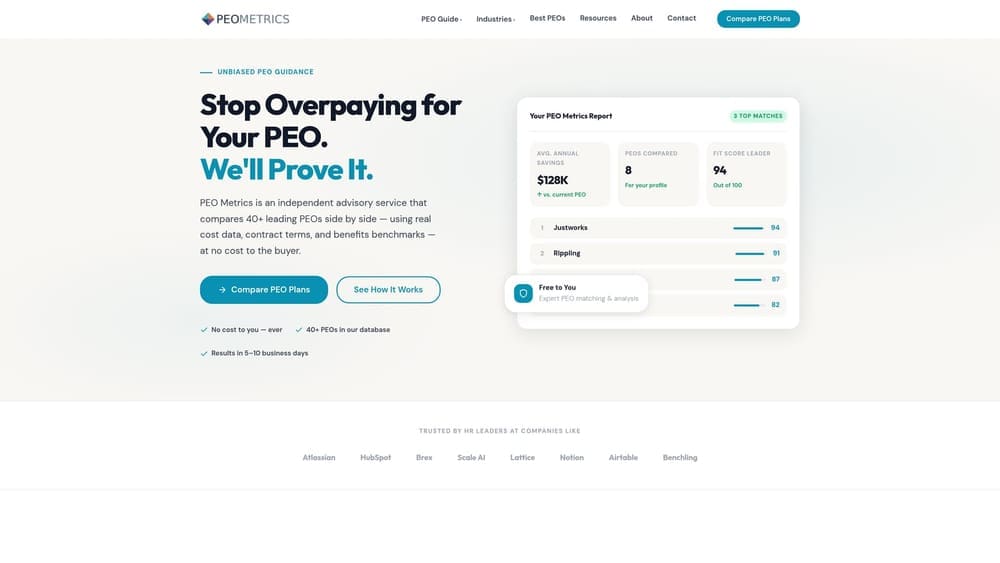
PEO Metrics is a comparison and advisory service that helps businesses evaluate PEO and payroll providers using detailed metrics and pricing analysis, rather than relying on vendor sales pitches.
Where This Tool Shines
Most food manufacturers approach the PEO or payroll decision without a clear benchmark for what they should be paying or what services are standard versus premium. PEO Metrics addresses that gap directly by structuring the comparison around your specific situation: your headcount, your workers’ comp risk profile, your benefits goals, and your compliance concerns.
For food manufacturers specifically, that context matters. Workers’ comp class codes for food production carry elevated base rates, and the difference between a PEO master policy and an independently negotiated policy can be meaningful. PEO Metrics helps you understand whether a PEO’s pricing structure actually makes sense for your operation before you sign anything.
Key Features
Side-by-Side Provider Comparisons: Evaluate multiple PEO and payroll vendors against each other using consistent metrics rather than each vendor’s own framing.
Pricing Analysis: Identifies whether a PEO or payroll solution is cost-appropriate for your headcount and risk profile, helping you avoid bundled fees and administrative markups.
Industry-Specific Context: Comparisons account for food manufacturing factors including workers’ comp exposure, compliance complexity, and shift payroll needs.
Unbiased Guidance: Framed around the buyer’s situation rather than vendor preferences. Note that PEO Metrics may receive vendor placement fees, which is disclosed transparently.
Best For
Food manufacturers at any stage of the PEO or payroll evaluation process, particularly those considering a first PEO relationship or reviewing a current contract at renewal. Also useful for HR leaders who want a structured framework before entering vendor conversations.
Pricing
Contact PEO Metrics directly for details. The service may receive vendor placement fees, which is disclosed as part of its transparency commitment.
2. TriNet
Best for: Small to mid-sized food manufacturers seeking a full-service PEO with strong benefits access and dedicated HR support.
TriNet is a publicly traded, full-service PEO that bundles payroll, benefits administration, HR support, and compliance services under a co-employment model.
Where This Tool Shines
One of the practical advantages TriNet offers smaller food manufacturers is access to large-group health benefits that would be difficult or expensive to obtain independently. If you’re running a production facility with 30 to 150 employees, the benefits purchasing power of a PEO like TriNet can make a real difference in what you’re able to offer workers.
TriNet also organizes its service teams around industry verticals, which means the HR support you receive is more likely to understand the general context of a manufacturing environment than a generalist support team would. That said, food-specific regulatory knowledge, particularly around FDA Food Safety Modernization Act requirements, sits outside what any PEO takes on as a compliance obligation.
Key Features
Large-Group Benefits Access: Health, dental, vision, and supplemental coverage options that smaller employers typically cannot access at competitive rates independently.
Dedicated HR Support: Industry-focused service teams that handle HR questions, employee relations guidance, and policy support.
Multi-State Payroll Processing: Useful for food manufacturers with facilities or distribution operations across multiple states.
Workers’ Comp Administration: Coverage through TriNet’s master policy, which can simplify administration and may affect your effective rate depending on your sub-category and loss history.
Best For
Food manufacturers with roughly 10 to 200 employees who want a single vendor handling HR, payroll, and benefits, and who prioritize benefits quality and HR support over customization flexibility. Verify current employee minimums directly with TriNet before engaging.
Pricing
Per-employee-per-month pricing; specific rates vary by company size and benefits selections. Contact TriNet directly for a quote based on your headcount and configuration.
3. Insperity
Best for: Food manufacturers that want deep HR consulting support alongside standard PEO services.
Insperity is a publicly traded, full-service PEO known for its HR consulting depth, compliance infrastructure, and hands-on service model.

Where This Tool Shines
Insperity’s reputation in the PEO market is built around the quality of its HR consulting rather than just payroll processing. For food manufacturers that are growing quickly, dealing with employee relations challenges, or building out HR infrastructure for the first time, that consulting depth can be genuinely useful. Think employee handbook development, HR policy guidance, and structured performance management, not just payroll runs.
Insperity also offers OSHA safety consulting resources, which is relevant for food production environments where workplace safety programs directly affect workers’ comp loss history. This doesn’t replace your internal safety function, but it can supplement it in meaningful ways.
Key Features
HR Program Development: Support for employee handbooks, HR policies, job descriptions, and HR infrastructure that many food manufacturers lack in-house.
Compliance Assistance: Coverage of federal and state employment law obligations, helping food manufacturers stay current as regulations change.
Workers’ Comp Coverage: Administered through Insperity’s master policy, with safety consulting resources that can support loss prevention efforts on the production floor.
Performance Management and Training: Tools and resources for employee development, which can help with retention in high-turnover food production environments.
Best For
Food manufacturers that want more than transactional payroll and benefits administration, particularly those building or rebuilding their HR function. Insperity typically works best with employers who have at least five employees; verify current minimums directly with Insperity.
Pricing
Per-employee-per-month model; pricing varies by employee count and service configuration. Contact Insperity for a quote tailored to your operation.
4. ADP TotalSource
Best for: Food manufacturers that want IRS-certified PEO status and tight integration with ADP’s broader HR and payroll ecosystem.
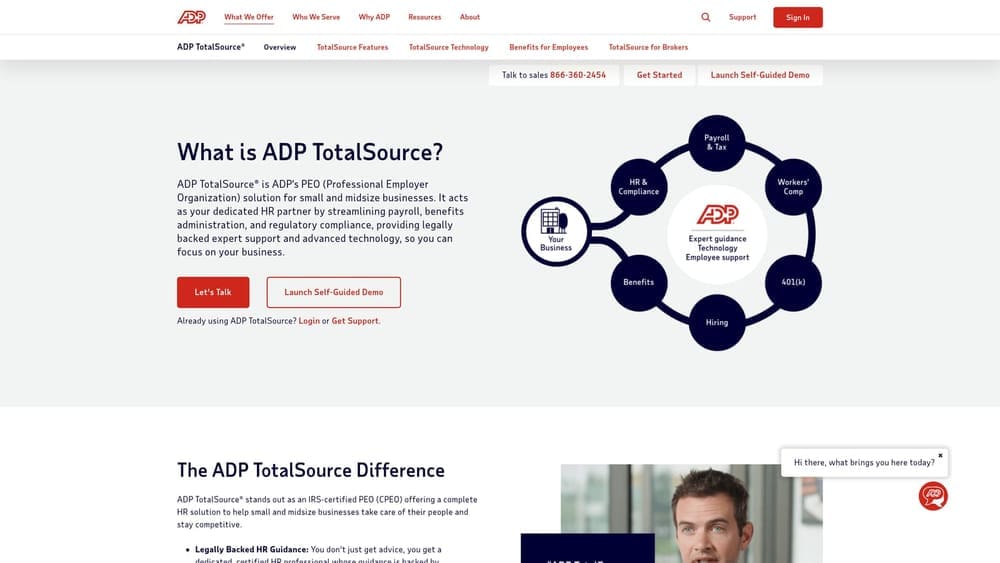
ADP TotalSource is the PEO division of ADP, offering co-employment services with CPEO certification, meaning clients receive IRS-recognized tax liability protections.
Where This Tool Shines
The CPEO designation matters for food manufacturers that are concerned about tax liability in a co-employment arrangement. A Certified PEO carries IRS-recognized status, which clarifies the tax responsibility structure between the PEO and the client. ADP TotalSource held CPEO certification as of the last confirmed check; verify current status directly with ADP before making any decisions based on that designation.
For food manufacturers already using ADP products elsewhere in their operation, TotalSource offers the advantage of integration within a familiar ecosystem. Payroll data, HCM reporting, and benefits administration can connect across ADP’s platform rather than requiring separate data feeds.
Key Features
CPEO-Certified Status: Provides IRS-recognized tax liability protections within the co-employment structure. Verify current certification status at time of evaluation.
ADP Ecosystem Integration: Connects with ADP’s broader payroll and human capital management tools for employers already operating within that platform.
Benefits Administration: Health, retirement, and supplemental coverage options administered through the co-employment relationship.
HR Compliance Tools: Dedicated compliance support and HR resources, including access to ADP’s compliance expertise across federal and state employment law.
Best For
Food manufacturers that prioritize CPEO-certified tax protection, are already in the ADP ecosystem, or want a large, established vendor with deep compliance infrastructure. Best suited for employers with stable, year-round headcount rather than highly seasonal operations.
Pricing
Pricing varies by company size and configuration. Contact ADP TotalSource directly for a quote specific to your headcount and service needs.
5. Paychex PEO
Best for: Food manufacturers that want a local point of contact and a hands-on service relationship rather than a call-center support model.
Paychex PEO is the PEO offering from Paychex, built around a local representative model that gives food manufacturers a dedicated HR professional for ongoing support.
Where This Tool Shines
The local representative model is Paychex PEO’s most distinctive characteristic. Rather than routing HR and payroll questions through a centralized support queue, Paychex assigns a dedicated local HR professional to each account. For food manufacturers managing shift supervisors, production floor HR issues, or time-sensitive payroll questions, having a named contact who knows your account can reduce friction considerably.
Paychex also has broad geographic reach, which matters for food manufacturers with multiple facilities or those in markets where regional compliance nuances apply. Verify current geographic coverage in your specific locations before committing.
Key Features
Dedicated Local HR Professional: A named account contact assigned to your business for HR questions, compliance guidance, and payroll support.
Workers’ Comp Administration: Coverage through the Paychex PEO master policy, simplifying administration for food manufacturers with elevated workers’ comp exposure.
Time and Attendance Integration: Payroll processing that connects with time and attendance data, relevant for multi-shift food production environments.
Employee Benefits Access: Health, retirement, and supplemental benefits administered through the co-employment relationship.
Best For
Food manufacturers that value relationship-based service and want a local HR professional rather than a centralized support model. Particularly useful for smaller operations where the owner or plant manager handles HR alongside other responsibilities.
Pricing
Pricing varies by location, headcount, and services selected. Contact Paychex directly for a quote based on your specific operation.
6. Gusto
Best for: Small food manufacturers or food businesses with straightforward payroll needs and limited compliance complexity.
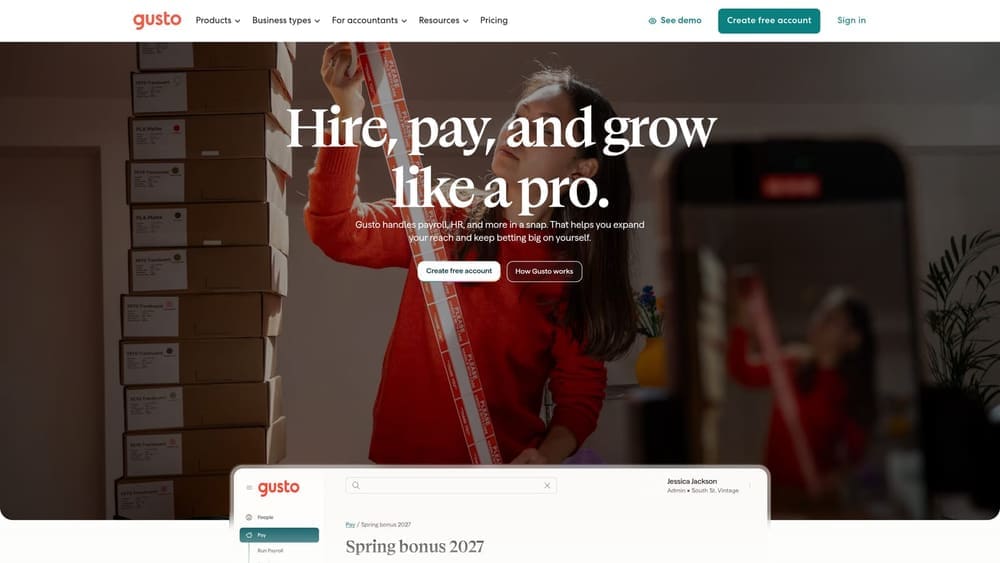
Gusto is a payroll-first platform designed for small businesses, offering payroll processing, basic HR tools, and benefits administration without a co-employment structure.
Where This Tool Shines
Gusto’s primary advantage is simplicity and transparent pricing. For a small food manufacturer with a straightforward workforce, say a specialty food producer with under 20 employees and a single location, Gusto delivers clean payroll processing without the complexity or cost of a full PEO relationship. The published pricing tiers mean you know what you’re paying before you sign up, which is not always the case with PEO contracts.
It’s worth being direct about what Gusto does not provide. There is no co-employment relationship, no PEO master workers’ comp policy, and no dedicated HR compliance support. For food manufacturers with significant production floor hazards, seasonal headcount swings, or multi-state operations, those gaps are meaningful. Gusto works best when the compliance picture is relatively simple.
Key Features
Payroll Processing: Handles hourly and salaried employees with automated tax filing and direct deposit.
Basic HR Tools: Onboarding workflows, document storage, and time tracking available within the platform.
Benefits Administration: Health benefits available as an add-on, though without the group purchasing power of a PEO.
Transparent Pricing: Published tiered pricing with a base monthly fee plus a per-employee monthly cost, visible on Gusto’s website.
Best For
Small food businesses with simple payroll needs, low workers’ comp complexity, and limited multi-state exposure. Not a fit for food manufacturers with elevated production floor risk or significant compliance requirements.
Pricing
Published tiered pricing starting at a base monthly fee plus a per-employee monthly cost. See Gusto’s website for current rates, as tiers and pricing are updated periodically.
7. Rippling
Best for: Food manufacturers that want a unified platform connecting payroll, HR, benefits, and IT management without a default co-employment structure.
Rippling is a workforce management platform that combines payroll, HR, benefits, and IT management in one system, operating without a default PEO co-employment arrangement in its standard configuration.
Where This Tool Shines
Rippling’s architecture is modular and unusually broad. Most payroll and HR platforms stop at the HR boundary. Rippling extends into IT and device management, which is relevant for food manufacturers that have both production floor workers and an administrative or quality assurance team using company devices and software. Managing access, onboarding, and offboarding across both groups from one platform reduces operational overhead.
For food manufacturers considering Rippling, one important clarification: Rippling does offer a separate PEO product, but its standard configuration is a payroll and HR platform, not a co-employment arrangement. If PEO co-employment is part of your evaluation, verify Rippling’s current PEO offering and its terms directly before assuming it applies.
Key Features
Unified Payroll and HR: Handles both hourly production staff and salaried employees within a single platform with consistent data across modules.
Time and Attendance with Scheduling: Tracks hours and supports shift scheduling, relevant for multi-shift food production environments.
Benefits Administration: Health, retirement, and supplemental benefits managed within the same platform as payroll.
IT and Device Management: Manages software access and company devices, useful for food manufacturers with mixed administrative and production floor workforces.
Best For
Mid-sized food manufacturers that want a technology-forward platform with broad capabilities and are comfortable managing their own employer-of-record responsibilities. Less suited for food manufacturers that specifically need PEO co-employment benefits like a master workers’ comp policy.
Pricing
Modular pricing based on which products are activated. Contact Rippling for a quote specific to your configuration and headcount.
8. Paylocity
Best for: Food manufacturers with shift-heavy, hourly workforces that need strong time-and-attendance and scheduling tools alongside payroll.
Paylocity is a payroll and human capital management platform with particularly strong time-and-attendance and scheduling capabilities, well-suited to the operational realities of food production environments.
Where This Tool Shines
Paylocity’s time-and-attendance functionality is more developed than what you’ll find in general-purpose payroll platforms. For food manufacturers running two or three shifts with overtime calculations, shift differentials, and fluctuating headcount, that depth matters. The platform handles the payroll complexity that comes with hourly production workforces without requiring significant manual intervention.
Paylocity also offers employee self-service tools that are accessible to production floor workers, which can reduce the administrative burden on supervisors and HR staff. Like Gusto and Rippling in its standard form, Paylocity is not a PEO. It does not offer co-employment, a master workers’ comp policy, or dedicated HR compliance support. It is a payroll and HCM platform, and it should be evaluated on that basis.
Key Features
Time and Attendance with Shift Scheduling: Built for hourly workforces with multi-shift environments, handling scheduling, clock-in, and overtime tracking in one system.
Payroll Processing: Handles overtime calculations and shift differentials accurately, reducing manual corrections in complex pay environments.
Employee Self-Service: Mobile-accessible tools that allow production floor workers to view pay stubs, request time off, and update personal information without going through HR.
Workforce Analytics: Reporting tools that give HR leaders and plant managers visibility into labor costs, overtime trends, and headcount patterns.
Best For
Food manufacturers with 50 or more hourly employees running multiple shifts who need a payroll and HCM platform with serious time-and-attendance capabilities. A strong fit for produce processors, canned goods manufacturers, or any operation with complex shift structures and seasonal volume changes.
Pricing
Per-employee-per-month pricing that varies by modules selected. Contact Paylocity for a quote based on your headcount and feature requirements.
Matching the Right Solution to Your Operation
The right answer for your food manufacturing business depends on a few factors that no vendor will volunteer upfront: your workers’ comp exposure, your headcount stability, and how much HR infrastructure you’re building versus maintaining.
If you’re a smaller food manufacturer with significant production floor risk and limited HR capacity, a full-service PEO like Insperity, TriNet, or Paychex PEO is worth serious consideration. The co-employment structure, master workers’ comp policy, and HR support can address gaps that a payroll platform simply won’t fill.
If you’re mid-sized with a stable workforce and existing HR infrastructure, a platform like Paylocity or Rippling may give you the payroll and workforce management capabilities you need without the overhead of a co-employment relationship. For the smallest food businesses with straightforward payroll needs, Gusto offers a clean, transparent starting point.
ADP TotalSource is worth evaluating if CPEO-certified tax protection is a priority, particularly for food manufacturers operating across multiple states with complex payroll tax situations.
Before any of these conversations happen, it’s worth understanding what you should actually be paying and what each structure genuinely offers for your specific situation. Many food manufacturers overpay for PEO services because of bundled fees, administrative markups, and contracts that limit flexibility at renewal time.
PEO Metrics gives you a side-by-side breakdown of pricing, services, and contract terms before you commit. Don’t auto-renew. Make an informed, confident decision.
Before you sign that PEO renewal, make sure you’re not leaving money on the table.
Many businesses unknowingly overpay because of bundled fees, hidden administrative markups, and contracts designed to limit flexibility. We give you a clear, side-by-side breakdown of pricing, services, and contract terms, so you can see exactly what you’re paying for and choose the option that truly fits your business.
