

Your renewal quote just landed, or maybe you’re setting up HR for the first time and someone suggested a PEO. Either way, you’re trying to figure out whether co-employment actually makes sense for a freight brokerage, or whether a payroll company gets you everything you need at a fraction of the cost.
The honest answer is: it depends on a few specific things. Freight brokerages aren’t like most small businesses. Your workforce is almost entirely office-based, which keeps workers’ comp exposure low. But your brokers may be working across a dozen states, your pay structure mixes base and commission in ways that trip up basic payroll platforms, and turnover is a known challenge in the industry. That combination makes the PEO-vs.-payroll decision genuinely worth thinking through, not just defaulting to whatever your accountant used last.
This guide covers the leading options in both categories, explains what each one actually delivers for a freight brokerage, and tells you when to choose one model over the other. PEO Metrics is listed first because it helps you make this call before you sign anything.
1. PEO Metrics
Best for: Freight brokerages that want an unbiased comparison before committing to any PEO or payroll provider.
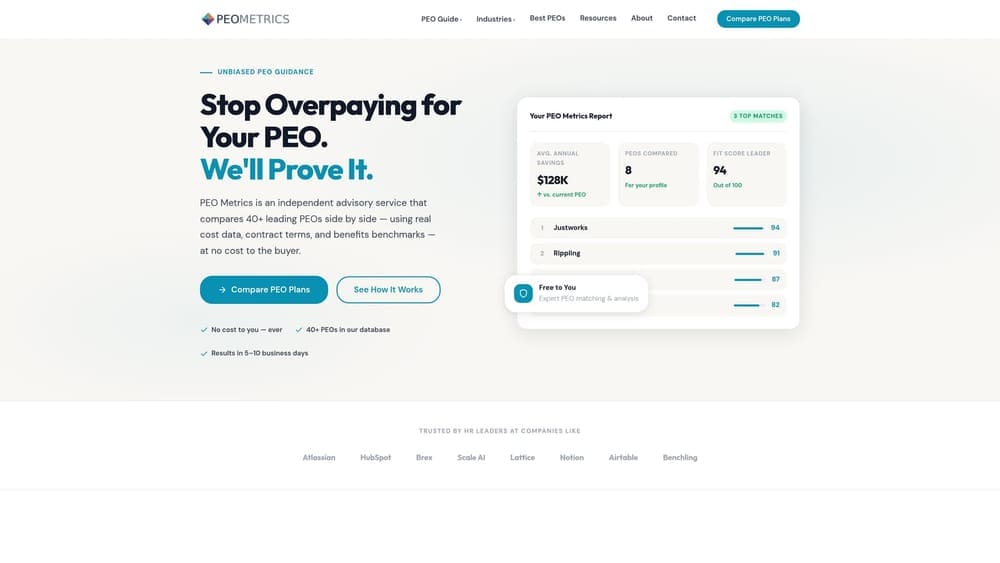
PEO Metrics is an independent advisory service that compares 40+ PEOs side by side on cost data, contract terms, and benefits benchmarks, completely free to the buyer.
Where This Tool Shines
The core problem with choosing a PEO or payroll company on your own is that you’re comparing proposals written by salespeople who have every incentive to obscure the real cost. PEO Metrics sits on your side of the table. They’re never paid by vendors, which means their comparison is actually unbiased, not “unbiased” in the way a broker who earns commissions from three providers uses that word.
For freight brokerages specifically, this matters because the PEO-vs.-payroll question has a real answer that depends on your state footprint, headcount, and benefits goals. PEO Metrics’ 12-dimension methodology covers pricing, compliance, benefits quality, and contract risk, so you get a structured comparison rather than a side-by-side of marketing brochures.
Key Features
40+ PEOs Compared: Side-by-side analysis of cost data, contract terms, and benefits benchmarks across a broad vendor set.
12-Dimension Methodology: Covers pricing structure, compliance depth, benefits quality, and contract risk, among other factors.
Fast Turnaround: Comparison reports delivered in 5-10 business days after an intake that takes roughly 8 minutes.
Genuinely Free: PEO Metrics is paid by neither vendors nor brokers. The service costs nothing to the buyer.
Benchmarking Scale: Has matched 850+ companies since 2019, with $2.1B in PEO spend benchmarked across 10-2,000 employee companies.
Best For
Any freight brokerage that’s evaluating a PEO for the first time, coming up on renewal, or trying to figure out whether their current payroll-only setup is leaving compliance gaps. Particularly useful for brokerages operating in three or more states, where the PEO value proposition is strongest but the contract complexity is also highest.
Pricing
Free to the buyer. PEO Metrics is compensated independently of vendor selection, so there’s no financial incentive to steer you toward any particular provider.
2. ADP TotalSource
Best for: Mid-size freight brokerages that want full-service PEO coverage across all 50 states.
ADP TotalSource is a full-service PEO from one of the largest payroll and HR companies in the US, covering co-employment, benefits administration, multi-state compliance, and workers’ comp.
Where This Tool Shines
If your brokerage has remote brokers spread across multiple states, ADP TotalSource’s compliance infrastructure is genuinely hard to match. They have state-level compliance support across all 50 states, which matters when you’re managing SUTA registrations, varying leave laws, and payroll tax filings in California, Colorado, New York, and Washington simultaneously.
The platform also handles commission and variable pay well, which is a real differentiator for freight brokerages where broker compensation mixes base salary with performance-based commission. Integrating that into a clean payroll run is harder than it sounds on basic platforms.
Key Features
Multi-State Compliance: Full compliance infrastructure across all 50 states, including SUTA, leave laws, and payroll tax registration.
Large-Group Benefits Access: Health, dental, and vision plans at group rates not available to smaller employers buying on their own.
Workers’ Comp Coverage: Included under the PEO master policy, with clerical class codes (typically 8810) applicable to office-based brokerage staff.
Commission Pay Handling: Strong payroll processing for variable and commission-based compensation structures.
Dedicated HR Support: HR specialists available alongside the ADP technology platform.
Best For
Freight brokerages with 25 or more employees operating across three or more states. Brokerages under 25 employees often report feeling underserved relative to ADP’s larger accounts, so headcount matters here.
Pricing
Custom pricing, quoted as a PEPM fee or percentage of payroll. Not published publicly. Pricing complexity is a known friction point; use PEO Metrics to benchmark any ADP proposal before signing.
3. Insperity
Best for: Freight brokerages that want a dedicated HR specialist, not just a platform login.
Insperity is a mid-market PEO known for high-touch service and dedicated HR specialists assigned per account, which makes it a strong fit for brokerages that want real HR guidance alongside their payroll and compliance coverage.
Where This Tool Shines
Most PEOs sell you a platform and a support queue. Insperity assigns a dedicated HR specialist to your account, which means someone who actually knows your brokerage is available when you need to handle a termination, navigate a leave situation in a state you’ve never dealt with before, or think through a comp structure change. For freight brokerages with no in-house HR staff, that’s a meaningful difference.
Their benefits administration is also comprehensive, covering health, 401(k), and ancillary benefits. Competing for experienced broker talent against carriers and tech-enabled logistics platforms means your benefits package matters, and Insperity’s large-group access helps close that gap.
Key Features
Dedicated HR Specialist: A named HR specialist assigned to your account, not a shared support queue.
Comprehensive Benefits: Health, 401(k), dental, vision, and ancillary coverage through the PEO master plan.
Multi-State Payroll and Compliance: Covers SUTA, leave law compliance, and payroll tax registration across states.
Workers’ Comp: Covered under the PEO master policy; office-based brokerage staff qualify for clerical class codes.
HR Technology Platform: Included with the service, though the platform is generally considered secondary to the service model.
Best For
Freight brokerages with 30 or more employees that want high-touch HR support and are willing to pay a premium for it. Very small brokerages may not meet Insperity’s minimum headcount requirements.
Pricing
Custom pricing, generally positioned at the higher end of the PEO market. Minimum headcount requirements apply. Requires a direct quote; not published publicly.
4. TriNet
Best for: Office-based freight brokerages that want vertical-specific benefit packages and a solid HRIS platform.
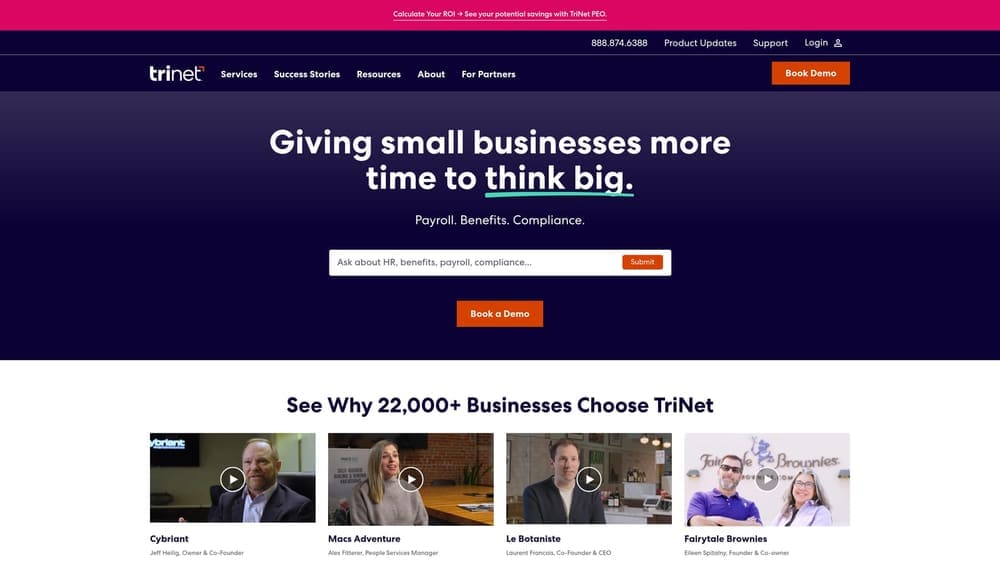
TriNet is a PEO with industry-specific benefit packages and a strong HRIS platform, well-suited to the commission-driven, professional-services-style workforce typical of freight brokerages.
Where This Tool Shines
TriNet’s benefit packages are built around professional-services workforces, which maps reasonably well to freight brokerage staff. Brokers, account managers, and ops coordinators are office workers, not warehouse or field employees, and TriNet’s benefit design reflects that. The HRIS platform also has strong employee self-service, which reduces administrative overhead when you’re managing a workforce with high turnover.
Commission and variable pay handling is supported, which matters for freight brokerages where broker compensation doesn’t fit a simple salary model.
Key Features
Industry-Specific Benefits: Benefit packages designed for professional-services-style workforces, not generic small-business plans.
Strong HRIS Platform: Employee self-service, reporting, and HR workflow tools included.
Workers’ Comp and Liability: Covered under co-employment arrangement.
Commission Pay Support: Variable compensation structures handled within the platform.
Best For
Freight brokerages with an office-based workforce of 20 or more employees that want a solid HRIS alongside PEO services. Less suited to brokerages with a high proportion of hourly or field workers.
Pricing
Custom pricing, quoted per employee per month. Varies by headcount and benefits selection. A known limitation: pricing can increase significantly at renewal, so benchmark any TriNet proposal before you’re locked in.
5. Justworks
Best for: Smaller freight brokerages under 75 employees that want transparent PEO pricing and straightforward benefits access.
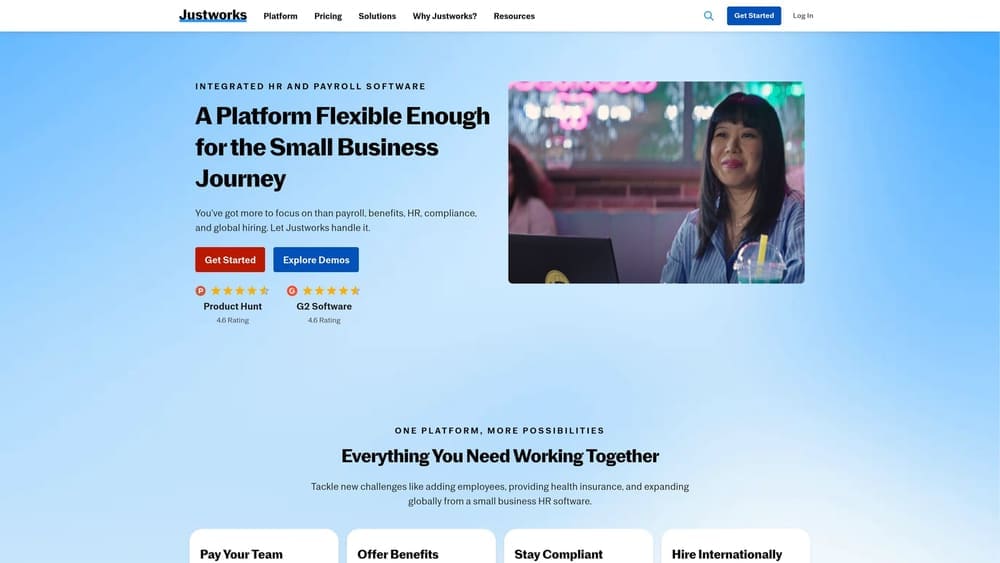
Justworks is a PEO built for smaller companies that want access to large-group health benefits at a flat, published per-employee price, without the opaque custom quoting process common among legacy PEOs.
Where This Tool Shines
The biggest practical advantage Justworks offers is pricing transparency. Most PEOs require a sales conversation before you see any numbers. Justworks publishes their tiers, which makes it genuinely easier to budget and compare. For a freight brokerage founder who is also doing their own finance work, that clarity has real value.
The platform is also genuinely easy to use. Small brokerage teams don’t have time for a complicated HR system, and Justworks’ clean interface with strong employee self-service keeps the administrative load low.
Key Features
Published Flat-Rate Pricing: Tiered pricing listed publicly on their website, which is unusual in the PEO market.
Large-Group Health Access: Medical, dental, and vision plans through the PEO master plan.
Multi-State Payroll: Handles payroll tax registration and filing across states.
Workers’ Comp: Included in the co-employment arrangement.
Simple Platform: Clean UI with employee self-service; low learning curve for small teams.
Best For
Freight brokerages with fewer than 75 employees that want PEO benefits access at a predictable cost. Less suited to brokerages with complex multi-state compliance needs or those that want dedicated HR advisory support. Justworks is a platform-first product; don’t expect the advisory depth of Insperity or ADP.
Pricing
Published tiered pricing starting at $59/employee/month (Basic) and $99/employee/month (Plus) as of 2025. Verify current rates on their website before budgeting.
6. Rippling
Best for: Tech-forward freight brokerages that want to start with payroll and add PEO services as they grow.
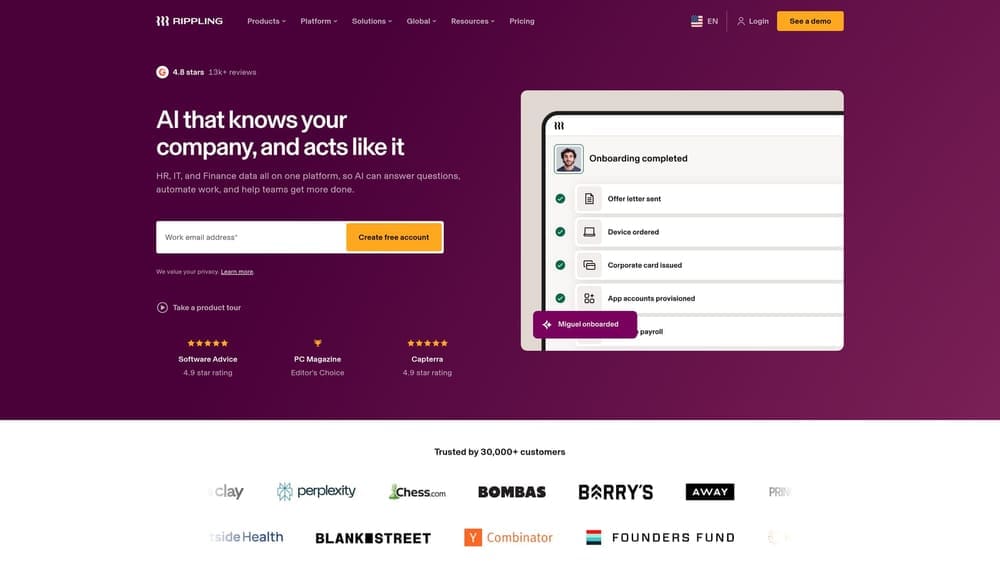
Rippling is a modular HR and IT platform that can operate as a payroll company, an HR platform, or a PEO depending on what you activate, which gives growing brokerages flexibility that most HR vendors don’t offer.
Where This Tool Shines
The modular structure is genuinely useful for freight brokerages at an inflection point. If you’re currently running payroll on a basic platform and starting to expand into new states, Rippling lets you add compliance tools and eventually PEO services without switching systems entirely. That continuity has real operational value.
The IT management integration is also worth noting. Rippling can manage device access, app provisioning, and HR data in a single system. For brokerages that are running distributed teams and managing broker onboarding and offboarding frequently, that combination reduces friction.
Key Features
Modular Architecture: Start with payroll, add HR tools, compliance automation, or PEO co-employment as your needs grow.
Multi-State Payroll Automation: Handles payroll tax registration and compliance across states with strong automation.
IT Management Integration: Device management and app access managed alongside HR data in one platform.
PEO Option Available: Rippling PEO provides co-employment and benefits access for brokerages that need it.
Commission Pay Support: Variable compensation structures handled within the payroll module.
Best For
Tech-forward freight brokerages that want a single platform to grow into, and are comfortable with a modular pricing model. The PEO offering is newer and less established than legacy PEOs like ADP or Insperity, which is worth factoring in if compliance depth is a priority.
Pricing
Modular pricing starting around $8/user/month for the core platform, with add-ons priced separately. PEO pricing is custom. Total cost can climb quickly as you add modules; get a full quote before comparing against PEO alternatives.
7. Gusto
Best for: Small freight brokerages under 25 employees that want clean, affordable payroll without co-employment.
Gusto is a payroll-only platform, not a PEO, with solid multi-state payroll handling and good compliance automation for smaller teams that don’t need or want co-employment.
Where This Tool Shines
Gusto’s strength is simplicity. The platform is genuinely easy to use, the pricing is clear, and the multi-state payroll handling is solid for a non-PEO product. For a freight brokerage with 10-20 employees operating in one or two states, Gusto covers the basics without the overhead or cost of a full PEO arrangement.
It also handles basic HR workflows, including offer letters, onboarding, and time tracking, which reduces the administrative gap between “payroll only” and “we need an HR system.”
Key Features
Multi-State Payroll: Automatic tax filing and registration across states, though depth of compliance support is less than a full PEO.
Basic HR Tools: Offer letters, onboarding workflows, and time tracking included.
Benefits Administration: Benefits available through the platform, but without large-group plan access that a PEO provides.
Clean Interface: Low learning curve; well-suited to small teams without a dedicated HR administrator.
No Co-Employment: You remain the sole employer of record, which some freight brokerage owners prefer for control over broker agreements and non-competes.
Best For
Freight brokerages with fewer than 25 employees in one or two states that want affordable, clean payroll without the complexity of co-employment. Growing brokerages often outgrow Gusto as multi-state complexity increases; plan for that transition if you’re expanding.
Pricing
Starts at $46/month base plus $6/person/month on the Simple plan. Higher tiers available. Verify current rates on their website.
8. Paychex Flex
Best for: Freight brokerages that want a scalable payroll and HR solution with a long service track record and nationwide coverage.
Paychex Flex is a tiered payroll and HR platform from Paychex with service options ranging from basic payroll processing to near-PEO HR outsourcing packages.
Where This Tool Shines
Paychex Flex’s tiered service model means you can start with basic payroll and add HR services as your brokerage grows, without switching platforms. The nationwide service network is genuinely broad, and the long track record means the platform handles edge cases, like mid-year state registrations or workers’ comp audits, that newer platforms sometimes struggle with.
The pay-as-you-go workers’ comp option is worth noting for freight brokerages. Rather than a large annual premium deposit, you pay workers’ comp as a percentage of each payroll run, which helps cash flow in a business where headcount and revenue can swing with freight market cycles.
Key Features
Tiered Service Model: Payroll-only up to full HR outsourcing, with flexibility to add services over time.
Benefits Administration: Health benefits and 401(k) options available, though without PEO-level large-group access.
Dedicated Payroll Specialist: A named payroll specialist assigned per account, which reduces the support-queue frustration common with large platforms.
Pay-As-You-Go Workers’ Comp: Workers’ comp premiums tied to each payroll run rather than an annual deposit.
Best For
Freight brokerages that want a scalable, full-service payroll and HR platform with a dedicated contact. Service quality is inconsistent across regions, which is a known limitation. The platform can also feel dated compared to newer competitors, and upselling is a common complaint among Paychex customers.
Pricing
Custom pricing based on headcount and service tier. Not published publicly; requires a quote. Request an itemized breakdown before signing.
Which Model Actually Fits Your Brokerage
Here’s the honest framework. If your brokerage operates in three or more states, has 25 or more employees, and has no dedicated HR staff, a PEO is almost certainly worth the cost. The multi-state compliance burden alone, covering SUTA registrations, leave law variations, and payroll tax filings across states like California, New York, and Colorado, is a real operational risk when it’s handled manually or with a basic payroll platform.
One thing most guides skip: joining a PEO resets your SUTA experience rating in most states. For a brokerage with low claims history and stable headcount, that reset can actually increase your unemployment tax cost in the short term. It’s worth running the numbers before you assume a PEO saves money on workers’ comp and unemployment taxes.
The co-employment structure also deserves a direct answer. Under a PEO, the PEO becomes the employer of record for tax purposes. Some freight brokerage owners are uncomfortable with that arrangement, particularly if they rely on non-compete or confidentiality agreements with brokers that they want to control directly. If that’s a concern, a payroll company like Gusto or Paychex keeps you as the sole employer and gives you full control over those agreements.
For smaller brokerages, say under 25 employees in one or two states, a payroll company is often the right call. You get clean payroll, basic compliance, and lower cost without the overhead of co-employment. Gusto or Paychex Flex covers most of what you need at that scale. As you add states and headcount, that calculus shifts.
Note also that FMCSA broker authority and licensing compliance is entirely separate from HR compliance. A PEO does not help with your broker authority, bond requirements, or FMCSA filings. Don’t let a PEO sales conversation conflate the two.
The vendors above span the full range from advisory (PEO Metrics) to full-service PEO (ADP TotalSource, Insperity, TriNet) to transparent small-company PEO (Justworks) to modular platform (Rippling) to payroll-only (Gusto, Paychex Flex). The right choice depends on your state count, headcount, in-house HR capacity, and how much you value benefits quality versus cost control.
Before you sign a PEO contract or auto-renew your current arrangement, it’s worth knowing what you’re actually paying relative to the market. PEO Metrics compares 40+ PEOs against your specific profile at no cost to you, with a report in 5-10 business days. Don’t auto-renew. Make an informed, confident decision.
Before you sign that PEO renewal, make sure you’re not leaving money on the table.
Many businesses unknowingly overpay because of bundled fees, hidden administrative markups, and contracts designed to limit flexibility. We give you a clear, side-by-side breakdown of pricing, services, and contract terms—so you can see exactly what you’re paying for and choose the option that truly fits your business.
