
Most advice on Group Management Services reviews gets one thing wrong. It treats a PEO like a local vendor purchase, where a star rating is supposed to tell the whole story. That doesn’t work. A five-star review won’t tell an HR director whether the contract uses percentage-of-payroll pricing, a per-employee fee, or both, even though those structures commonly range from 2% to 12% of payroll or a flat monthly amount per employee according to OEM America’s PEO agreement guide.
That gap matters more in 2026, not less. The cloud-based data management services market was valued at USD 40.7 billion in 2023 and is projected to reach USD 258.4 billion by 2030, growing at a projected 30.4% CAGR according to PS Market Research’s market analysis. Buyers have more data than ever. They still need a better method for reading it.
That’s the main problem with most group management services reviews. They are either polished testimonials or one-off complaints, and neither tells a CFO much about renewal caps, implementation friction, or exit exposure. Smart buyers should read reviews the same way they review solutions for growing business finances. As one input among many, not as the decision itself. The right approach is to combine client feedback, employee sentiment, complaint handling, and contract analysis into a single risk picture before signing.
Table of Contents
- 1. PEO Metrics
- 2. Better Business Bureau
- 3. Glassdoor
- 4. Indeed Company Reviews
- 5. Gartner Peer Insights
- 6. Birdeye
- 7. RepVue
- Group Management Services, 7-Source Review Comparison
- Your Next Step From Reviews to a Data-Backed Decision
1. PEO Metrics
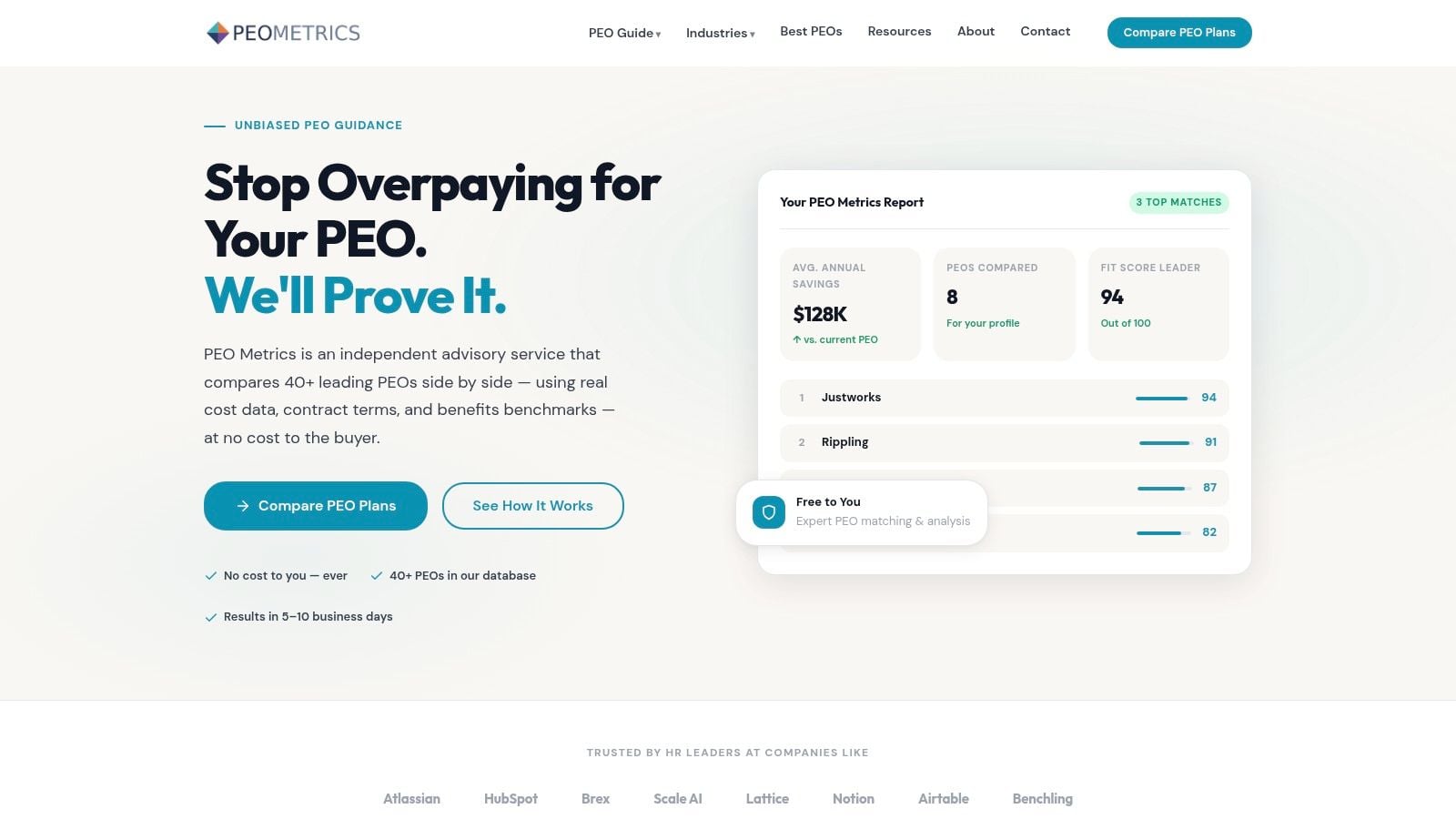
Review scores are the easy part. The harder job is figuring out whether positive sentiment will hold up once the contract starts, payroll goes live, and renewal terms kick in. That is why PEO Metrics deserves to be the first stop in a Group Management Services review process.
A buyer evaluating GMS should not treat this source as another review directory. It works better as a decision framework. Instead of asking whether clients seem happy, it helps a team compare providers across the issues that actually drive cost and operating risk: service model, benefits fit, workers’ compensation posture, implementation support, pricing structure, and exit terms. That broader view matters because client reviews, employee reviews, sales reviews, and complaint records each show a different slice of the same provider.
Best use case
PEO Metrics fits best when the company is already in buying mode and needs to narrow the field with discipline. The firm describes a process that compares dozens of national and specialist PEOs, builds a shortlist, and supports employers through selection. For a CFO, HR leader, or operator replacing an incumbent PEO, that structure is more useful than reading review sites one by one and trying to reconcile conflicting opinions.
It also helps early in the process if the team still needs baseline context on what a professional employer organization is. If pricing is still fuzzy, their guide to how much a PEO costs is a practical next read before comparing GMS against alternatives.
Practical rule: Use reviews to spot patterns. Use side-by-side comparison work to test whether those patterns create financial, service, or contract risk.
What stands out
A primary value here is negotiation support. A review site may tell you that service feels responsive or inconsistent. It usually will not tell you whether the admin fee is competitive, whether the rate can reset after year one, whether implementation costs are waived, or how hard it will be to exit cleanly if the relationship misses the mark.
That distinction matters with a scaled provider like Group Management Services. GMS has public growth signals, including its placement on Crain’s Cleveland Business Fast 50 list according to GMS’s Fast 50 announcement. Growth can signal market traction. It does not answer the buyer’s harder questions about fit for a multi-state employer, a high-claim workers’ compensation profile, or a business that needs strong support across several operating entities.
Here is where PEO Metrics adds a different kind of evidence. It gives buyers a way to synthesize what each review source is good at. Client reviews can reveal service consistency. Employee reviews can hint at turnover or internal process strain. Sales reviews can expose pressure on quotas or territory quality, which sometimes shows up later in retention and handoff quality. Compliance and complaint sources can highlight how the provider responds when billing disputes, claims issues, or cancellation friction appear.
That is a better way to read Group Management Services reviews. Not as isolated praise or criticism, but as inputs into a single risk assessment.
A practical buyer should look for three outcomes:
- Shortlist discipline: Useful for teams replacing a PEO, testing the market before renewal, or comparing several providers at once.
- Contract clarity: Helpful for pressure-testing fees, renewal language, implementation terms, service commitments, and exit conditions.
- Scope limits: Advisory input can improve the buying process, but final legal interpretation still belongs with counsel.
2. Better Business Bureau
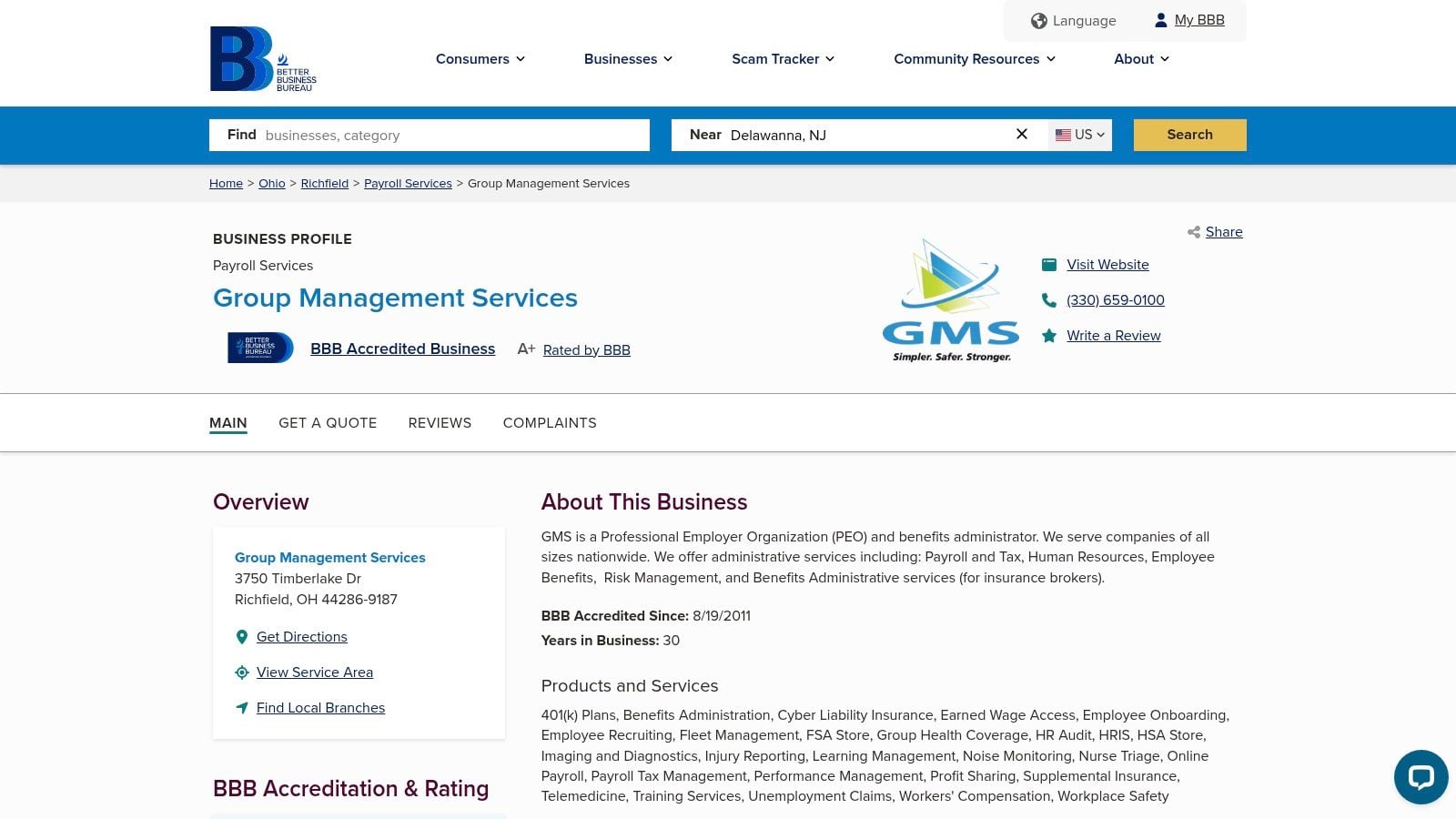
The Better Business Bureau profile is where complaint-handling discipline shows up. That’s different from customer happiness. For a PEO buyer, that distinction matters because a provider can have positive day-to-day service and still handle disputes poorly when billing, cancellation, or coverage issues surface.
The BBB listing for Group Management Services’ Richfield, Ohio headquarters is available through Better Business Bureau. The useful part isn’t the rating by itself. It’s the ability to read complaint narratives, review company responses, and see whether the same issue keeps appearing.
Where BBB helps
BBB is most useful late in the buying process, after a provider makes the shortlist. At that point, an HR leader or CFO should already have rough pricing, service promises, and implementation assumptions in hand. The BBB profile becomes a pressure test. If complaints repeatedly center on billing clarity, account transitions, or responsiveness during disputes, those themes should show up in negotiation.
A practical move is to compare what appears in BBB with the provider’s actual fee structure. PEO contracts commonly use percentage-of-payroll fees, per-employee monthly pricing, or a blended model, and buyers should insist on fee transparency before signing. Teams that need a baseline for that conversation can review how much a PEO costs.
Complaint platforms don’t answer, “Is this provider good?” They answer, “What happens when something goes wrong?”
The trade-off is obvious. BBB can overrepresent unhappy customers because that’s why many people post there. That doesn’t make the profile less useful. It just means it should be read as a dispute-handling tool, not a brand reputation scorecard.
3. Glassdoor
Glassdoor doesn’t tell buyers whether Group Management Services is the right PEO contract. It does tell them whether internal operating conditions may affect service consistency. That’s valuable because account management, payroll execution, onboarding quality, and compliance follow-through all depend on the people inside the organization.
The profile for Group Management Services is available on Glassdoor. The best use of Glassdoor is pattern recognition, not score worship. Buyers should focus on comments from service, payroll, account management, implementation, and compliance-adjacent roles rather than broad culture complaints.
What employee sentiment can reveal
Employee review sites are especially helpful when the sales process is smooth but the buyer wants to know what happens after kickoff. If multiple reviews point to heavy workload, leadership turnover, or uneven support, that doesn’t automatically mean clients are unhappy. It does suggest the buyer should ask harder questions about team structure, account coverage, and escalation paths.
That cross-check is more relevant because one external review source cited a verified Google Maps reviewer saying they had used GMS for over 14 years, while employee reviews on Indeed showed an overall 3.8 out of 5 based on 76 reviews, according to DesignRush’s GMS profile. Long client tenure and moderate employee sentiment can both be true at once. That’s common in service businesses.
- Use role filters: Prioritize reviews from implementation, client service, payroll, and HR support functions.
- Watch timing: A wave of recent negative posts can indicate transition pain, management change, or policy shifts.
- Separate culture from delivery: Not every employee complaint affects clients, but persistent staffing issues often do.
For teams trying to connect internal signals to business outcomes, the broader case for HR outsourcing benefits is worth reviewing. The key is to test whether the provider’s service model can support those promised benefits in practice.
4. Indeed Company Reviews
Indeed is the better cross-check when Glassdoor feels too broad. The reviewer base often reads differently, and employer replies can add context that buyers won’t get from anonymous comments alone. For Group Management Services, the company review page is on Indeed.
Indeed matters because it can reveal whether issues are isolated to one office, one role, or one period. If a buyer sees complaints tied to a local branch, that may matter less for a national client served from a centralized account team. If the same themes appear across locations and over time, the signal gets stronger.
A useful cross-check
Indeed showed an overall rating of 3.8 out of 5 based on 76 reviews in the verified data tied to the same DesignRush summary already noted earlier. That isn’t enough, on its own, to draw a buying conclusion. It is enough to justify pointed diligence questions.
A buyer evaluating Group Management Services should ask who handles implementation, how handoffs occur between sales and service, and what happens if an account manager leaves in the first contract year. Those questions become even more important when the company is considering a switch, because leaving a PEO often creates transition expenses such as termination fees, new HR software subscriptions that typically run $50 to $150 per employee annually for integrated platforms, and possible increases in benefits costs if master-policy discounts disappear, according to Coastal Payroll’s guide for employers leaving a PEO.
What to test in demos: Ask the provider to map the first 90 days by team, system, and decision owner. Vague answers usually become expensive transitions.
That’s why buyers considering an incumbent replacement should also read why companies regret using a PEO. Many regrets start with assumptions that weren’t pressure-tested during diligence.
5. Gartner Peer Insights
Gartner Peer Insights is the cleanest place to find structured B2B end-user commentary, even when volume is light. The Group Management Services page is available through Gartner Peer Insights. What makes it useful isn’t scale. It’s the format. Reviews typically disclose role, company size, and industry context, which gives buyers more relevant signal than a generic star average.
That kind of structured review is particularly helpful for HR directors and CFOs who need to compare providers by transition quality, ongoing service, and evaluation experience. A review from a similarly sized buyer in a related industry can be more useful than dozens of broad public comments.
Why one validated review can still matter
A small review set shouldn’t be dismissed. It should be read carefully. If a validated reviewer talks about implementation quality, contract clarity, or service responsiveness, that feedback has more weight than a casual public review because the business context is clearer.
This is also where buyers should focus on a problem that ordinary review sites usually miss. There is still weak transparency around PEO-specific service depth, especially compliance support and industry fit. The verified data notes that many reviews focus on payroll or HR administration while missing whether GMS delivers recognized compliance expertise in specialized sectors, and that poor compliance support is often cited by SMBs switching PEOs, based on the summary provided in the verified data and the Group Management Services website.
For broader provider comparison work, a shortlist from a list of PEO companies is useful, but the essential work is forcing each vendor to answer the same questions about implementation, compliance coverage, and service ownership.
6. Birdeye
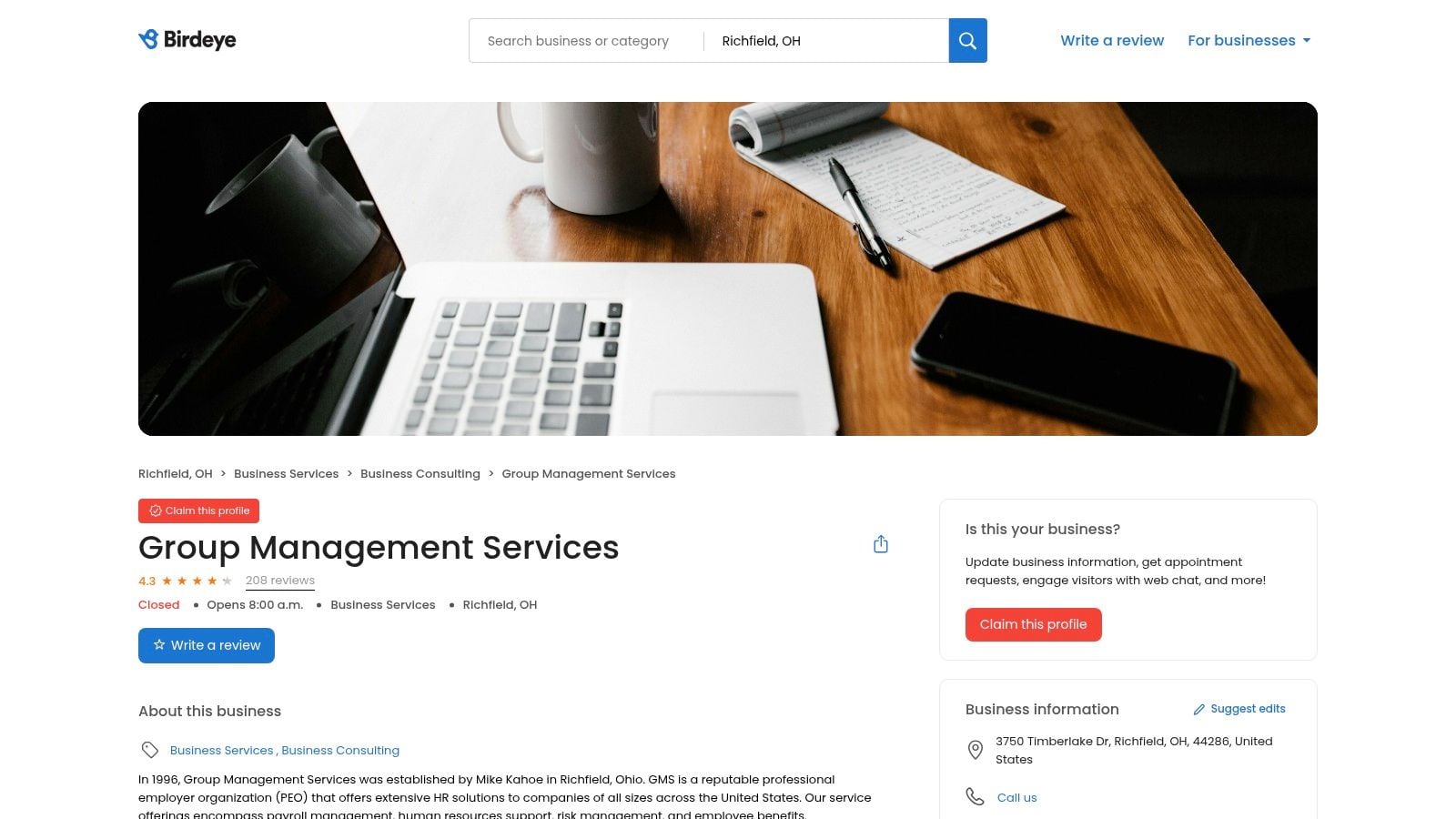
Birdeye is good for speed. It gives a fast snapshot of public-facing sentiment and points buyers to the underlying Google review profile for more detail. The Group Management Services listing is on Birdeye, and that makes it useful at the top of the funnel when a buyer wants a quick read before deeper diligence.
This is the easiest place to see whether clients generally sound satisfied, frustrated, or mixed. It can also help identify whether reviews talk about payroll accuracy, responsiveness, benefits help, or workers’ compensation support. Those recurring themes matter more than the headline score.
Fast signal, limited depth
Birdeye should never be the deciding source in a PEO evaluation. Public review aggregation is thin on contract context, company size, and service complexity. A positive review from a very small employer with simple needs may have little relevance for a multi-state construction company or a healthcare group with licensing and compliance demands.
That said, it can still surface useful details. The verified data includes a public reviewer statement praising GMS specialists as responsive, kind, and knowledgeable, and describing broad support across HR, insurance, workers’ compensation, payroll, and other business operations over a long relationship. That sort of comment is directionally helpful because it highlights what actual clients value once the contract is live.
Buyers comparing review software categories may recognize how aggregation platforms shape sentiment presentation from guides on choosing a review generation platform. The same caution applies here. Aggregated ratings are a starting point, not an underwriting tool.
7. RepVue
RepVue is a different kind of review source, and that’s exactly why it belongs in a serious GMS diligence stack. The Group Management Services page on RepVue focuses on the sales organization, not client delivery. For a buyer, that can sound peripheral. It isn’t.
A PEO relationship often goes wrong at the sales-to-service handoff. If sales teams are under pressure, poorly enabled, or disconnected from operations, buyers may hear polished promises that the implementation team can’t support cleanly. RepVue can help identify that risk.
Sales reviews as an early warning system
Sales-organization reviews are useful for reading expectation risk. If comments suggest weak enablement, turnover, or disconnects around product-market fit, a buyer should become stricter about documenting every commercial promise in writing. That includes implementation timing, service team structure, pricing mechanics, and what happens at renewal.
This category also connects to a broader market shift. Enterprise data integration spending has grown because buyers want cleaner side-by-side comparisons across systems and vendors. Verified data notes that the data integration market is projected to reach $47.60 billion by 2034, with projected CAGR ranges of 12.1% to 14.9%, and that large enterprises often allocate 2% to 3% of annual revenue to integration and ERP while mid-market companies allocate 3% to 5%, according to Integrate.io’s analysis of enterprise data integration adoption. In practice, that means finance and HR teams are better equipped to challenge sales narratives with actual operating data.
A strong sales experience is useful. A sales process that survives documentation is what matters.
RepVue won’t tell a buyer whether payroll support is excellent six months after go-live. It will help identify whether the front end of the buyer journey looks disciplined enough to trust.
Group Management Services, 7-Source Review Comparison
| Item | Implementation complexity | Resource requirements | Expected outcomes | Ideal use cases | Key advantages |
|---|---|---|---|---|---|
| PEO Metrics | Low, consultant-driven, 5–10 business days | Minimal internal time; share headcount/benefits data; no fee | Tailored PEO matches, cost benchmarks, negotiation playbook, contract risk flags | Companies with 10–2,000 employees; multi‑state, PE‑backed, industry-specific PEO selection | Independent benchmarking, real negotiated pricing, hands‑on negotiation support |
| Better Business Bureau (GMS) | Very low, public business profile lookup | None beyond time to review | Complaint trends, response history, accreditation and business facts | Vetting complaint handling and verified company details | Independent complaints record, accreditation and rating visibility |
| Glassdoor (GMS) | Very low, public employee reviews | None beyond review time | Employee morale, turnover, leadership and culture signals | Assessing internal culture and account management health | Large review volume, role/location filters for targeted insights |
| Indeed (GMS) | Very low, public employee reviews | None beyond review time | Corroborated employee themes with time‑stamps and employer replies | Cross‑checking employee sentiment and local office differences | Employer replies, sortable reviews and time‑stamped entries |
| Gartner Peer Insights (GMS) | Low–moderate, may require account/validation | Account access; validated reviewer details | Structured, validated client feedback across evaluation, transition, delivery | B2B due diligence and vendor selection | High authenticity, structured B2B review format |
| Birdeye (GMS) | Very low, aggregator snapshot | None beyond review time; click‑through to sources | Quick client‑facing rating snapshot with links to Google reviews | Fast sentiment checks for corporate HQ listing | Aggregates Google reviews for rapid public‑facing view |
| RepVue (GMS) | Very low, niche review site | None beyond review time | Sales organization signals: compensation, enablement, GTM fit | Evaluating sales team strength and client acquisition risk | Sales‑specific scoring and verified reviewer context |
Your Next Step From Reviews to a Data-Backed Decision
Reviews help only if they change the questions you ask before signing. A five-star client comment, a weak employee rating, a BBB complaint trail, and a polished sales process are not competing truths. They are different views into the same operating model.
That is the useful way to read Group Management Services reviews. Client feedback points to service consistency. Employee reviews often hint at turnover, training gaps, or overloaded account teams. Sales-focused commentary can reveal pressure inside the go-to-market function, which matters because aggressive promises often become implementation problems later. Put together, those signals form a practical risk screen, not a popularity contest.
Use that screen in procurement.
If public reviews praise responsiveness, ask who owns the relationship after implementation, how many accounts each team member carries, and what happens when your primary contact is out. If employee comments suggest burnout or uneven leadership, ask for the service model in writing, including backup coverage, escalation paths, and implementation roles. If complaint patterns point to billing friction, require line-item fee detail, renewal notice samples, and clear language on administrative charges, benefit pass-through costs, and rate change timing.
The business issue is simple. PEO regret usually comes from contract structure and operating fit, not from a bad homepage or a weak sales demo. Buyers need direct answers on pricing mechanics, benefits value, compliance support boundaries, service ownership, and exit terms. Vague answers should be treated as a risk signal, especially when reviews from different source types point in the same direction.
Strong teams use reviews to test the gap between sales claims and delivery reality. They compare what current clients say, what former employees describe, and what complaint records show. Then they push those gaps into the final negotiation, where they belong.
That’s the shift from review reading to vendor diligence. Teams that want a stronger evaluation process often borrow the same discipline they use when assessing top customer feedback software. Surface ratings matter less than the underlying service system and the contract that governs it.
A sound PEO decision comes from pattern recognition, side-by-side comparison, and disciplined negotiation.
Companies evaluating Group Management Services or any other PEO can use PEO Metrics, as noted earlier, to turn scattered reviews, proposals, and contract language into a side-by-side decision framework. The service helps HR, finance, and leadership teams compare providers, benchmark pricing and benefits, flag contract risks, and negotiate better terms at no cost to the buyer.
