
A CFO is reviewing PEO proposals. An HR manager is cleaning up the employee census before sending it out. At the same time, a supervisor is discussing an employee's performance improvement plan in a coffee shop, loud enough for two nearby people to hear. None of this looks dramatic in the moment. It's ordinary business activity.
That's also how many confidentiality failures start. Not with a hacker in a hoodie, but with routine access, rushed decisions, loose file sharing, and vendors getting more information than they need. For companies with 10 to 2,000 employees, that risk gets sharper during a PEO evaluation, a contract renewal, or a provider exit, because payroll, benefits, medical information, tax records, and employee relations files start moving across more hands and more systems.
Leaders asking how to maintain confidentiality in the workplace usually don't need another reminder to “be careful.” They need an operating model. That means clear policy language, practical data classification, technical controls that match job duties, recurring training, disciplined vendor management, and a fast offboarding process when something goes wrong.
Table of Contents
- The Real Cost of a Confidentiality Breach
- Building Your Confidentiality Framework Policy and Classification
- Implementing Technical and Physical Safeguards
- From Policy to Practice Training and Employee Agreements
- Managing Confidentiality Risks with Your PEO
- When Breaches Happen Incident Response and Offboarding
The Real Cost of a Confidentiality Breach
A manager discusses an employee's upcoming performance improvement plan at a café. The intent isn't malicious. The manager is trying to move quickly between meetings, and the conversation feels routine. But anyone within earshot now knows details they shouldn't. If that employee later hears about it from a coworker, HR is no longer dealing with a simple coaching issue. It's dealing with trust damage, possible complaint exposure, and a leadership credibility problem.

That same pattern shows up digitally. A payroll export gets attached to the wrong email. A benefits file sits in a shared drive with broad permissions. A broker, payroll vendor, and two competing PEOs all receive a richer employee census than they need for quoting. The breach point isn't always theft. Often, it's overexposure.
A 2023 data privacy report by EEI HR found that 80% of HR professionals have either witnessed or been guilty of questionable data management practices in the workplace, which shows how often confidentiality breaks down in normal operations, not just extreme cases. The same report noted that 13% of employees reported being directly affected by a data breach at work. That combination makes the risk plain. Workplace confidentiality fails most often through ordinary behavior, not extraordinary sabotage.
What the business actually loses
The immediate cost is rarely limited to one incident. A confidentiality lapse can trigger:
- Employee relations fallout that turns manageable performance or leave issues into formal complaints
- Legal and insurance exposure when sensitive records are shared beyond a legitimate business need, especially in areas tied to discipline, medical information, pay, or investigations
- Vendor risk multiplication when third parties keep copies of files after the original task is done
- Leadership trust erosion because employees remember who handled private information carelessly
For companies already reviewing employment risk, this often sits next to broader liability concerns such as employment practices liability coverage, but insurance doesn't fix internal handling failures.
Practical rule: Confidentiality isn't a handbook sentence. It's a control system for who can see what, when, and why.
Why PEO decisions make this harder
PEO relationships widen the exposure surface. During evaluation, employers share census data, benefits details, payroll patterns, workers' compensation information, and sometimes employee relations context. During implementation, data moves into new systems. During termination, employers need that data back and need the vendor to stop retaining it.
That's why a useful confidentiality program has to cover three layers at once:
| Layer | What it covers | What commonly goes wrong |
|---|---|---|
| Policy | Rules, definitions, employee expectations | Policy is vague, outdated, or buried in a handbook |
| Controls | Access, encryption, storage, file sharing, paper records | Too many people have access, old permissions stay active |
| Vendor governance | PEOs, brokers, payroll firms, consultants | Data is overshared, copied, retained, or poorly deleted |
The companies that handle this well don't rely on discretion alone. They decide in advance how confidential information will be classified, shared, audited, and shut off.
Building Your Confidentiality Framework Policy and Classification
A confidentiality program fails when employees have to guess. “Use judgment” sounds reasonable until a recruiter opens the wrong folder, a manager downloads compensation data to a laptop, or a finance lead sends a full census to five PEOs because no one defined a narrower quoting file.
Start with plain-language rules
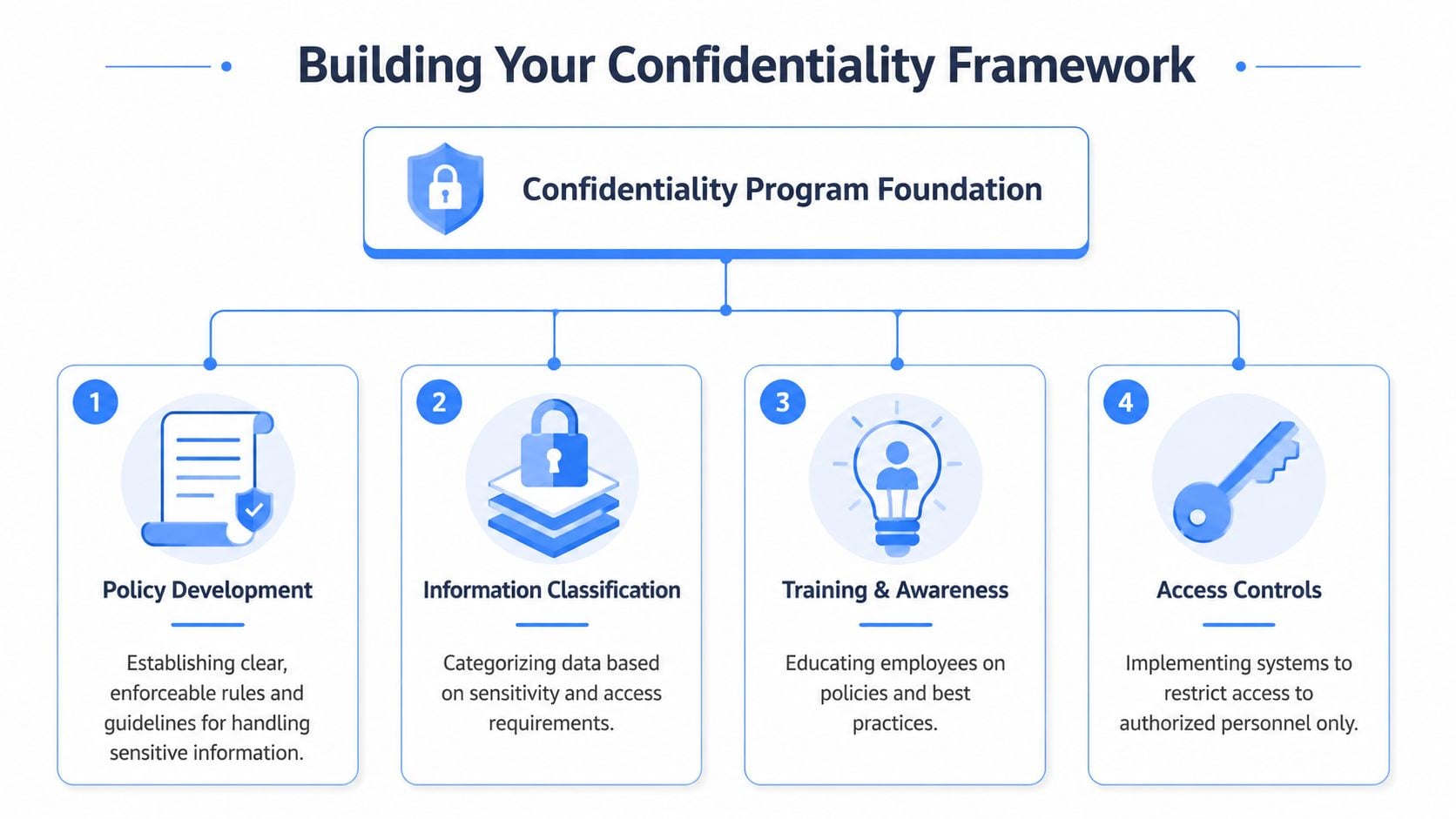
A strong policy isn't written for outside counsel. It's written for supervisors, payroll staff, recruiters, HR generalists, and department heads who touch sensitive data every day. The document should tell employees four things clearly:
- What counts as confidential information
- Who may access it
- How it must be stored, shared, and disposed of
- What happens when someone ignores the rule
For most employers, the policy should explicitly name examples instead of staying abstract. Medical certifications, I-9 records, background check results, salary data, investigation notes, payroll files, benefit elections, and tax forms should all appear by name. Employees are less likely to mishandle information when the policy sounds like their actual workplace.
A separate employee handbook section also matters. Many companies bury confidentiality in a general conduct paragraph, then wonder why managers apply it inconsistently. It should stand on its own, just like harassment, leave, and wage policies do in a solid employee handbook framework.
For teams that rely on transcription tools, meeting notes, or voice workflows, vendor privacy standards also deserve scrutiny. Before allowing any tool to capture HR or payroll conversations, leadership should review how the provider handles retention, access, and use of submitted data. That's why it helps to understand our privacy commitment before sensitive workflows get routed through third-party software.
Use a four-tier classification model
Most mid-sized employers don't need an elaborate classification scheme. They need one that people will readily use. A four-tier model works well:
| Classification | HR and finance example | Handling rule |
|---|---|---|
| Public | Press release, public job posting | Open distribution is fine |
| Internal | Org charts, all-hands deck, internal SOPs | Share inside the company on a need-to-use basis |
| Confidential | Salary bands, performance reviews, payroll summaries, vendor proposals | Limit to named roles and approved systems |
| Restricted PII | Medical records, I-9 forms, SSNs, bank details, background results | Highest restriction, tightly logged access, no casual forwarding |
This mirrors a practical access-control framework that starts by tagging data assets with sensitivity levels such as Public, Internal, Confidential, and PII, then assigning access based on a documented need to know. Without classification, access control turns into guesswork.
A policy works when a manager can answer one question fast: “What kind of data is this, and what am I allowed to do with it?”
What classification changes in day-to-day operations
Classification should affect actual behavior. That means:
- Emailing files differently: Restricted PII shouldn't move through casual email threads
- Building separate folders: Investigation files shouldn't sit in the same broad directory as general HR templates
- Changing quoting workflows: A PEO bidder should receive only the fields needed to price and compare, not a full employee history
- Limiting exports: Compensation or payroll exports should have named owners and retention rules
The key takeaway is simple. If the company hasn't classified its information, it hasn't really decided how to maintain confidentiality in the workplace. It has only said confidentiality is important.
Implementing Technical and Physical Safeguards
Policy tells people what should happen. Systems decide what can happen. That distinction matters because many confidentiality failures come from employees who had access they never needed, or who kept access long after their role changed.
Match access to the job, not the person
The most reliable model is role-based access control paired with the principle of least privilege. In practice, that means systems grant access according to job duties, and only to the minimum information required for that job.
A finance manager may need payroll data in the HRIS, but not employee investigation notes. A talent acquisition specialist may need candidate files, but not active employee I-9 forms. A regional manager may need headcount and compensation bands for planning, but not individual medical leave documents. If the system isn't segmented that way, confidentiality depends on restraint. That's a weak control.
The technical framework behind this is straightforward. Data should be tagged by sensitivity, access should be assigned to roles with a documented need to know, and privileged accounts should be protected with two-factor authentication. For stored and transmitted confidential information, the verified standard is AES-256 for data at rest and TLS 1.3 for data in transit.
The weak spot is usually permission drift after reorgs, promotions, and temporary projects. The 2025 Verizon Data Breach Investigations Report found that 60% of insider threats stem from employees with excessive access privileges who were not properly audited, a problem widely known as permission creep. That's why quarterly permission reviews matter, especially across HRIS platforms, payroll systems, shared drives, and the employee portals used in PEO environments.
A simple access review often catches issues like these:
- Former recruiters who still have access to candidate compensation notes after moving into HR operations
- Payroll backups who kept administrator rights after a temporary coverage assignment ended
- Managers on investigation teams who can still open case files months later
- PEO implementation contacts who still have broad file access after go-live
Physical controls still matter
Many employers tighten cloud permissions and then ignore the file cabinet. That's a mistake. Confidentiality still breaks through paper, printers, and office habits.
A practical physical control checklist includes:
- Locked storage: Medical files, I-9s, and paper investigation records belong in locked cabinets
- Clean desk rules: Payroll printouts and benefits forms shouldn't sit in open areas overnight
- Secure disposal: Use a shredding process for obsolete paper records instead of office trash
- Workspace limits: Restrict access to active case files only for people directly working the matter
In shared workspaces, limiting access to active investigations only is especially important. The underlying practice is simple. Split permissions so only the legal, HR, or leadership team directly involved can open those records. For facilities where access to rooms and physical areas needs tighter control, building access systems can help centralize who gets in and when. That's part of why some companies look at tools like Nimbio for buildings when strengthening the physical side of confidentiality management.
Operational insight: If a control depends on everyone remembering the rule every time, it isn't a strong control. Good systems remove the option to overshare.
From Policy to Practice Training and Employee Agreements
Most confidentiality training fails because it's forgettable. New hires click through slides, sign an acknowledgment, and never see the topic again unless a breach happens. That doesn't build discipline. It creates a paper trail.
The Federal Trade Commission's guide Protecting Personal Information says businesses must create a “culture of security” by implementing a regular schedule of employee training and updating staff on new risks, including seasonal workers. That standard matters because confidentiality isn't just an HR concern. It touches supervisors, payroll staff, IT, finance, recruiters, temp labor, and anyone who handles employee data.
What useful training looks like
Training should use scenarios that mirror real decisions employees make. A quarterly exercise works better than a once-a-year lecture.
For example:
You receive an urgent message from a senior leader asking for a spreadsheet with employee pay rates and leave status before a board prep call. The request came through a personal email address, and the normal approval path wasn't followed. What should happen next?
That scenario tests several habits at once. Verify identity. Confirm authority. Use the approved channel. Limit what's sent. Escalate if the request falls outside policy.
A practical training cycle usually includes:
- Quarterly mini-scenarios: Short prompts on phishing, misdirected email, manager gossip, offsite conversations, and document sharing
- Role-based modules: Recruiters, payroll, HR business partners, and finance leads shouldn't all get the same examples
- Manager refreshers: Supervisors often create the biggest confidentiality risk because they handle employee issues informally
- Vendor moments: Teams involved in a PEO quote, implementation, or renewal should get a briefing before files go out
Agreements need to be current and specific
Training alone won't carry the load. Every employee and contractor with access to sensitive data should sign a confidentiality agreement that matches current operations. The FTC guidance also requires businesses to have every new hire sign a confidentiality agreement and make data security part of their duties.
That agreement should address:
| Clause area | What it should do |
|---|---|
| Definition of confidential data | Name employee, payroll, benefits, and investigation information specifically |
| Use restrictions | Limit access and disclosure to legitimate business purposes |
| System and device expectations | Require use of approved systems and secure handling |
| Return and deletion duties | Cover company data on departure or role change |
| Survival after employment | State that obligations continue after employment ends |
Leadership behavior matters just as much. Employees notice whether executives discuss sensitive matters in open offices, forward reports casually, or ask for shortcuts outside the process. If leaders ignore the rules, training becomes theater.
Managing Confidentiality Risks with Your PEO
Most articles on how to maintain confidentiality in the workplace stay inside the company walls. That misses one of the biggest exposure points. A PEO relationship pushes sensitive data into a shared operating model, and the risk spikes before the contract is even signed.
The highest-risk moment is often the shopping process
Companies evaluating providers usually send the same census and benefits file to several bidders, plus a broker, plus internal stakeholders. That creates a quiet problem. Each recipient may now hold names, dates of birth, compensation details, enrollment information, and payroll patterns that go well beyond what's required to prepare a proposal.
According to a 2025 Deloitte HR Technology survey, 68% of SMBs delaying PEO switches cite fear of data leakage during the evaluation process as a primary barrier. That concern is rational. Multi-vendor quoting is exactly when disciplined data minimization tends to disappear.
A safer PEO evaluation process looks like this:
- Use a secure data room, not ordinary email attachments.
- Sign mutual nondisclosure terms before sharing anything substantive.
- Minimize the file fields so each vendor gets only what's required for pricing and plan comparisons.
- Version control the census so there's one approved file owner.
- Log who received what, including brokers and consultants.
Common mistakes are easy to spot. Employers send a full payroll register when headcount by class would have been enough. They include employee names when unique IDs would work. They share prior claims or medical-related details too early. They let line managers pull ad hoc files without legal or HR review.
For employers reviewing vendor responsibilities more closely, state and practical HR confidentiality obligations should inform the workflow, not just the final contract.
Don't ask a vendor to protect data that never needed to leave the company in the first place.
Contract language decides who carries the risk
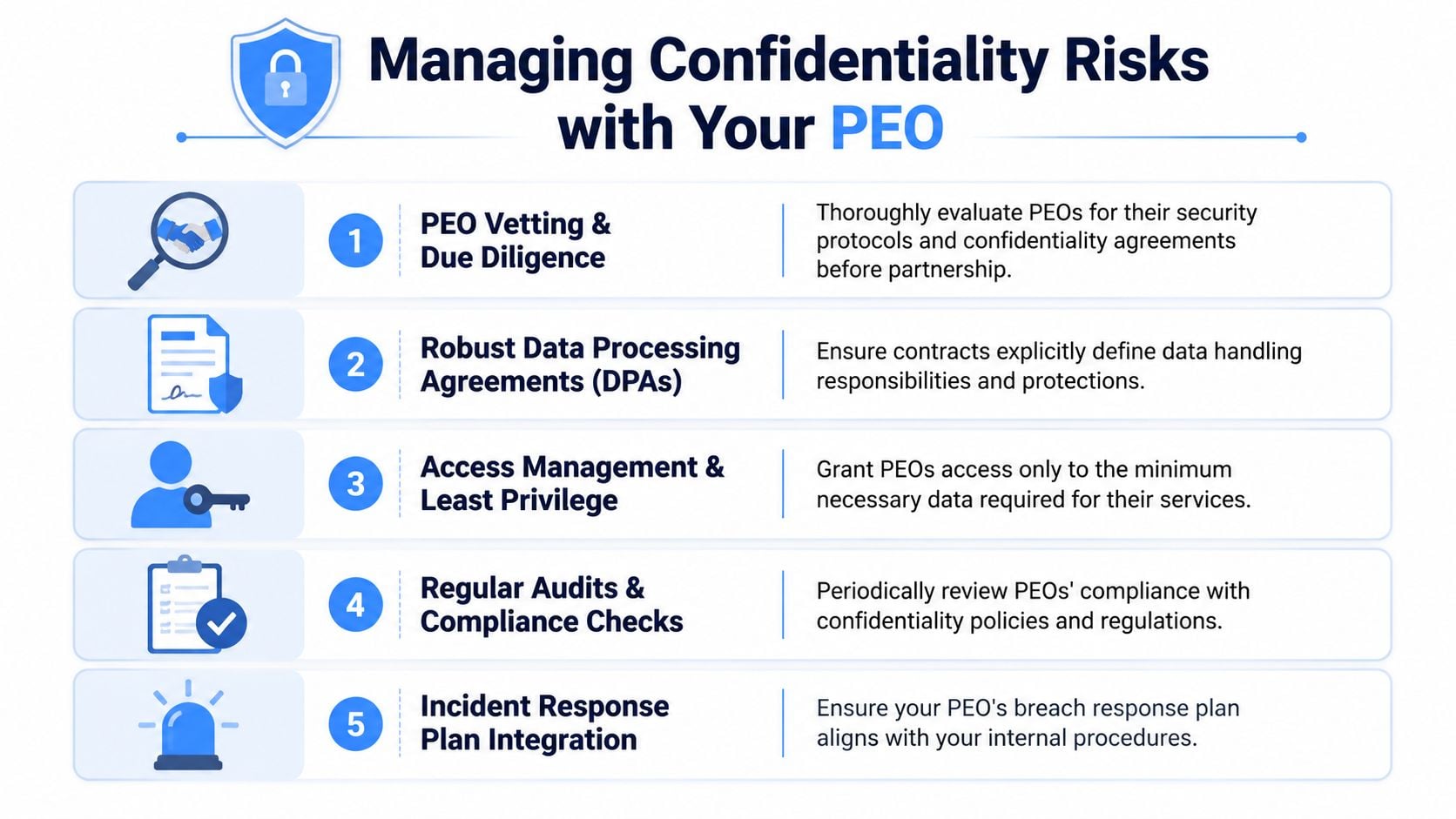
A clean sales presentation doesn't answer the hard questions. The contract does. For PEOs, confidentiality protection should show up in the master service agreement, exhibits, data processing terms, and termination language.
The most important clauses are usually these:
- Security standard commitments: The PEO should define how it protects confidential information, not rely on broad “commercially reasonable” language alone.
- Access limitation terms: The provider should restrict access internally to personnel with a business need.
- Breach notification procedures: The contract should say how and when the PEO will notify the client and what cooperation is required.
- Subprocessor oversight: If the PEO relies on other vendors, those parties need equivalent confidentiality obligations.
- Audit and verification rights: The client needs a way to verify key commitments.
- Return and deletion language: Data return is only half the issue. Verified deletion matters too.
This last point gets missed often. Employers assume a terminated vendor will “return the data” and the matter is closed. But retained copies in backups, archives, or legacy systems can create long-tail risk. That's why strong contracts ask for a certified destruction process, documented retention limits, and a right to verify deletion where feasible.
A practical comparison during negotiations should separate nice-to-have terms from essential terms:
| Contract point | Weak language | Stronger position |
|---|---|---|
| Confidentiality | General duty to protect data | Defined confidential data categories and handling duties |
| Incident notice | Notice in a reasonable time | Specific internal escalation and response obligations |
| Data retention | Return data on termination | Return plus deletion protocol, including retained copies where applicable |
| Audit rights | None or provider discretion | Limited but usable verification rights |
| Access scope | Broad service access | Minimum necessary data access tied to service delivery |
Companies rarely regret pushing harder on these points before signing. They often regret not pushing when they switch vendors later.
When Breaches Happen Incident Response and Offboarding
At 4:40 p.m. on a termination day, a former payroll manager still has live access to the HRIS, the PEO admin portal, and a shared benefits folder. By 5:10, files have been exported, an inbox rule has forwarded messages to a personal account, and nobody can say with confidence which system was shut off first. That is how a routine separation turns into a confidentiality event.
The weak point is rarely the written policy. It is the handoff between HR, IT, legal, and the PEO, especially when each party assumes someone else disabled access. During an incident, speed and structure must happen together.
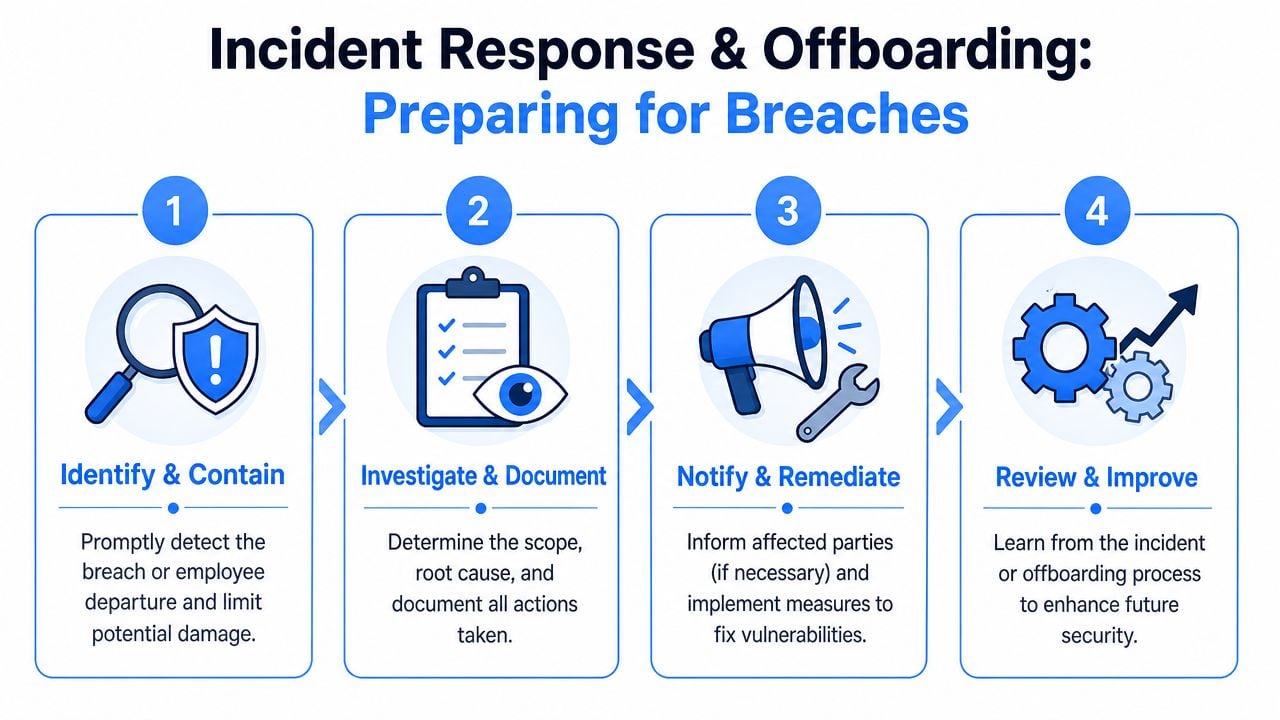
A practical four-step response
For a common HR confidentiality incident, such as a payroll spreadsheet being emailed to the wrong recipient, the response should be documented and repeatable.
Contain
Revoke or restrict access immediately. Recall the message if possible, lock the file, and stop any additional sharing. If a PEO platform or payroll vendor is involved, notify that provider at once so they can suspend access, preserve logs, and confirm whether the file was opened or exported.Assess
Determine what data was involved, who received it, whether it was opened, downloaded, or forwarded, and which legal or contractual duties may be triggered. Separate employee data, compensation data, benefits data, and tax identifiers because the reporting obligations may differ.Notify
Pull in the right decision-makers quickly. That usually includes HR, IT, legal, leadership, and any vendor that touched the data. If the company is in the middle of a PEO transition, include both providers until system ownership and access history are clear.Review
Find the root cause and change the process. If the issue came from bad permissions, fix the permission model. If it came from manual emailing, move the workflow into a secure system. If the failure happened during a PEO exit, rewrite the termination runbook so responsibility for account shutdown, data return, and deletion verification is assigned by name.
Offboarding has to move faster than the departure
Employee exits create concentrated risk because access rights often sit in more places than managers realize. The checklist should cover HRIS access, single sign-on, email, cloud storage, collaboration tools, payroll admin rights, expense systems, and any vendor platform tied to the employee's role.
PEO relationships add another layer. A departing HR lead may still have admin rights inside the PEO portal, direct access to census files, or authority to approve payroll changes after their company laptop is collected. During a PEO switch, old access can also survive in implementation workspaces, support tickets, broker portals, and file transfer folders that were set up outside core IT.
A strong offboarding workflow should include:
- Automatic deactivation triggers from HRIS to identity systems where possible
- Device collection and logging before the employee leaves
- Shared credential review for tools not tied to single sign-on
- Vendor access checks for PEO, payroll, benefits, and timekeeping platforms
- Post-exit permission audit to catch stale group memberships
I advise finance and HR leaders to treat termination timing as an operating control, not an HR courtesy. Access should be removed based on a documented employee termination process that coordinates manager notice, IT shutdown, PEO portal review, and confirmation of any delegated payroll or benefits authority.
One more point gets missed in practice. Offboarding is not finished when the employee account is disabled. It is finished when the company has confirmed that no active sessions remain, no shared passwords still work, no vendor admin rights are lingering, and no former PEO contact can still reach company data through a legacy workspace or retained export. That is the standard that prevents a manageable issue from turning into a legal, financial, and reputational problem.
