
A lot of teams reach the same point the same way. Payroll is getting harder, benefits questions keep landing on the CFO's desk, multi-state hiring has exposed gaps in compliance coverage, and the current HR setup depends too heavily on one internal person who's already overloaded. Then the proposals arrive. One vendor quotes a clean per-employee fee. Another bundles benefits. A third promises flexibility but leaves key service terms vague.
That's where most human resources outsourcing decisions go sideways. The comparison gets reduced to admin fees and feature lists, while the core financial exposure sits in contract language, implementation effort, support model, and pass-through costs. Buyers don't need another high-level overview of payroll, benefits, and onboarding. They need a defensible way to decide whether outsourcing is truly worth it.
Table of Contents
- Why Human Resources Outsourcing Is a Critical Decision
- PEO vs ASO vs HRO What's the Real Difference
- Calculating the True Cost of HR Outsourcing
- Decoding the Service Agreement and Contract Terms
- Selecting the Right Outsourcing Partner for Your Company
- Your Human Resources Outsourcing Implementation Checklist
- Key Metrics to Monitor After Going Live
Why Human Resources Outsourcing Is a Critical Decision
The finance view and the HR view usually collide here. Finance sees rising internal cost, fragmented systems, and avoidable compliance exposure. HR sees process drag, support gaps, and too much time spent on transactional work that doesn't move the business forward.
Both are right.
The decision is bigger than headcount
Human resources outsourcing is no longer a niche move for companies that lack internal staff. A 2025 industry summary on HR outsourcing adoption reported that about 80% of organizations outsource HR in some form, with 57% outsourcing at least one specific function. The same source reported that companies using HR outsourcing can save 20% to 40% versus maintaining an in-house team.
That data matters, but it's easy to misuse it. Savings ranges don't answer whether a specific proposal will reduce cost for a specific employer. They also don't tell leadership which model creates the right balance of control, service, and risk.
Practical rule: If the business case depends on a vendor's headline savings claim, the analysis isn't finished.
The stakes go beyond administration. HR outsourcing changes how payroll taxes get handled, how benefits are delivered, how employee issues are escalated, and who owns operational follow-through when something goes wrong. Once a provider is embedded into payroll, benefits, and employee records, switching becomes disruptive.
The real question leadership should ask
The smart question isn't “Should HR be outsourced?” The market already answered that. The fundamental question is whether a given arrangement improves the company's net operating position after cost, service quality, compliance support, implementation effort, and exit constraints are all included.
A useful leadership discussion usually starts with these questions:
- What problem is being solved: admin overload, compliance risk, weak benefits, limited internal expertise, or all of the above.
- What must stay internal: employee relations, leadership coaching, compensation strategy, culture-building, or final policy decisions.
- What failure would be most expensive: payroll disruption, poor support, weak implementation, or a contract that's hard to exit.
- What decision will still look sound at renewal: not just on day one, but after service issues, organizational change, and rate negotiations.
When those answers are clear, human resources outsourcing becomes a strategic operating decision instead of a rushed vendor purchase.
PEO vs ASO vs HRO What's the Real Difference
Most confusion starts because these models get described as if they're interchangeable. They're not. They solve different problems and create different obligations.
Three models with three different risk profiles
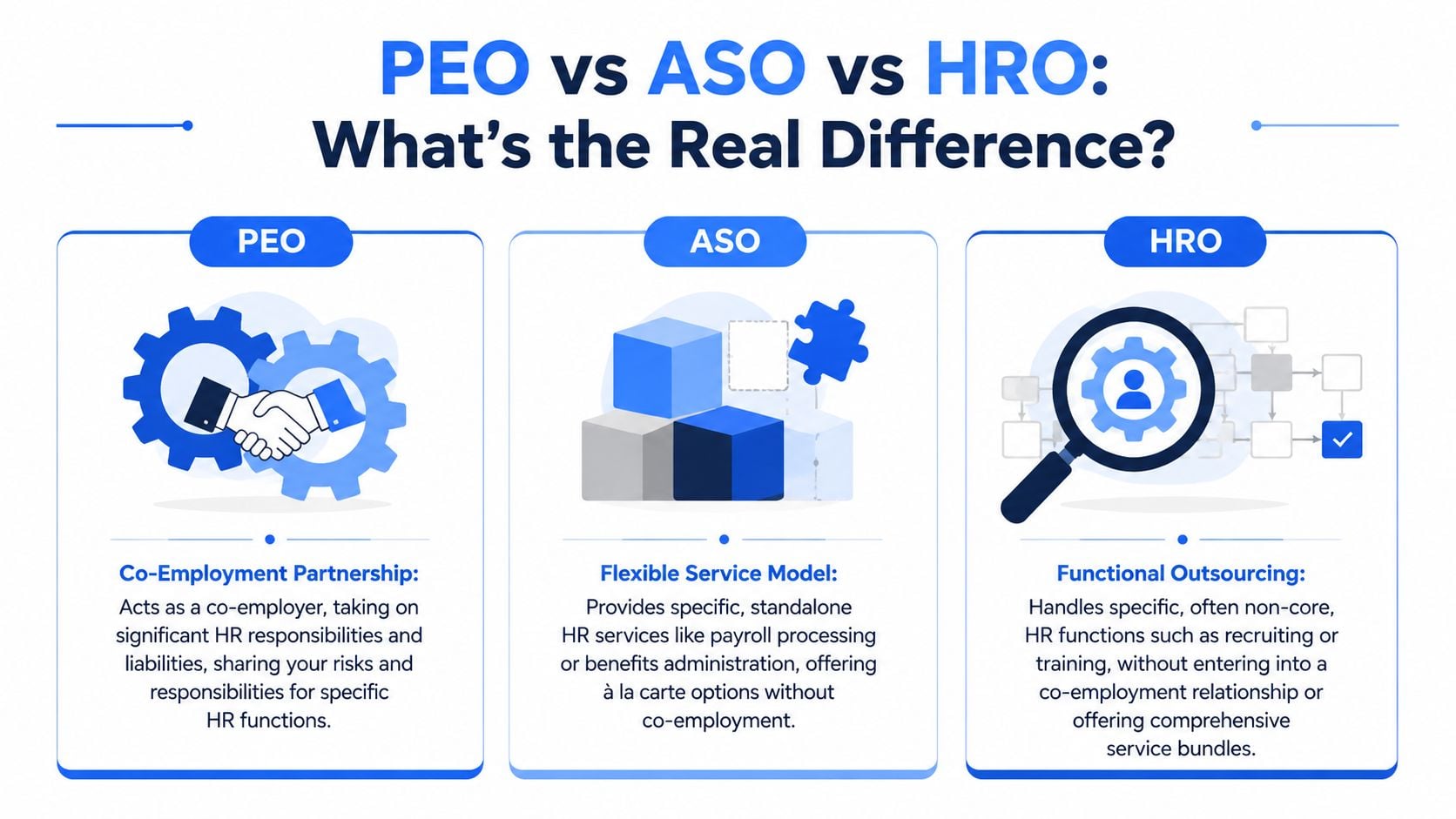
A PEO is the closest thing to a fully managed HR operating structure. The business enters a co-employment arrangement, and the provider takes on a broader role across payroll, benefits, workers' comp, and compliance administration. That's why PEOs often appeal to growing employers that want one integrated vendor instead of managing separate providers.
An ASO looks similar on the surface but works differently. The provider handles administrative services without the co-employment structure. The employer keeps more direct responsibility while outsourcing processes like payroll, benefits administration, or HR support.
An HRO arrangement is usually narrower and more modular. Instead of outsourcing the whole HR stack, the buyer externalizes selected functions. That can include recruitment support, benefits administration, compliance monitoring, onboarding, offboarding, or payroll services.
A practical way to think about the models:
- PEO: closer to moving into a managed building where operations are standardized and bundled.
- ASO: more like hiring a property manager while keeping ownership and more direct liability.
- HRO: closer to hiring specialists for specific jobs when internal staff can manage the rest.
A side-by-side way to think about it
The technical driver behind many outsourcing decisions is modular function design. Providers can centralize payroll tax filing, wage reporting, carrier coordination, labor-law reporting, and employee-record workflows into one SLA-backed operating model. That reduces internal bandwidth strain and improves process consistency, especially for multi-state employers.
Here's the comparison that usually matters most:
| Model | Best fit | Liability model | Service scope | Common trade-off |
|---|---|---|---|---|
| PEO | Employers wanting integrated HR, benefits, payroll, and compliance support | Shared through co-employment structure | Broad and bundled | Less flexibility, more dependence on one platform and contract |
| ASO | Employers wanting admin support without co-employment | Employer retains more direct responsibility | Broad but customizable | Buyer must monitor more risk directly |
| HRO | Employers with internal HR leadership that need targeted support | Employer typically retains core liability | Specific functions only | Coordination across vendors can get messy |
A company deciding between these paths should focus less on labels and more on operating consequences:
- Benefits access: PEOs often change the benefits buying structure.
- Tax and reporting workflow: PEOs and some ASOs may materially alter how payroll administration is handled.
- Service accountability: HRO can work well, but only if responsibilities are clearly segmented.
- Internal staffing needs: A narrow HRO model doesn't remove the need for internal ownership.
For a deeper comparison of how these models differ in practice, this PEO vs HRO guide for finance buyers is a useful reference.
A vendor can offer more services and still be the wrong model. The right choice depends on which responsibilities the company wants to transfer, not how impressive the service menu looks.
Calculating the True Cost of HR Outsourcing
The quickest way to misprice human resources outsourcing is to treat the quoted admin fee as the total cost. It almost never is.

What belongs in the cost model
A provider may quote a simple per-employee-per-month number, but the actual cost stack is broader. Public guidance often says outsourced HR can save up to 30% versus in-house, yet it also notes that many comparisons fail to account for total cost of ownership, including coordination burden and time delays. The true decision is about net savings and risk-adjusted value, not a narrow fee comparison, as explained in this analysis of HR outsourcing economics.
A buyer-grade cost model should include at least these lines:
- Administrative fees: the visible recurring charge.
- Benefits spend: medical, dental, vision, ancillary lines, and any change in contribution structure.
- Insurance-related charges: workers' comp administration and related program costs where applicable.
- Implementation costs: setup, data migration, onboarding support, and internal project time.
- Payroll transition friction: parallel runs, correction cycles, employee support load.
- Exit costs: what it takes to leave, replace, or unwind the arrangement later.
That's the difference between quoted price and landed cost.
Where buyers underestimate spend
The biggest misses usually show up in three places.
First, pass-through items get treated as neutral. They're not. Carrier choices, plan design, administration layers, and payroll handling all affect the total.
Second, companies ignore internal labor. If HR, finance, operations, and managers spend months cleaning data, resolving enrollment errors, and escalating service tickets, that time has cost even if it never appears on an invoice.
Third, switching risk is under-modeled. Moving into a new provider can create downstream work in accounting, payroll reconciliation, employee communications, and compliance tracking.
A cleaner way to evaluate proposals is to build a comparison sheet with four columns:
| Cost category | Current state | Provider A | Provider B |
|---|---|---|---|
| Visible recurring fees | Current payroll, benefits admin, HR tech, outside advisors | Quoted recurring charges | Quoted recurring charges |
| Operational labor | Internal HR and finance time spent managing work | Internal time still required | Internal time still required |
| Risk-related costs | Error correction, compliance support, fragmented vendors | Included support and exclusions | Included support and exclusions |
| Switching and exit | Existing lock-in or manual process burden | Transition and termination terms | Transition and termination terms |
For teams building that model from scratch, this PEO total cost of ownership analysis framework gives a practical structure for comparing quotes without relying on sales assumptions.
Decoding the Service Agreement and Contract Terms
Most outsourcing problems weren't visible in the demo. They were sitting in the agreement the whole time.

The contract is the product
The literature describes HR outsourcing as a “double-edged strategy” because it can improve efficiency while also introducing dependency and governance risk. It also notes that flexibility, affordability, and contract terms such as service-level controls, exit terms, and data protection are core variables, not side issues, according to this review of HR outsourcing risk and governance.
That's exactly how buyers should approach the agreement. The marketing deck explains aspirations. The contract defines accountability.
If a service promise matters, it should appear in the service agreement with measurable language and a remedy.
Legal review earns its keep in these scenarios. Even a general contract checklist can sharpen the review process. The Miles Hansford Law Firm contract insights are aimed at employment contracts, but the core lesson applies here too. Definitions, obligations, restrictions, and exit language deserve line-by-line attention.
Clauses that deserve real scrutiny
Some clauses carry more risk than others.
- Termination rights: If the company is acquired, restructures, or outgrows the provider, can it leave without a painful financial penalty or long notice trap?
- Automatic renewals and escalators: Renewal mechanics often get less scrutiny than initial pricing. That's a mistake.
- Limitation of liability: Buyers should check what happens if payroll is mishandled, filings are missed, or data is exposed.
- Data ownership and portability: Employee records must be accessible in usable form, not trapped in a proprietary workflow.
- Service levels: “Dedicated support” means little without response targets, issue severity definitions, and escalation rights.
A useful contract review test is simple: if the provider underperforms, what can the client do? If the answer is “open a ticket and hope,” the agreement is too weak.
A focused legal and operational review should also examine where the provider's obligations stop. For example:
| Clause area | What to ask |
|---|---|
| Compliance support | Is the provider advising, administering, or assuming any responsibility if something is missed? |
| Implementation language | What counts as successful go-live, and who fixes setup errors discovered later? |
| Exit support | Will the provider assist with payroll history, employee files, and benefits transition after termination? |
| Subcontracting | Which parts of service are delivered directly, and which are handed to other vendors? |
For teams doing a formal contract review, this PEO service agreement legal review guide is a useful checklist to work through before signing or renewing.
Selecting the Right Outsourcing Partner for Your Company
A good outsourcing partner can still be a bad fit. That usually shows up after go-live, when employees start opening tickets and leaders realize the service model doesn't match how the company operates.
Fit matters more than the demo
A provider may know employment law and still miss the organization's pace, decision style, and employee expectations. That gap becomes more visible when the company is multi-state, growing quickly, or asking the provider to support change across locations. As noted in this RSM perspective on HR outsourcing and transformation, many explainers gloss over how outsourced HR performs during scaling and complexity, even though provider fit strongly affects long-term value.
That's why selection should start with the company's operating profile, not the provider's feature sheet.
Three examples make the point:
- A construction employer may care more about workers' comp coordination, field onboarding, and location-specific compliance workflow.
- A software company may put more weight on employee experience, manager self-service, and speed of policy interpretation.
- A private equity-backed platform may prioritize roll-up integration, multi-entity reporting, and the ability to onboard acquisitions without rebuilding everything.
A practical scorecard for selection
The strongest selection process uses a scorecard with weighted criteria. Not every buyer needs enterprise-grade sophistication, but every buyer needs discipline.
A practical scorecard should evaluate:
- Industry fit: Has the provider supported employers with similar labor mix, state footprint, and compliance exposure?
- Service model: Is support delivered by a named team, a pooled service center, or a hybrid structure?
- Technology usability: Can managers and employees complete common tasks without opening avoidable tickets?
- Escalation quality: When something sensitive happens, who owns it and how fast do issues move?
- Contract flexibility: Can the relationship adapt if the company grows, acquires, relocates, or changes benefits strategy?
One useful exercise is to ask each finalist for a walkthrough of three real workflows instead of another generic demo:
- A new hire in a different state.
- A payroll correction with deadline pressure.
- A benefits eligibility issue involving an employee and a carrier.
That reveals more than polished slides ever will.
Some buyers also use independent comparison support to pressure-test vendor claims. One option is PEO provider selection guidance from PEO Metrics, which focuses on side-by-side evaluation of pricing, terms, service model, and fit.
The right partner doesn't just process HR tasks. The right partner matches the company's decision speed, risk profile, and service expectations.
Your Human Resources Outsourcing Implementation Checklist
A signed agreement doesn't solve anything by itself. Implementation is where strong decisions get validated or exposed.
Pre-launch priorities
Most implementation trouble starts before launch. Bad census data, unclear deductions, missing policy decisions, and weak employee communication create avoidable issues later.
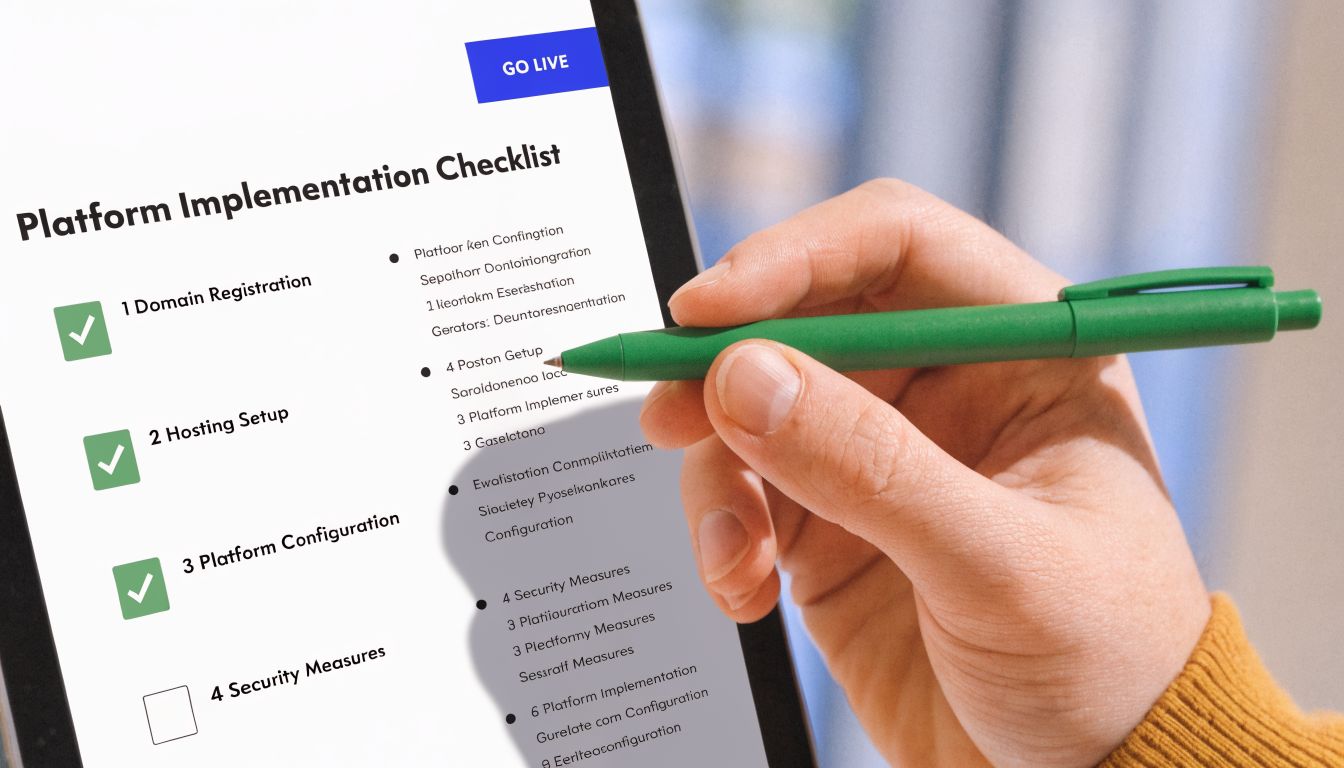
A practical pre-launch checklist includes:
- Data cleanup: confirm employee demographics, work locations, pay details, tax setup, and benefit eligibility rules.
- Ownership map: assign one internal lead from HR or operations, one finance lead, and one executive sponsor.
- Decision log: document open choices on benefits, payroll timing, approvals, onboarding workflow, and reporting.
- Employee communication plan: explain what's changing, when it changes, and where employees go for help.
Companies often underestimate the internal work required here. Human resources outsourcing isn't a software flip. It's a controlled transfer of recurring operational work.
Launch and post-launch controls
Go-live should be managed like a risk event, not a celebration.
A cleaner rollout usually includes these stages:
Launch week
- Benefits enrollment support: hold live sessions and publish simple instructions.
- Manager training: cover approvals, hiring steps, ticket escalation, and policy questions.
- First payroll controls: review files closely, reconcile exceptions, and confirm tax setup before finalizing.
First month
- Ticket review: categorize employee issues by source, such as payroll, benefits, access, or workflow confusion.
- Escalation tracking: identify which issues are resolved fast and which ones stall.
- Policy validation: check that handbook, onboarding, and leave processes align with the new operating model.
First quarter
- Service review meeting: compare actual performance to contractual expectations.
- Finance reconciliation: confirm invoice logic, pass-through charges, and billing accuracy.
- Renewal risk log: document concerns early instead of waiting for contract renewal.
For teams managing a provider transition, this PEO onboarding and implementation process guide can help structure the rollout and assign ownership across departments.
Key Metrics to Monitor After Going Live
The selection project ends. Vendor management begins.
The dashboard that actually matters
A useful post-launch dashboard doesn't need dozens of KPIs. It needs a handful of metrics that show whether the outsourcing relationship is performing financially and operationally.
Track these first:
- Total landed cost per employee: not just the quoted fee. Include recurring charges, pass-through items, and internal labor still required to manage the provider.
- Payroll issue frequency: monitor corrections, late changes, off-cycle activity, and root causes.
- Employee support resolution time: measure how quickly benefits, payroll, and HR admin questions get closed.
- Open escalation count: count issues that require repeated follow-up or executive intervention.
- Implementation defect carryover: log setup mistakes that continue affecting billing, access, deductions, or reporting after launch.
- Renewal bargaining notes: maintain a running file of service misses, pricing changes, and unresolved contract issues for use before renewal.
The discipline here matters. Providers should be managed the way finance teams manage any critical vendor. With evidence, not impressions.
Companies comparing or renegotiating human resources outsourcing options can use PEO Metrics to review pricing, benefits, contract terms, service models, and provider fit side by side before making a final decision.
