

If you’re weighing whether to hand over HR to a PEO or keep things simpler with a standalone payroll company, the decision usually comes down to two things: how much you want to offload, and whether pooled insurance rates actually make sense for your group size. A PEO puts you into co-employment and gives you access to a master health insurance policy, which can open group rates that would otherwise be out of reach for a small employer. A payroll company processes wages and taxes but leaves you as the sole employer of record, buying insurance on your own through a broker. Both models are legitimate. The right one depends on your headcount, your risk tolerance, and how much administrative work you’re willing to keep in-house. The providers below represent both models, so you can compare them on their own terms rather than assume one is simply a cheaper version of the other.
Quick Comparison
- PEO Metrics: best for businesses ready to compare PEO providers before signing; pricing is quote-based; the only option here that compares other vendors’ pricing instead of selling a PEO or payroll product itself.
- Insperity: best for mid-sized businesses wanting hands-on HR support; quote-based; pairs a dedicated HR team with master policy insurance access.
- TriNet: best for businesses in industries TriNet specializes in; quote-based; builds its PEO plans around industry verticals.
- Justworks: best for small, tech-comfortable teams; quote-based; a self-service software platform built to reduce manual HR admin.
- ADP TotalSource: best for current ADP users wanting PEO-level insurance pooling; quote-based; backed by ADP’s broader payroll and carrier network scale.
- Paychex PEO: best for businesses wanting payroll and insurance pooling from one vendor; quote-based; consolidates payroll processing with a master health policy.
- Gusto: best for small businesses keeping their own EIN; pricing starts with a base fee plus per-employee cost; lets you pick your own insurance broker.
- OnPay: best for very small teams wanting straightforward payroll; pricing starts with a base fee plus per-employee cost; the simplest structure on this list, with no co-employment.
- Rippling: best for growing companies expecting to move from payroll to a PEO; quote-based; the only provider offering both models in one platform.
1. PEO Metrics
PEO Metrics is built for the moment before you sign anything: it’s a comparison service that puts multiple PEO providers’ pricing, fee structures, and benefits terms side by side so you can see what you’re actually being offered instead of relying on a single vendor’s sales presentation.
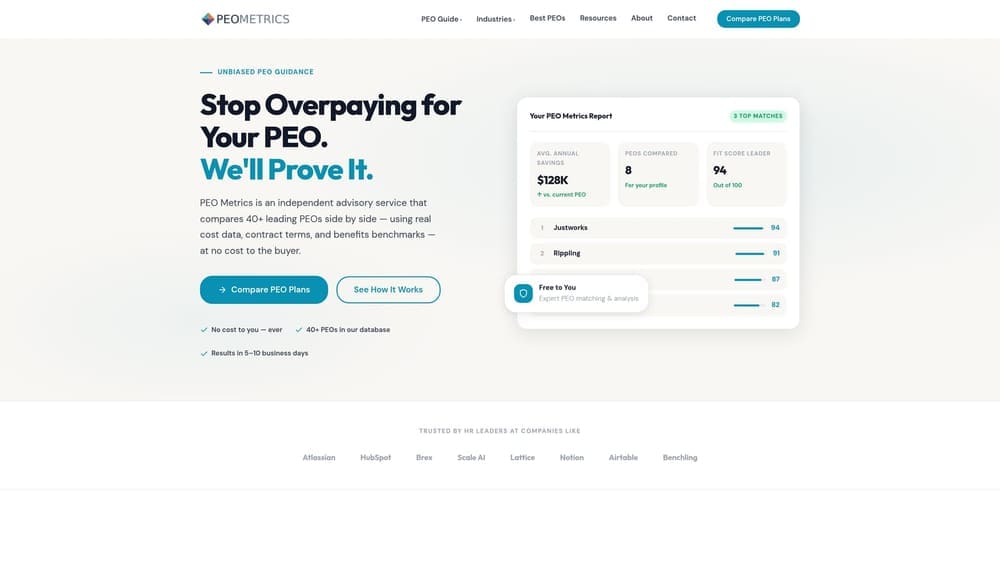
What sets it apart from every other entry on this list is that it doesn’t sell payroll or insurance itself. It exists to help you evaluate the providers that do, using standardized data rather than each vendor’s own framing of its plan.
- Lays out fee and markup structures from multiple PEO providers next to each other, so hidden costs are easier to spot
- Breaks down how each provider’s benefits and insurance terms compare, not just the headline premium
- Walks through how to read a PEO service agreement, including the parts that are easy to gloss over
- Delivers independent analysis rather than a proposal from a single vendor with an interest in closing the deal
It works alongside any PEO proposal you’ve already received, so there’s nothing to migrate and no software to learn. Setup is really just sharing your current quotes or renewal terms and having someone walk through the comparison with you.
The limitation is straightforward: PEO Metrics doesn’t run payroll, administer benefits, or take on any employer responsibilities. It’s an advisory layer, not an HR platform, so if you’ve already decided on a provider and just need someone to process payroll, this isn’t that. Pricing is quote-based; contact PEO Metrics directly for current details.
Best for: Businesses that have already decided to explore a PEO and want to compare providers before signing.
2. Insperity
Insperity is a full-service PEO that combines HR administration, risk management, and access to large-group health insurance through a co-employment arrangement.
Its main features include:
- Gives employees access to a master health insurance policy shared across Insperity’s client base
- Assigns a dedicated HR support team rather than routing everything through a general help desk
- Handles workers’ compensation and broader risk management administration
- Runs payroll and tax filing as part of the bundled service
What distinguishes Insperity is the depth of its HR support model. It leans on dedicated HR generalists working with your account, not just a self-service dashboard, which matters if you don’t have in-house HR expertise to lean on.
That same depth can be a mismatch for very small or early-stage employers. The service model is built for a company with more moving HR parts, and businesses with just a handful of employees may find the structure heavier than they need. You should verify Insperity’s current integration list directly on its website, since this can change.
Pricing is quote-based. Confirm current figures directly with Insperity, since PEO fee structures are typically built around a combination of per-employee cost and the specific insurance plans selected.
Best for: Mid-sized businesses that want hands-on HR support alongside pooled insurance access.
3. TriNet
TriNet takes a different approach to the PEO model by building its plans around industry verticals, such as technology and professional services, rather than offering one generic package to every client.
Key features include:
- Offers PEO plans structured specifically for certain industries
- Provides a master health policy so smaller employers can access pooled insurance rates
- Delivers HR compliance guidance tailored to the regulatory realities of each industry track
- Handles payroll processing and benefits administration as part of the core service
The industry-specific approach is what separates TriNet from the more generalized PEOs on this list. If your business sits squarely in one of TriNet’s specialty sectors, that focus can translate into more relevant compliance guidance and benefits design.
The tradeoff is that plan availability and pricing can shift meaningfully depending on which industry vertical your business is placed in, so two companies of similar size in different industries may see different terms. It’s worth confirming exactly which vertical you’d be quoted under before comparing numbers with another provider.
As with the other PEOs here, integrations should be checked directly on TriNet’s site. Pricing is quote-based and depends on your industry classification, headcount, and selected benefits.
Best for: Businesses in a specific industry vertical that TriNet specializes in serving.
4. Justworks
Justworks approaches the PEO model from a software-first angle, wrapping payroll, compliance, and insurance access into a self-service platform aimed at reducing manual HR work.
Its feature set covers:
- A self-service platform where employees and admins handle most tasks without calling a rep
- Health insurance access made possible through the co-employment arrangement
- A flat per-employee pricing model instead of variable, negotiated fees
- Built-in compliance alerts that flag issues before they become filing problems
What sets Justworks apart is how little manual administration it asks of the buyer. Instead of leaning on account managers for every request, the platform is designed so a small team can run most of its own HR operations directly.
That simplicity comes with a narrower insurance carrier network in some states compared to larger, longer-established PEOs like Insperity or ADP TotalSource. If your business operates across many states, it’s worth confirming carrier availability in each one before assuming coverage will match what a bigger PEO can offer.
Setup is generally light since the platform is built for self-onboarding, though you should verify Justworks’ current integration list directly on its site. Pricing is quote-based; check current rates with Justworks.
Best for: Small, tech-comfortable teams that want a lighter-touch PEO experience.
5. ADP TotalSource
ADP TotalSource is ADP’s dedicated PEO product, pairing master health insurance access with the broader ADP payroll and HR technology ecosystem.
Where TotalSource stands out is scale. Because it’s backed by ADP’s overall size, it can widen the insurance carrier and plan options available in certain regions compared to smaller PEOs.
- Provides access to a master health insurance policy through co-employment
- Connects directly with ADP’s existing payroll and HR technology suite
- Offers compliance and risk support alongside the insurance benefit
- Draws on a large-scale carrier network in many regions, which can widen plan choice
What to confirm before signing
ADP sells both PEO and non-PEO payroll-only products, and the two are structured very differently in terms of employer status and insurance access. Buyers should confirm explicitly that they’re being quoted the TotalSource PEO product and not a standard ADP payroll plan, since the sales conversation can otherwise blur the line between them.
Setup typically runs through ADP’s existing implementation process, and day-to-day administration is usually shared between an internal HR contact and ADP’s support team. Pricing is quote-based; verify current figures directly with ADP.
Best for: Businesses already using ADP products that want PEO-level insurance pooling without switching payroll vendors.
6. Paychex PEO
Paychex PEO pairs standard payroll processing with master health insurance policy access through a co-employment structure, aiming to consolidate two functions that many businesses otherwise split across vendors.
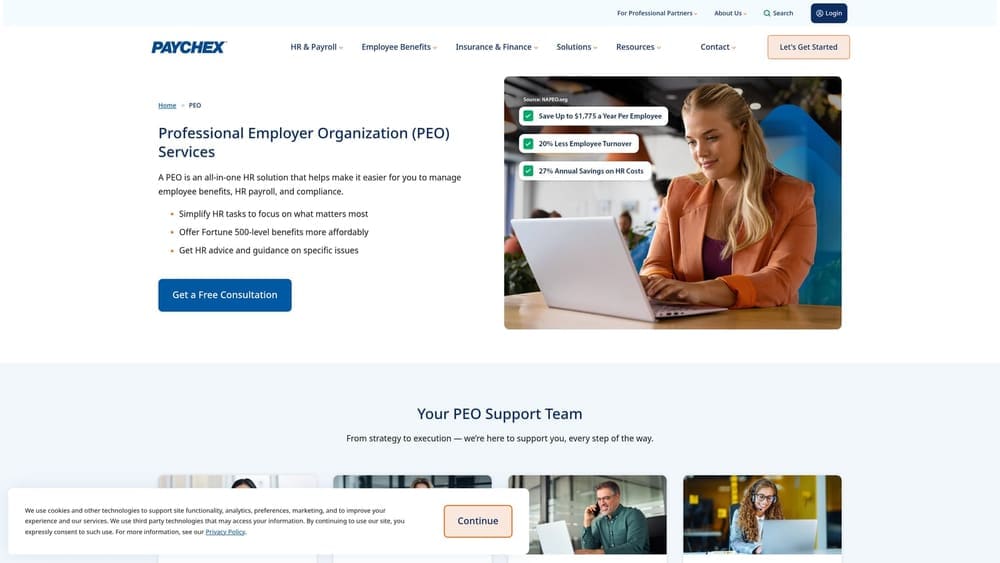
The consolidation is the real selling point here: one vendor handles both payroll runs and the PEO’s pooled insurance access, which can simplify vendor management for a business that doesn’t want separate relationships for each function.
- Provides a master health insurance policy for pooled group rates
- Combines payroll processing with benefits administration under one account
- Offers HR compliance support alongside the insurance and payroll functions
- Administers workers’ compensation coverage as part of the bundled service
As with ADP, Paychex sells both a PEO product and separate payroll-only plans. Buyers should confirm explicitly which product they’re being quoted, since the employer-of-record structure and insurance access differ substantially between the two.
Day-to-day administration typically involves a mix of self-service tools and support from Paychex account representatives. You should verify Paychex’s current integration list directly on its website before assuming compatibility with tools you already use.
Pricing is quote-based. Confirm current rates directly with Paychex, since PEO pricing generally reflects headcount and the specific benefits package selected.
Best for: Businesses that want payroll and PEO-level insurance access from a single, established provider.
7. Gusto
Gusto is a payroll company, not a PEO. It handles payroll processing, tax filing, and benefits administration tools, but it does not enter a co-employment relationship or offer a master insurance policy.
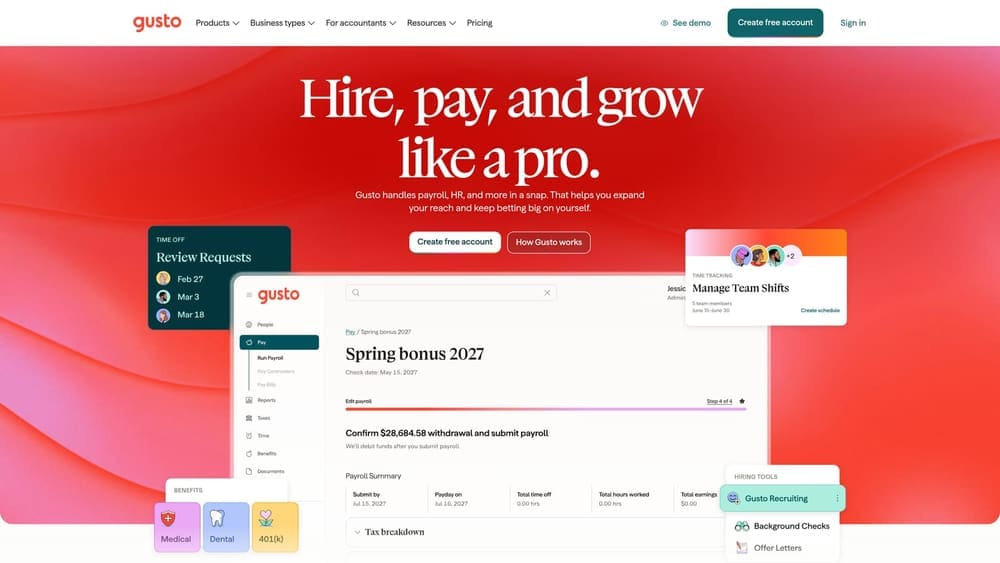
The distinction that matters most here is employer status. With Gusto, your business remains the sole employer of record and keeps its own EIN, which means you retain full control over which insurance broker you use and how your benefits plan is structured, rather than joining a pooled plan set by a PEO.
- Runs payroll processing and handles tax filing obligations
- Connects to outside insurance brokers for benefits administration rather than bundling its own master policy
- Gives employees a self-service portal for pay stubs, tax forms, and benefits elections
- Includes time tracking and onboarding tools as part of the platform
Gusto integrates with accounting tools like QuickBooks and Xero, along with various time tracking and HR apps, according to Gusto’s website. Setup is generally self-directed, and most small businesses run it themselves without a dedicated HR administrator.
The limitation is inherent to the payroll-only model: without a master health insurance policy, smaller employers may not access the same group insurance rates a PEO can offer, particularly if their headcount is small enough that a broker can’t secure competitive group terms on its own.
Pricing is quote-based and generally starts with a base monthly fee plus a per-employee fee; verify current pricing directly on Gusto’s website.
Best for: Small businesses that want to remain the sole employer of record and manage their own broker relationship.
8. OnPay
OnPay is another payroll-only provider, offering payroll processing and tax filing along with benefits administration integration, but without any co-employment or pooled insurance structure.
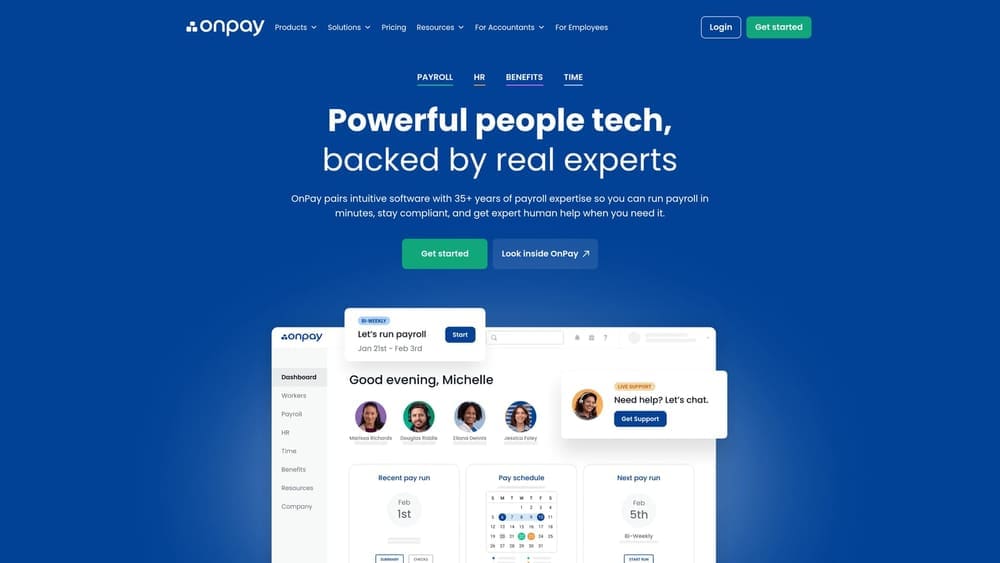
Its main appeal is simplicity. Because the business never enters co-employment, there’s less structural complexity to manage compared to a PEO, and fewer contract terms to review before signing.
- Processes payroll and handles tax filing for the business
- Integrates with outside benefits administration so you can manage plans alongside payroll
- Stores HR documents in one place rather than scattering them across systems
- Uses a simple, flat pricing structure rather than variable, negotiated fees
OnPay connects with various accounting and time tracking tools, according to OnPay’s website. It’s typically run day to day by whoever handles HR or finance internally, without needing a dedicated payroll specialist.
The limitation is the same one that applies to any payroll-only provider: there’s no access to pooled group insurance rates or the compliance support that comes bundled into a PEO relationship. If your business is growing quickly and expects to need more structured HR compliance support soon, that’s worth weighing against the simplicity OnPay offers now.
Best for: Very small teams that want straightforward payroll without taking on PEO-level services.
9. Rippling
Rippling takes a different approach from every other entry on this list: it offers both a standalone payroll product and a separate PEO module, letting a business choose one model or move between them without switching platforms entirely.
Why the dual model matters
Most businesses on this list have to pick a lane and switch vendors if their needs change. Rippling’s structure means a company that starts on payroll-only can shift into the PEO module later, or vice versa, while keeping the same underlying employee data and platform. That’s a meaningful advantage for a business that expects its HR needs to shift as it scales.
- Offers a standalone payroll module for businesses that want to stay their own employer of record
- Provides a separate PEO module with insurance access through co-employment for those who want it
- Adds IT and device management as an optional layer beyond core HR functions
- Keeps employee data unified across whichever modules a business selects
Rippling offers a wide app marketplace, according to its website, which can be a plus if your business relies on a lot of connected software tools.
The limitation is that insurance access and pricing depend entirely on which module you select, and comparing Rippling’s PEO option against a dedicated PEO like Insperity or TriNet requires being clear about which Rippling product is actually being quoted. That can complicate side-by-side comparison shopping if the sales conversation isn’t specific about which module applies.
Pricing is quote-based; verify current figures directly on Rippling’s website, since costs vary by module and by the add-ons selected.
Best for: Growing companies that expect to move from payroll-only to a PEO as they scale.
Choosing Between Pooled Insurance and Keeping Your Own EIN
The nine providers above split cleanly into two groups. Insperity, TriNet, Justworks, ADP TotalSource, and Paychex PEO all offer co-employment and master insurance policy access, which makes sense if you want compliance support and group insurance rates handed off to someone else. Gusto and OnPay sit on the other side: you keep your own EIN, pick your own broker, and manage benefits independently, which suits a business that wants to stay in control of its insurance relationships. Rippling is the outlier, letting you access either model from the same platform as your needs change.
Whichever direction you’re leaning, the fee structures, insurance markups, and contract terms behind a PEO quote are rarely obvious from the proposal alone. That’s the gap PEO Metrics is built to close, by putting multiple providers’ pricing and terms side by side so you’re comparing real numbers rather than sales pitches.
Don’t auto-renew. Make an informed, confident decision.
Before you sign that PEO renewal, make sure you’re not leaving money on the table.
Many businesses unknowingly overpay because of bundled fees, hidden administrative markups, and contracts designed to limit flexibility. We give you a clear, side-by-side breakdown of pricing, services, and contract terms, so you can see exactly what you’re paying for and choose the option that truly fits your business.
