
Kitchen hood cleaning sits in a tricky spot when it comes to HR and payroll decisions. You’re sending crews into commercial kitchens, managing grease fire hazards, and dealing with workers’ comp classifications that most payroll companies don’t fully understand. The question isn’t simply “PEO or payroll?” It’s whether the additional cost of a PEO actually buys you anything meaningful given your specific risk profile, crew size, and compliance exposure.
This isn’t a pitch for either path. It’s a breakdown of three resources that can help you compare your options honestly, plus the key factors worth thinking through before you commit to anything.
What Makes This Decision Different for Hood Cleaning Operators
Before diving into the tools, it’s worth naming what makes this comparison genuinely different from the generic PEO vs. payroll question that applies to, say, a marketing agency or a retail shop.
Hood cleaning workers typically fall under high-hazard workers’ comp classifications. Grease fire risk, working at heights, and chemical exposure push these codes into territory where misclassification can trigger audits, reclassifications, and premium surprises. A payroll company processes your payroll correctly, but it won’t necessarily catch a misclassified comp code or flag an exposure gap before it becomes expensive.
A PEO with a master workers’ comp policy that already includes these trade classifications may offer more stable pricing and better classification accuracy. But that only holds if the PEO has real experience in the trades and cleaning sector. Not all of them do, and a PEO with thin experience in your risk category isn’t necessarily better than a well-run payroll arrangement with a knowledgeable independent comp agent.
There are also a few other factors that shift the calculus specifically for this industry. Crew size tends to fluctuate seasonally or with contract volume. Many small operations can’t access competitive group health coverage on their own. And OSHA compliance obligations around chemical handling, respiratory protection, and sometimes confined space entry create HR complexity that a payroll-only provider won’t touch.
None of this automatically means a PEO is the right answer. It means the decision deserves more than a quick comparison of monthly fees.
1. PEO Metrics
Best for: Operators who want unbiased, side-by-side PEO pricing comparisons before committing
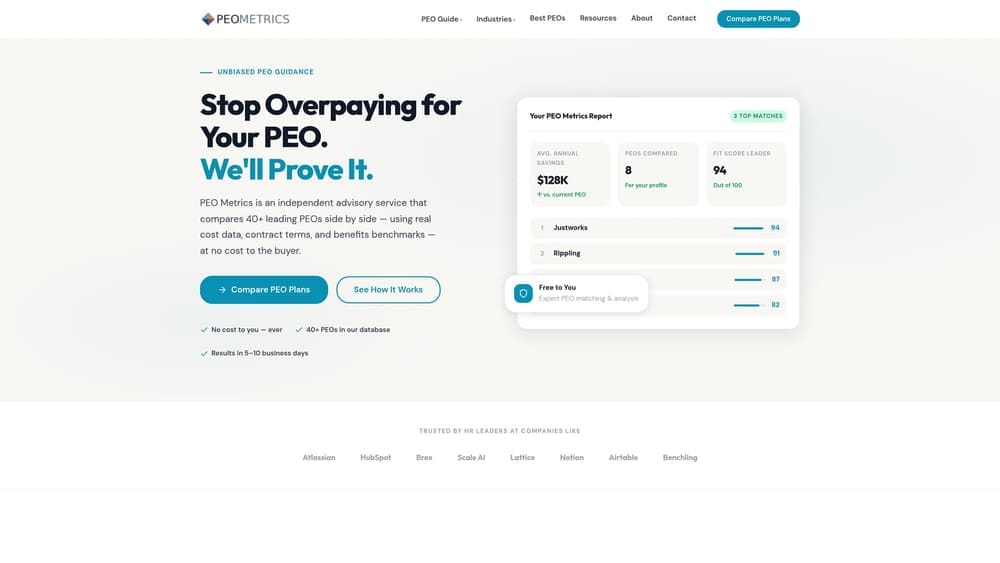
PEO Metrics is a comparison service that helps businesses evaluate PEO providers using actual pricing data and structured analysis, with no affiliation to any PEO provider.
Where This Tool Shines
The core value here is independence. PEO Metrics doesn’t earn referral fees from the providers it evaluates, which changes the nature of the comparison. You’re not getting a curated shortlist from a platform that benefits from steering you toward certain providers. You’re getting a structured look at what different PEOs actually charge and what’s included.
For hood cleaning operators specifically, this matters because PEO pricing isn’t always transparent. Bundled fees, administrative markups, and contract structures can make it genuinely hard to compare apples to apples. If you’re trying to figure out whether a PEO’s workers’ comp handling and benefits access justify the cost over your current payroll setup, you need real numbers in front of you, not a sales pitch.
Key Features
Side-by-side provider comparisons: Lets you evaluate multiple PEOs against each other on pricing, services, and contract terms rather than evaluating each one in isolation.
No referral fees from PEO providers: The platform’s independence means recommendations aren’t shaped by which PEO pays the highest commission.
Cost structure transparency: Breaks down what you’re actually paying for, including administrative fees, benefits, and workers’ comp handling, so bundled pricing doesn’t obscure the real cost.
High-risk classification awareness: Useful for identifying which PEOs have experience with trade and cleaning sector comp codes, which is a real differentiator for hood cleaning businesses.
Contract term visibility: Surfaces details around flexibility, exit terms, and renewal structures before you sign.
Best For
Hood cleaning operators who are actively evaluating PEOs and want to compare real pricing before committing. Also useful for operators currently on a PEO who want to verify they’re not overpaying compared to alternatives in the market.
Pricing
Free to use. No cost to compare providers.
2. PEOcompare
Best for: Early-stage research when you’re not yet sure which PEO providers to evaluate
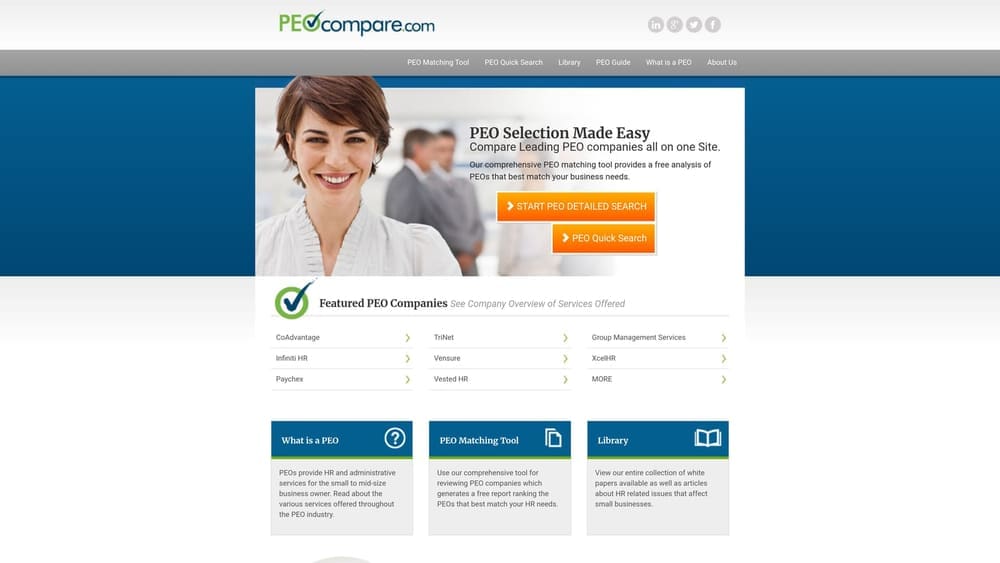
PEOcompare is a platform that aggregates PEO provider options and allows businesses to compare them across multiple dimensions in one place.
Where This Tool Shines
If you’re at the beginning of this process and don’t yet have a shortlist of PEO providers to evaluate, PEOcompare gives you a broad market view. It’s useful for getting oriented, understanding what’s available, and starting to filter options before you go deeper.
For a hood cleaning operator who hasn’t worked with a PEO before and isn’t sure where to start, this kind of overview can help you understand the landscape without having to cold-call a dozen providers or wade through sales decks. The comparison interface lets you look at multiple providers side by side, which at minimum helps you understand the range of what’s out there.
Key Features
Broad market coverage: Surfaces a wide range of PEO providers rather than a curated or limited set, giving you a fuller picture of available options.
Side-by-side comparison interface: Lets you look at multiple providers simultaneously without having to track information across separate tabs or sales conversations.
Multi-industry and multi-size coverage: Covers businesses across different industries and headcount tiers, useful if you’re still figuring out whether your operation’s profile fits a PEO model at all.
Early-stage research support: Better suited for initial exploration than final decision-making, but that’s a legitimate stage of the process that benefits from having a structured starting point.
Best For
Operators who are in the early stages of evaluating whether a PEO makes sense and want to understand what’s available before narrowing down to specific providers for deeper comparison.
Pricing
Free to use.
3. HR Guide
Best for: Understanding your baseline employer obligations before you outsource anything
HR Guide is an educational HR resource covering employer obligations, compliance requirements, and HR fundamentals written for business owners rather than HR professionals.

Where This Tool Shines
Here’s the thing about evaluating PEOs or payroll companies: if you don’t understand what you’re legally required to manage as an employer, you can’t evaluate whether a vendor is actually covering those obligations or just claiming to. HR Guide helps close that gap.
For hood cleaning operators, this is particularly relevant. OSHA requirements around chemical handling, respiratory protection programs, and potentially confined space entry create compliance obligations that go beyond basic payroll. Understanding what you’re on the hook for, regardless of which service model you use, puts you in a much better position to ask the right questions when evaluating vendors. A PEO that offers “HR compliance support” means something very different depending on whether they understand the specific OSHA standards applicable to your trade.
Key Features
Plain-language employer obligation explanations: Written for business owners, not HR specialists, so the material is actually usable without a background in employment law.
Payroll, benefits, and compliance coverage: Covers the full range of employer HR responsibilities, not just the pieces that are easiest to outsource.
Employment law basics: Helps operators understand what’s legally required versus what’s optional or discretionary when building out their HR structure.
Better vendor evaluation: When you understand your obligations, you can ask more specific questions and spot gaps in what a PEO or payroll provider is actually offering versus what they’re implying.
Best For
Hood cleaning operators who are newer to managing employees, or who want to make sure they understand their compliance baseline before deciding how much to outsource and to whom.
Pricing
Free resource.
Which Path Actually Fits Your Operation
For most kitchen hood cleaning businesses, this decision comes down to three things: crew size, workers’ comp exposure, and how much HR overhead you’re currently absorbing internally.
If you’re running a small team with a stable comp rate and straightforward payroll, a payroll company is probably enough. The overhead of a PEO, both in cost and administrative complexity, often doesn’t justify itself for operations under five to eight employees, particularly if you’re already working with a knowledgeable independent comp agent who understands your trade classification.
If you’re growing, dealing with high-risk comp classifications that are creating premium volatility, or spending real time on HR compliance without internal capacity to manage it properly, a PEO comparison is worth doing before you assume the cost isn’t justified. The benefits access argument is also real for operators trying to attract and retain skilled technicians in a competitive labor market.
The tools above give you a way to run actual numbers rather than hypotheticals. PEO Metrics lets you compare providers with real pricing data so you’re not guessing at cost. PEOcompare gives you a broader market view when you’re still in the orientation phase. And HR Guide helps you understand what you’re legally on the hook for regardless of which path you take.
Don’t make this call based on a sales pitch from either side. Run the numbers, understand the tradeoffs, and pick the structure that fits your operation, not someone else’s.
Before you sign that PEO renewal, make sure you’re not leaving money on the table. Many businesses unknowingly overpay because of bundled fees, hidden administrative markups, and contracts designed to limit flexibility. Don’t auto-renew. Make an informed, confident decision.
Before you sign that PEO renewal, make sure you’re not leaving money on the table.
Many businesses unknowingly overpay because of bundled fees, hidden administrative markups, and contracts designed to limit flexibility. We give you a clear, side-by-side breakdown of pricing, services, and contract terms—so you can see exactly what you’re paying for and choose the option that truly fits your business.
