
Most advice on a list of professional employer organizations is too soft. It treats PEOs like interchangeable HR bundles and skips the parts that usually create regret later: renewal language, termination mechanics, who owns the employee experience, and whether pricing is tied to headcount or payroll. For a company with 10 employees, a sloppy contract can be annoying. For a company with 300 employees, it can become a budget problem fast.
That matters because this isn’t a niche category. In the United States, the PEO industry market size is $254.8 billion in 2026, with 6,675 active businesses and 3.3% growth from 2021 to 2026. Buyers aren’t choosing from one dominant model. They’re sorting through a crowded market with very different service philosophies, pricing structures, and compliance depth.
The broad case for outsourcing is clear. Employers using a PEO often report fewer administrative mistakes, and the U.S. Chamber notes that PEOs can also take full liability for employment tax filings while offering support in areas like cybersecurity and workforce planning through providers such as Paychex (PEO facts for business). But none of that means every PEO fits every employer.
This list of professional employer organizations focuses on practical fit. It covers who each provider tends to suit, where the trade-offs show up, and what buyers should press on before signing. Companies that also want broader small business payroll and HR support should read this as part of a larger vendor decision, not a standalone shopping list.
Table of Contents
- 1. ADP TotalSource
- 2. Insperity
- 3. TriNet
- 4. Paychex PEO including Oasis
- 5. Justworks
- 6. Rippling PEO
- 7. CoAdvantage
- 8. G&A Partners
- 9. Engage PEO
- 10. ExtensisHR
- Top 10 PEOs: Side-by-Side Comparison
- Final Thoughts
1. ADP TotalSource
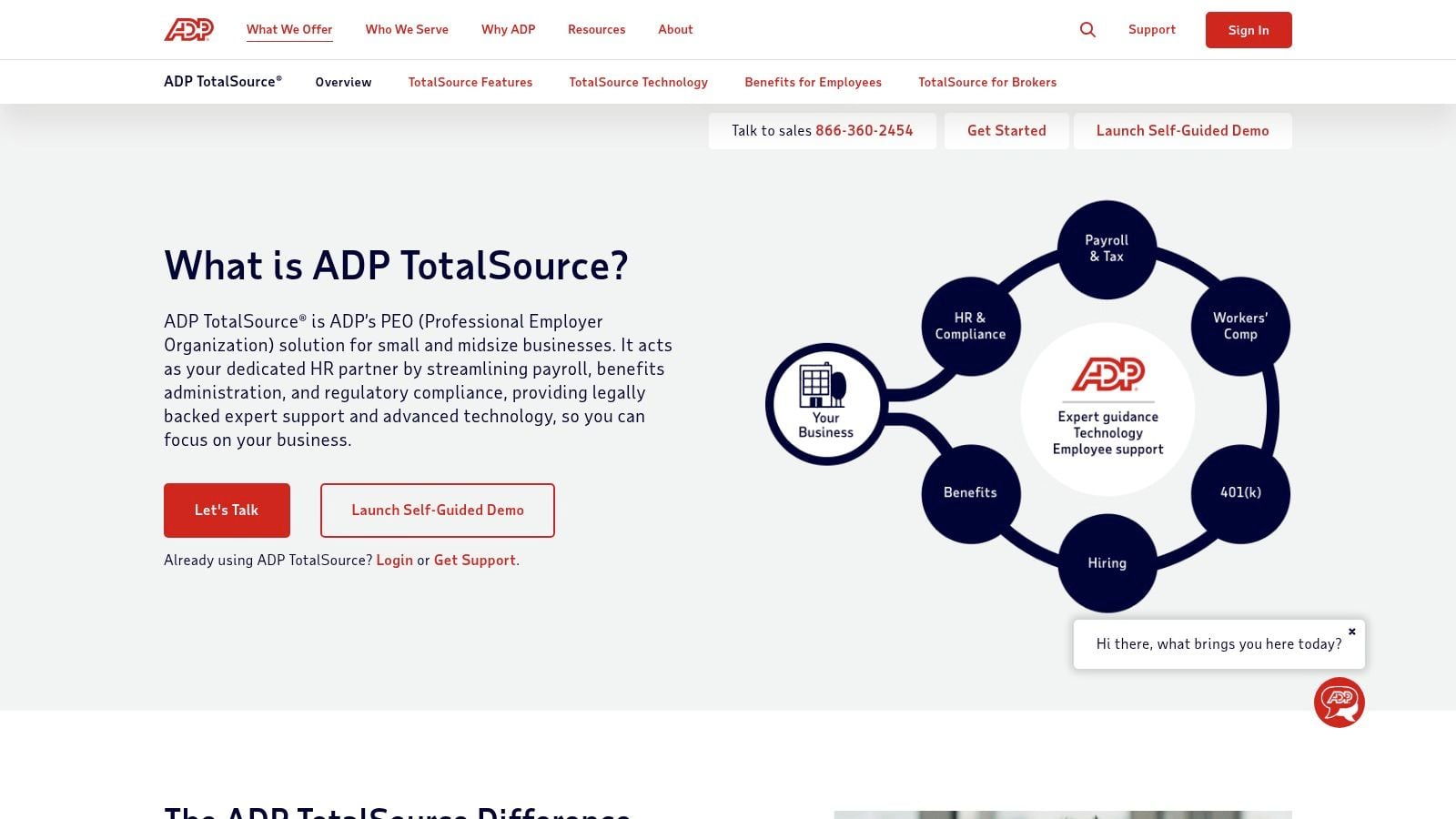
ADP TotalSource is usually on the first shortlist for one reason. Scale. For buyers that want a national platform with broad payroll capability, benefits administration, compliance support, and a deep surrounding tech ecosystem, ADP is hard to ignore.
It tends to fit employers that are already operating across multiple states or expect to get there soon. The attraction isn’t just payroll processing. It’s the combination of payroll, tax filing, benefits administration, HRIS functionality, workers’ comp support, risk programs, and analytics inside one recognizable platform. Teams that need a quick primer on the structure can review what a professional employer organization is before comparing contracts.
Where ADP TotalSource fits
The strongest use case is a company that values breadth over boutique attention. ADP can support firms that need national medical access, retirement administration, ancillary benefits, and a compliance engine that doesn’t feel improvised. That’s useful for a 150-person employer opening in three new states, or a 900-person company that wants fewer HR vendors.
The trade-off is usually service feel and pricing clarity. ADP doesn’t publish straightforward public pricing for TotalSource, so buyers need a full proposal and should expect renewal discussions to matter. Smaller employers sometimes feel like a modest-sized account inside a very large machine.
Practical rule: Ask ADP to show the service team structure before signature, not after kickoff. The platform may be strong, but the day-to-day experience still comes down to who answers payroll, benefits, and employee relations issues.
A solid contract review matters here. Large providers often have the strongest infrastructure and the least flexible paper unless the buyer negotiates early.
2. Insperity
Insperity usually appeals to companies that want a PEO to feel more like an outsourced HR department than a software layer. The product set is broad, but its primary distinction is the consultative posture around HR support, policy work, training, performance management, and compliance.
That profile tends to land well with mid-market operators that have outgrown basic payroll outsourcing but don’t want to build a full internal HR bench yet. Buyers comparing fee structures should also look at how much a PEO costs so they can separate base admin fees from benefit pass-through costs and risk charges.
Where Insperity earns its keep
Insperity is a strong fit when leadership wants guidance, not just transaction processing. A company with 75 employees and no experienced internal HR leader often gets more value from a provider that can help shape policy, documentation, performance processes, and manager support. The same goes for employers with recurring employee relations issues that need steadier handling.
The downside is that package design can feel layered. Buyers often need more time to understand what’s included, what’s optional, and which support elements are embedded in the quoted service model. That doesn’t make it a bad option. It just means the evaluation process shouldn’t be rushed.
A useful benchmark on why companies accept that complexity is the broader market itself. The global PEO market was valued at USD 43.31 billion in 2026 and is projected to reach USD 91.97 billion by 2033 at an 8.73% CAGR, which reflects continued demand for bundled HR and compliance support.
Insperity makes the most sense when the buyer wants judgment and process support, not only software and payroll execution.
3. TriNet
TriNet is one of the few large PEOs that sells around vertical fit instead of scale alone. That sounds like marketing language until you compare how different buyers evaluate a PEO. A biotech firm usually cares about benefits competitiveness, HR support that understands regulated hiring, and service teams that have seen similar employee issues before. A nonprofit or SaaS company may care about a very different mix.
That makes TriNet worth a closer look, but also makes it easier to overpay for a story that is not backed by contract terms or service reality.
Where TriNet stands out
TriNet tends to make the most sense when industry context changes the value of the service, not just the branding around it. The company has long positioned itself around verticals such as technology, financial services, nonprofits, and healthcare-oriented employers. Buyers deciding whether they want a full co-employment model or a lighter service arrangement should also compare a PEO vs. ASO structure before assuming TriNet is the right setup.
The nonprofit angle is one area where specialization can matter in practical terms. The Council of Nonprofits notes that 65% of smaller nonprofits now use PEOs to access larger-employer benefits. For that type of employer, the question is not whether payroll and benefits can be processed. Most national PEOs can do that. The question is whether the provider understands board reporting, lean internal teams, and the budget pressure that comes with annual renewal cycles.
TriNet also gets attention from healthcare and life sciences buyers because that segment is growing faster than many other areas of outsourced HR. Grand View Research projects continued expansion in the U.S. healthcare HR software and services market, which helps explain why employers in regulated, talent-constrained sectors often look for more specialized HR support.
The trade-off is fit variance. If your company lines up well with one of TriNet’s target industries, the service model can feel more relevant than a broad national PEO pitch. If it does not, TriNet can look a lot like other large providers, with similar payroll, benefits, compliance, and support claims.
That is where buyers should get more specific.
- Best fit: Employers that want benefits, HR guidance, and compliance support tied to a clear industry profile, often in the SMB to lower mid-market range.
- Pricing angle: Ask whether the quote is PEPM, a percentage of payroll, or a blended structure with benefit and risk costs separated. TriNet comparisons get muddy fast if those pieces are bundled.
- Contract angle: Review auto-renewal language, termination notice windows, and any early exit fees. Also ask whether vertical-specific support is written into the agreement or only described in the sales process.
- Watch item: Request actual plan designs, service scope, and support team details for your industry, not a generic national presentation.
4. Paychex PEO including Oasis
Paychex PEO, including Oasis, is usually a practical shortlist option for buyers who care less about brand story and more about execution risk. Finance leaders already know the payroll side of Paychex, which can make stakeholder approval easier. That matters, but it should not substitute for contract review and service-level scrutiny.
The core offer is familiar: payroll, tax administration, benefits administration, workers’ compensation support, EPLI-related resources, and HR guidance delivered through a co-employment model. If your team is still deciding between full co-employment and a lighter outsourcing arrangement, compare the service scope against a PEO vs. ASO model comparison before you get too far into pricing.
What separates Paychex from smaller PEOs is operating scale and channel reach. The company serves businesses across payroll, HR, and retirement services, and Paychex positions its PEO offering around outsourced HR administration, compliance support, and employee benefits access through its Paychex PEO offering.
The trade-off is service consistency. Buyers may enter through Paychex PEO or Oasis relationships, and support quality can vary by region, implementation team, and account structure. That is common after expansion, but it creates a real buying task. Reference checks need to match your company size, state footprint, and the exact service path you are being sold.
Contract review matters here more than the demo. Ask whether pricing is quoted as PEPM, percentage of payroll, or a blended structure. Then check auto-renewal language, notice periods, off-cycle payroll fees, benefit plan change rules, and any termination charges tied to leaving mid-term.
Ask for a sample service agreement, the implementation timeline, named support roles, and the escalation path for payroll corrections before signing.
Paychex often fits employers that want a national provider and a broad service menu without jumping to the most enterprise-heavy option. For a 40-person company replacing a local payroll bureau, that can be a clear operational improvement. For a 700-person multi-state employer with complex leave administration and benefit strategy needs, the assigned team, contract terms, and service commitments matter more than logo recognition.
5. Justworks
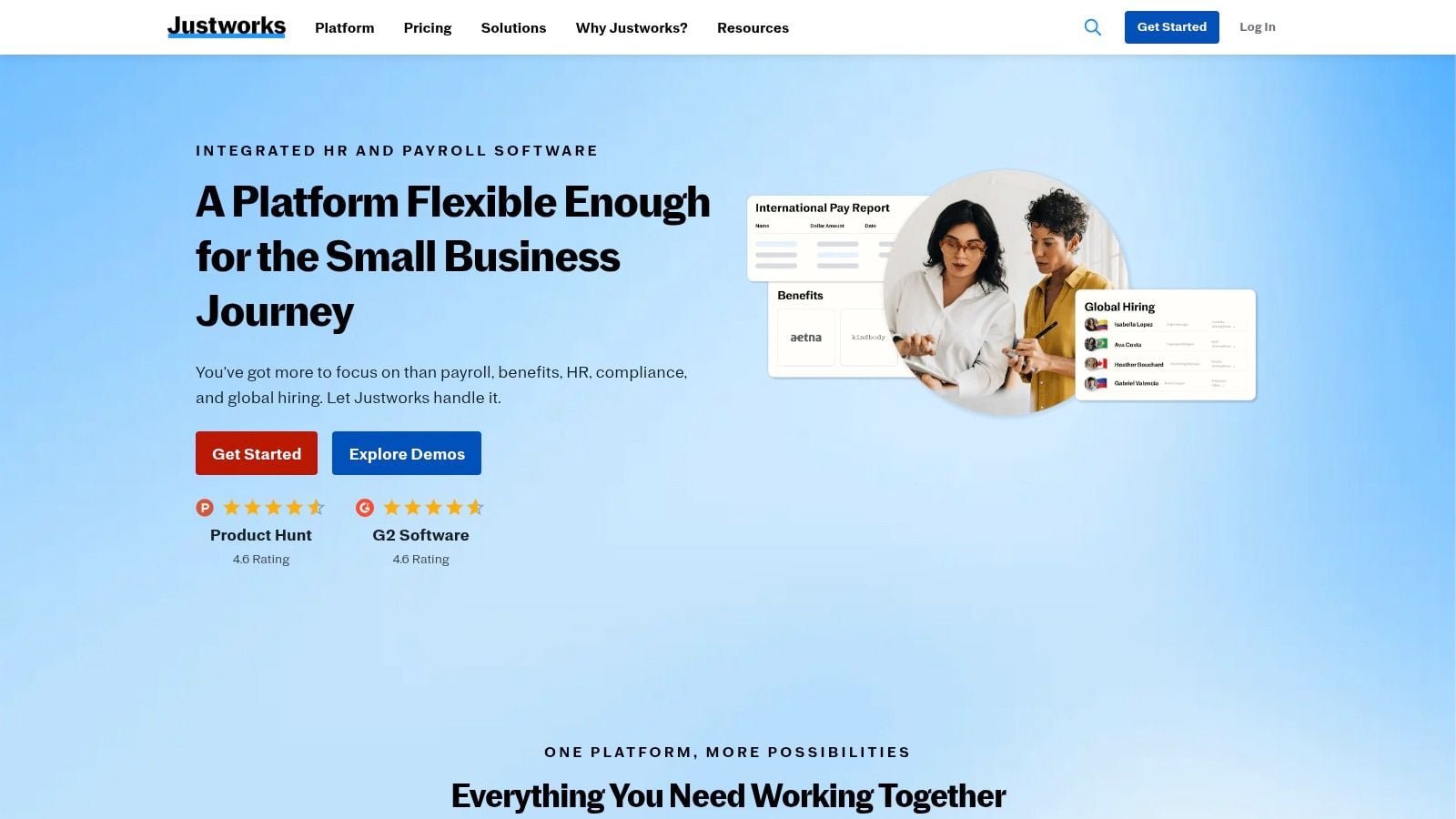
Justworks gets shortlisted for a simple reason. Buyers can usually understand what they are buying without sitting through a long enterprise sales process. In a category full of custom quotes and vague service descriptions, that matters.
The company tends to appeal to smaller employers that want a clean platform, faster onboarding, and clearer pricing logic. If the goal is to get payroll, benefits, and HR administration under control without building a complex service model around it, Justworks is often one of the easier options to evaluate. Employers still need to decide whether they want a full PEO relationship or a lighter outsourcing model, which is where a comparison like PEO vs. ASO helps.
Where Justworks works best
The best fit is usually a small or midsize company that values speed and standardization more than heavy customization. That includes distributed startups, agencies, and operating teams that need payroll, tax filing, compliance support, and benefits access in one system. Justworks’ product design reflects the broader shift toward cloud HR software, as noted in industry reporting from G2’s Justworks overview, where buyers consistently focus on ease of use, support responsiveness, and implementation speed.
That simplicity comes with trade-offs. Companies with multiple employee classes, unusual eligibility rules, or benefit designs that fall outside a standard setup can run into limits faster than they expect. A 25-person startup may prefer those guardrails. A 300-person employer with layered policies across states may find them restrictive.
Pricing deserves more attention than the interface. Justworks is commonly viewed through a PEPM lens, which many finance leaders prefer because it is easier to budget than percentage-of-payroll pricing. If compensation is rising through commissions, overtime, or aggressive hiring, percentage-based fees can move faster than expected. PEPM is not always cheaper. It is usually easier to forecast.
The contract still needs the same scrutiny you would apply to any other PEO. Review auto-renewal terms, notice periods, implementation fees, off-cycle payroll charges, and any penalties tied to early termination. A polished buying experience does not remove exit risk.
- What works: Clearer pricing posture, user-friendly administration, and a strong fit for smaller teams that want quick deployment.
- What doesn’t: Limited flexibility for employers that need custom workflows, broad carrier choice, or complex policy exceptions.
- Who should pause: Companies nearing mid-market scale, especially those with multi-state complexity, separate employee classes, or benefit strategy needs that may outgrow a standardized model.
Visit Justworks
6. Rippling PEO
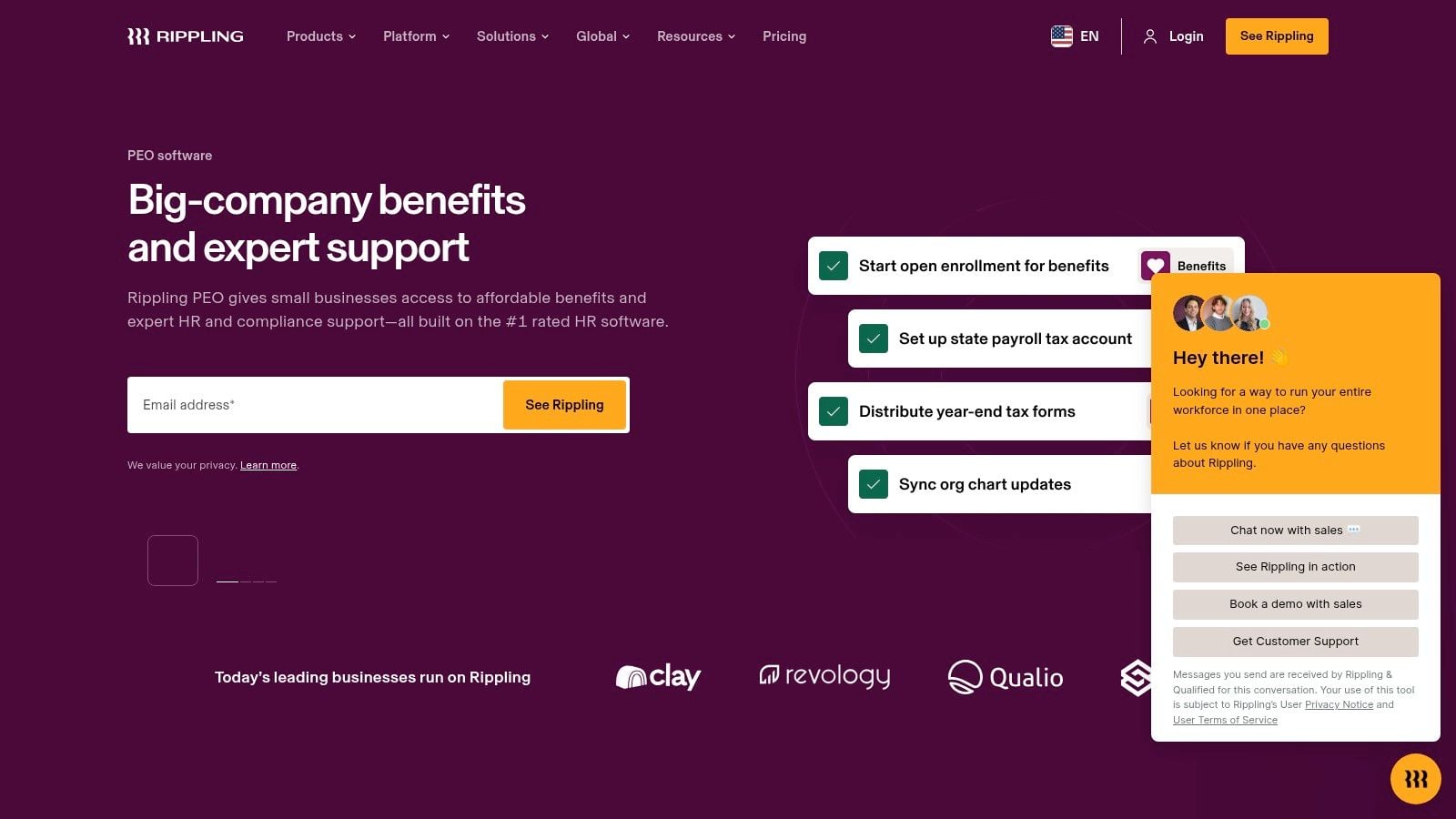
Rippling PEO stands out for a reason that cuts both ways. It brings HR, payroll, benefits, and IT administration into the same system, which can remove a lot of manual work. It also means the PEO decision is partly a software architecture decision, not just an HR outsourcing decision.
That distinction matters.
For a buyer comparing a list of professional employer organizations, Rippling is usually not the safest pick for companies that just want a familiar co-employment model and high-touch HR guidance. It is stronger for employers that care about workflow control, approvals, onboarding orchestration, app access, and device management alongside payroll and benefits. If HR and IT already work closely, that can be a real advantage. If they do not, implementation gets harder fast.
Rippling is often a natural fit for tech companies and other employers with distributed teams, frequent hiring, and a heavy software stack. The appeal is straightforward. One system can connect offer letters, payroll setup, benefits enrollment, laptop provisioning, and software permissions instead of pushing those tasks across several vendors and spreadsheets.
The trade-off is complexity at the front end. Buyers should ask how much configuration work sits with their team, what support is included during setup, and how changes are handled after go-live. A polished demo does not answer those questions.
Pricing and contract terms deserve extra scrutiny here because Rippling is often evaluated for more than PEO services alone. Finance leaders should pin down whether fees are quoted as PEPM, bundled across modules, or tied to added products that can raise the total cost over time. Review implementation charges, minimum commitments, notice periods, auto-renewal language, and any termination fees tied to leaving the PEO while keeping software modules, or vice versa. That is the kind of contract detail many PEO lists skip, and it affects the actual cost far more than a feature checklist.
Rippling can work very well for a 75 to 250 person company that wants tighter operational control and expects HR and IT processes to scale together. It is a weaker fit for employers that want a relationship-led PEO, broad handholding on employee relations, or minimal process redesign.
7. CoAdvantage
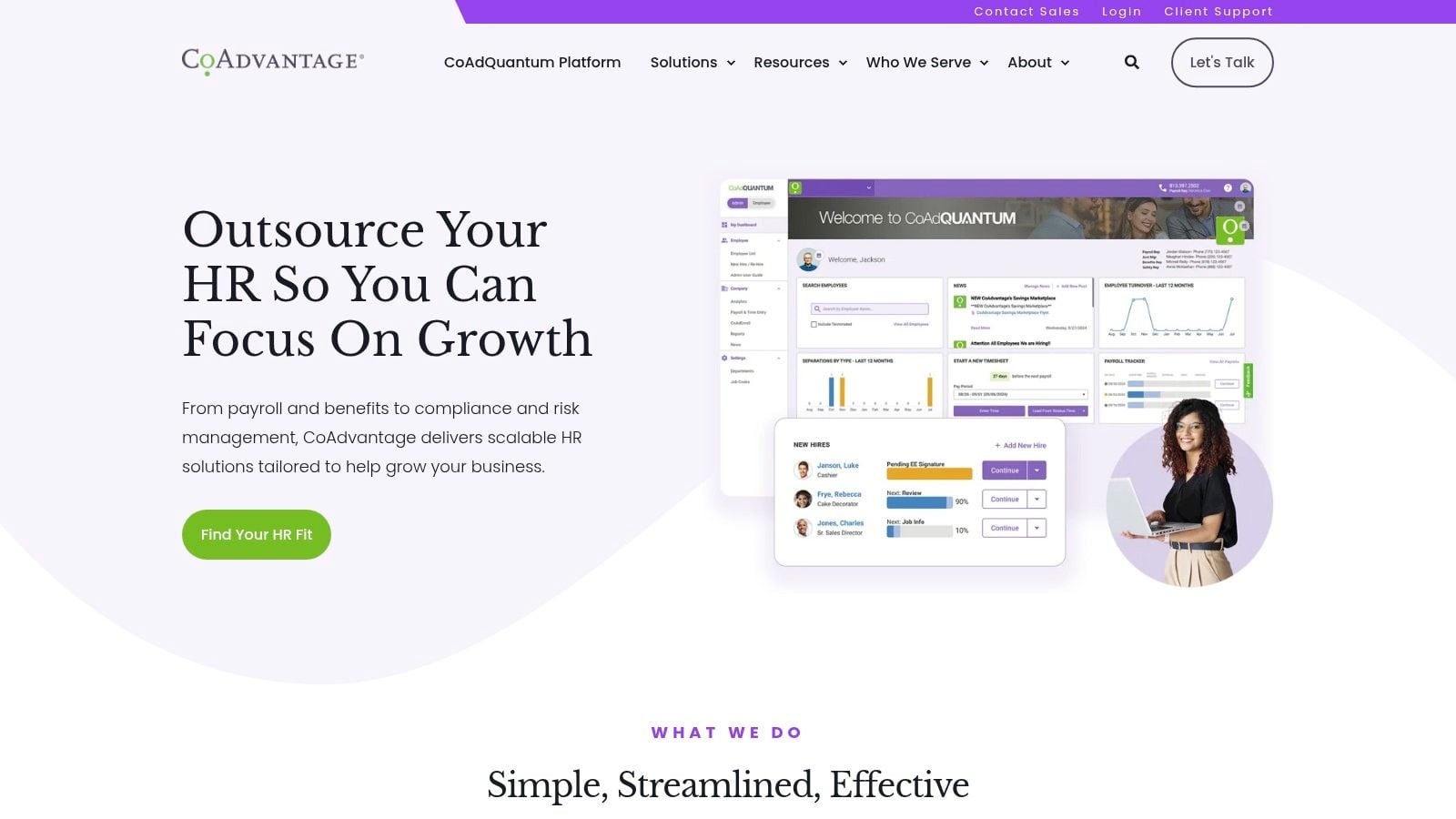
CoAdvantage is often evaluated by SMBs that want a national PEO without defaulting to the biggest public brands. Its positioning is practical: payroll, tax administration, benefits, workers’ comp, risk support, and HR help for growing employers that need a bundled solution.
That can work well for companies that have enough complexity to need real co-employment support, but don’t want to feel like a minor account inside a very large enterprise provider. The company’s merger with PrimePay in March 2025 also matters because it expands software distribution and reach, which buyers should factor into current service expectations.
Where CoAdvantage makes sense
CoAdvantage tends to fit the middle of the market. A 30-person contractor, an 80-person professional services firm, or a 200-person distributor can all find value if they want national support with a still-SMB-oriented posture. The merger angle can be a positive if it leads to broader platform capability.
The caution is transition risk. Any merger creates a period where buyers need sharper questions about account ownership, support continuity, technology roadmap, and service levels. That isn’t a reason to avoid the provider. It is a reason to verify operational details instead of assuming the combined story is already smooth.
One useful industry context point is overall footprint. The U.S. PEO industry serves between 2.7 million and 3.4 million worksite employees across 156,000 to 180,000 client organizations, so smaller and mid-sized employers aren’t unusual edge cases. They’re core customers.
- Good fit: SMB and lower mid-market firms that want bundled HR and risk support.
- Key diligence point: Confirm post-merger service model, escalation path, and any platform migration plans.
- Pricing note: If the quote isn’t easy to compare, ask for every recurring fee line to be separated.
8. G&A Partners
G&A Partners appeals to buyers who want more clarity before they commit. That matters because many PEO sales processes still make it hard to compare real cost drivers until late in the cycle. Finance and HR leaders usually want the opposite: a provider that gives enough pricing direction early to decide whether a formal quote is worth the time.
Its offering covers the standard full-service PEO stack: payroll, tax administration, HRIS support, benefits administration, COBRA, training, safety support, and risk management. G&A also operates as an IRS-certified PEO, which some buyers use as one credibility check, not a substitute for diligence.
What stands out with G&A Partners
The practical differentiator is quote transparency. G&A publishes more pricing context than many competitors, and that helps buyers frame the first conversation around actual budget ranges instead of vague promises. In a market where pricing may come as PEPM, a percentage of payroll, or a bundled rate with add-on fees, that is useful.
It is still only a starting point.
A published range does not tell you how implementation fees, benefit plan changes, off-cycle payroll charges, year-two increases, or termination terms will show up in the contract. The National Association of Professional Employer Organizations points buyers toward due diligence on service agreements, accreditation, and service model questions, but many shortlist articles still stop at feature summaries instead of helping buyers review the contract mechanics that drive total cost and switching risk (NAPEO PEO purchasing guidance).
G&A often fits companies that sit between very small owner-led firms and larger employers that already know they want one of the biggest national brands. A 50 to 150 employee business with a lean HR team is a reasonable profile. So is a company that wants responsive service and enough structure to support growth, but does not want to buy into a black-box pricing model.
Contract warning: Ask whether pricing is PEPM or percentage-of-payroll, whether the agreement auto-renews, what notice period applies, and whether there are charges tied to early termination or implementation recovery.
For buyers who value service access and better upfront pricing context, G&A deserves a close look. Just do the less glamorous work before signing. Read the renewal clause, map the exit terms, and compare the quote on a normalized basis.
9. Engage PEO
Engage PEO is one of the clearer choices for employers that want a compliance-first relationship. Its positioning leans heavily into HR regulatory support, ACA administration, COBRA, payroll, benefits, and risk management, with an attorney-led flavor that distinguishes it from more generic PEO marketing.
That makes it particularly relevant for multi-state employers, regulated industries, and leadership teams that have already felt the cost of inconsistent HR administration. For a company with employees in several jurisdictions, the appeal isn’t just outsourcing. It’s having a provider that treats compliance as a primary product.
Where Engage PEO fits best
Engage PEO tends to make sense when legal and regulatory complexity drives the buying decision. A healthcare-adjacent employer, a financial services group, or a multi-state services firm may value a more compliance-centered model than a startup would.
The likely trade-off is cost and selectivity. A provider that builds its value around legal and compliance guidance often won’t be the cheapest option, and it may be more deliberate about underwriting or fit. That’s not bad. It just means the buyer should decide whether the organization requires that level of support.
One practical way to evaluate a compliance-led PEO is by the operating metrics it can commit to. HR and finance leaders should expect dashboards that track payroll timeliness, tax compliance accuracy, employee attrition, benefit utilization, workers’ comp claim severity, and response times, with benchmarks such as mistake rates below 0.5% and client response times under 2 hours.
A legal-forward pitch is easy to sell. Documented service standards are harder to fake.
10. ExtensisHR
ExtensisHR tends to attract buyers who are cautious by design. Its value proposition isn’t based on being the loudest brand. It’s based on a credible service stack paired with a strong accreditation profile, including CPEO, ESAC, and SOC 1 Type 2.
For finance and HR leaders, that matters because PEO selection isn’t only about benefits richness or software polish. It’s also about payroll controls, tax handling confidence, and whether the provider looks durable enough to trust with a critical operating function.
Why ExtensisHR gets attention from cautious buyers
ExtensisHR often fits SMB and mid-market employers that want national capability with stronger assurance signals than some smaller competitors can offer. A 120-person firm moving from a local provider may like the balance between scale and accountability. A larger company entering a multi-state phase may appreciate the compliance orientation without moving straight to the biggest national platforms.
The main trade-off is network breadth and scale. ExtensisHR isn’t as large as the most dominant national names, so buyers should verify carrier access, state support, and implementation depth in their actual footprint. That diligence matters more than the accreditation stack alone.
There’s also a broader reason companies keep taking the category seriously. According to NAPEO research, businesses that use a PEO grow at twice the rate of comparable non-PEO firms, have 12% lower employee turnover, and are 50% less likely to go out of business. Those outcomes don’t belong to one provider, but they explain why a risk-aware buyer may accept the work of a thorough evaluation.
A careful buyer shouldn’t confuse smaller scale with weaker controls. But the buyer also shouldn’t assume accreditations answer every service question.
Top 10 PEOs: Side-by-Side Comparison
| PEO | Core features | Best fit / Target | Key strengths (USPs) | Pricing model | Key concerns / risk flags |
|---|---|---|---|---|---|
| ADP TotalSource | National benefits, payroll/HRIS, risk & workers’ comp, analytics | Employers needing scale, multi-state compliance, Fortune-style benefits | Carrier leverage, mature compliance/risk programs, ADP tech ecosystem | Quote-based; custom proposals & negotiable renewals | Opaque pricing, can feel low-touch for smaller groups |
| Insperity | Co-employment, HR consulting, time & performance tools, risk services | Mid-market teams wanting consultative HR & compliance support | Deep HR advisory, strong compliance resources | Quote-based; often positioned at premium | Premium pricing reported; package complexity extends eval |
| TriNet | Industry-tailored benefits, payroll/HRIS, compliance, risk services | Industry-specific employers (tech, life sciences, nonprofits, etc.) | Industry specialization, strong carrier relationships | Custom proposal via sales process | Fit varies by industry; compare plan designs closely |
| Paychex PEO (Oasis) | Payroll/tax filing, benefits admin, workers’ comp, Paychex integrations | Companies wanting PEO with familiar Paychex payroll tech | National availability, mature payroll/HR technology | Quote-based; regional quoting | Delivery varies by region/product line; pricing not public |
| Justworks | Published PEPM tiers, payroll/tax, benefits, 24/7 support | Startups and SMBs seeking simple, transparent PEOs | Pricing transparency, intuitive platform, fast onboarding | Published per-employee-per-month tiers (Basic/Plus) | Less customization, curated carrier options, verify network fit |
| Rippling PEO | Unified HR/IT/payroll platform, automations, device/app management modules | Tech-forward orgs wanting integrated HR + IT automation | Powerful integrations, modular add-ons, reduces tool sprawl | Quote-based; varies by bundle | Pricing varies; tech change management required |
| CoAdvantage | Payroll/benefits, workers’ comp, HR support; PrimePay merger | SMBs seeking national PEO with expanded payroll distribution | SMB focus, strengthened platform/partnerships after merger | Quote-based; confirm post-merger terms | Post-merger SLAs/service model changes; mixed mobile UX feedback |
| G&A Partners | Payroll/HRIS, benefits & COBRA, safety/risk, CPEO status | SMBs & mid-market wanting consultative, white-glove service | Publishes typical fee range, consultative service model | Publishes typical fee range but final price custom | Price depends on size/risk; smaller scale vs largest PEOs |
| Engage PEO | Attorney-led HR compliance, ACA expertise, benefits & COBRA admin | Multi-state employers needing strong legal/regulatory guidance | Compliance-centric model backed by legal team, solid benefits admin | Quote-based; sales-driven proposals | Potentially higher cost; selective underwriting may apply |
| ExtensisHR | Payroll/benefits, multi-state compliance, notable accreditations (CPEO, ESAC, SOC1) | SMB & mid-market employers prioritizing compliance assurance | Strong accreditation stack, financial/compliance assurance | Custom proposals required | Pricing not public; verify carrier networks by state |
Final Thoughts
A list of professional employer organizations is only useful if it helps a buyer avoid expensive mistakes. Brand recognition matters far less than fit, contract terms, and how the pricing behaves after headcount changes.
That is the gap in a lot of PEO roundups. They describe features, then stop before the parts that create real cost or operational risk.
The better way to use this list is as a buying tool. Start with client-size fit. A PEO that works well for a 20-person startup may be the wrong choice for a 400-person multi-state employer with complex workers’ comp exposure, tighter reporting needs, and less tolerance for service inconsistency. Then compare how each provider prices the relationship. PEPM and percentage-of-payroll models can both work, but they create very different forecasting and renewal dynamics for finance.
The PEO model can produce real value when the match is right. Guardian points to better retention, business stability, and cost outcomes among PEO users in its PEO trends report. Those results are not automatic. They depend on implementation quality, service execution, benefit fit by state, and whether the contract still works after the company grows.
The buying mistake I see most often is simple. Teams spend too much time on the demo and too little time on the agreement.
A polished platform does not answer the hard questions. How does pricing change at renewal? Is there an auto-renewal clause? What is the notice window to terminate? Are there implementation fees, benefit minimums, or runout support charges? Who owns payroll corrections, employee issue escalation, leave tracking, and open enrollment support once the sales team disappears?
Three areas usually deserve the closest review:
- Pricing model: Break out PEPM fees, percentage-of-payroll charges, benefit premiums, workers’ comp assumptions, admin fees, and one-time implementation costs. If a proposal blends them together, finance cannot model the actual spend.
- Service model: Get the operating model in writing. Confirm who handles payroll issues, HR guidance, employee support, compliance questions, and year-end tasks. A strong sales process does not guarantee a strong service team.
- Contract risk: Review termination notice periods, auto-renewal language, fee escalation terms, data access, and offboarding support before signing. Those points are easier to negotiate before onboarding than after a rough first year.
Growth changes the math. A contract that feels reasonable at 30 employees can look very different at 120, especially if fees scale poorly, workers’ comp assumptions change, or the provider’s service model starts to strain. That is why this list focuses on common risk flags and typical client profiles, not just marketing descriptions.
The practical takeaway is straightforward. Use the shortlist to identify likely fits, then force every finalist into the same comparison: pricing structure, benefit setup, compliance support, service ownership, termination terms, and fit for your size and state footprint. That is how a directory becomes a decision.
PEO Metrics helps companies compare, select, and negotiate the right PEO with an independent side-by-side view of pricing, benefits, service model, compliance support, industry fit, and contract risk. Teams evaluating providers for the first time, switching from an existing PEO, or renegotiating renewal terms can use PEO Metrics to benchmark options, identify the strongest matches, and negotiate better pricing and protections at no cost to the buyer.
