

If you run clinics, salons, home service crews, restaurants, or franchise units across more than one location, a PEO can lighten the administrative load or add a layer of cost and rigidity you didn’t plan for. The deciding factor is rarely how many sites you have. It’s how many states they sit in, and how each provider handles tax registrations, workers’ comp by class code, and state-specific benefits.
The providers below were weighed on multi-state payroll and tax handling, workers’ comp approach, service model across sites, benefits flexibility by state, and pricing transparency. Each entry covers the pros and cons for a multi-location service business. Vendor details change, so confirm current terms directly with each provider.
Quick Comparison of Multi-Location PEO Options
- PEO Metrics: best for buyers who want to compare PEOs before choosing; pricing on its website; the only entry that compares several PEOs side by side without being one.
- Insperity: best for multi-site employers whose managers need hands-on HR coaching; quote-based; an assigned HR advisor and in-person support model.
- TriNet: best for employers in a trade that matches one of its packages; quote-based; industry-tailored plan packages.
- ADP TotalSource: best for companies already on ADP or expanding into many states; quote-based; large payroll and tax filing infrastructure.
- Paychex PEO: best for growing chains that want a path from payroll to a PEO; quote-based; lighter HR and payroll options plus a PEO under one vendor.
- Justworks: best for smaller multi-site operators wanting predictable costs; see website for pricing; published, easier-to-compare plan information.
- Rippling PEO: best for tech-comfortable operators wanting one system; quote-based; location-based policies and workflows on one employee record.
- Barrett Business Services (BBSI): best for higher-risk trades; quote-based; a local branch model focused on safety and workers’ comp.
1. PEO Metrics
PEO Metrics is an independent comparison service, not a PEO. It doesn’t run payroll, administer benefits, or enter a co-employment relationship with your staff. What it does is help you line up several PEOs side by side, with detailed provider metrics and pricing analysis, so you can see what each structure costs and covers before you commit to one.
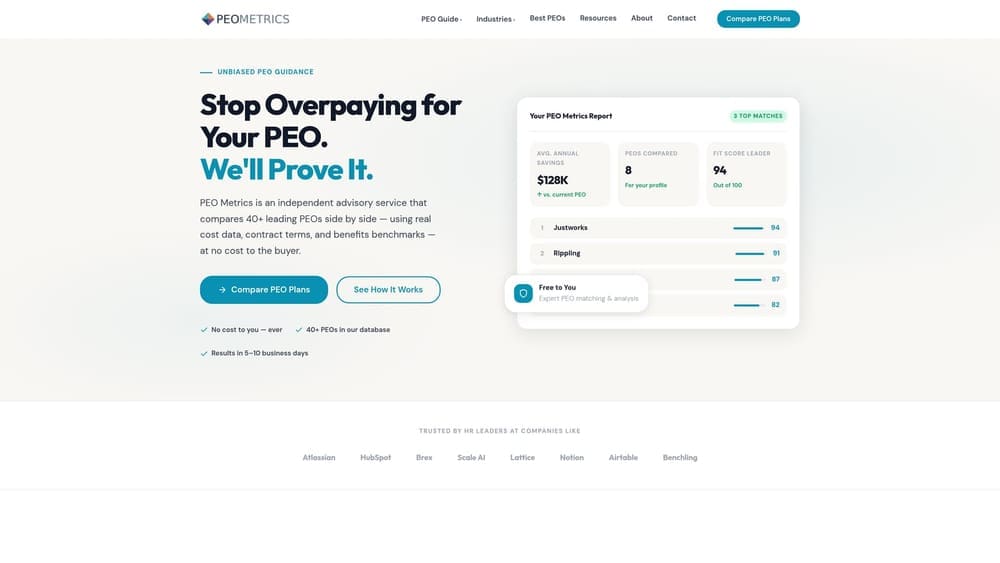
That matters for multi-location service businesses because PEO pricing is not a single number. Fees, administrative markups, workers’ comp treatment, and contract terms vary, and a quote that looks cheap for one state can look different once your second and third states are added. A neutral comparison makes those differences visible.
- Side-by-side provider comparison, so you weigh service models and structures against each other rather than one sales pitch at a time.
- Pricing analysis that shows what you’d pay for and where bundled fees sit.
- Detailed provider metrics that give you more to compare than a brochure does.
- Guidance on selecting a PEO, useful if this is your first time evaluating co-employment.
Setup and who runs it: there’s nothing to integrate. An owner or HR lead brings their locations, states, headcount, and trades, and uses the comparison to build a shortlist. It’s an advisory step that happens before implementation with any PEO.
Limitations: it provides no payroll, benefits, or co-employment itself, so you still need to choose and onboard a PEO. PEO Metrics may receive vendor placement fees, so you should factor that in when weighing its guidance, and verify any vendor’s terms directly.
Pricing: see the website for current details.
Best for: buyers who want to compare quotes and structures across PEOs before choosing.
2. Insperity
Insperity is a national PEO built around a service-heavy model. Its distinguishing feature is an assigned HR advisor and an in-person support approach, which suits businesses where site managers handle hiring, discipline, and scheduling questions without an HR department behind them.
What you get
- A dedicated HR advisor, so a general manager at one site has a person to call about a termination or leave request.
- Payroll and tax administration across the states where you employ people.
- Benefits administration, which takes enrollment and carrier management off your plate.
- Workers’ comp and risk support to help manage coverage and claims.
- Employee handbook and compliance guidance, helpful when each location has different local rules.
Where it falls short
Pricing is quote-based, and minimum-size and contract terms need to be verified with Insperity before you rely on them. A service-heavy model can be more than a very small team needs, and you may end up paying for support that a three-person site never uses. Integrations also need confirming on the vendor site, particularly if you have scheduling or point-of-sale systems that feed payroll.
Pricing: quote-based. Headcount, states, benefits selections, and the service level you choose are the usual drivers, so get quotes in writing for each configuration.
Best for: multi-site employers whose managers need hands-on HR coaching.
3. TriNet
TriNet offers a PEO with industry-focused packages and a technology platform aimed at small and midsize businesses. The industry angle is its main distinction on this list: instead of one generic bundle, plans are built around a business’s trade, which can matter if your service line has specific benefits expectations or risk profile.
Start with the limitation. Eligibility and plan options vary by industry and state, and pricing isn’t published. A multi-location operator in several states could find that a package fits in one state and not another, so ask TriNet to confirm availability for every state you operate in, not just your headquarters.
- Industry-specific plan packages, so benefits and services reflect how your trade operates.
- Payroll and tax compliance across the states you register in.
- A benefits marketplace that gives employees choices rather than a single plan.
- Risk and workers’ comp support to help with coverage and safety.
- An HR technology platform for employee self-service and administrator tasks.
Implementation is typically handled between your HR lead or owner and TriNet’s onboarding team, and integrations should be verified on the vendor site. Because the tailored packages are the draw, the fit depends on whether your trade lines up with one.
Pricing: quote-based. Expect headcount, industry, location, and plan choices to move the number.
Best for: employers in a trade that matches one of its industry packages.
4. ADP TotalSource
ADP TotalSource is ADP’s PEO, built on the same payroll and tax infrastructure ADP uses for its other products. For a business spreading across many states, the appeal is filing capacity: multi-state payroll tax filing is a core strength, and it connects to ADP’s wider ecosystem.
The trade-off is structure. A standardized offering may limit how much you can customize benefits, workflows, or service levels by location. Before signing, confirm the provider’s CPEO status (check the IRS list of certified professional employer organizations), the contract term, and the exit provisions. Leaving a PEO means moving payroll, benefits, and often workers’ comp, so exit terms deserve as much attention as the rate.
- Multi-state payroll tax filing, so new-state registrations and filings don’t fall to you.
- Benefits administration with enrollment and carrier handling.
- Workers’ comp coverage, which is relevant when class codes differ by site.
- HR compliance support for state and local rules.
- Integrations with ADP payroll and HR products; verify others on the vendor site.
If you already use ADP for payroll or time tracking, migration is likely simpler because data sits in a familiar environment. Companies on other systems should ask what transfers and what gets rebuilt.
Pricing: quote-based, driven by headcount, states, and benefits selections.
Best for: companies already on ADP or expanding into many states.
5. Paychex PEO
Paychex sells a PEO alongside several other HR and payroll options, which makes it unusual here. A growing chain can begin with lighter payroll or HR services and move up to co-employment later without changing vendors, a useful path when you’re unsure whether two locations or twelve justify a PEO.
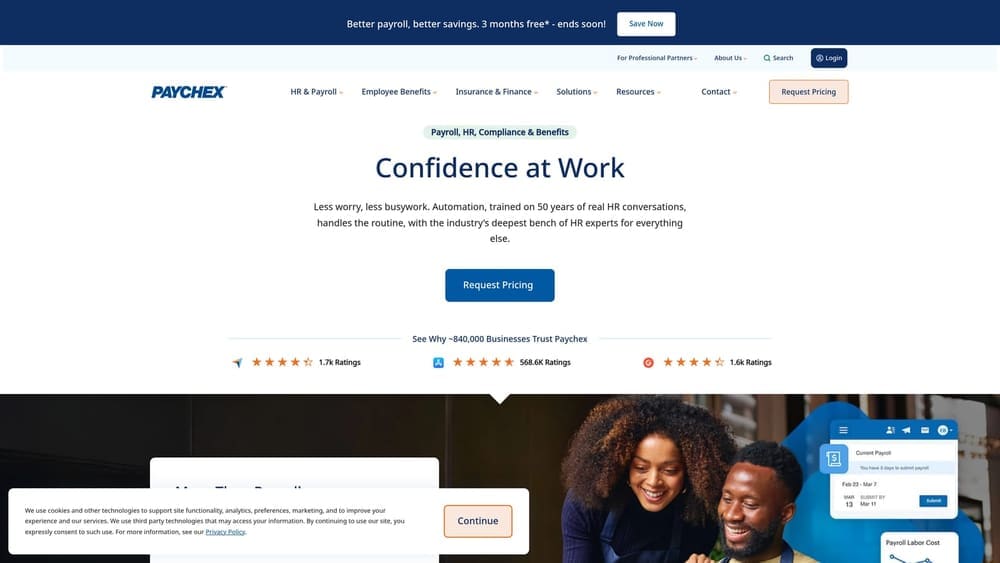
- PEO and non-PEO options under one vendor, so you can choose the level of involvement as you grow.
- Payroll and tax services across the states you operate in.
- Benefits administration for enrollment and plan management.
- Workers’ comp coverage within the PEO option.
- A local sales and service presence, which some owners prefer to a call center.
Integrations include Paychex Flex; verify anything beyond that on the vendor site. Day-to-day, an owner or office manager typically works in the platform, with support from Paychex staff.
Limitations: pricing isn’t published, and minimums need verifying. The local presence is a selling point, but check what it looks like in your actual markets rather than assuming a representative is nearby. Also confirm that the PEO option, not just the payroll product, meets your benefits and workers’ comp needs in each state.
Pricing: quote-based, shaped by headcount, services chosen, and states.
Best for: growing chains that want a path from payroll to a PEO without switching vendors.
6. Justworks
Pricing clarity is why owners look at Justworks. It’s a PEO aimed at small businesses, with published plan information and a self-service platform, so you can see roughly what you’d pay before talking to sales. That’s rare in a market where most pricing is quote-based.
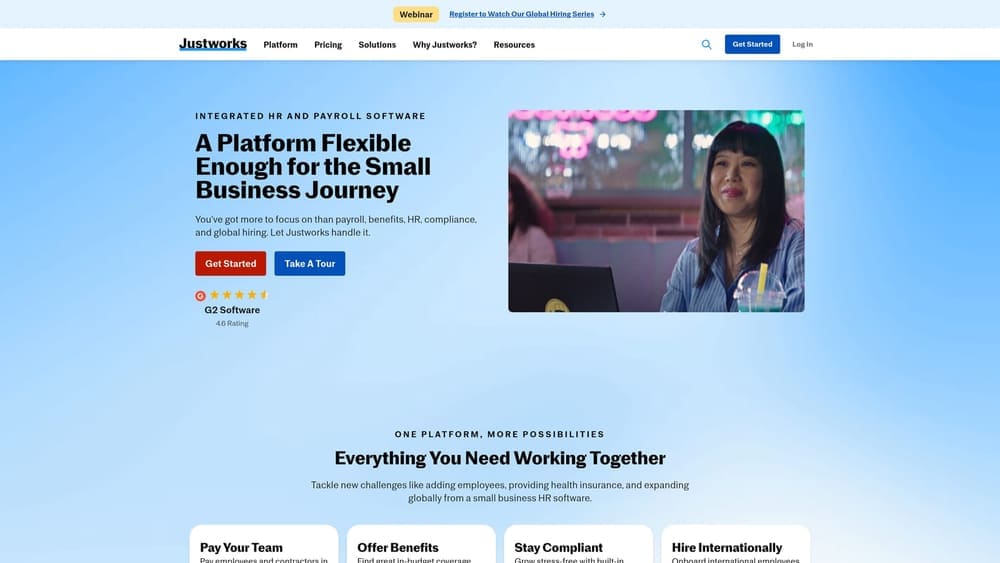
The employee app is the other draw. With no HR staff on site, a salon stylist or line cook can handle pay stubs, time off, and benefits enrollment from a phone, which lightens the load on managers.
- Published plan information that makes it easier to compare costs against other PEOs.
- An employee self-service app that reduces routine HR questions to managers.
- Payroll and tax filing across states where you have employees.
- Benefits administration that covers enrollment and changes.
- Compliance support for common employer obligations.
Limitations: it offers less hands-on advisory than service-heavy PEOs, which can matter for complex multi-state operations or high-risk trades where claims and safety need active management. Verify which benefits options are available in each of your states, and check integrations on the vendor site.
Pricing: see the website for current plan information. Headcount and plan selection are the likely drivers, and you should confirm what’s included before comparing it with quote-based rivals.
Best for: smaller multi-site operators wanting predictable costs and self-service.
7. Rippling PEO
Rippling PEO is delivered on Rippling’s unified HR, payroll, and IT platform. Its standout feature for multi-location work is one employee record with policies and workflows that can differ by work location, so a site in one state can follow its own onboarding steps and rules without a separate system.
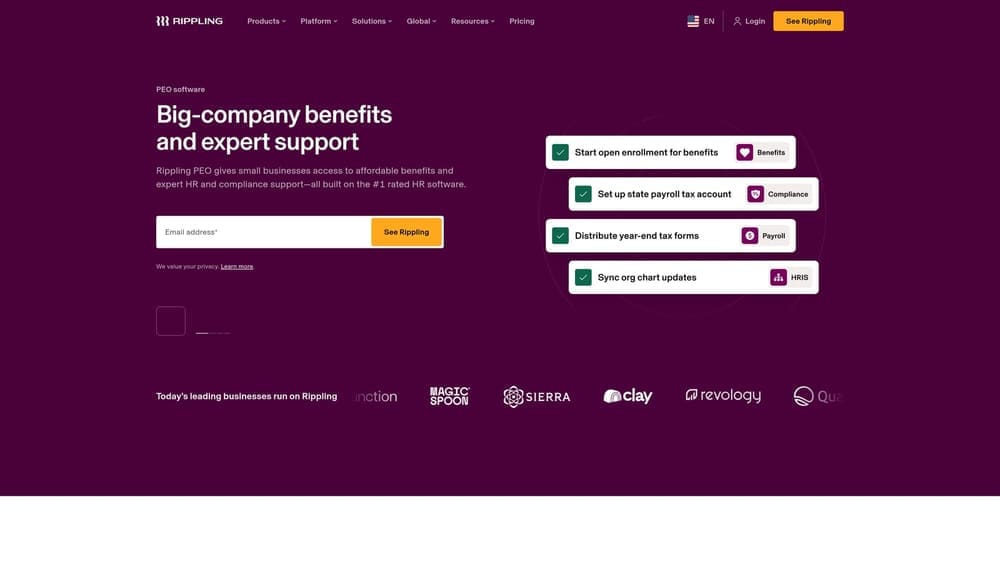
- A single platform for HR, payroll, and benefits, which cuts down on reconciling data between tools.
- Location-based policies and workflows, matched to each site’s rules.
- Device and app management, useful if staff use company laptops or software.
- Payroll tax filing across the states where you employ people.
- Benefits administration inside the same system.
Setup suits operators who are comfortable configuring software; someone in HR or operations will need to own the system day to day. Its app ecosystem supports integrations, and you should verify specifics on the vendor site.
Limitations: it’s a newer PEO than several others here, so verify state availability, supported industries, and how workers’ comp underwriting treats service trades like restaurants or home services. A hands-off owner who wants a person to call may find a platform-first model less comfortable.
Pricing: quote-based. Headcount, modules, states, and benefits choices influence it.
Best for: tech-comfortable operators wanting one system across all sites.
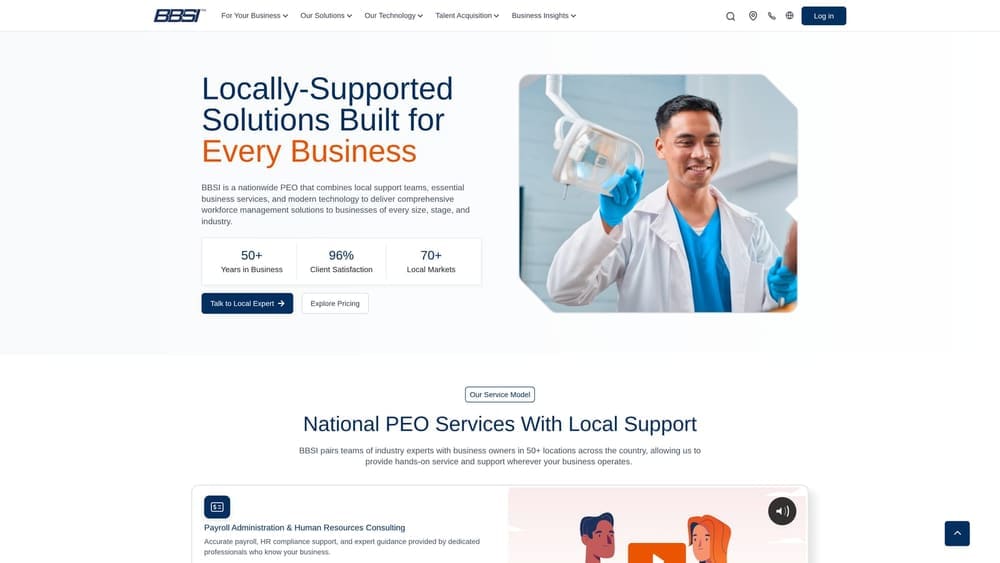
8. Barrett Business Services (BBSI)
Barrett Business Services (BBSI) is a PEO-style business management provider with a branch-based, local service model. Where other entries lean on platforms or national call centers, BBSI emphasizes local branches and a focus on safety and workers’ comp management, which fits trades where injuries drive cost.
Strengths for risk-heavy trades
- Local branch support, so someone familiar with your region can respond in person.
- Workers’ comp and safety support aimed at reducing claims, not just insuring them.
- Payroll and tax administration across the states it covers.
- Benefits access for employees.
- Risk management services that go beyond paperwork.
Constraints
Its geographic footprint is narrower than that of national PEOs, so confirm coverage in every state where you have employees before you consider it. If one site sits outside its branches, you could end up splitting providers. Integrations should be verified on the vendor site, and because it’s described as PEO-style, confirm how the contract and co-employment structure compare with a traditional PEO.
Pricing: quote-based. Payroll size, trade, claims history, and location are the usual factors.
Best for: higher-risk trades where injury and claims costs drive the decision.
Matching a PEO to Your Situation and Checking the Fine Print
Three picks cover most situations, though the rest may fit specific needs:
- Want a neutral side-by-side first: start with PEO Metrics, then request quotes from the two or three providers that fit.
- Need local advisory help: Insperity for hands-on HR coaching, or BBSI if local branches and safety management matter most.
- Prefer transparent pricing: Justworks.
- Run high-risk trades: BBSI, with workers’ comp approach as the deciding factor.
- Want one platform: Rippling PEO, or ADP TotalSource if you already run on ADP.
Whichever you choose, verify three things in writing before signing: that the PEO covers every state you operate in, its CPEO status on the IRS list, and the contract’s exit terms. A PEO shares employer responsibilities but doesn’t remove your liability, and pricing is rarely one number. Our contact page is the way to reach us if you’d like help sorting through quotes.
Before you sign that PEO renewal, make sure you’re not leaving money on the table.
Many businesses unknowingly overpay because of bundled fees, hidden administrative markups, and contracts designed to limit flexibility. We give you a clear, side-by-side breakdown of pricing, services, and contract terms, so you can see exactly what you’re paying for and choose the option that truly fits your business.
