
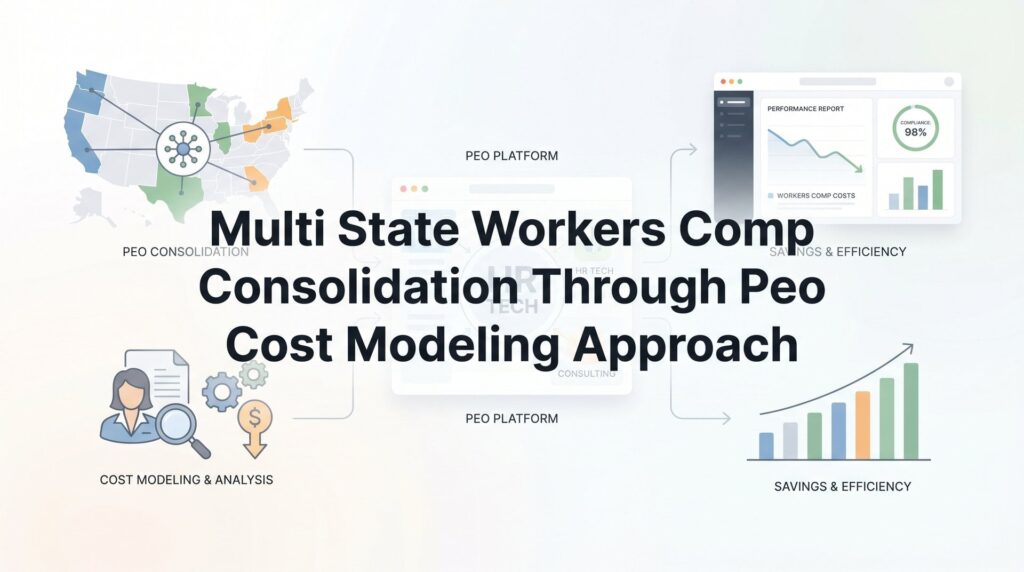
If you’re running operations across four or more states, you already know what workers’ comp management actually looks like in practice: separate policies with different carriers, renewal dates scattered across the calendar, annual audits that always seem to surface surprises, and experience mods that you’re managing in isolation rather than strategically. Every year feels like a scramble, and you’re rarely confident you’re paying a fair price.
The pitch from PEOs is appealing: consolidate everything under one master policy, one carrier, one audit cycle, and get out of the multi-carrier juggling act for good. And for many multi-state employers, it genuinely works. But “it works” isn’t a cost model. Before you make this move, you need actual numbers — your numbers, not a PEO’s generic proposal built on assumptions about your business.
This article walks through how to build a real cost model for multi-state workers’ comp consolidation through a PEO. Not a high-level overview of what PEOs do, but the specific analytical framework you need to determine whether consolidation makes financial sense for your operation. Fair warning upfront: sometimes the numbers don’t support it. The whole point of doing this work is to know that before you commit, not after your old policies are cancelled.
Why Multi-State Workers’ Comp Gets Expensive So Fast
The foundational problem is that workers’ comp is not a federal program. It’s fifty separate systems, each with its own rating bureau, class code structure, and premium calculation methodology. The same job title — say, a field technician or a warehouse supervisor — can carry meaningfully different base rates depending on whether that employee works in Texas, Ohio, or California. Those differences aren’t small. In some cases, the variance is significant enough to materially affect your total comp spend depending on where your payroll is concentrated.
Most states use NCCI (National Council on Compensation Insurance) as their rating bureau, but several major states operate independently. California, New York, New Jersey, and Pennsylvania all have their own bureaus and their own class code systems. If you have employees in any of these states, you’re not just dealing with different rates — you’re dealing with different classification logic, different audit procedures, and different rules around how experience modification is calculated and applied. That complexity multiplies across every state you operate in.
Experience modification rates add another layer. Your EMR is supposed to reflect your actual claims history relative to businesses of similar size and type, but the formula varies by state. A significant claim in one state can affect your overall mod, but the ripple effect depends on which state’s formula applies, how the split point calculations work, and whether the claim falls in a state where your policy is primary. Without a unified view across all your policies, you’re essentially managing your EMR blind — reacting to it rather than influencing it. Understanding how to calculate PEO workers’ comp premiums is essential context for this kind of analysis.
Then there’s the operational drag that doesn’t show up on any invoice. Separate policies mean separate audits, often with different audit firms, different timelines, and different standards for documentation. Each renewal is a separate negotiation. Each deposit is tied up separately. Classification errors — which are genuinely common in multi-state operations — get caught at audit, triggering true-up payments that can be painful and unpredictable. And coverage gaps, the kind that only become visible when a claim is filed in a state where your policy was miscoded or underreported, can expose you to out-of-pocket losses that dwarf whatever you thought you were saving.
The cost of running this patchwork isn’t just the premium. It’s the premium plus the audit surprises plus the admin time plus the broker fees across multiple relationships plus the opportunity cost of not having a clean, unified picture of your comp exposure. That’s the real baseline you’re comparing against when you evaluate PEO consolidation.
What PEO Consolidation Actually Changes (And What It Doesn’t)
Under a PEO arrangement, your employees across all states are covered under the PEO’s master workers’ comp policy. One carrier. One audit cycle. One point of contact for claims management. On paper, this solves the multi-carrier complexity problem entirely.
In practice, the picture is more nuanced. The most important thing to understand is that you’re not just getting a simpler administrative structure — you’re joining the PEO’s experience pool. Your loss history gets blended into their overall book of business. The PEO’s master policy rate is influenced by their aggregate claims experience across all their clients, not just yours. This is the core of how workers’ comp risk transfer actually functions in a co-employment arrangement.
This can work in your favor or against you, depending on where you stand. If your standalone EMR is 1.15 because you’ve had a rough few years with claims, joining a PEO pool with a strong aggregate loss history could meaningfully lower your effective comp rate. If your EMR is 0.72 because you’ve invested heavily in safety programs and have a clean claims record, you may find yourself subsidizing other employers in the pool who haven’t. The math here is real, and it has to be part of your model.
Consolidation also doesn’t make state-specific regulatory complexity disappear. You still need correct class codes assigned per state, accurate payroll allocation by state and class, and compliance with each state’s workers’ comp board requirements. The PEO takes on the mechanical burden of managing this, but that doesn’t mean you can disengage. Class code errors in a PEO arrangement are still your problem at audit — they just show up differently. You need to verify that the PEO is handling your specific workforce distribution accurately, especially if you have employees in the independent bureau states where classification logic differs from NCCI standards.
The financial shift that matters most isn’t just rate. It’s predictability. Under your current multi-policy structure, your actual annual comp cost is unknowable until every audit closes — sometimes 12 to 18 months after the policy year ends. Under a PEO, you’re typically paying a bundled per-employee or per-payroll rate that you can actually forecast. That shift from variable, audit-dependent costs to predictable periodic charges has real budget value, particularly for companies that are growing or shifting their workforce across states.
The key word in that last paragraph is “bundled.” PEO pricing doesn’t break out workers’ comp as a separate line item by default. It’s wrapped into an administrative fee or a total employment cost rate. That’s where the cost modeling work begins.
Building Your Baseline: What to Gather Before You Model Anything
You cannot build a useful cost model without a clean baseline. This is where most companies shortcut the process, and it’s why they end up making the PEO decision based on vibes rather than numbers.
Start with your current workers’ comp costs by state. Pull the actual premiums paid, not just the quoted premiums. Include audit true-ups — both the amounts you paid and the amounts you received back. Include deposits currently held by carriers. If you’ve received any dividend or return premium in the past few years, note that too, because it’s part of your effective cost. Do this for each state, for each of the past three to five policy years. You’re building a picture of what you’ve actually spent, not what was quoted at inception.
Add the administrative cost. This one gets left out constantly, and it skews the comparison. Estimate the hours your HR or finance team spends managing multiple policies each year: audit prep, carrier communications, classification reviews, broker meetings, deposit tracking. Assign a dollar value to that time. A solid cost accounting comparison of internal vs PEO expenses should capture all of these hidden line items.
Next, pull your loss runs. You need three to five years of loss run data by state, including open claims. This is the data a PEO will use to price you, so you need it before you sit down with any PEO to negotiate. More importantly, you need to understand your own EMR trajectory. Is it improving, stable, or deteriorating? A declining EMR on a standalone policy is an asset you may not want to give up. A rising EMR is a liability that PEO consolidation might help you escape.
Map your workforce by state, class code, and payroll volume. This matters more than most people realize. Consolidation economics are heavily influenced by payroll concentration. A company with 80% of its payroll in one low-rate state and the remaining 20% scattered across higher-rate states has a fundamentally different cost profile than a company with payroll evenly distributed across six states. The PEO’s bundled rate will be calculated across your entire workforce — so the blended rate you end up with depends on that distribution.
If you operate in any monopolistic states — Ohio, Washington, Wyoming, or North Dakota — note that separately. In monopolistic states, workers’ comp is provided through a state fund, not private carriers. PEOs cannot provide workers’ comp coverage in these states through their master policy. You’ll still need state fund coverage for those employees, which means your consolidation won’t be complete in those locations. The nuances of monopolistic state workers’ comp handling deserve careful attention in your model.
The Cost Model Framework: Comparing Apples to Apples
The model has two columns: what you’re paying now, and what you’d pay under PEO consolidation. The goal is to make those columns genuinely comparable — which requires more work than most PEO proposals ask you to do.
Current Total Cost (Column A): Sum of actual premiums paid by state, plus audit adjustments (net of returns), plus deposits currently outstanding, plus broker fees, plus your estimated administrative labor cost. This is your real annual comp spend. Not the quoted premium. The actual all-in cost.
Projected PEO Cost (Column B): The PEO’s bundled rate multiplied by your payroll, but you need to isolate the workers’ comp component. This is non-negotiable. PEOs will often quote you a total employment cost rate or an administrative fee that wraps comp, benefits, HR services, and their margin into one number. Ask explicitly for the workers’ comp component broken out in writing. If they won’t provide it, you cannot model the comparison. A well-built cost structure modeling template will help you organize these inputs systematically.
Once you have the isolated comp rate, apply it to your payroll by state and class code. Don’t just apply it to total payroll — the rate may vary by class, and you need to understand how the PEO is pricing your specific workforce mix, not a generic blended estimate.
Model year one separately from years two and three. Year one has transition costs that don’t recur: potential short-rate cancellation penalties on existing policies if you exit mid-term, gap periods where your loss history isn’t yet fully integrated into the PEO pool, and the administrative time of transitioning payroll and coverage. These are real costs that belong in the model, not footnotes.
Run sensitivity scenarios. At minimum, model three situations beyond your base case:
1. Headcount growth in a new state: If you expand into a new state next year, how does the PEO’s pricing adjust? Is it automatic under the master policy, or does it trigger a re-rating? Standalone policies require new carrier relationships and deposits when you enter a new state. That friction has a cost. PEO consolidation typically handles this more smoothly — but verify the mechanics and the pricing impact before assuming it’s seamless. Companies navigating this challenge should also understand how PEOs handle multi-state payroll compliance more broadly.
2. A large claim in year one: Under your standalone policies, a significant claim directly affects your own EMR. Under a PEO, the impact is diluted across the pool — but the PEO may still adjust your rate at renewal based on your individual loss experience within their book. Ask specifically how the PEO handles individual client loss experience at renewal. Some PEOs insulate you from your own claims; others re-price you aggressively after a bad year. This distinction matters enormously for the durability of the savings you’re projecting.
3. Renewal pricing in years two and three: First-year PEO pricing is often the most competitive you’ll see. Ask for renewal history data from existing PEO clients in your industry and state footprint. If renewal increases have been steep, the year-one savings may evaporate quickly. Model a conservative renewal scenario and see whether the consolidation still makes sense over a three-year horizon.
Red Flags and Deal-Breakers in PEO Workers’ Comp Pricing
A few things should stop a negotiation cold.
The first is a PEO that won’t break out the workers’ comp component of their bundled rate. This isn’t a minor transparency issue — it’s a structural problem. If you can’t see what you’re paying for comp specifically, you literally cannot run the comparison. Some PEOs resist this disclosure because the comp component is where margin is buried. That’s exactly why you need it. Knowing how to track and verify workers’ comp accounting through your PEO is critical for catching these issues.
The second red flag is aggressive first-year pricing without renewal history to back it up. Some PEOs use low introductory rates to win business, knowing that once your old policies are cancelled and your employees are enrolled, switching back is painful and expensive. Before you commit, ask for documented renewal rate history from current clients in comparable industries and state distributions. If they can’t produce it, or if the history shows consistent double-digit renewal increases, model that trajectory before you sign.
Third: pay attention to how the PEO handles loss-sensitive pricing. Some PEO arrangements include a loss-sensitive component where your individual claims experience affects your rate within the pool. Others are fully pooled and insulate you from your own claims. Neither structure is inherently better — it depends on your loss history. But you need to know which structure you’re buying into, because it changes the risk profile of the arrangement significantly. Running a thorough renewal risk analysis before your contract renews will help you stay ahead of unexpected pricing shifts.
And if your current EMR is genuinely strong — say, 0.70 or below with a clean claims history — approach PEO consolidation with real skepticism. You’ve earned a pricing advantage through your safety performance. Joining a pool that averages you toward the mean means giving that advantage away. The cost model should make this obvious if you run it honestly, but it’s worth naming directly: consolidation is not automatically better. For employers with excellent loss histories, it can genuinely cost more.
When the Numbers Don’t Support It
There are situations where multi-state workers’ comp consolidation through a PEO is simply not the right financial move, and it’s worth being direct about them.
If you operate in two or three states with a strong broker relationship, favorable standalone rates, and a low EMR, the administrative simplification of a PEO may not justify the cost tradeoffs. The friction of managing two or three policies is real but manageable. What you’d be giving up — your own EMR, your direct carrier relationships, your ability to negotiate independently at renewal — may be worth more than the consolidation benefit. Understanding the full landscape of how PEOs cut workers’ comp costs — and when they don’t — is essential before making this call.
Companies in high-hazard industries with genuinely excellent safety programs sometimes find that PEO consolidation works against them. Their low mod is a competitive asset in the standalone market. Inside a PEO pool, that advantage gets averaged away. The PEO isn’t rewarding your safety performance the same way a direct carrier relationship would. If your safety program is a real differentiator, protect it.
Rapidly shifting multi-state footprints create a different problem. If you’re frequently opening and closing locations, adding states, or shifting workforce concentration quickly, some PEOs struggle to keep pace with the administrative requirements: state registrations, class code updates, payroll reallocation. Compliance gaps in a fast-moving operation can create exposure that offsets whatever you’re saving on premium. Before assuming a PEO can handle your pace of change, ask specifically how they manage mid-year state additions and workforce reclassifications, and get that process documented.
The honest answer is that PEO consolidation is the right move for some multi-state employers and not for others. The only way to know which category you’re in is to run the numbers.
The Bottom Line on Multi-State Comp Consolidation
This is a math problem. The cost model either shows savings or it doesn’t, and the quality of the model depends entirely on the quality of the data you bring to it. Generic PEO proposals built on estimated payroll and assumed class codes aren’t a cost model — they’re a starting point for a conversation. The actual analysis happens when you bring your real numbers: your actual premiums, your true audit history, your loss runs, your EMR trajectory, your workforce distribution by state and class.
Build your baseline first. Then approach PEO comparisons with specific numbers and specific questions. Ask for the workers’ comp component broken out in writing. Ask for renewal history. Ask how individual loss experience affects pricing within their pool. Run the year-one and steady-state models separately. Run the sensitivity scenarios.
And compare more than one PEO. The only way to know if you’re getting a genuinely competitive rate is to put the same data set in front of multiple providers and compare the outputs side by side. A single proposal from a single PEO tells you almost nothing about whether the pricing is fair.
PEO Metrics exists to help you do exactly this kind of structured, data-driven comparison — so you’re evaluating real numbers across providers, not trusting a sales rep’s assurances. Don’t auto-renew. Make an informed, confident decision.
