
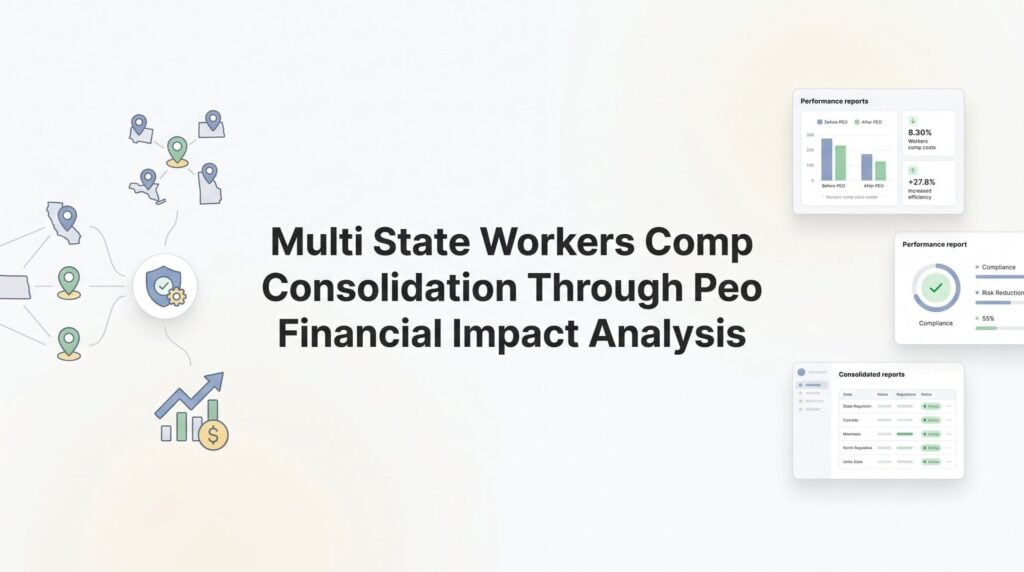
If your business operates in multiple states, you already know workers’ comp isn’t a single problem. It’s four problems, or six, or eight — each with its own carrier, its own audit cycle, its own rate structure, and its own regulatory quirks. You’re managing a patchwork of policies that were never designed to work together, and the financial drag is bigger than most owners realize.
The pitch for consolidating under a PEO master policy sounds clean: one policy, one audit, one billing relationship, and access to the PEO’s volume-based pricing. For some businesses, that’s exactly what happens. For others, the math doesn’t work out that way.
This article is a practical financial analysis of what actually changes when you move multi-state workers’ comp under a PEO versus continuing to manage it state-by-state. We’ll walk through the cost layers, the risk shifts, the state-specific variables that change the calculation, and how to build your own comparison model. The goal isn’t to sell you on consolidation — it’s to give you the framework to figure out whether it makes sense for your specific situation.
Why Multi-State Workers’ Comp Gets Expensive Fast
The premium is the obvious cost. Everything else tends to get buried in overhead and written off as “the cost of doing business.” But when you add it up, the non-premium costs of managing separate state policies can be substantial.
Start with policy minimums. Most states have minimum annual premiums per policy, regardless of your actual payroll exposure in that state. If you have a handful of employees in a state, you may be paying a minimum premium that bears no relationship to your actual risk. Multiply that across several states and you’re paying for coverage floors that don’t scale with your actual exposure.
Then there’s the broker layer. If you’re working with a single broker across multiple states, you may be paying duplicated service fees or, worse, working with different brokers in different states who aren’t coordinating your overall risk strategy. Either way, broker commissions are embedded in your premiums and rarely itemized clearly.
Audit timing is another underappreciated cost driver. Each state policy audits on its own schedule. That means your team is handling multiple audit cycles per year, pulling payroll records, reconciling classification codes, and sometimes disputing findings — all for policies that don’t talk to each other. Staff time is real money, and multi-policy audit management is one of the more consistent hidden costs in this structure. Understanding how to track and verify workers’ comp accounting becomes critical when you’re juggling this many policies.
The deeper problem is what fragmented policies do to your experience modification rate strategy. Your EMR is calculated based on your claims history relative to industry peers. It’s one of the most direct levers you have on long-term premium costs. But when your workers’ comp is siloed across multiple state policies, you can’t build a unified loss history. A strong safety record in your largest state doesn’t offset a rough claims year in a smaller one. Each policy stands alone, which means your ability to improve your EMR through better safety outcomes is limited by the fragmentation itself.
There’s also the classification code problem. Workers’ comp class codes aren’t uniform across states. The same job function can carry different codes and different base rates depending on jurisdiction. Managing this correctly requires someone who understands each state’s rating bureau rules — and getting it wrong in either direction costs you money. Misclassification that overstates risk means you’re overpaying. Misclassification that understates risk means audit surprises.
None of these costs are catastrophic in isolation. Together, they represent a meaningful financial drag that compounds the longer you operate in a fragmented structure.
How PEO Master Policy Consolidation Actually Works
The mechanics are straightforward in concept. When you engage a PEO, they become the employer of record for your workforce. As the employer of record, the PEO holds the workers’ comp policy — a master policy that covers employees across all states where the PEO operates. Your employees roll under that policy rather than under policies you hold individually.
Coverage still complies with each state’s statutory requirements. The PEO’s master policy is structured to meet the rules of every state where it operates, including state-specific benefit levels, class code requirements, and reporting obligations. From an employee perspective, their coverage is functionally identical to what they’d have under a standalone state policy. From your perspective, you now have one billing relationship, one audit, and one point of contact for claims management. For a deeper look at how this co-employment arrangement shifts liability, review the workers’ comp risk transfer framework.
What changes is control. You no longer select your carrier. You no longer negotiate individual policy terms. You’re part of the PEO’s book of business, which means your pricing is influenced by the PEO’s aggregate claims performance across all their clients — not just your own loss history. That’s a meaningful shift, and it cuts both ways.
Pay-as-you-go billing is worth calling out specifically. Many PEOs bill workers’ comp premiums with each payroll run, based on actual wages paid. This eliminates the large upfront deposit requirements that standalone policies often require and removes the audit true-up exposure that catches many businesses off guard. For businesses with seasonal payroll swings or rapid headcount changes, the cash flow benefit of pay-as-you-go billing is real and shouldn’t be dismissed.
Now for the nuance most articles skip: monopolistic state funds.
Ohio, North Dakota, Washington, and Wyoming operate state-run workers’ comp funds. In these states, employers must obtain coverage through the state fund — private carriers are not permitted to write workers’ comp coverage. This creates a direct complication for PEO master policy consolidation. For a detailed breakdown of how PEOs navigate these jurisdictions, see our guide on monopolistic state workers’ comp handling.
In monopolistic states, the PEO’s master policy doesn’t apply in the same way it does in competitive market states. The PEO typically handles the administrative relationship with the state fund on your behalf, but the coverage itself is still through the state fund. This means the rate advantages the PEO might negotiate with a private carrier in other states don’t exist here. The PEO can still provide administrative value in monopolistic states — handling filings, managing the relationship, processing claims — but the premium leverage component of consolidation is largely absent.
If a significant portion of your workforce is concentrated in monopolistic states, the financial case for PEO consolidation on workers’ comp specifically becomes weaker. The administrative consolidation benefit remains, but the pricing benefit depends heavily on what’s happening in your competitive market states.
Texas adds another wrinkle. It’s the only state where workers’ comp coverage isn’t mandatory for most private employers. If you have Texas operations and have opted out of the traditional workers’ comp system, your PEO arrangement in Texas will look different from other states. This needs to be addressed explicitly in any consolidation analysis.
Running the Numbers: Where Consolidation Saves and Where It Doesn’t
Let’s work through a realistic comparison framework. Imagine a business with 80 employees distributed across four states: a competitive market state where they have 40 employees, two mid-sized competitive states with 15 employees each, and one monopolistic state with 10 employees. This isn’t a real company — it’s a structure to illustrate the cost categories that matter.
Under standalone multi-state management, the total cost of ownership includes:
Direct premiums: Four separate policies, each with its own rate structure. The two smaller competitive states likely hit minimum premium thresholds, meaning they’re paying more per employee than their payroll exposure would justify.
Deposits and cash flow timing: Standalone policies often require upfront deposits or down payments at policy inception. These are reconciled at audit but represent working capital tied up throughout the policy year.
Audit costs: Four audit cycles per year, each requiring staff time to prepare payroll documentation, reconcile classification codes, and respond to carrier inquiries. At even a few hours per audit, this adds up quickly across a year.
Broker fees and commissions: Embedded in premiums but real. If the broker isn’t actively managing your multi-state program as a unified strategy, you’re paying for coordination that isn’t happening.
Administrative overhead: Someone on your team is tracking four policy renewal dates, four sets of carrier contacts, four compliance calendars. That’s not free.
Under PEO consolidation, you replace most of that with a single bundled fee structure. The PEO’s workers’ comp component is typically priced as a rate per $100 of payroll, embedded in the overall PEO pricing. The monopolistic state (Washington, in this example) still runs through the state fund, but the PEO handles the administrative relationship. A thorough workers’ comp financial impact assessment can help you quantify these differences precisely.
Where consolidation typically delivers financial benefit: businesses with high state count relative to headcount per state, industries with complex or variable classification codes, and businesses whose current EMR is poor enough that the PEO’s blended rate is actually better than their individual mod. The minimum premium problem is also often solved — the PEO’s aggregate payroll across all clients means you’re not hitting minimums on small-state exposures.
Where consolidation may not save money: businesses with very large payrolls that already command competitive standalone rates, businesses with strong individual EMRs who would lose that advantage in a PEO risk pool, and businesses concentrated in monopolistic states where the PEO’s rate leverage doesn’t apply. Exploring workers’ comp captive alternatives may be worthwhile for these businesses.
The PEO admin fee is a real cost that needs to be in your model. Consolidation isn’t free. The workers’ comp savings need to exceed the incremental cost of the PEO’s administrative fee, or at minimum, the total bundled cost needs to be lower than your current total cost of ownership. This comparison is harder than it sounds because PEO proposals bundle workers’ comp, payroll administration, HR services, and benefits into a single per-employee fee that’s designed to be difficult to unbundle.
Risk Exposure Shifts You Need to Model Before Switching
Moving under a PEO master policy isn’t just a cost decision. It’s a risk structure decision, and the implications extend beyond the first year’s premiums.
The most significant shift is your EMR transition. Your current experience modification rate reflects your individual claims history. When you move under a PEO, that individual mod may no longer apply in the same way. Depending on the PEO’s structure, your pricing may be based on the PEO’s master policy EMR, a blended rate across their client base, or a client-specific rate that the PEO negotiates with their carrier based on your loss history. How this works varies significantly by PEO — and it’s one of the most important questions to ask before signing. Understanding the workers’ comp underwriting risk review process can help you anticipate how PEOs evaluate your loss history.
If your current EMR is below 1.0 — meaning your claims history is better than industry average — you may be giving up a real pricing advantage by moving into a risk pool. Your good performance subsidizes clients with worse loss histories. If your EMR is above 1.0, the reverse is true: you may benefit from the PEO’s aggregate performance pulling your effective rate down.
The exit problem is worth thinking about before you enter. If you move under a PEO for three years and then leave, you’ll need to re-establish standalone workers’ comp coverage. Carriers will want to see your individual loss history during the PEO period. Some PEOs provide detailed loss runs that make this transition manageable. Others don’t, or the data is structured in ways that make it hard to use for standalone underwriting. A gap in usable individual loss history can complicate your return to the standalone market and limit your carrier options.
Carrier lock-in is a related risk. Under a PEO, you typically have no say in which carrier holds the master policy. If the PEO switches carriers — which happens — you’re along for the ride. Evaluating the carrier financial strength behind a PEO’s master policy is a step many businesses skip but shouldn’t. If their master policy terms change at renewal, your costs change too. You’ve traded policy control for administrative simplicity, and that tradeoff has real implications if the PEO’s carrier relationship deteriorates.
The risk pool dynamic cuts both ways. If the PEO’s overall client base has a bad claims year, your pricing may be affected at renewal even if your own employees had zero claims. You’re no longer fully insulated from the loss performance of businesses you’ve never heard of. This is the flip side of the volume pricing benefit — shared risk means shared consequences.
State-by-State Variables That Change the Math
There’s no universal answer to whether PEO workers’ comp consolidation saves money, because the financial impact is fundamentally shaped by your state mix. Two businesses with identical headcounts and industries can get completely different outcomes based solely on where their employees are located.
Competitive market states like Florida, California, and most of the Southeast and Midwest allow private carriers to compete for workers’ comp business. In these states, the PEO’s volume-based purchasing power can translate into real rate advantages, particularly for smaller employers who don’t have enough payroll to negotiate competitive standalone rates on their own. Managing multi-state payroll compliance alongside workers’ comp adds another layer of complexity that consolidation can simplify.
Monopolistic states — Ohio, North Dakota, Washington, Wyoming — are a different story, as covered earlier. The PEO can still add administrative value, but the pricing leverage that drives consolidation savings in competitive states largely doesn’t exist here. If your workforce is concentrated in monopolistic states, be skeptical of broad claims about workers’ comp savings through PEO consolidation.
Some states have surcharge structures, assessments, or second-injury fund contributions that affect the total cost of coverage in ways that aren’t always visible in base rate comparisons. California, for example, has a complex regulatory environment with specific assessment structures that affect how workers’ comp pricing works in practice. A PEO operating at scale in California may have structural advantages in navigating this — or they may not, depending on their carrier relationships and client mix in the state.
States with aggressive audit requirements create more administrative burden under standalone policies, which means consolidation delivers more administrative relief in those states. If you’re operating in states known for detailed audit scrutiny, the staff time savings from moving to a single PEO audit cycle can be meaningful.
Here’s a practical framework for evaluating your own state mix before making a decision:
Map your monopolistic state exposure. What percentage of your payroll sits in Ohio, North Dakota, Washington, or Wyoming? If it’s more than a third of your total, the workers’ comp savings case is significantly weaker.
Identify your minimum premium problem states. In which states are you hitting policy minimums because your headcount is small? Those are the states where consolidation under a PEO master policy is most likely to deliver direct premium savings.
Assess your classification code complexity. Are your employees doing work that gets classified differently across states? Higher complexity means more audit risk and more administrative overhead under standalone policies — and more potential relief from consolidation.
Pull your current EMR and understand its trajectory. Is your mod improving, stable, or worsening? A business with an improving mod on a standalone policy may want to stay standalone long enough to capture the full benefit of that improvement before entering a risk pool.
Building Your Own Financial Impact Model
The only way to know whether consolidation makes financial sense for your business is to build an actual comparison. Here’s the data you need to gather before you can do that analysis honestly.
Current premiums by state: Pull your most recent policy declarations for every state. Get the written premium, not the estimated premium — the number after audit true-up if available.
Deposits and cash flow timing: Note any upfront deposit requirements and when they’re due relative to your cash flow cycle. This is a real cost even if it’s technically returned at audit.
Audit costs: Estimate the staff hours your team spends on audit preparation and response per policy, per year. Assign a realistic hourly cost to that time.
Broker commissions: Ask your broker to disclose their commission on each policy. This is your right. If they won’t tell you, that’s information too.
Claims history by state: Pull loss runs for each state policy going back three to five years. You need this to understand your individual EMR and how it might interact with a PEO risk pool.
Payroll distribution by state and class code: This is the foundation of any workers’ comp pricing comparison. You can’t evaluate a PEO proposal without knowing how your payroll is distributed.
When you receive a PEO workers’ comp proposal, the pricing is almost always bundled into a per-employee or per-payroll-dollar fee that includes HR services, payroll administration, and benefits alongside workers’ comp. Ask the PEO to provide a workers’ comp-specific rate by state and class code so you can make a direct comparison to your current standalone rates. Our guide on how to build a PEO scenario analysis financial model walks through this comparison process in detail. Many won’t do this cleanly, which is itself a red flag.
Red flags to watch for in PEO proposals: vague language about “market competitive” workers’ comp pricing without specific rates, refusal to provide state-by-state cost breakdowns, and proposals that don’t address how your individual loss history will be treated within their master policy structure. If a PEO can’t explain clearly how your EMR interacts with their pricing, you don’t have enough information to make the decision. Running a workers’ comp renewal risk analysis before your current policies expire gives you the leverage to negotiate from a position of knowledge.
Putting It All Together
Multi-state workers’ comp consolidation through a PEO is a real financial opportunity for certain business profiles. For businesses with many states, small headcounts per state, complex classification codes, or above-average EMRs, the combination of premium savings, administrative relief, and pay-as-you-go billing can deliver meaningful value.
For businesses concentrated in monopolistic states, with strong individual EMRs, or with large enough payrolls to command competitive standalone rates, consolidation may be neutral or even cost more when the full PEO fee is accounted for.
The answer lives in your specific numbers: your state mix, your payroll distribution, your claims history, and your current total cost of ownership across all policies. Anyone telling you consolidation will definitely save you money without running those numbers isn’t giving you analysis — they’re giving you a pitch.
Gather your data. Build the comparison properly. And be skeptical of proposals that bundle everything together in ways that make direct comparison difficult.
Before you sign that PEO renewal, make sure you’re not leaving money on the table. Many businesses unknowingly overpay because of bundled fees, hidden administrative markups, and contracts designed to limit flexibility. PEO Metrics gives you a clear, side-by-side breakdown of pricing, services, and contract terms so you can see exactly what you’re paying for and choose the option that truly fits your business. Don’t auto-renew. Make an informed, confident decision.
