

When someone asks which PEO offers the best value for their company, the honest answer is: it depends. Your headcount, industry, state footprint, and what you actually need from a co-employer all matter. A 15-person tech startup and a 200-person construction firm will get completely different answers, and both can overpay badly if they pick the wrong provider.
This guide ranks eight PEO providers by the buyer profiles they genuinely serve best, with a clear-eyed look at where each one wins and where it falls short. PEO Metrics is listed first because it is the only tool on this list that compares the others side by side for free, using verified cost and contract data. The vendors that follow are ranked by how well they serve distinct buyer profiles, not by marketing spend.
1. PEO Metrics
Best for: Any company that wants to compare PEO quotes against verified benchmarks before signing.
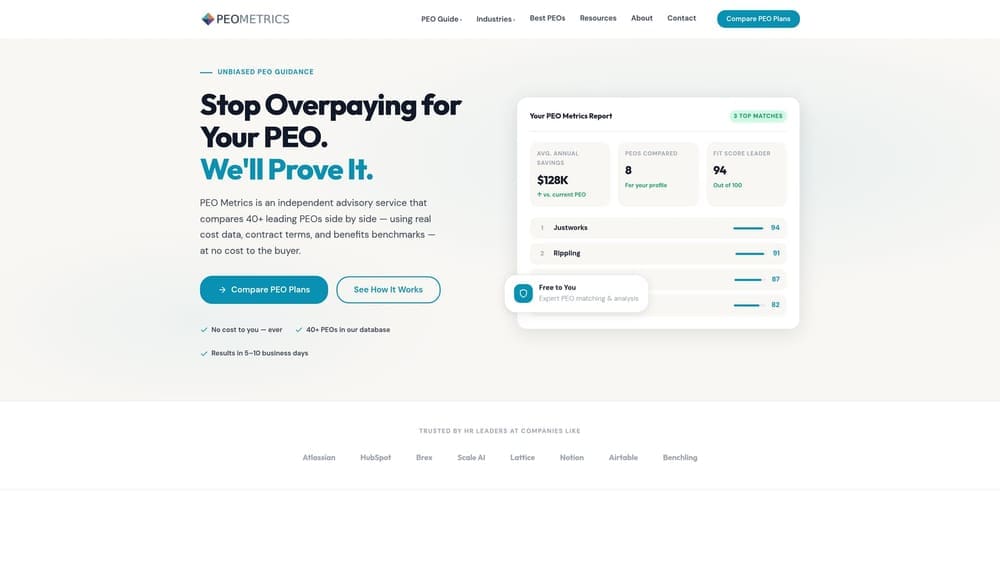
PEO Metrics is an independent PEO advisory service that compares 40+ providers side by side on cost data, contract terms, and benefits benchmarks, entirely free to the buyer.
Where This Tool Shines
Most PEO buyers go into their first quote process blind. They receive proposals in different formats, with different fee structures, and no reliable way to tell whether the number on page three is competitive or inflated by 30%. PEO Metrics solves that problem directly. Using a 12-dimension methodology built from 850+ company matches since 2019 and more than $2.1 billion in benchmarked PEO spend, the team can tell you whether a quote is fair, where the contract terms create risk, and which providers are genuinely competitive for your specific profile.
The intake takes about eight minutes. A report comes back in 5 to 10 business days. There is no vendor pitch at the end because PEO Metrics is compensated by providers only when a match is made, which means the incentive is to find the right fit, not the highest-margin referral. That structure is rare in the advisory space and worth understanding before you trust any comparison source.
Key Features
12-Dimension Methodology: Evaluates each PEO across cost, contract terms, benefits quality, compliance support, technology, and more, rather than relying on feature checklists alone.
Benchmarked Spend Data: More than $2.1 billion in PEO spend benchmarked across 850+ company matches since 2019, giving the team real pricing context most buyers never access.
Side-by-Side Comparisons: Produces a structured comparison of the providers that fit your headcount, industry, and state footprint, so you can evaluate them on the same terms.
Contract Risk Review: Flags clauses that limit flexibility, create auto-renewal traps, or obscure fee escalators before you sign.
Fast Turnaround: Report delivered in 5 to 10 business days after an approximately eight-minute intake, with no lengthy discovery calls required to get started.
Best For
First-time PEO buyers who need an independent starting point. Companies facing renewal who want to know whether their current provider is still competitive. Any HR leader or CFO who has received multiple PEO quotes and cannot tell which one is actually the better deal. PEO Metrics serves companies from 10 to 2,000 employees.
Pricing
100% free to the buyer. PEO Metrics is compensated by providers only when a successful match is made.
Compare PEO Plans and get a benchmarked comparison in 5 to 10 business days.
2. Justworks
Best for: Small teams that want predictable, transparent pricing and clean group health access.
Justworks is a PEO known for publishing its per-employee-per-month pricing, a practice that remains genuinely rare in this market.
Where This Tool Shines
If you have ever tried to get a straight price out of a PEO, you know how unusual Justworks is. Published flat-rate PEPM pricing means you can actually model your costs before you talk to a sales rep. For small companies building their first benefits package, that transparency is worth real money in planning time alone.
The platform is clean and modern, onboarding is largely self-service, and the group health access is competitive for teams that could not otherwise get large-group rates on their own. Where Justworks starts to show its limits is at higher headcounts or in companies with complex HR needs. The service model is built for simplicity, which is a feature when you are small and a constraint when you grow.
Key Features
Published PEPM Pricing: Flat-rate pricing posted publicly, making budget modeling straightforward before any sales conversation.
Large-Group Health Access: Group health, dental, and vision plans that give small teams access to coverage they could not negotiate independently.
Simple Onboarding: Online-first payroll administration and employee onboarding designed for teams without a dedicated HR department.
24/7 Support: Phone, email, and Slack support channels, which matters when a payroll question comes up outside business hours.
Best For
Startups and small businesses with 10 to 100 employees that prioritize cost predictability and want a modern self-service platform. Less suited for companies with complex multi-state compliance needs or those that want a dedicated HR specialist assigned to their account.
Pricing
Published pricing starting around $59 to $99 PEPM depending on plan tier. Verify current rates directly with Justworks, as pricing can change.
3. Rippling
Best for: Remote-first or tech-forward companies that want HR and IT management in a single platform.
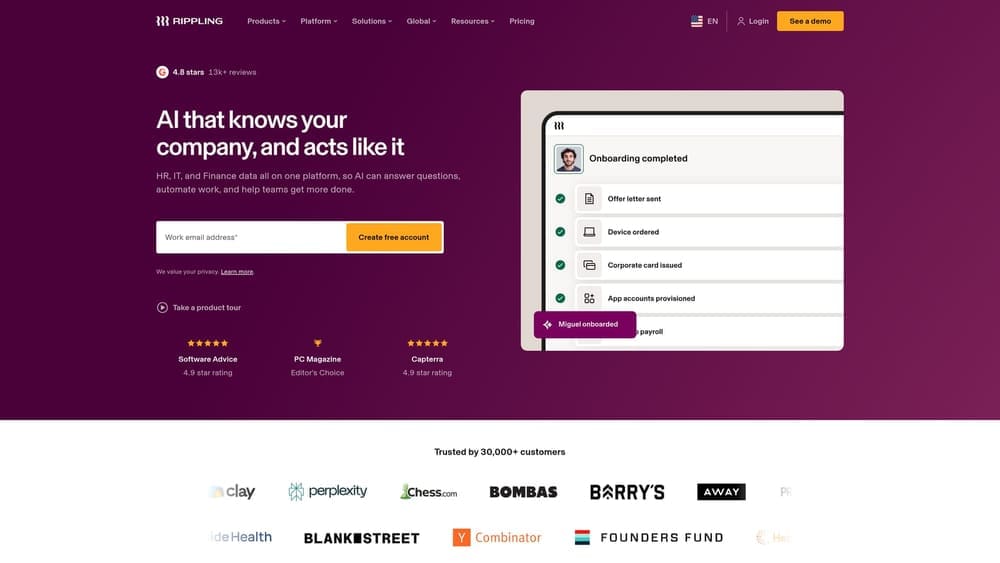
Rippling is a modular workforce platform that combines PEO services with IT management, including device provisioning and software access control.
Where This Tool Shines
Rippling built its reputation by solving a problem that most PEOs ignore entirely: the operational friction of onboarding a new employee across HR, payroll, and IT at the same time. With Rippling, you can provision a laptop, set up app access, and run payroll from the same dashboard. For remote-first companies or teams with significant technology overhead, that integration has real operational value.
The limitation is pricing. Rippling’s modular structure means the base platform is inexpensive, but costs compound quickly as you add modules. Buyers consistently report that the full-platform cost is higher than initial quotes suggest. Go in with a clear list of the modules you actually need and get a total cost estimate before you compare it to other PEO proposals.
Key Features
Unified HR and IT Management: Manages payroll, benefits, device provisioning, and software access from one platform, reducing the handoff between HR and IT teams.
Modular Architecture: Buy only the modules your company needs rather than paying for a bundled service package.
Onboarding and Offboarding Automation: Automated workflows that handle the repetitive steps of bringing someone on or off your systems.
Remote Team Support: Built with distributed teams in mind, including international workforce tools beyond the PEO layer.
Best For
Tech companies, remote-first teams, and growth-stage startups that want HR and IT in one place. Less suited for companies that want a dedicated HR advisor relationship or that find modular pricing hard to budget.
Pricing
Modular pricing; base platform starts at $8 PEPM with add-on costs per module. Verify current rates with Rippling directly, and ask for a total-cost estimate across all modules you plan to use.
4. Insperity
Best for: Midsize companies that want genuine HR partnership and are willing to pay for it.
Insperity is one of the largest PEOs in the US, known for its dedicated HR specialist model and a proprietary benefits pool that can deliver competitive group health rates.
Where This Tool Shines
Insperity’s differentiator is the dedicated HR specialist. Not a call center, not a ticketing system: an actual named person who knows your account, understands your industry, and can give substantive guidance on employment practices, compliance, and benefits strategy. For midsize companies that have outgrown the self-service model but are not ready to build a full internal HR team, that relationship has real value.
The tradeoff is cost. Insperity consistently prices at the higher end of the market, and for cost-sensitive small businesses, that premium is hard to justify. If you are comparing Insperity to a lower-cost PEO, the question is whether the HR specialist model and benefits pool quality are worth the delta. That is exactly the kind of comparison PEO Metrics can run for you against verified benchmarks.
Key Features
Dedicated HR Specialist: A named HR professional assigned to your account, not a shared service queue.
Proprietary Benefits Pool: Large-group health rates through Insperity’s own benefits pool, which can be competitive for midsize employers.
Employment Practices Guidance: Substantive compliance support including employment practices liability guidance, not just payroll administration.
Workday-Powered Technology: HR technology platform built on Workday infrastructure, which is a meaningful step up from many competitors.
Best For
Companies with roughly 50 to 500 employees that want an HR partner, not just a payroll processor. Not the right fit for cost-sensitive small businesses or companies that want a self-service digital experience.
Pricing
Not published. Quote-based, and typically on the higher end of the PEO market. Request a quote directly from Insperity.
5. ADP TotalSource
Best for: Companies already in the ADP ecosystem that need multi-state compliance coverage.
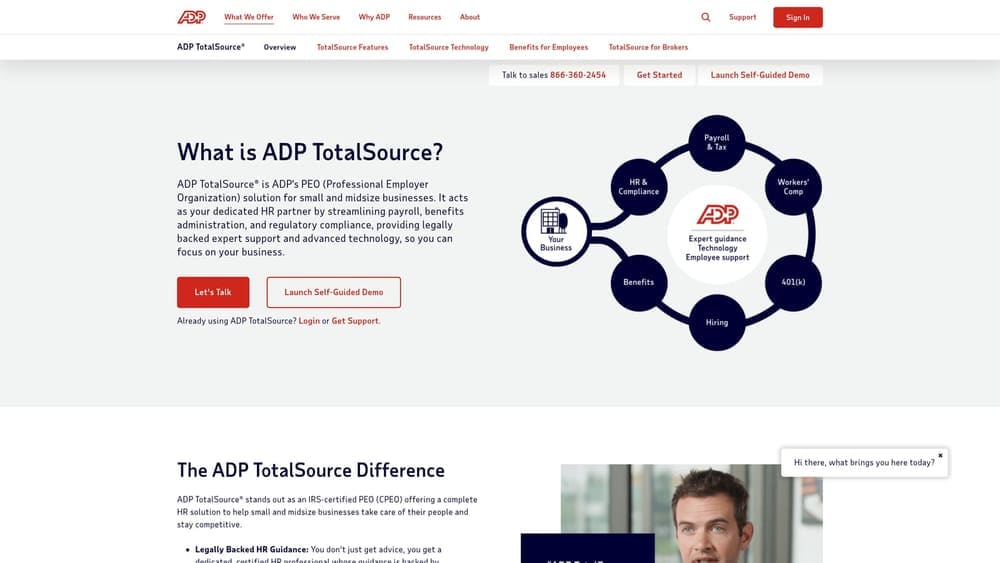
ADP TotalSource is ADP’s full-service PEO offering, built on the company’s payroll infrastructure with broad multi-state compliance capability across all 50 states.
Where This Tool Shines
ADP’s core strength is scale. If you are running payroll in multiple states, dealing with varying SUTA rates, and managing compliance across different regulatory environments, ADP TotalSource has the infrastructure to handle it. The integration with ADP’s existing payroll and HR systems is also a genuine advantage for companies already using ADP products, since it reduces the migration friction that comes with switching to a new PEO platform.
The honest limitation is service consistency. ADP TotalSource operates through regional offices, and the account management experience varies significantly depending on which office handles your account. Some buyers report strong, responsive HR business partners. Others describe slow response times and high turnover on their account teams. That variability is worth asking about directly when you evaluate a quote.
Key Features
ADP Payroll Integration: Deep integration with ADP’s payroll and HR systems, reducing friction for companies already on ADP platforms.
Multi-State Compliance: Coverage across all 50 states, with compliance support for companies with employees in multiple jurisdictions.
Large-Group Benefits Access: ADP’s purchasing pool provides access to group health, dental, and vision plans at scale.
HR Business Partner Model: Dedicated HR business partner support for larger accounts, though quality varies by region.
Best For
Companies with 50 or more employees operating across multiple states, especially those already using ADP payroll infrastructure. Less suited for companies that want consistent, high-touch account management or that are starting fresh without existing ADP relationships.
Pricing
Not published. Quote-based, with pricing varying by headcount and service configuration. Request a quote directly from ADP TotalSource.
6. TriNet
Best for: Professional services, tech, and life sciences firms competing for white-collar talent on benefits.
TriNet is organized around industry verticals, with HR and benefits packages tailored to the talent markets of tech, finance, life sciences, nonprofits, and professional services.
Where This Tool Shines
TriNet’s vertical model means the benefits packages are designed for the talent markets where your company actually competes. A software company using TriNet gets health plan options calibrated to what engineers in competitive markets expect, not a generic small-business package. That specificity matters when benefits are a recruiting tool, not just a compliance requirement.
The limitation is rigidity. If your company’s profile does not fit cleanly into one of TriNet’s defined verticals, the model can feel constraining. Pricing has historically been on the higher end of the market, and some buyers report that the vertical focus creates friction when their business spans multiple industries or shifts profile over time. TriNet is a strong fit when the vertical match is clean and a weaker one when it is not.
Key Features
Industry-Vertical HR Packages: HR and benefits structured around the specific needs of tech, finance, life sciences, nonprofits, and professional services employers.
Talent-Competitive Health Plans: Group health options designed for markets where benefits are a meaningful recruiting factor.
Vertical HR Expertise: HR team members with experience in your specific industry’s regulatory and compliance environment.
Compliance Support: Strong employment law and regulatory compliance support, particularly for professional services environments.
Best For
Professional services firms, tech companies, and life sciences employers with 25 to 300 employees in talent-competitive markets. Less suited for companies that do not fit neatly into a defined vertical or that are primarily cost-driven in their PEO selection.
Pricing
Not published. Quote-based, and historically priced at a premium relative to market averages. Request a quote directly from TriNet.
7. Paychex PEO
Best for: Small business owners who want a familiar brand, local rep access, and flexible service tiers.
Paychex PEO is backed by one of the largest payroll and HR service networks in the US, with flexible tiers ranging from basic payroll administration to full PEO co-employment.
Where This Tool Shines
Paychex’s strongest asset is its local and regional service network. If you want a rep you can call by name or meet in person, Paychex has that infrastructure in a way that most tech-first PEOs do not. The flexible service tiers also mean you can start with a lighter engagement and layer in more services as your needs grow, rather than committing to a full co-employment model from day one.
The honest limitation is the digital experience. Paychex’s platform lags behind Rippling and Justworks for self-service functionality and modern interface design. If your team expects a consumer-grade HR platform, Paychex may feel dated. It is a better fit for owners who value the human relationship over the software experience.
Key Features
Local Service Network: Large network of local and regional reps, providing in-person and phone support that tech-first competitors do not offer.
Flexible Service Tiers: Options from basic payroll processing to full PEO co-employment, allowing companies to right-size their engagement.
Workers’ Comp Pay-As-You-Go: Pay-as-you-go workers’ comp options that eliminate large upfront deposits and improve cash flow predictability.
Benefits and Retirement Access: Group health benefits and retirement plan options through Paychex’s purchasing relationships.
Best For
Small business owners with 10 to 150 employees who value local support, a recognizable brand, and flexibility in service scope. Less suited for companies that want a modern self-service platform or that prioritize digital-first HR tools.
Pricing
Not published. Quote-based, with pricing varying by service tier and headcount. Request a quote directly from Paychex.
8. Oasis (a Paychex Company)
Best for: Companies with meaningful workplace risk exposure that need strong workers’ comp pooling.
Oasis, acquired by Paychex in 2018, has historically focused on risk management and workers’ comp pooling for employers with above-average workplace risk profiles.
Where This Tool Shines
Before the Paychex acquisition, Oasis built a reputation in workers’ comp pooling and risk management that was genuinely differentiated. For companies in industries where workers’ comp costs are a significant line item, access to a well-managed risk pool can produce meaningful savings compared to going direct to a carrier. That core strength is still present in the Oasis offering.
The important caveat is brand clarity. Since the 2018 acquisition, the Oasis brand has become less distinct from standard Paychex PEO services. If you are evaluating Oasis specifically for its risk management history, ask directly which services are Oasis-specific and which are simply Paychex PEO delivered under a different name. The answer matters for what you are actually buying.
Key Features
Workers’ Comp Pooling: Risk pool access with a history of serving companies with elevated workplace risk, which can lower comp costs compared to individual carrier quotes.
Paychex Infrastructure: Payroll and HR administration backed by Paychex’s systems and service network following the 2018 acquisition.
Benefits Administration: Group health benefits access and benefits administration services.
HR and Compliance Support: HR support and compliance services consistent with the broader Paychex PEO offering.
Best For
Companies with meaningful workers’ comp exposure, including light manufacturing, field services, and similar industries. Buyers should confirm exactly which services are Oasis-specific versus standard Paychex PEO before signing.
Pricing
Not published. Quote-based. Operates under Paychex infrastructure; request a quote and ask specifically which services are Oasis-branded versus standard Paychex PEO.
How Small Business Owners Can Verify PEO Trustworthiness
Verified reviews are useful, but they capture satisfaction — not financial stability, regulatory standing, or contractual reliability. Small business owners and founders evaluating PEO trustworthiness should look at a short stack of objective signals alongside review data.
Accreditation and Certification
The two most meaningful third-party quality signals in the PEO industry are ESAC accreditation (Employer Services Assurance Corporation) and IRS Certified Professional Employer Organization (CPEO) status. ESAC-accredited PEOs maintain independently audited financial standards, background checks, and compliance reviews — fewer than 10% of PEOs hold ESAC accreditation. CPEO certification from the IRS confirms the PEO meets statutory tax compliance standards. Both designations are publicly verifiable and serve as a meaningful filter before you look at anything else.
Industry Association Membership
NAPEO (National Association of Professional Employer Organizations) membership requires adherence to a code of conduct, though it is not an audit-based accreditation. It signals that a provider is operating within the organized industry rather than as an unregulated standalone. SHRM Preferred Provider designations and Better Business Bureau ratings can add additional context, though neither substitutes for ESAC or CPEO status.
Client References in Your Industry
Ask any PEO you are evaluating for references from businesses of similar size, industry, and state footprint. A provider who cannot produce references from companies like yours is either unwilling to share them or lacks that client base — both matter. Peer conversations with active clients often surface service quality issues that formal reviews do not capture, particularly around claims handling, HR responsiveness during a crisis, and exit process transparency.
Review Platforms and What to Filter For
G2, Capterra, and Trustpilot each carry small business reviews of major PEOs. When reading reviews, weight recent reviews more heavily than historical ones, filter for reviewers whose company size matches yours, and look specifically for patterns around account management responsiveness, billing transparency, and contract exit experience. A PEO with strong onboarding reviews but repeated complaints about exit fees or auto-renewals is telling you something important about how the relationship changes over time.
For founders who want a structured comparison of which providers hold ESAC accreditation, CPEO status, and have competitive client reviews for companies their size, PEO Metrics runs that filter as part of its free benchmarking service — so you are not sorting through this independently for each provider you evaluate.
Which PEO Is Actually Right for Your Company
No single PEO wins for every company, and any article that claims otherwise is selling something. The right answer depends on your headcount, industry, state footprint, and what you actually need from a co-employer.
Justworks is hard to beat for small teams that need predictable, transparent pricing. Insperity earns its premium for midsize companies that want genuine HR partnership. ADP TotalSource makes sense if you are already in their ecosystem and need multi-state coverage. TriNet is the right call for professional services firms competing for white-collar talent on benefits. Rippling suits tech-forward teams that want HR and IT in one place. Paychex and Oasis serve buyers who want a familiar brand with local support and risk management depth.
But knowing which category you fall into is the starting point, not the finish line. The actual question is whether the quote in front of you is competitive for your specific profile. That requires verified benchmark data, not a feature comparison chart.
PEO Metrics has tracked 40+ PEOs across 850+ company matches since 2019, benchmarking more than $2.1 billion in PEO spend. The intake takes about eight minutes. A report comes back in 5 to 10 business days. Before you sign that renewal or commit to a new provider, it is worth knowing whether the number on the proposal is fair.
Many businesses overpay because of bundled fees, hidden administrative markups, and contracts designed to limit flexibility. A side-by-side comparison of pricing, contract terms, and service quality gives you the context to make a confident decision rather than an expensive guess.
Don’t auto-renew. Make an informed, confident decision.
Before you sign that PEO renewal, make sure you’re not leaving money on the table.
Many businesses unknowingly overpay because of bundled fees, hidden administrative markups, and contracts designed to limit flexibility. We give you a clear, side-by-side breakdown of pricing, services, and contract terms—so you can see exactly what you’re paying for and choose the option that truly fits your business.
