

Running an oilfield services company with around 50 employees puts you in a genuinely awkward position with most PEO providers. You’re large enough to have complex HR and workers’ compensation needs, but small enough that many enterprise-focused PEOs will either overlook you or quote rates designed for much larger accounts.
Add the industry-specific complications of high-hazard workers’ comp class codes, rotating field crews across multiple states, DOT compliance obligations, and headcount that swings with project cycles, and the wrong PEO choice can cost you significantly. Not just in fees, but in coverage gaps and administrative headaches you won’t discover until something goes wrong.
This guide covers eight PEO providers and one comparison resource worth evaluating if you operate in oilfield services at roughly the 50-employee mark. Selection criteria include high-hazard industry experience, workers’ comp handling, payroll flexibility for field workers, and transparency in pricing.
1. PEO Metrics
Best for: Oilfield services companies that want an independent comparison before committing to a provider.
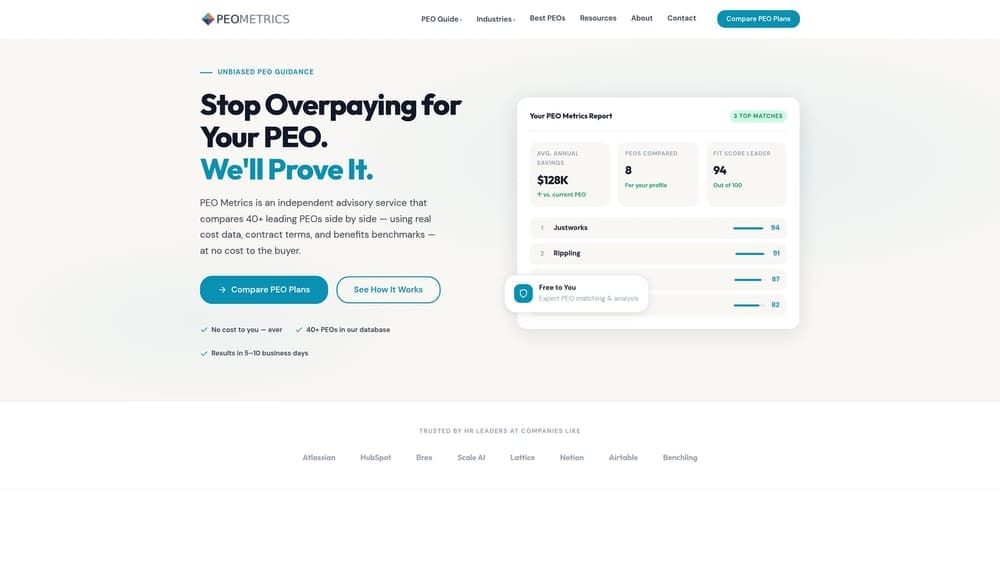
PEO Metrics is a comparison service that helps businesses evaluate PEO providers side-by-side using detailed pricing and capability data, before signing anything.
Where This Tool Shines
If you’re at the 50-employee mark in oilfield services, you’re exactly the kind of company that benefits most from a structured comparison process. The PEO market is not transparent by design. Providers quote custom rates, bundle fees in different ways, and rarely make apples-to-apples comparison easy. PEO Metrics exists to cut through that.
For oilfield operators specifically, the platform’s consultative approach helps identify which PEOs are actually equipped to handle your workers’ comp class codes and field workforce payroll, rather than which ones will accept your business on paper and then create problems at renewal. If you’ve ever been declined by a standard PEO because of your class codes, this kind of pre-screening is worth doing before you invest time in a formal sales process. The article on top PEO providers for workers’ compensation insurance is a useful companion read.
Key Features
Side-by-Side Provider Comparisons: Breaks down pricing structures and capabilities across multiple PEO providers so you can evaluate them on consistent terms.
Industry-Specific Guidance: Addresses high-hazard workers’ comp considerations relevant to oilfield and energy-sector employers.
Class Code and Payroll Screening: Helps identify which PEOs can handle oilfield-specific class codes and multi-state field workforce payroll without manual workarounds.
Consultative Transparency: Focused on finding the right fit rather than defaulting to the provider with the highest placement fee.
Designed for Mid-Market Companies: Particularly useful for companies at roughly 50 employees who are often underserved by enterprise-focused PEOs.
Best For
Oilfield services companies that are shopping for their first PEO, reconsidering a current provider at renewal, or trying to understand whether they’re overpaying. Also useful for companies that have been declined by standard PEOs and aren’t sure where to turn next. Note that PEO Metrics may receive vendor placement fees from providers.
Pricing
Contact PEO Metrics directly for details. The comparison service is consultative in nature. PEO Metrics may receive vendor placement fees from providers in its network.
2. Insperity
Best for: Oilfield services companies that prioritize strong group benefits and a structured HR service model.
Insperity is a publicly traded, CPEO-certified full-service PEO known for large group benefits access and dedicated HR support teams.
Where This Tool Shines
At 50 employees, one of the most tangible advantages a PEO can offer is access to large-group health benefits that you couldn’t negotiate on your own. Insperity’s buying power in this area is one of its most frequently cited strengths. For oilfield services companies trying to compete for field talent in remote locations, that can matter more than it does in other industries.
Insperity uses dedicated HR service teams rather than a rotating call-center model. For a company with complex payroll situations, multi-state workers, and compliance questions that don’t fit a standard script, having a consistent point of contact is a real operational advantage. That said, buyers in high-hazard industries should verify directly with Insperity whether their specific workers’ comp class codes are covered under the master policy before moving forward.
Key Features
CPEO Certification: Carries specific tax liability and co-employment implications that can benefit clients. Worth understanding before signing.
Large Group Benefits Access: Buying power that can improve health plan options for a 50-person workforce relative to going to market independently.
Dedicated HR Service Teams: Named or assigned HR contacts rather than a general support queue.
Multi-State Payroll Processing: Handles payroll across multiple states, relevant for companies deploying crews across different jurisdictions.
Integrated HR Technology: Platform covering time tracking, benefits administration, and HR data in one system.
Best For
Oilfield services companies where benefits competitiveness is a top priority and where the workforce includes a mix of field-based and office-based employees. Companies with relatively stable headcount will get more value here than those with high project-cycle volatility.
Pricing
Custom pricing. Contact Insperity directly for a quote. No verified public rate is available.
3. TriNet
Best for: Companies with a mixed workforce that need a technology-forward platform and industry-specific HR packages.
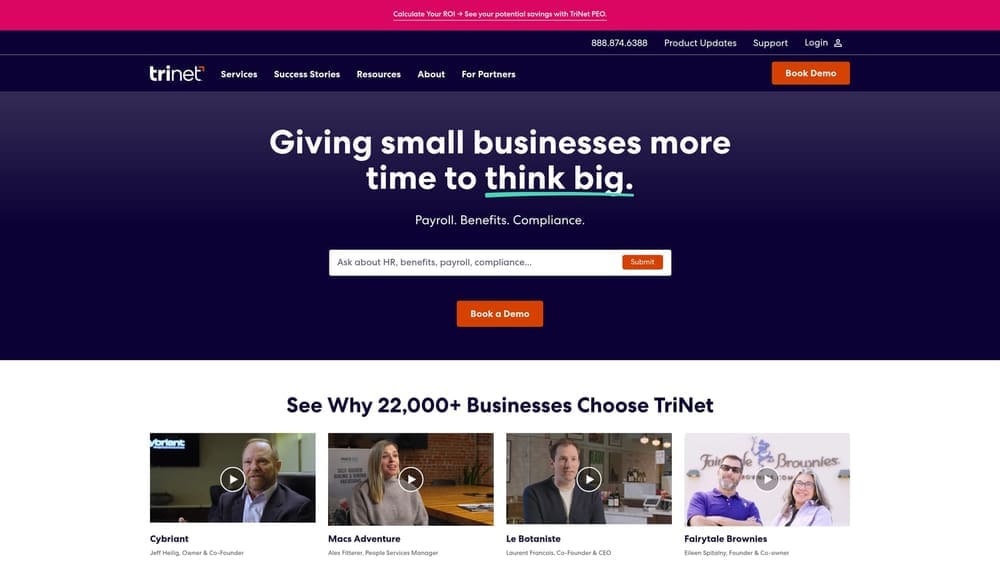
TriNet is a publicly traded, CPEO-certified PEO offering industry-vertical HR packages and a consolidated platform for payroll, benefits, and compliance.
Where This Tool Shines
TriNet’s industry-vertical approach means it packages HR services around specific workforce types rather than offering a one-size-fits-all model. For oilfield services companies that have both office-based administrative staff and field crews with different payroll structures and compliance requirements, that flexibility can reduce the friction of managing two very different employee populations through a single provider.
The technology platform is a genuine strength. If your HR team is small or your operations manager doubles as the HR lead, having payroll, benefits enrollment, and compliance tracking in one place reduces the administrative load. As with any PEO in this space, you’ll want to confirm workers’ comp class code acceptance directly before engaging their sales process.
Key Features
CPEO Certification: Established compliance infrastructure with tax co-employment implications for clients.
Industry-Vertical HR Packages: Designed around different workforce types rather than a generic HR bundle.
Consolidated Technology Platform: Payroll, benefits, and compliance management in a single system.
Broad Benefits Options: Health, dental, vision, and 401(k) plan access included in the co-employment model.
Mixed Workforce Support: Suited to companies managing both office-based and field-based employees under the same provider.
Best For
Oilfield services companies with a meaningful office-side operation alongside field crews, where a technology-forward HR platform would reduce administrative burden. Also worth evaluating if your HR function is lean and needs a system that handles multiple tasks without manual coordination.
4. Oasis by Paychex
Best for: Companies already using Paychex payroll that want to expand into a full co-employment model.
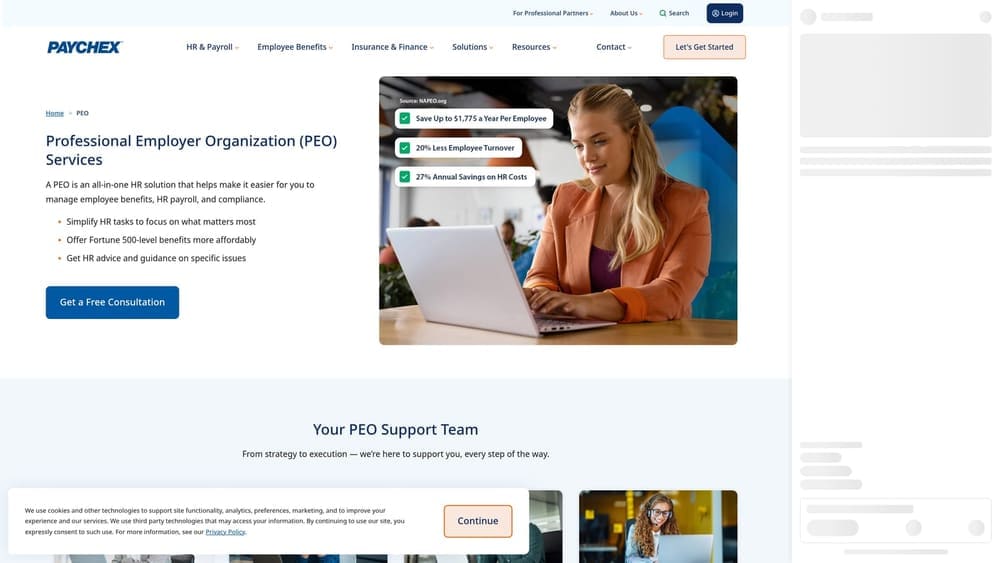
Oasis by Paychex is Paychex’s PEO offering, built on one of the largest payroll processing infrastructures in the US and covering co-employment, benefits, and compliance.
Where This Tool Shines
Paychex built its reputation on payroll processing at scale, and Oasis inherits that infrastructure. For oilfield services companies operating across multiple states, that matters. Multi-state payroll is one of the more error-prone areas in HR administration, particularly when you’re dealing with state-specific withholding rules, varying workers’ comp rates by state, and per diem structures for field crews. Broad, proven infrastructure reduces the likelihood of costly errors.
If your company already uses Paychex for payroll, transitioning to Oasis can be relatively straightforward compared to switching platforms entirely. That familiarity has real operational value. The caveat, as with other large PEOs, is that high-hazard workers’ comp class code acceptance should be verified explicitly before assuming coverage.
Key Features
Paychex Payroll Infrastructure: Broad multi-state processing capability built on an established national payroll platform.
Co-Employment Model: Full co-employment structure with access to group benefits plans.
Integrated HR Technology: Time, attendance, and compliance tools integrated with payroll processing.
Existing Client Continuity: Familiar option for companies already running payroll through Paychex.
Nationwide Coverage: Relevant for oilfield operators deploying crews across state lines on project rotations.
Best For
Oilfield services companies that already have a relationship with Paychex and want to add co-employment benefits and HR support without a full platform migration. Also worth evaluating for companies where multi-state payroll complexity is the primary operational pain point.
Pricing
Custom pricing. Contact Paychex directly for a PEO quote. No verified public rate is available.
5. Engage PEO
Best for: Smaller oilfield companies that need hands-on compliance support, particularly around labor law and employment practices.
Engage PEO is known for its attorney-led HR support model, providing compliance guidance that goes beyond what a standard HR generalist can offer.
Where This Tool Shines
Most PEOs staff their HR support with generalists. Engage PEO’s differentiator is that its HR support is attorney-led, which changes the quality of guidance you get on employment practices, labor law questions, and regulatory compliance. For oilfield services companies navigating state-specific labor law complexity across multiple jurisdictions, that distinction is meaningful.
Engage PEO tends to target smaller companies that need more intensive, hands-on support than a large national PEO typically provides. If you’re at 50 employees and your HR function is essentially one person or part of someone’s job, having access to attorney-backed HR guidance can prevent the kind of compliance mistakes that become expensive employment claims. This is a good option to evaluate if regulatory exposure is a top concern alongside workers’ comp.
Key Features
Attorney-Led HR Support: Compliance guidance backed by employment law expertise rather than generalist HR knowledge.
Labor Law and Employment Practices Guidance: Hands-on support for navigating state-specific and federal employment obligations.
Targeted at Smaller Employers: Service model suited to companies that need more intensive support than large PEOs typically provide.
Full Co-Employment Model: Benefits administration and payroll processing included alongside compliance support.
Multi-State Compliance: Useful for oilfield companies facing varying labor law requirements across operating states.
Best For
Oilfield services companies where employment law compliance is a significant concern, particularly those with workforce situations that generate above-average legal exposure. Also a strong candidate for owner-operated companies without dedicated in-house HR or legal staff.
6. Employer Flexible
Best for: Texas and Gulf Coast oilfield services companies that prefer a regional PEO with local market knowledge.
Employer Flexible is a Texas-based PEO with regional experience in Gulf Coast and Texas markets where oilfield services activity is concentrated.
Where This Tool Shines
National PEOs know Texas employment law the way someone knows a city from reading about it. A Texas-based PEO like Employer Flexible knows it from operating in it. That includes familiarity with Texas workers’ comp requirements, which operate differently from most states given Texas’s non-subscriber system, and the specific labor market dynamics of Gulf Coast oilfield regions.
For companies whose operations are concentrated in Texas or the Gulf Coast, the regional focus also means you’re not paying for national infrastructure you don’t use. The service model is oriented toward mid-sized regional employers, which maps well to an oilfield services company at the 50-employee mark. If your crews rarely cross state lines, a regional PEO may offer better fit and more attentive service than a large national provider.
Key Features
Texas and Gulf Coast Regional Focus: Operational familiarity with the markets where oilfield services activity is concentrated.
Texas Workers’ Comp Knowledge: Familiarity with Texas-specific workers’ comp requirements, including the state’s non-subscriber framework.
Full HR and Payroll Administration: Co-employment structure covering HR, payroll, and benefits administration.
Mid-Sized Employer Service Model: Dedicated service orientation suited to regional employers rather than large enterprise accounts.
Local Market Preference: A practical option for companies that value local knowledge over national brand recognition.
Best For
Oilfield services companies primarily operating in Texas or the Gulf Coast that want a PEO with genuine regional familiarity rather than a national provider applying generic processes to a Texas-specific situation.
Pricing
Custom pricing. Contact Employer Flexible directly for a quote. No verified public rate is available.
7. G&A Partners
Best for: Owner-operated or closely held oilfield services companies in Texas and the Southwest that want a relationship-driven service model.
G&A Partners is a Texas-headquartered PEO with a relationship-focused approach and familiarity serving energy-sector employers in Texas and the Southwest.
Where This Tool Shines
G&A Partners occupies a specific niche: a regional PEO with energy-sector experience and a service model built around dedicated HR advisors rather than a generalized support queue. For owner-operated oilfield services companies, that distinction matters. When you have a payroll question or a workers’ comp issue, you want to talk to someone who knows your account, not explain your situation from scratch to whoever picks up.
The energy-sector client familiarity also means G&A Partners has likely encountered the kinds of HR situations that come up in oilfield services, from managing rotating field crews to handling the compliance side of project-based staffing fluctuations. That institutional knowledge is harder to quantify than a feature list but often more valuable in practice. Companies considering G&A Partners and Employer Flexible should evaluate both, as they serve overlapping markets with somewhat different service philosophies.
Key Features
Texas and Southwest Regional Focus: Geographic and market familiarity with energy-sector employers in the region.
Dedicated HR Advisors: Named advisors rather than a general support queue, providing continuity in the service relationship.
Full Co-Employment Model: Payroll, benefits, and compliance covered under a standard co-employment structure.
Energy-Sector Client Base: Experience with employers in the oilfield and broader energy industry.
Personalized Service Orientation: Positioned as a relationship-driven alternative to large national PEOs.
Best For
Owner-operated or closely held oilfield services companies in Texas and the Southwest where the owner or a small management team handles most business decisions and wants a PEO that functions as a genuine partner rather than a vendor processing transactions.
Pricing
Custom pricing. Contact G&A Partners directly for a quote. No verified public rate is available.
8. Vensure Employer Services
Best for: Oilfield services companies that have been declined or quoted unfavorably by other PEOs due to high-hazard workers’ comp class codes.
Vensure Employer Services is a PEO known for accepting a broader range of industries, including those with high-hazard workers’ comp classifications that other PEOs decline.
Where This Tool Shines
Workers’ comp class code acceptance is one of the most common barriers oilfield services companies face when shopping for a PEO. Well drilling, pipeline construction, equipment operation, and related activities carry high-hazard NCCI class codes that many standard PEO master policies either exclude or price so aggressively that the co-employment model stops making financial sense. Vensure’s broader industry acceptance makes it a practical option when you’ve already been turned down elsewhere.
Vensure has grown significantly through acquisitions, which has expanded its service footprint and its capacity to take on industries that more selective PEOs avoid. That growth-through-acquisition model means the service experience can vary depending on which part of the organization you’re working with, so asking specific questions about your assigned service team and their familiarity with oilfield operations is worth doing during the evaluation process. For more context on how class codes work under co-employment, the article on workers’ comp class code restructuring under a PEO is worth reading before your conversations with any provider.
Key Features
Broad Industry Acceptance: Willing to work with higher-risk and high-hazard classifications that many PEOs decline.
High-Hazard Class Code Access: A primary differentiator for oilfield companies that have been turned down by standard PEOs.
Expanded Service Footprint: National reach built through acquisitions, providing broad geographic coverage.
Last-Resort or First-Call Option: Worth evaluating early if workers’ comp class code acceptance is the primary barrier to finding a PEO.
Best For
Oilfield services companies whose specific workers’ comp class codes have created barriers with other PEOs, and companies that have already been declined or received unfavorable quotes and need a provider with more flexible underwriting criteria.
Choosing the Right PEO for Your Oilfield Services Company
No single provider on this list is the right answer for every oilfield services company at 50 employees. The right choice depends on where your operations are concentrated, what your workers’ comp situation looks like, and what you need most from a PEO relationship.
Here’s a practical starting point by situation:
If you want an unbiased comparison before committing: Start with PEO Metrics. Getting a side-by-side view of pricing and capabilities before you’re deep in a vendor sales process is the most cost-effective thing you can do at this stage.
If you’re primarily Texas or Gulf Coast-based: Evaluate Employer Flexible and G&A Partners. Both have regional familiarity that national providers can’t replicate, and both are oriented toward mid-sized employers rather than enterprise accounts.
If workers’ comp class code acceptance is your primary barrier: Put Vensure at the top of your evaluation list. That’s specifically where they differentiate from the standard PEO market.
If benefits competitiveness is your biggest recruiting challenge: Insperity’s large-group buying power is worth evaluating, particularly if you’re trying to offer competitive health coverage to field workers in remote locations.
If compliance exposure keeps you up at night: Engage PEO’s attorney-led support model is worth a conversation, especially if your HR function is thin and you’re operating across multiple states with different labor law requirements.
Before you make any final decision, take time to understand how workers’ comp class codes are handled under co-employment. The article on top PEO providers for workers’ compensation insurance covers this in detail and is worth reading before your first vendor call.
This content is informational and does not constitute individualized legal, tax, or benefits advice. PEO Metrics may receive vendor placement fees from providers in its network.
Don’t auto-renew. Make an informed, confident decision.
Before you sign that PEO renewal, make sure you’re not leaving money on the table.
Many businesses unknowingly overpay because of bundled fees, hidden administrative markups, and contracts designed to limit flexibility. We give you a clear, side-by-side breakdown of pricing, services, and contract terms, so you can see exactly what you’re paying for and choose the option that truly fits your business.
