
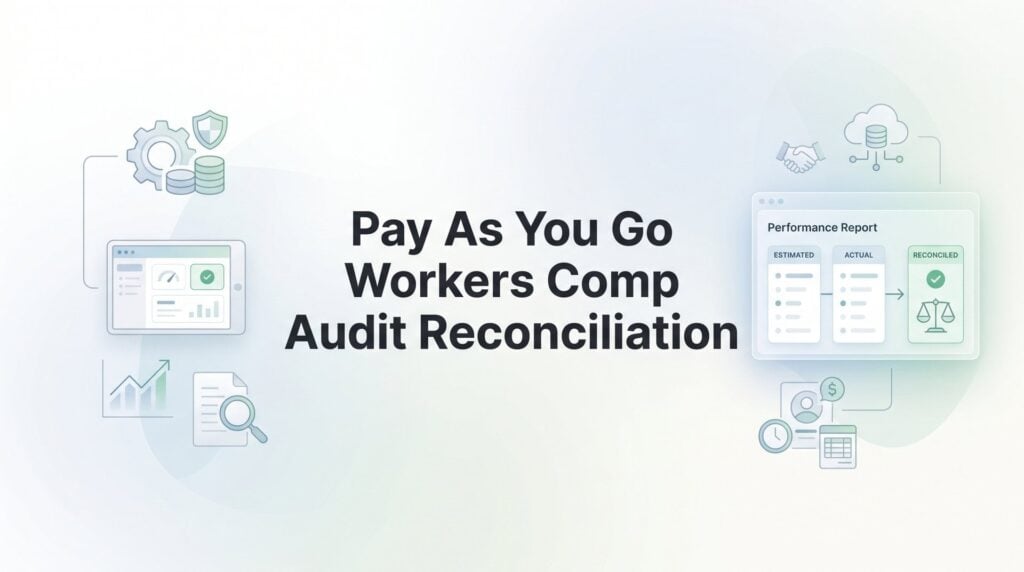
A lot of business owners switch to pay-as-you-go workers comp expecting the year-end audit to disappear. The logic makes sense on the surface: if you’re paying premiums in real time based on actual payroll, what’s left to reconcile? Turns out, quite a bit.
The audit doesn’t go away. What changes is the size of the potential swing. And if you’re not managing the underlying data carefully throughout the year, you can still walk into a reconciliation process with a meaningful bill waiting for you — even under a pay-as-you-go structure.
This article is specifically about the reconciliation mechanics: what actually happens during a pay-as-you-go workers comp audit, why discrepancies still occur, and what you can do to keep the surprises small. If you’re newer to how PEO workers comp structures work in general, you’ll want to start with a foundational overview before diving into this level of detail. But if you already understand the basics and want to know what to watch for at reconciliation time, you’re in the right place.
The Audit Isn’t Optional — It’s Built Into the Policy
Pay-as-you-go workers comp is a payment structure, not a different type of policy. The underlying workers comp policy still has all the same carrier requirements, including an annual audit. That distinction matters because a lot of business owners conflate the payment method with the compliance structure.
Here’s what pay-as-you-go actually does: instead of paying a large estimated premium upfront at the start of the policy year and then getting a big true-up bill (or credit) at the end, you’re paying smaller premium amounts tied to each payroll run. Your premium tracks your actual payroll in near real time. That’s genuinely better for cash flow and it does reduce the magnitude of year-end adjustments in most cases.
But the carrier still needs to verify, at the end of the policy period, that what you reported throughout the year actually matches your real payroll exposure. That verification is the audit. It’s not optional, and it’s not something your PEO or broker can waive on your behalf. Understanding the full pay-as-you-go workers comp model helps clarify why the audit remains a requirement regardless of payment method.
The comparison to the traditional deposit model is worth spelling out. Under the old-school approach, you’d estimate your annual payroll at the start of the year, pay a lump-sum deposit based on that estimate, and then get hit with a potentially large reconciliation bill if your actual payroll came in higher than projected. The year-end surprise could be substantial — sometimes tens of thousands of dollars for a mid-sized employer.
Pay-as-you-go narrows that gap significantly because the premium is being adjusted with every payroll cycle. If your payroll goes up in Q3 due to seasonal hiring, your premium goes up with it in Q3 — not all at once in January when the audit closes. The audit adjustment at year-end is typically smaller because you’ve been tracking closer to actual all year long.
The PEO context adds another layer. When you’re running workers comp through a PEO, the PEO is usually the policyholder on a master workers comp policy that covers all their client companies. The reconciliation mechanics may look different from a standalone policy — the PEO handles the reporting to the carrier, and your payroll data feeds into that process. That’s an important distinction we’ll come back to, because it shifts where the data accuracy burden lives.
What the Reconciliation Process Actually Looks Like
The timeline is fairly consistent across carriers and PEO arrangements. The policy period ends, the carrier or PEO initiates the audit, payroll records get compared against what was reported and paid throughout the year, adjustments are calculated, and you receive either an additional premium bill or a credit for overpayment. Having a clear understanding of audit timeline planning helps you prepare for each phase of this process.
The window between policy end and audit completion varies. Some carriers move quickly; others take several months. If you’re in a PEO arrangement, the PEO typically manages this process on your behalf, but you should still understand what’s being reviewed.
Auditors are looking at a specific set of data points. Total payroll by class code is the primary one. Every employee and covered worker needs to be assigned to a workers comp class code that reflects the nature of their work, and the premium rate varies significantly by code. A clerical employee and a roofing laborer are not in the same class code, and they shouldn’t be paying the same rate.
Subcontractor certificates of insurance are another major audit item. If you use subcontractors and they carry their own workers comp coverage, their payments to you are typically excluded from your payroll exposure. But if they don’t have valid coverage — or if you can’t produce a current certificate of insurance — the auditor may include their payments in your payroll total and charge you accordingly. More on this in a moment.
Overtime calculations are also reviewed, and this is where state-specific rules create real complexity. Many states allow the overtime premium portion of wages to be excluded from workers comp payroll calculations. That means if an employee earns $20/hour straight time and $30/hour for overtime, only the $20 base rate applies to the overtime hours for premium calculation purposes. If your payroll system isn’t set up to break this out correctly, you may be overpaying — or the auditor may flag a discrepancy.
Mid-year changes get scrutinized too. If you added a new job function, opened a location in a new state, or shifted employees into different roles during the policy year, those changes need to be reflected in your class code reporting. Auditors are specifically looking for situations where the reported class code mix doesn’t match the actual workforce composition.
Class code accuracy is consistently the biggest source of reconciliation surprises. Misclassification — whether intentional or accidental — is what drives most unexpected audit bills. Industries with mixed-role workforces are particularly vulnerable. A construction company with project managers, laborers, and office staff needs those roles clearly separated and correctly coded throughout the year, not sorted out after the fact during the audit. A solid payroll classification strategy is essential for avoiding these issues.
What Usually Causes the Unexpected Bill
If you’ve been through a reconciliation and received a larger-than-expected adjustment, it almost always traces back to one of a few common issues.
Payroll that grew faster than your reported estimates. Seasonal hiring spikes, project-based labor surges, or bonus payments that weren’t factored into your premium calculations can all push actual payroll above what was being reported. Pay-as-you-go is supposed to capture this in real time, but only if the payroll data being fed into the premium calculation is accurate and complete. If bonuses are processed separately or seasonal workers are classified incorrectly, the system doesn’t automatically catch it. Learning how to track and verify workers comp accounting through your PEO can help you identify these gaps before the audit does.
Subcontractor COI failures. This is a significant cost driver in construction, trades, and any industry that relies heavily on subcontracted labor. If a subcontractor doesn’t carry their own workers comp coverage and you didn’t collect a valid certificate of insurance before they started work, the auditor will likely add their payments to your payroll exposure. That exposure gets rated at whatever class code applies to their work — often a high-hazard rate. One or two uncovered subs on a commercial project can produce a meaningful audit bill.
State-specific rule misapplication. Different states handle workers comp payroll calculations differently. Executive officer payroll caps — which limit the amount of an owner or officer’s wages that can be included in the payroll calculation — vary by state and can significantly affect your premium. Some states allow certain family members to be excluded from coverage. Overtime exclusions are handled differently across jurisdictions. If your payroll reporting doesn’t account for these state-level rules correctly, the reconciliation will surface the gap. Businesses operating across multiple states face even more complexity, which is why multi-state payroll compliance deserves careful attention.
Class code drift that wasn’t updated mid-year. Employees change roles. Companies add new service lines. A business that started the year doing primarily residential work and shifted to commercial construction mid-year may have employees in the wrong class code for the second half of the year. That drift accumulates quietly and shows up clearly during the audit.
Staying Ahead of It: Practical Disciplines That Actually Help
The businesses that come through reconciliation with minimal surprises aren’t doing anything exotic. They’re just treating payroll accuracy and class code management as ongoing operational disciplines rather than annual fire drills.
Update class codes as roles change, not at year-end. When you hire someone into a new function, or when an existing employee’s duties shift materially, update the class code assignment immediately. Notify your PEO or carrier in writing. Don’t wait for the audit to sort it out — by then, you’ve been paying the wrong rate for months, and the adjustment will reflect that.
Build a subcontractor COI tracking system. This doesn’t need to be complicated. A spreadsheet with subcontractor names, their coverage carrier, policy numbers, and expiration dates is enough to get started. The key behaviors are: collect the certificate before the sub starts any work, verify it’s actually current and lists the correct coverage, and set calendar reminders to re-verify before expiration. A lapsed certificate that slips through is just as costly as never having one. If you’re in construction and use a lot of subs, this process is non-negotiable.
Do a quarterly internal reconciliation. Pull your payroll by class code for the quarter and compare it against what’s been reported to your carrier or PEO. This takes maybe an hour if your payroll system is organized. What you’re looking for is drift: employees in the wrong code, payroll categories that aren’t being captured, new roles that haven’t been classified. Using a compliance audit checklist can help structure this quarterly review so nothing gets missed.
Understand your state’s payroll calculation rules. If you have executive officers, family members on payroll, or employees who regularly work overtime, take the time to understand how your state treats those wages for workers comp purposes. Your PEO or insurance broker should be able to walk you through this. If they can’t, that’s useful information about the quality of your current partnership.
How Your PEO Affects the Reconciliation Outcome
Under a PEO arrangement, the PEO is typically the named policyholder on the master workers comp policy. That means they’re the ones doing the reporting to the carrier, managing the audit process, and handling the reconciliation mechanics. From the carrier’s perspective, the PEO is the client — you’re a worksite employer covered under their policy. Understanding how PEO workers compensation management actually works gives you better leverage in these conversations.
This setup has real advantages. A PEO that tightly integrates payroll processing with workers comp premium calculation can reduce reconciliation gaps significantly. Because premium is calculated directly from each payroll run, there’s less room for the kind of estimation errors that cause large year-end adjustments. The data flows from payroll to premium automatically, which is the whole premise of pay-as-you-go.
But this only works if the data going into the system is accurate. The PEO can’t fix class code misclassifications they don’t know about. If your payroll data has employees in the wrong codes, or if subcontractor payments are being categorized incorrectly, the automated premium calculation just locks in the error at a faster cadence. Garbage in, garbage out — but now it’s happening every two weeks instead of once a year.
There’s also a transparency question worth asking before you sign any PEO service agreement: how does the PEO handle audit credits? If the reconciliation produces an overpayment credit, does that money come back to you, or does the PEO absorb it into their margin? This isn’t a universal problem — many PEOs pass credits through to clients clearly and promptly — but it’s not a safe assumption either. Ask the question directly, and get the answer in writing.
PEOs also vary in how they handle audit disputes. If the auditor’s findings look wrong — a class code assignment you disagree with, a subcontractor inclusion you think shouldn’t apply — your PEO should be willing to go to bat for you. Some do this well. Others treat the audit result as final and move on. Knowing your options for audit dispute resolution matters when the numbers are significant.
When Recurring Surprises Are Telling You Something Bigger
A one-time reconciliation adjustment isn’t necessarily a red flag. Businesses grow, workforce compositions shift, and occasional mismatches happen. But if you’re getting hit with meaningful audit bills year after year under a pay-as-you-go model, that’s a pattern worth paying attention to.
Persistent reconciliation surprises usually point to a systemic reporting problem, not a series of isolated errors. Either the data flowing from your payroll into the premium calculation is consistently inaccurate, or the PEO’s system isn’t capturing changes to your workforce correctly, or there’s a class code structure that was set up wrong at the beginning and never corrected. Any of these is fixable — but only if someone identifies the root cause.
Repeated issues can also signal that you’ve outgrown your current PEO’s operational capabilities. PEOs vary significantly in how well they handle complex workforce situations: multi-state employees, mixed class code workforces, heavy subcontractor use, rapid headcount changes. A PEO that works fine for a 20-person single-location business may not have the infrastructure to manage workers comp reporting accurately for a 150-person construction company operating across three states. Running a thorough workers comp renewal risk analysis before your contract renews can help you determine whether your current arrangement is still the right fit.
If you find yourself in this situation, treat it as a decision point. Persistent audit issues are a legitimate reason to compare PEO providers and evaluate whether a different partner would handle workers comp administration more effectively. The cost of switching PEOs is real, but so is the cost of absorbing unexpected audit bills every year — plus the administrative burden of managing disputes and reconciling discrepancies that shouldn’t exist in the first place.
The Bottom Line on Pay-As-You-Go Reconciliation
Pay-as-you-go workers comp is genuinely better than the traditional model for most businesses. The cash flow benefits are real, and the reduced year-end shock is meaningful. But it’s not a pass on the audit. The reconciliation still happens, and the businesses that come through it cleanly are the ones that treat payroll accuracy and class code management as year-round responsibilities.
The audit is really just a verification process. If what you reported throughout the year matches your actual payroll exposure, the adjustment is small. If there’s meaningful drift — misclassified employees, uncovered subs, unreported payroll categories — the audit surfaces it, and you pay for it.
For businesses running through a PEO, the quality of your PEO’s workers comp administration directly affects how smooth or painful this process is. A well-integrated PEO with clean data practices makes reconciliation nearly invisible. A PEO with loose reporting and unclear credit policies turns it into an annual headache.
If you’re approaching a PEO renewal and workers comp reconciliation has been a recurring friction point, that’s worth examining before you auto-renew. Don’t auto-renew. Make an informed, confident decision. Understanding what you’re actually paying for — and whether your current PEO is managing workers comp administration as effectively as they should be — is exactly the kind of analysis that prevents expensive surprises down the road.
