How PEOs work across industries like construction, healthcare, startups, and multi-state employers.
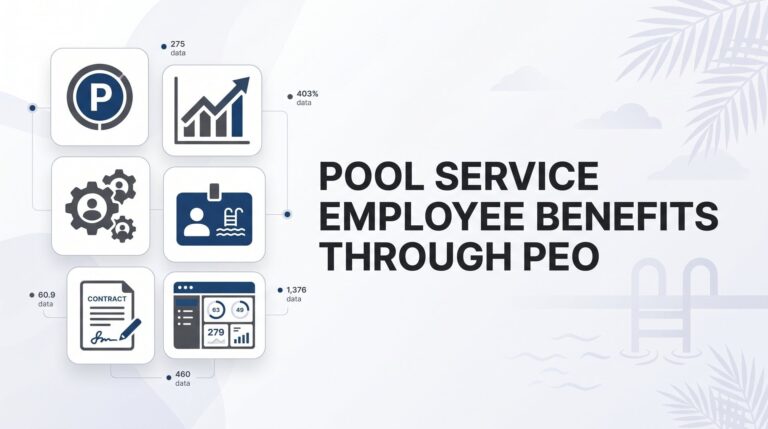
Pool service employee benefits through a PEO allow small pool companies to offer competitive health insurance and perks by pooling their technicians into a larger group, giving even a 10-15 person crew access to Fortune 500-level benefit options. This guide breaks down exactly what pool service owners gain from a PEO arrangement, what the real costs look like, and how the math actually works for seasonal, fluctuating workforces.
Pest Control PEO Payroll Services help operators manage the unique complexities of technician payroll — from multi-county workers’ comp classifications to seasonal workforce fluctuations — by bundling HR, compliance, and payroll administration under one provider. This guide breaks down exactly what these services cover, what they typically cost, and how to determine whether the investment makes financial sense for your pest control business.
Pest control PEO compliance support covers employment-related obligations like payroll taxes, workers’ comp, and HR regulations, but stops short of industry-specific requirements such as EPA pesticide licensing, FIFRA compliance, and state applicator certifications. Operators who assume a PEO handles all regulatory obligations risk leaving significant compliance gaps unaddressed in areas that fall outside the co-employment model.

Pest control employee benefits through a PEO give small pest control businesses access to competitive group health plans, retirement options, and HR support typically reserved for large companies. By pooling employees with thousands of others, a PEO helps owners attract and retain skilled technicians without the administrative burden or high costs of managing benefits independently.
Pool service PEO pros and cons come down to your company’s size, risk profile, and seasonal hiring patterns—this guide gives owners an honest breakdown of when co-employment makes financial sense and when it doesn’t, covering workers’ comp costs, payroll complexity, and the real tradeoffs of sharing employer responsibilities with a Professional Employer Organization in a high-risk, seasonal industry.

Small security guard companies face unique HR challenges that most PEOs aren’t equipped to handle. This guide outlines seven practical strategies for choosing the right Security Guard PEO for 5 Employees, focusing on workers’ comp classifications, licensing compliance, and cost structures that actually fit a small-headcount operation without overpaying for enterprise-level services you don’t need.
Pest control business owners struggling with high premiums and experience mod penalties can find relief through a Pest Control PEO Workers Compensation Program, which pools employees under a master policy to potentially lower rates. This guide cuts through the sales pitch to explain how these arrangements actually work, what they cost, and how to evaluate providers before committing.
A landscaping PEO workers compensation program can reduce costs and simplify administration for small and mid-size operators struggling with high-risk class codes and expensive standalone coverage. This guide breaks down exactly how these programs work, including rate structures, risk pooling, and claims management, helping landscaping business owners determine whether a PEO arrangement will genuinely save money or result in overpaying.
Landscaping PEO payroll services can simplify the complex payroll challenges unique to the industry—seasonal workforce fluctuations, multi-site crew management, and mixed pay structures—but whether they’re worth the investment depends on finding a provider built specifically for landscaping’s demands. This guide breaks down what these services actually handle and helps business owners determine if a PEO is the right solution for their operation.
Landscaping PEO compliance support helps seasonal employers navigate OSHA recordkeeping, ACA reporting thresholds, and multi-site HR regulations that catch most business owners off guard. This guide breaks down exactly what compliance coverage includes, how it varies between providers, and how to determine the right level of support for your operation’s size and risk exposure.
