Side-by-side comparisons between PEOs and in-house HR, ASOs, payroll providers, and staffing agencies.
The PEO with fractional HR director model combines administrative efficiency with strategic HR expertise for growing companies that have outgrown DIY HR but can’t justify a full-time director. This dual approach works when you need a PEO’s scalable infrastructure for payroll, benefits, and compliance alongside a fractional HR director’s customized guidance for talent strategy, culture development, and complex employee situations that standard PEO reps aren’t equipped to handle.
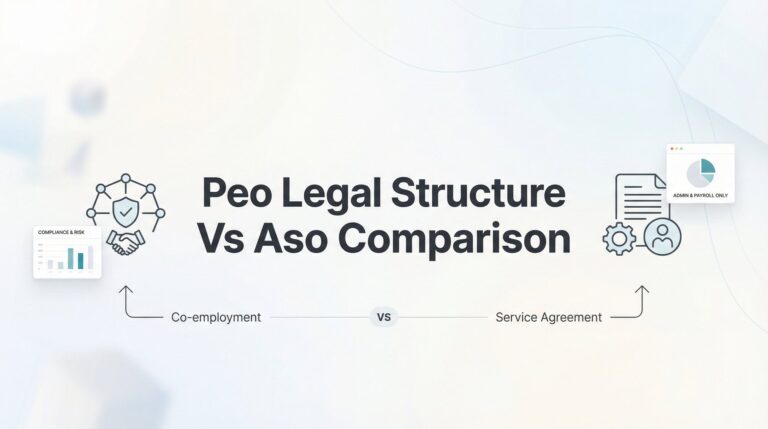
Understanding the PEO legal structure vs ASO comparison is critical when selecting outsourced HR solutions, as it determines employer liability, tax filing responsibility, and employee benefit administration. PEOs create a co-employment relationship where they become the employer of record, while ASOs maintain your sole employer status and simply handle administrative tasks—a distinction that directly impacts your risk exposure, compliance obligations, and operational control.

A PEO with insurance broker partnership is possible but depends on the PEO’s structure and your broker’s adaptability. While some PEOs require bundled master health plans that exclude brokers, others offer flexibility—though often with hidden costs. Understanding how co-employment affects your existing broker relationship is essential before committing to a PEO arrangement that may or may not accommodate the insurance partnerships you’ve already built.

Most businesses dramatically underestimate the true cost of internal HR by comparing only salary expenses against PEO quotes, missing dozens of hidden line items like compliance costs, technology, benefits administration, and risk management. This guide provides seven practical PEO vs internal HR cost modeling strategies that reveal the complete financial picture on both sides, helping companies from 15 to 200+ employees determine whether a Professional Employer Organization delivers better v…

PEO vs Employer of Record (EOR) isn’t about service differences—it’s about legal structure. PEOs create co-employment where you remain the legal employer, while EORs become the legal employer on paper. This distinction determines liability, control, costs, and exit complexity. Choose a PEO if you have legal entities where employees work; select an EOR for international hiring or markets without established entities.

PEO workers comp captive programs promise savings through risk-sharing, but they’re not the only option for reducing workers compensation costs. This guide explores seven practical peo workers comp captive alternatives—including guaranteed cost programs, self-insurance, and state funds—each with different risk profiles and cost structures to help you choose the right approach for your business without the long-term captive commitment.

At 25 employees, companies face a critical inflection point where HR tasks overwhelm part-time staff but don’t justify a full department. A PEO for 25 employees becomes worth considering when benefits costs, compliance demands, and payroll complexity consume valuable time—but choosing the right provider requires understanding the specific economics and operational fit at this headcount to avoid costly mismatches.
