
Construction compliance isn’t complicated in the way that most HR compliance is complicated. It’s complicated in the way that a multi-trade federal project with a mobile crew spanning four states is complicated. You’ve got OSHA recordkeeping questions, prevailing wage obligations, workers’ comp class codes that vary by trade, and subcontractors whose classification status is genuinely murky. Now layer a PEO co-employment relationship on top of all that, and the picture gets messier fast.
The wrong PEO won’t simplify this. It’ll add another party to every compliance question and create ambiguity about who’s responsible when something goes wrong. The right combination of tools, starting with how you select your PEO in the first place, can meaningfully reduce your exposure across all of these risk areas.
Every tool on this list addresses a specific compliance pain point that construction companies actually face in PEO arrangements. No generic HR software. No filler picks.
1. PEO Metrics
Best for: Construction companies evaluating PEO providers based on construction-specific compliance capabilities and pricing
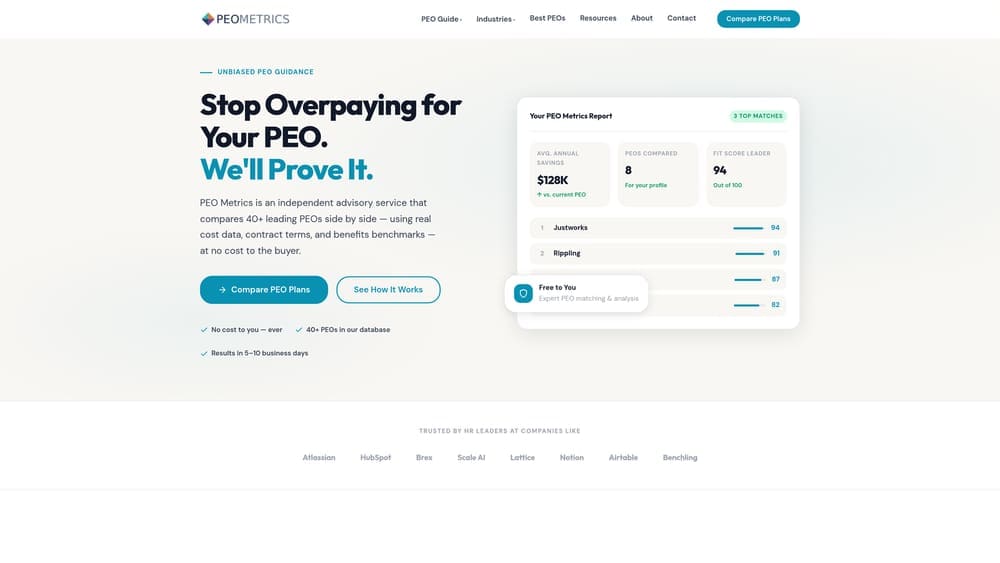
PEO Metrics is an unbiased PEO comparison platform built to help businesses evaluate providers side-by-side with real depth, not just surface-level feature lists.
Where This Tool Shines
Most PEO comparison resources are either too generic or quietly affiliated with the providers they’re recommending. For construction companies, that’s a real problem. The construction PEO market is already narrow — many general-market PEOs either decline construction clients outright or price them punitively because of workers’ comp exposure. Picking the wrong one isn’t just inconvenient, it’s expensive.
PEO Metrics focuses on the factors that actually matter for construction: how providers handle workers’ comp classification across NCCI class codes, whether they have multi-state payroll infrastructure for mobile workforces, and whether the pricing structure includes hidden compliance-related fees that show up at renewal. That specificity is what separates this from a generic “best PEO” listicle.
Key Features
Side-by-Side PEO Comparison: Construction-specific compliance metrics across multiple providers, not just benefits and admin features.
Workers’ Comp Analysis: Evaluation of how each PEO handles classification, rate management, and audit exposure across construction trades.
Multi-State Coverage Evaluation: Assesses whether a PEO can realistically support crews working across state lines without creating compliance gaps.
Pricing Transparency Analysis: Surfaces hidden administrative markups and fee structures that construction companies commonly miss during initial PEO negotiations.
Best For
Construction companies that are selecting a PEO for the first time, evaluating a renewal, or questioning whether their current provider is actually equipped to handle construction-specific compliance. Particularly useful for businesses that have outgrown a generalist PEO or have had workers’ comp audit issues.
Pricing
Free comparison service. Contact PEO Metrics directly for details on the full scope of the comparison process and what’s included.
2. Procore
Best for: Jobsite safety documentation, OSHA recordkeeping, and subcontractor compliance management
Procore is a construction management platform with compliance and safety modules that address the operational side of OSHA risk on active jobsites.

Where This Tool Shines
One of the murkiest areas in a PEO co-employment arrangement is OSHA recordkeeping. Who maintains the 300 log? Who responds to an inspection? Who carries citation liability? Procore doesn’t resolve the legal question, but it does give you a documented, defensible record of safety activity at the site level — which matters enormously if that question ever gets litigated.
The subcontractor prequalification and insurance verification module is particularly useful for construction companies managing 1099 exposure. Tracking certificate of insurance status and prequalification documents in one place reduces the risk of a subcontractor relationship being reclassified as employment after the fact.
Key Features
Jobsite Safety Inspection and Incident Tracking: Digital documentation of safety activity across projects with timestamped records.
Worker Certification Management: Tracks training completions and certification expirations so you’re not caught with an uncertified crew on a compliance-sensitive project.
OSHA Recordkeeping Support: Structured documentation workflows aligned with OSHA 300 log requirements, relevant regardless of how co-employment is structured.
Subcontractor Prequalification: Insurance verification and compliance document collection for subcontractors, reducing misclassification and liability exposure.
Best For
Mid-to-large construction companies managing multiple active jobsites who need centralized safety documentation. Especially valuable for general contractors managing layers of subcontractors where insurance and classification compliance is a constant moving target.
Pricing
Custom pricing based on annual construction volume. Typically starts in the mid-four-figure range annually. Request a demo for a specific quote.
3. LCPtracker
Best for: Certified payroll compliance and prevailing wage reporting on government-funded construction projects
LCPtracker is a purpose-built certified payroll and prevailing wage compliance platform for contractors working on Davis-Bacon and state prevailing wage projects.
Where This Tool Shines
Most PEOs are not equipped to handle certified payroll. The Davis-Bacon Act and its state-level equivalents create payroll reporting obligations that require trade-specific wage determinations, fringe benefit tracking, and WH-347 report generation — none of which fit neatly into standard PEO payroll workflows. If your PEO is running payroll but can’t produce a compliant WH-347, you have a problem.
LCPtracker fills that gap. It integrates with major payroll systems, including some PEO platforms, so you can maintain your PEO co-employment structure while still meeting the certified payroll obligations that come with public works contracts. That integration capability is what makes it relevant here rather than just another standalone compliance tool.
Key Features
Automated WH-347 Generation: Certified payroll reports generated automatically from payroll data, reducing manual error and reporting time.
Prevailing Wage Rate Lookups: Davis-Bacon and state wage determinations accessible within the platform for accurate rate application by trade and classification.
Fringe Benefit Tracking: Validates that fringe benefit contributions meet prevailing wage requirements, a common audit trigger.
Payroll System Integration: Connects with major payroll platforms, allowing PEO-processed payroll to flow into certified payroll reporting workflows.
Best For
Contractors working on federal or state-funded projects with Davis-Bacon or prevailing wage requirements. Essential for any construction company using a PEO that doesn’t natively support certified payroll reporting.
Pricing
Per-project pricing model. Contact LCPtracker directly for quotes based on project volume and complexity.
4. Arcoro
Best for: Construction-specific HR compliance, credentialing, and federal contractor reporting requirements
Arcoro is an HR and compliance platform built specifically for construction, covering onboarding, license tracking, and regulatory reporting for contractors of all sizes.
Where This Tool Shines
Construction onboarding is not like onboarding in other industries. You’re collecting trade licenses, safety certifications, OSHA cards, and compliance documents that vary by role, project, and jurisdiction. Arcoro handles this with trade-specific onboarding workflows rather than generic HR forms, which matters when you’re trying to prove compliance during an audit.
For federal contractors with EEO and OFCCP obligations, Arcoro’s reporting module is genuinely useful. These requirements don’t disappear just because you’re using a PEO, and the responsibility for maintaining compliant records often stays with the contractor regardless of co-employment structure.
Key Features
Trade-Specific Onboarding Workflows: Compliance document collection tailored to construction roles, not generic HR templates.
License and Certification Tracking: Automated renewal alerts for trade licenses and safety certifications before they lapse on active projects.
EEO and OFCCP Reporting: Compliance reporting tools for federal contractors with affirmative action obligations, maintained independently of PEO structure.
Procore Integration: Bidirectional data sharing with Procore reduces duplicate entry and keeps HR and project management records aligned.
Best For
Construction companies with federal contracts, high credential turnover, or complex onboarding requirements across multiple trades. Strong fit for companies that need to demonstrate compliance documentation during audits or prequalification reviews.
Pricing
Modular pricing, typically starting around $5 to $8 per employee per month depending on which modules are selected. Contact Arcoro for a configuration-specific quote.
5. SafetyCulture (iAuditor)
Best for: Mobile OSHA inspection documentation, corrective action tracking, and jobsite safety audit trails
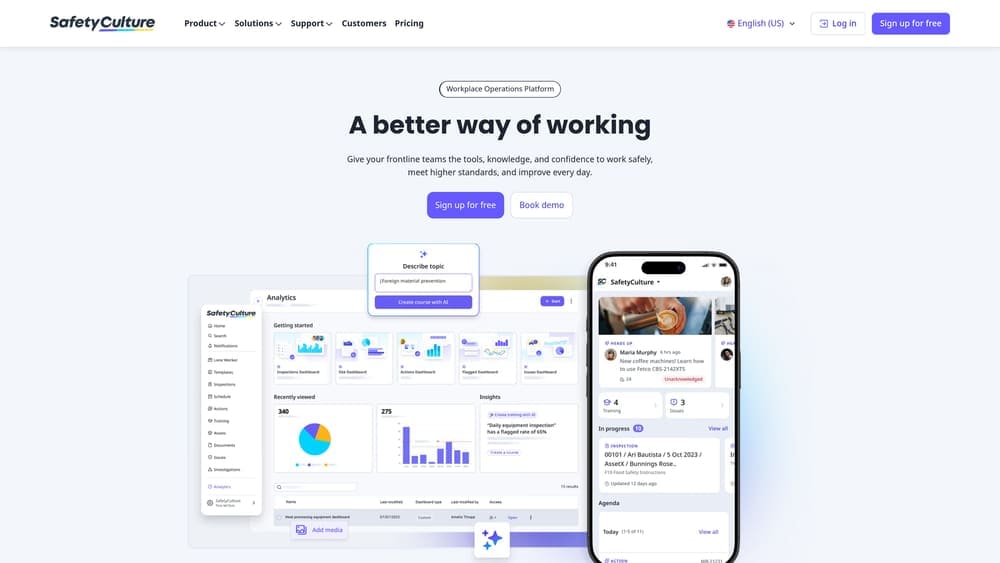
SafetyCulture is a mobile-first inspection and safety audit platform used extensively in construction for building OSHA-ready documentation at the field level.
Where This Tool Shines
The value here is in the documentation trail. If your PEO co-employment arrangement creates ambiguity about who’s responsible for OSHA compliance at a given site, having a robust, timestamped record of inspections, corrective actions, and sign-offs gives you defensible evidence of your safety program’s effectiveness. SafetyCulture makes that documentation practical for field crews who aren’t going to fill out paper forms.
The customizable checklist library is worth noting. You can build inspection templates specific to your trades, whether that’s excavation, electrical, scaffolding, or confined space work, rather than using generic safety checklists that don’t reflect your actual risk profile.
Key Features
Customizable OSHA-Aligned Checklists: Trade-specific inspection templates that can be configured for your actual jobsite conditions and risk areas.
Photo and Annotation Documentation: Visual evidence capture for jobsite conditions, tied to specific inspection items and locations.
Corrective Action Workflows: Assign, track, and close corrective actions with accountability and timestamps, creating a clear audit trail.
Safety Trend Analytics: Dashboard visibility into recurring issues across projects, useful for identifying systemic compliance gaps before they become OSHA citations.
Best For
Construction companies that need field-level safety documentation at scale. Particularly useful for companies with distributed crews where consistent inspection quality is hard to maintain without a mobile-first tool.
Pricing
Free tier available for basic use. Premium plans start at $24 per seat per month. Enterprise pricing available for larger organizations.
6. Deel
Best for: Worker classification risk management and multi-state contractor compliance
Deel is a global workforce compliance platform with contractor classification tools that address one of construction’s most persistent compliance risks: the W-2 versus 1099 boundary.
Where This Tool Shines
Construction’s reliance on subcontractors creates classification risk that doesn’t go away when you bring in a PEO. In fact, a PEO co-employment arrangement can complicate the picture further if you have workers flowing between W-2 status under the PEO and 1099 status on the same project. Deel’s classification analysis tools apply state-specific tests to your actual worker relationships, surfacing risk before it becomes an audit finding.
The Shield product, which provides liability protection against contractor misclassification claims, is a meaningful differentiator for construction companies that rely heavily on specialized trade subcontractors and can’t always draw a clean line between employee and contractor work.
Key Features
Automated Classification Risk Analysis: State-specific worker classification tests applied to your contractor relationships, flagging high-risk arrangements.
Compliance-First Contractor Agreements: Contract generation built around classification risk reduction, not just administrative convenience.
Multi-State Tax Management: Registration and withholding management across states for contractors working in multiple jurisdictions.
Shield Misclassification Protection: Liability coverage product for contractor misclassification claims, available as an add-on for higher-risk contractor relationships.
Best For
Construction companies with significant subcontractor workforces operating across multiple states. Most relevant where classification lines are genuinely ambiguous and where a misclassification finding would create meaningful financial exposure.
Pricing
Contractor management from $49 per contractor per month. Employer of Record services from $599 per employee per month. Shield pricing varies by arrangement.
7. HCSS Safety
Best for: Heavy civil and infrastructure contractors managing EMR, toolbox talks, and OSHA 300 log requirements
HCSS Safety is a safety management platform built exclusively for heavy civil, infrastructure, and highway construction, with features designed around the specific compliance needs of that sector.
Where This Tool Shines
If you’re in heavy civil, HCSS Safety is in a different category than general construction safety tools. The Experience Modification Rate tracking is particularly relevant for PEO arrangements: your EMR directly affects your workers’ comp premiums, and if your PEO is managing your workers’ comp program, understanding how your claims history is affecting your rate is critical information that many PEOs don’t proactively surface.
The toolbox talk delivery system is practical in a way that matters for field crews. Digital delivery with crew sign-off creates the documentation trail you need to demonstrate an active safety program, which is relevant both for OSHA purposes and for workers’ comp audit defense.
Key Features
EMR Tracking and Trending: Monitors your Experience Modification Rate over time, giving you visibility into how your claims history affects your insurance costs.
Digital Toolbox Talk Delivery: Crew sign-off documentation for safety meetings, creating a defensible record of safety training activity.
Near-Miss and Incident Reporting: Root cause analysis workflows that support both OSHA compliance and internal safety improvement.
OSHA 300/300A Log Management: Automated log generation and management, clarifying recordkeeping responsibilities regardless of how co-employment is structured.
Best For
Heavy civil contractors, highway builders, and infrastructure companies where the safety risk profile is distinct from vertical construction. Particularly valuable for companies where EMR directly affects bonding capacity or project prequalification.
Pricing
Custom pricing based on company size and configuration. Contact HCSS directly for a construction-specific quote.
8. Paylocity
Best for: Multi-state payroll tax compliance, job costing, and prevailing wage management outside of a PEO arrangement
Paylocity is a payroll and HCM platform with multi-state tax infrastructure and construction-relevant features that make it a viable alternative or complement to PEO-managed payroll.
Where This Tool Shines
Paylocity belongs on this list for a specific reason: sometimes the right answer to PEO compliance risk is reducing your dependence on the PEO for payroll-sensitive functions. If your PEO is struggling with multi-state tax registration, prevailing wage rate management, or job costing accuracy, Paylocity’s direct payroll infrastructure can handle those functions without requiring a full PEO relationship.
The job costing and labor distribution features are genuinely useful for project-based construction accounting, where you need payroll costs allocated accurately by project, phase, and cost code. Most PEOs provide limited visibility into this level of payroll detail.
Key Features
Multi-State Payroll Tax Automation: Registration and filing across states for mobile workforces, reducing the manual burden of multi-jurisdiction compliance.
Job Costing and Labor Distribution: Project-level payroll cost allocation for accurate construction accounting and project profitability tracking.
Prevailing Wage Rate Management: Rate tracking and reporting support for contractors with public works obligations.
Benefits Administration: Benefits management that can complement or replace PEO-administered benefits depending on your arrangement.
Best For
Construction companies evaluating whether to move certain payroll functions out of their PEO arrangement, or those looking for stronger job costing visibility than their current PEO provides. Also useful as a benchmark when negotiating PEO pricing, since Paylocity’s direct costs are often comparable to mid-market PEO administrative fees.
Pricing
Custom pricing based on employee count and selected modules. Generally competitive with mid-market PEO administrative fee structures.
Picking the Right Combination for Your Risk Profile
No single tool on this list covers everything. That’s not a flaw in the list — it reflects how construction compliance actually works. Your PEO handles co-employment and benefits. Your safety platform handles OSHA documentation. Your certified payroll tool handles Davis-Bacon. Your classification tool handles subcontractor risk. These are distinct compliance domains, and the tools that serve them well are specialized by design.
The most important starting point is still the PEO selection itself. If your PEO can’t handle construction workers’ comp classification accurately, doesn’t have multi-state payroll infrastructure, or isn’t transparent about how compliance responsibilities are divided under co-employment, no amount of supplemental tooling will fully compensate for that. Getting the foundational PEO relationship right is where the leverage is.
A few practical filters to guide your decisions:
If you work on federal or state-funded projects: LCPtracker is close to non-negotiable. Most PEOs won’t produce a compliant WH-347, and the penalties for certified payroll violations on public works projects are real.
If your crews move across state lines regularly: Multi-state payroll capability and worker classification tools (Deel, Paylocity) become high priority. Multi-state exposure is one of the most common areas where PEOs underperform for construction companies.
If you’re in heavy civil or infrastructure: HCSS Safety’s EMR tracking and OSHA log management address risks that general construction safety tools don’t handle as precisely.
If subcontractor classification is a live concern: Deel’s classification analysis and Shield product are worth evaluating, especially if you have workers moving between W-2 and 1099 status on the same projects.
Before committing to any of this, it’s worth pressure-testing your current PEO arrangement. Many construction companies are overpaying because of bundled fees, workers’ comp markups, and contract terms that limit flexibility. Don’t auto-renew. Make an informed, confident decision. A side-by-side comparison of what you’re currently paying versus what the market actually offers is often the most valuable compliance exercise a construction company can do.
