
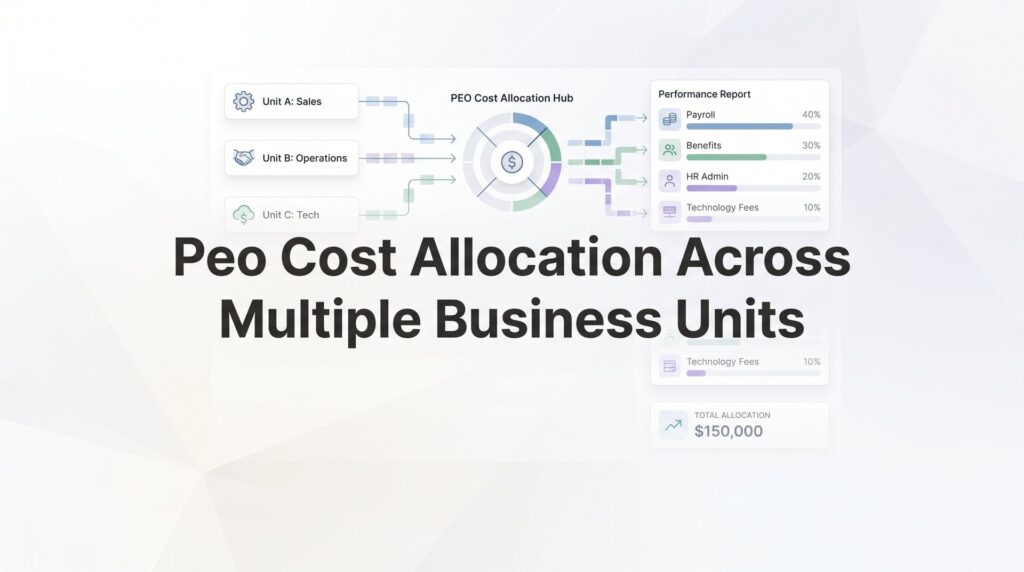
When you operate multiple business units under a single PEO relationship, the invoice arrives as one consolidated number. Your CFO wants to know what each division actually costs. Your department heads want fair allocations that don’t penalize them for someone else’s high-risk operations or expensive benefits elections. And you need a system that holds up under scrutiny without requiring a full-time analyst to maintain.
This guide walks through the exact steps to build a cost allocation framework that accurately distributes PEO expenses across your business units—whether you’re splitting costs between two locations or twenty distinct profit centers. We’ll cover the methodology decisions that actually matter, the data you need to gather, and how to handle the messy edge cases that generic advice ignores.
Before diving into allocation mechanics, understanding how PEO pricing structures work provides essential context for why certain costs allocate differently than others.
Step 1: Map Your PEO Cost Components to Allocation Categories
Your PEO invoice isn’t a single line item. It’s a collection of distinct cost types that require different allocation approaches. The first step is breaking down that consolidated number into components you can actually work with.
Start with direct costs. These are straightforward: per-employee administrative fees, workers’ compensation premiums tied to specific job classifications, and state-specific payroll taxes. These costs trace directly to individual employees and, by extension, to their business units. No allocation methodology needed—just accurate employee-to-business-unit mapping.
Then you have pooled costs. Platform fees, benefits administration overhead, compliance services, and technology access fees typically appear as flat monthly charges or percentage markups that don’t tie to specific individuals. These require allocation decisions.
Here’s where it gets tricky: some costs look direct but behave like pooled expenses. Benefits costs are the classic example. Your PEO might charge per-employee-per-month for health insurance, but if one business unit has older employees who elect family coverage while another skews young with individual plans, identical headcounts produce wildly different costs. You need to decide whether to allocate actual costs or use averaged rates. Understanding how PEO providers calculate your bill helps clarify which costs fall into each category.
Create a spreadsheet that inventories every line item on your PEO invoice. Label each as “Direct – Assign,” “Pooled – Allocate,” or “Hybrid – Decide.” That third category is where your methodology choices actually matter. A manufacturing division and a sales office might have the same headcount, but their workers’ comp experience modifiers, benefit elections, and state compliance costs differ substantially.
Document which costs vary by state, job classification, or benefit tier. These variations aren’t allocation problems—they’re reality. Your framework needs to preserve these differences, not smooth them away with blended averages that hide true unit economics.
The cost component inventory you build here becomes your allocation foundation. Get this wrong, and every subsequent step compounds the error.
Step 2: Establish Your Allocation Bases and Weighting Logic
Once you know what costs need allocation, you need to decide how to distribute them. The allocation base you choose determines whether your framework feels fair to business unit leaders or creates resentment and gaming behavior.
Headcount allocation is the simplest approach. Count employees in each business unit, divide pooled costs proportionally. It works reasonably well for platform fees and basic administrative overhead. If you have 60 employees total and Business Unit A has 20 of them, they get 33% of the pooled costs. Clean, defensible, easy to explain.
But headcount ignores payroll differences. A business unit with 10 senior engineers earning $150,000 each creates different PEO costs than a unit with 10 entry-level staff at $40,000. For costs that scale with compensation—payroll taxes, certain insurance components, percentage-based admin fees—allocate by payroll dollars, not bodies.
The workers’ comp allocation deserves special attention because it’s where most frameworks break down. Your PEO calculates workers’ comp premiums by classification code, then often presents a blended rate on the invoice. Don’t allocate using that blended rate. Go back to the classification-level detail. Learning how workers’ comp cost allocation models actually work reveals why blended rates create hidden subsidies.
If Business Unit A employs warehouse workers (high-risk classification) and Business Unit B employs office staff (low-risk), allocating workers’ comp by headcount or even payroll dollars penalizes B and subsidizes A. You need classification-specific rates applied to each unit’s actual employee mix. This requires getting granular data from your PEO, but it’s the only way to avoid hidden cross-subsidies.
For benefits costs, you face a choice: allocate actual costs or use normalized rates. Actual costs are more accurate but create volatility. If someone in Business Unit C has a major medical event, their unit’s allocation spikes through no fault of management. Normalized rates smooth this out but can feel unfair when one unit genuinely has healthier, younger employees who make cheaper benefit elections.
There’s no universally correct answer. The right choice depends on whether you want allocations to reflect true economic cost or to avoid penalizing units for factors outside their control. Document your decision and the business rationale. When a division head questions their allocation six months from now, you’ll need to explain the logic.
Weighted allocation methods add another layer of sophistication. You might allocate 70% of platform fees by headcount and 30% by payroll to balance simplicity with economic reality. Or use FTE-equivalent calculations for workforces mixing full-time, part-time, and seasonal employees. The complexity is only worth it if it materially improves allocation fairness in your specific business structure.
Step 3: Build the Data Collection and Reconciliation Process
Allocation methodology means nothing if you can’t execute it consistently with accurate data. This step is about building the operational infrastructure that makes your framework actually work month after month.
Start by identifying every data source you need. The PEO invoice itself, obviously. Detailed payroll reports showing employee-level compensation by business unit. Employee census data with current headcount, job classifications, and benefit elections. Business unit assignments for every employee. State location data if you operate across multiple jurisdictions.
These sources probably live in different systems. Your PEO portal has some data. Your accounting system has others. HR might maintain business unit assignments in a spreadsheet. The reconciliation workflow you build needs to pull these together and catch discrepancies before they become allocation errors.
Set up business unit coding in your PEO system if it’s not already configured. Most PEOs support department or division codes that can segment reporting. Getting this implemented now saves you from manual data manipulation every month. Retroactive fixes are painful—employees who transferred between units six months ago create allocation nightmares if you’re working from incomplete historical data.
Create a single source of truth for employee-to-business-unit assignments. This sounds obvious, but it’s where most allocation processes break down. HR updates their system when someone transfers. Payroll uses a different effective date. The PEO doesn’t get notified until the next pay cycle. Suddenly you have three systems with conflicting data about where to allocate an employee’s costs. Implementing cost reporting best practices helps prevent these reconciliation failures.
Establish a monthly reconciliation workflow with specific checkpoints. Total allocated costs must equal total PEO invoice amount. Employee counts by business unit must match your census. Payroll totals must reconcile between your allocation base and actual PEO charges. Build these validations into your process, not as an afterthought when numbers don’t tie out.
The workflow should flag exceptions automatically. New hires who don’t have business unit assignments yet. Terminated employees whose final costs need allocation. Classification code changes that affect workers’ comp distribution. You need to catch these before running allocations, not discover them when a business unit leader questions their numbers.
Step 4: Handle Edge Cases and Shared Employee Situations
The clean allocation methodology you designed in Step 2 works great until you encounter employees who don’t fit the standard model. This step is about building rules for the messy reality of actual business operations.
Employees who split time across multiple business units are the first challenge. You have two basic approaches: percentage allocation or primary assignment. Percentage allocation is more accurate—if someone works 60% in Unit A and 40% in Unit B, split their costs accordingly. But it requires tracking time allocation data you might not have. Primary assignment is simpler—assign them fully to whichever unit they primarily support—but it creates allocation errors if you have many split-role employees.
The right choice depends on how common split roles are in your organization and whether the allocation error from primary assignment is material. If 5% of your workforce splits time, primary assignment is probably fine. If it’s 30%, you need percentage allocation.
Corporate overhead employees present a different problem. Your CFO, HR director, and IT staff support all business units. Do you allocate their costs to a shared services center that gets charged back to operating units? Or distribute them directly across business units based on some allocation key? If you’re managing multiple legal entities, understanding multi-entity consolidation becomes essential for handling these shared resources.
Shared services creates cleaner business unit P&Ls but adds complexity. Direct allocation is simpler but can feel arbitrary. If you allocate corporate overhead by business unit headcount, a unit that doubles in size suddenly gets charged more for the CFO’s time even though CFO workload didn’t actually double. There’s no perfect answer—just tradeoffs between precision and simplicity.
Mid-month transfers, new hires, and terminations that span billing periods need clear protocols. Does a new hire who starts on the 15th get allocated 50% of monthly costs or 100%? When someone transfers from Unit A to Unit B on the 20th, which unit bears their costs? Establish rules and apply them consistently. The specific rule matters less than consistency.
One-time costs like PEO implementation fees, annual compliance charges, or technology upgrades require special treatment. You can allocate them in the month incurred, spread them across the fiscal year, or treat them as corporate overhead that doesn’t touch business unit P&Ls. The choice affects whether business unit leaders see volatile monthly allocations or smoothed charges that don’t reflect actual invoice timing.
Document every edge case rule you create. These situations repeat, and you need consistent treatment. When the same scenario occurs six months later with a different employee, whoever runs the allocation process needs to apply the same logic.
Step 5: Validate Allocations Against Business Unit P&L Impact
Before you implement your allocation framework for real, run it against historical data to identify unexpected results. This validation step catches methodology problems while they’re still easy to fix.
Pull three to six months of historical PEO invoices and employee data. Run your allocation model. Look at the results by business unit. Do the numbers make intuitive sense? If Business Unit A has twice the headcount of Unit B but gets allocated three times the costs, you need to understand why. Maybe A has a different employee mix, higher-risk classifications, or more expensive benefit elections. Or maybe your allocation methodology has a flaw.
Compare allocated costs to what business units would pay if they had standalone PEO relationships. This isn’t about proving your PEO is cheaper—it’s about validating that your allocation isn’t creating hidden subsidies. If Unit C’s allocated costs are 40% higher than what they’d pay independently, either they’re genuinely more expensive to serve (older workforce, high-risk operations, expensive state) or your methodology is overcharging them. Running a cost variance analysis helps identify these discrepancies systematically.
Look for allocation outcomes that create perverse incentives. If your framework penalizes units for hiring (because headcount-based allocations increase faster than actual cost drivers), you’ll discourage growth. If it rewards units for high turnover (because new hires get partial-month allocations while terminated employees get full charges), you’re incentivizing the wrong behavior.
Run sensitivity analysis on your allocation bases. What happens if one business unit grows 20% while others stay flat? Does the allocation shift make sense? If you switch from headcount to payroll-based allocation for certain costs, how much do results change? Material swings suggest your original methodology might not be capturing actual cost drivers.
Get business unit leader buy-in before finalizing the framework. Schedule individual sessions to walk through their allocated costs, explain the methodology, and address concerns. Allocation disputes are easier to prevent than resolve. If a division head fundamentally disagrees with how costs are distributed, fix it now rather than fighting about it every month.
This validation process often reveals that your initial methodology needs refinement. That’s fine. Better to discover it in testing than after you’ve started reporting allocated costs in monthly P&Ls.
Step 6: Implement Reporting and Ongoing Governance
You’ve built the allocation framework. Now you need reporting that makes it transparent and governance that keeps it accurate over time.
Monthly allocation reports should show business unit leaders exactly what they’re being charged and why. Don’t just present a total number. Break it down by cost category: “Your unit was allocated $X for workers’ comp based on Y classification codes, $Z for benefits based on actual elections, and $W for platform fees based on headcount.” Transparency prevents disputes. Understanding how to present PEO costs on financial statements ensures your reports align with accounting standards.
Include variance analysis in your reports. How do this month’s allocations compare to last month? To budget? To the same period last year? Business unit leaders need context to understand whether changes reflect their operations or methodology adjustments. A 15% increase in allocated costs means something very different if it’s driven by headcount growth versus a change in how you’re allocating benefits.
Establish a review cadence for the allocation methodology itself. Annual reviews at minimum, or whenever business structure changes materially. If you acquire a new business unit, launch a new product line, or restructure divisions, your allocation framework might need adjustment. Don’t let it become stale.
Create an escalation path for allocation disputes that doesn’t require executive intervention for every question. Business unit leaders should know who to contact with allocation questions, what documentation they can request, and how disagreements get resolved. A clear process prevents small questions from becoming political battles. Familiarizing yourself with the PEO dispute resolution process provides a framework for handling these escalations.
Document the full methodology in a format that survives staff turnover. The person who built your allocation framework won’t run it forever. Write down the business rationale for each methodology choice, the data sources used, the reconciliation steps, and the edge case rules. Future team members need to understand not just what the allocation does but why it was designed that way.
Build in audit trails. Who ran the allocation? What data sources were used? When were business unit assignments last updated? If someone questions an allocation from three months ago, you need to be able to reconstruct exactly how it was calculated.
Consider automation opportunities as your process matures. Manual allocation processes work for a while, but they’re error-prone and don’t scale. If you’re running the same calculations every month, build them into your financial systems rather than maintaining complex spreadsheets. The upfront investment in automation pays off in reduced errors and faster monthly close.
Making Allocation Frameworks Work Long-Term
A defensible PEO cost allocation framework comes down to three things: transparent methodology that business unit leaders understand, consistent data that reconciles to your actual PEO invoices, and governance that catches problems before they become budget battles.
Start with Step 1’s cost component mapping this month, even if you’re not ready to implement the full framework. That inventory alone often reveals allocation issues you didn’t know existed. You might discover you’ve been allocating workers’ comp using blended rates that hide massive subsidies between high-risk and low-risk operations. Or that benefit cost variations between business units are far larger than your current headcount-based allocation captures.
The operational burden of maintaining allocation systems is real. Don’t underestimate it. A sophisticated framework that requires 20 hours of manual work each month might not be worth the incremental accuracy over a simpler approach that takes 3 hours. The tradeoff between allocation precision and administrative simplicity is something you need to evaluate based on your specific situation.
Allocation disputes can affect business unit relationships in ways that go beyond the numbers. When division heads feel they’re being unfairly charged for costs they don’t control, it creates resentment that spills into other areas. The perception of fairness matters as much as mathematical accuracy. Sometimes a slightly less precise methodology that everyone agrees is reasonable beats a theoretically perfect approach that half your leaders distrust.
Before you sign that PEO renewal, make sure you’re not leaving money on the table. Many businesses unknowingly overpay because of bundled fees, hidden administrative markups, and contracts designed to limit flexibility. We give you a clear, side-by-side breakdown of pricing, services, and contract terms—so you can see exactly what you’re paying for and choose the option that truly fits your business. Don’t auto-renew. Make an informed, confident decision.
