
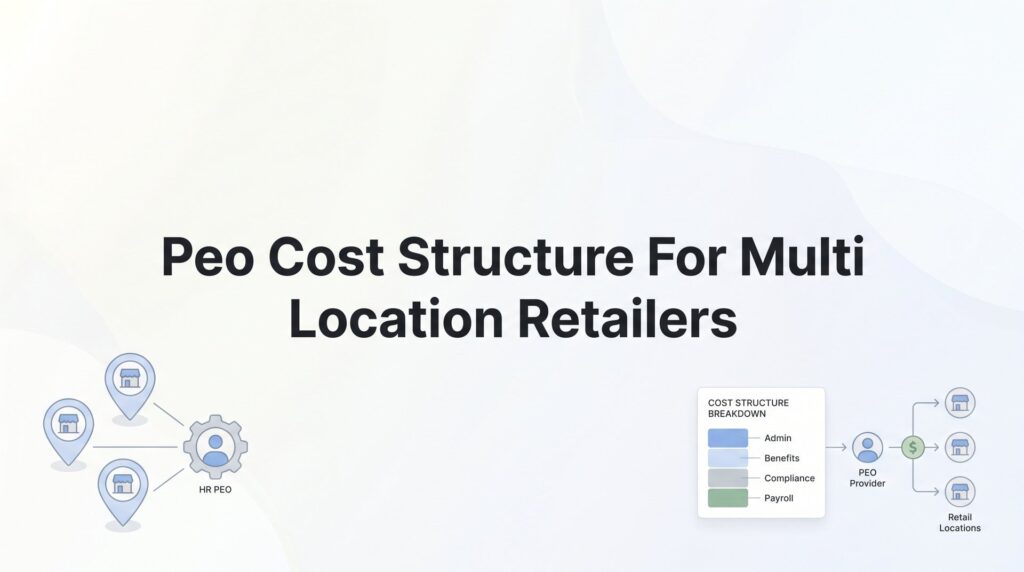
If you’re running retail across multiple locations, you already know that almost nothing about your business fits the standard template. Your workforce is a mix of salaried managers, part-time floor associates, and seasonal hires who appear in October and vanish in January. Your footprint spans multiple states with different rules, different tax rates, and different ideas about what employers owe their workers. So when a PEO sales rep hands you a pricing sheet built for a 50-person professional services firm, it’s not just unhelpful — it’s actively misleading.
Multi-location retail is one of the most complex PEO pricing scenarios that exists. The cost drivers are layered in ways that don’t show up in a standard quote, and the contracts are often structured in ways that punish exactly the kind of volatility that defines retail operations. If you’re evaluating PEO partners for your retail business, you need to understand what’s actually driving your price before you compare anything.
This article focuses specifically on what makes multi-location retail different. If you want a broader grounding in how PEO pricing works generally, that foundational context is worth reviewing separately. What we’re covering here is the retail-specific layer on top of that — the cost dynamics, hidden variables, and contract terms that matter most when you have stores in multiple states and a workforce that never stays the same size for long.
Why Retail Multi-Location Pricing Doesn’t Follow the Standard Playbook
The two most common PEO pricing models are per-employee-per-month (PEPM) and percentage-of-payroll. Both have their logic. But both were essentially designed with stable, office-based workforces in mind. Retail breaks the assumptions underlying each one.
Take PEPM pricing. The appeal is predictability: you know what you’re paying per head each month. The problem is that retail headcount is rarely stable. A 200-person retail operation in September might swell to 280 by November and drop back to 190 by February. If your PEO contract is built around a fixed headcount with a minimum commitment, you’re either overpaying during thin months or scrambling to renegotiate every time you open a new store or close a slow one. Building a reliable PEO cost forecast becomes essential when your headcount swings this dramatically.
Percentage-of-payroll pricing has a different problem. Retail payroll is not uniform. A district manager earning a competitive salary and a part-time cashier working 20 hours a week are both on your payroll, but they’re pulling in very different amounts. When your PEO charges a flat percentage of total payroll, the math can end up being surprisingly expensive relative to the services actually consumed by your lower-wage, lower-benefit workforce segments.
Then there’s the multi-state layer. Each state where you operate carries its own unemployment insurance rate, workers’ comp requirements, and increasingly, a growing list of employer mandates around paid leave, predictive scheduling, and minimum wage. A PEO operating under its own Federal Employer Identification Number (FEIN) absorbs some of these obligations, but how it prices that absorption varies enormously by provider. Some PEOs blend the compliance costs across your entire workforce and give you a single national rate. Others price by location. Neither approach is inherently wrong, but if you don’t know which one you’re looking at, you can’t evaluate whether the number is fair.
Headcount volatility also creates friction with how PEO pricing tiers are structured. Many PEOs set pricing tiers based on employee count, with better rates unlocked at higher headcounts. For a retailer who hits those thresholds only during peak season, you may never actually receive the rates you were quoted — or you may receive them briefly before dropping back down and triggering a mid-contract adjustment you didn’t anticipate.
The Hidden Cost Drivers Most Retailers Miss Until the First Invoice
The sticker price on a PEO proposal is rarely the full picture. For multi-location retailers specifically, there are several cost components that tend to surface only after the contract is signed.
Workers’ Compensation Classification Codes: Retail isn’t a single workers’ comp category. The classification codes assigned to your employees vary based on what they actually do. A cashier, a stockroom worker, a delivery driver, and a store manager can each carry different class codes with meaningfully different rate implications. In states like California, where workers’ comp rates are already elevated, the difference between a correctly classified retail floor employee and a misclassified one can have real cost consequences. PEOs that are sloppy about initial classification may quote you a rate that looks competitive, then adjust it at year-end when the audit reveals the actual exposure. Understanding advanced workers’ comp structuring is critical before you accept any quote at face value.
Benefits Participation Rates: If a significant portion of your workforce is part-time, a large share of your employees will likely decline health coverage. That’s standard in retail. The issue is that some PEOs build their administrative overhead into the per-head cost as if enrollment rates were higher than they actually are. You end up paying for benefits infrastructure that most of your workforce isn’t using. Ask specifically how benefits administration fees are structured relative to actual enrollment, not total headcount.
Onboarding and Offboarding Volume: This is the one that catches retailers most off guard. Retail has some of the highest employee turnover of any industry. The Bureau of Labor Statistics consistently tracks retail trade among the sectors with the highest quit rates, and that’s before you factor in seasonal churn. Every hire and every separation generates processing work: onboarding paperwork, benefits enrollment or waiver, payroll setup, offboarding documentation, final pay compliance. Some PEOs charge per-transaction fees for this work. Others bundle it into the base rate but at a level calibrated for lower-churn industries. Either way, if you’re cycling through a significant portion of your workforce annually, the embedded cost of that processing volume can be substantial. A professional services firm with 50 employees and minimal turnover doesn’t generate anything close to the same administrative load as a 150-person retailer with three stores and seasonal hiring spikes.
Multi-Location Administrative Overhead: Managing HR across 12 locations isn’t 12 times the work of managing one, but it’s also not the same as managing one. PEOs that don’t have strong multi-location infrastructure may charge additional fees for location-level reporting, separate payroll runs by location, or HR support that has to be customized by site. Ask whether multi-location management is included in the base rate or whether it carries additional fees.
State-by-State Complexity: How Geography Multiplies Your PEO Bill
Every state where you operate adds a layer of cost and compliance complexity. For a retailer with locations in, say, California, Texas, and New York, you’re not just dealing with three sets of regulations — you’re dealing with three very different regulatory philosophies, each with its own cost implications.
California brings mandatory paid sick leave, strict predictive scheduling requirements in certain jurisdictions, some of the highest workers’ comp rates in the country, and a regulatory environment that generates compliance overhead that employers in Texas simply don’t face. New York has its own paid family leave program, which carries a cost that gets embedded in your per-employee rate for New York locations. Texas has no state income tax and generally lighter employer mandates, but workers’ comp is handled through a unique private market system that requires its own navigation.
The question you need to ask any PEO is: are you quoting me a blended national rate, or are you pricing by state? A blended rate averages the compliance costs across all your locations. That can work in your favor if your most expensive states are a small part of your footprint, or against you if you’re heavily concentrated in high-cost states. Location-specific pricing gives you more transparency but can also reveal uncomfortable truths about what it actually costs to employ people in certain markets. Managing multi-state payroll compliance is one of the primary reasons retailers turn to PEOs in the first place.
There’s also a licensing issue that doesn’t get enough attention. Not every PEO is registered and licensed to operate in every state. Some are strong in certain regions and either absent or operating in a gray area in others. If you’re a retailer expanding into new states, a PEO that can’t follow you there creates a real problem. You may end up in a split arrangement: PEO for some states, in-house HR or a separate vendor for others. That fragmentation doesn’t just create operational headaches — it undermines the compliance and enterprise compliance risk management you were trying to achieve in the first place.
Before you sign with any PEO, get a written confirmation of every state where they are fully licensed and registered to operate as a co-employer. If you have expansion plans, ask about their roadmap for states they’re not currently in. This is a detail that gets glossed over in sales conversations and creates real problems 18 months into a contract.
Comparing Pricing Models: Which Structure Actually Works for Retail
There’s no universally correct answer here, but there are better and worse fits depending on your specific retail operation.
Flat PEPM: The appeal is budget predictability. You know what you’re paying per employee per month, and you can model costs against headcount projections. The problem for retailers is that PEPM pricing doesn’t flex well with seasonal swings. If you add 80 employees for the holiday season and your contract doesn’t have a clear mechanism for temporary headcount increases, you may be charged at a higher tier rate for those months — or worse, face a retroactive adjustment that covers the full year. Retailers with more than 30% seasonal workforce fluctuation should be especially careful about how PEPM contracts handle headcount changes.
Percentage-of-Payroll: This model aligns your PEO cost with actual payroll spend, which sounds fair. The catch for retail is that payroll isn’t uniform. If you’re paying store managers well above minimum wage while your floor staff earns near minimum, the percentage model can get expensive on the manager side without providing proportionally more value. Understanding the PEO impact on labor cost reporting helps you see how these percentage-based fees actually flow through your financials.
Hybrid and Tiered Models: Some PEOs offer combinations: a base PEPM rate with percentage-of-payroll components for benefits, or tiered pricing that adjusts based on headcount bands. These can work well, but they come with complexity. The annual true-up is the part that surprises most multi-location retailers. If your actual average headcount over the year comes in below the tier you were priced at, you may owe a reconciliation payment. If it comes in above, you may be entitled to a credit — but only if you ask for it. Read the reconciliation terms in any hybrid contract carefully before signing.
The honest answer is that no pricing model is perfect for retail. What matters more than the model itself is whether the PEO is willing to structure the contract around your actual operational reality rather than forcing your business into their standard template.
What to Negotiate Before You Sign: Retail-Specific Contract Levers
Most PEO contracts have more flexibility than the sales process suggests. Here’s where to push.
Location-Level Pricing Transparency: Don’t accept a single blended national rate without understanding what’s underneath it. Push for a breakdown by state or by location cluster. You need to know what each store is actually costing you in PEO fees so you can make informed decisions about staffing, expansion, and whether the PEO relationship makes sense for your entire footprint or just part of it. Using a cost structure modeling template can help you organize this data before negotiations begin.
Seasonal Headcount Flexibility: This is negotiable more often than retailers realize. Some PEOs will agree to adjusted minimums during off-peak months if you commit to annual volume. Others will agree to a seasonal addendum that defines how temporary headcount increases are handled and priced. If a PEO refuses to discuss seasonal flexibility at all, that’s a meaningful signal about how they’ll handle the operational realities of your business throughout the contract term.
Workers’ Comp Audit Terms: Get clarity on the audit process before you sign. Retail employers with multiple class codes across multiple locations are prime candidates for year-end workers’ comp adjustments. If the PEO’s initial classification was imprecise, you could face a significant retroactive charge. Ask specifically: how are class codes assigned, who reviews them, and what happens if there’s a reclassification after the contract starts? Understanding the workers’ comp cost allocation model your PEO uses will help you anticipate these adjustments.
Termination and Exit Terms: If you open a new store in a state the PEO doesn’t cover, or if your business changes significantly, you need to know what it costs to exit or modify the contract. Multi-location retailers change faster than most businesses. Make sure the contract reflects that.
When a PEO Isn’t the Right Fit for Your Retail Operation
PEOs are genuinely useful for many multi-location retailers. But they’re not the right answer for everyone, and it’s worth being honest about the scenarios where the math doesn’t work.
If you’re operating in more than eight to ten states with highly variable local regulations, the compliance value of a PEO can start to be offset by the complexity of managing a single co-employment relationship across all of them. Co-employment has legal implications that compound as your geographic footprint grows. An Administrative Services Organization (ASO) or Employer of Record (EOR) model may give you more operational control without the co-employment layer, depending on your specific risk tolerance and compliance needs.
Retailers with very low benefits enrollment should run the numbers carefully. If the majority of your workforce is part-time and declines health coverage, you may be paying for a benefits administration infrastructure that isn’t delivering proportional value. Reviewing how benefits cost containment strategies work for multi-location businesses can help you determine whether a PEO’s benefits bundle is actually saving you money.
High turnover is another honest disqualifier for some retailers. If you’re cycling through a significant portion of your workforce each year, the per-transaction costs embedded in PEO pricing can erode the savings you expected. Before committing to a PEO, estimate your actual annual onboarding and offboarding volume and ask the PEO to show you exactly how that processing load is priced in their model. Comparing internal HR costs versus PEO expenses at your actual turnover rate is the only way to know if the economics truly work.
None of this means a PEO is a bad idea for your retail business. It means the evaluation has to be based on your actual cost drivers, not on a generic pitch about efficiency and compliance peace of mind.
Putting It All Together Before You Sign Anything
Multi-location retail PEO pricing is genuinely complex, and the retailers who end up with bad deals are almost always the ones who accepted a blended quote without understanding what was underneath it. The cost drivers that matter most for your business — headcount volatility, geographic spread, workforce composition, turnover rate, benefits participation — are all knowable before you start comparing providers. You just have to do the work of quantifying them first.
Get granular with your own data before you request a single quote. Know your average headcount by month, not just annually. Know your turnover rate and what it translates to in actual onboarding and offboarding transactions per year. Know which states you operate in and which ones carry the heaviest compliance burden. Know your benefits enrollment rate by workforce segment. With that information in hand, you can ask the questions that actually reveal whether a PEO’s pricing is built for your business or built for someone else’s.
The retailers who negotiate the best PEO terms are the ones who walk into the conversation with their own data and refuse to accept a quote that doesn’t account for it.
Before you sign that PEO renewal, make sure you’re not leaving money on the table. Many businesses unknowingly overpay because of bundled fees, hidden administrative markups, and contracts designed to limit flexibility. PEO Metrics gives you a clear, side-by-side breakdown of pricing, services, and contract terms so you can see exactly what you’re paying for and choose the option that truly fits your multi-location operation. Don’t auto-renew. Make an informed, confident decision.
