
You signed with a PEO that looked like a solid choice. The pricing was competitive, the benefits package checked the right boxes, and the sales rep had good answers for every question you asked. Six months later, something feels off. Your HR team is still maintaining spreadsheets to track things the PEO was supposed to handle. The service rep keeps asking you to explain your industry’s compliance requirements instead of the other way around. Your workers’ comp renewal came in higher than expected — again — despite a clean claims history. And when you looked at the contract exit terms, you realized leaving would cost more than staying.
This is enterprise mismatch risk. Not a bad PEO. Just the wrong PEO for your business.
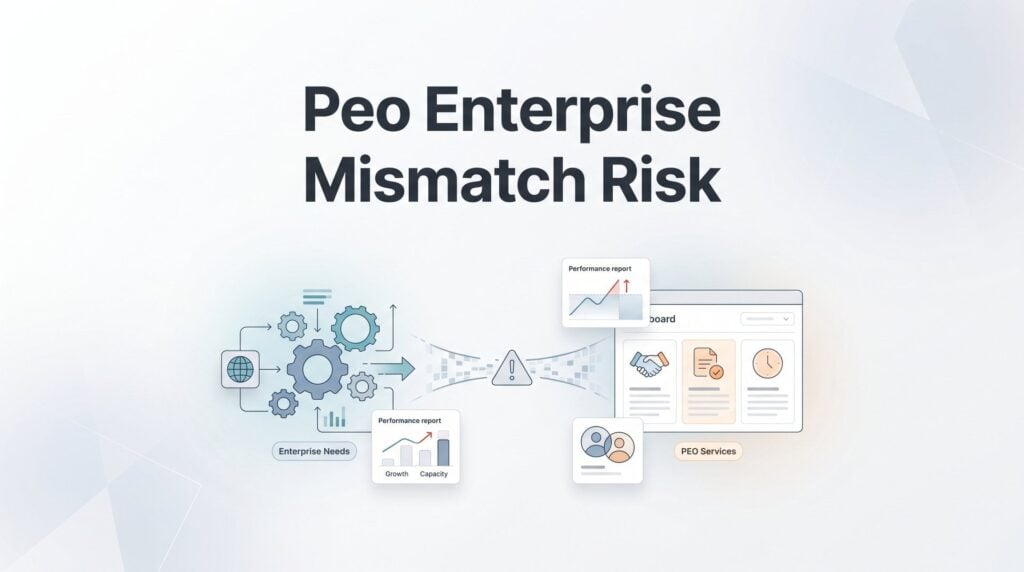
It’s one of the most expensive problems in PEO relationships, and it doesn’t get nearly enough attention. Most evaluation frameworks focus on features, pricing, and reviews. Those matter, but they don’t tell you whether a PEO is actually built to serve a business like yours — your industry, your workforce structure, your geographic footprint, your compliance environment. Mismatch risk lives in that gap between what a PEO offers in general and what your business needs specifically. And by the time it becomes obvious, you’re usually already locked in.
This article breaks down where mismatch risk actually comes from, what it costs when you get the fit wrong, how to recognize it if you’re already in it, and how to evaluate fit properly before you sign anything.
Where Mismatch Risk Actually Comes From
It’s worth being clear about what mismatch risk isn’t. It’s not about choosing a disreputable PEO or falling for a bad deal. Most PEO mismatch situations involve legitimate, well-run providers. The problem is structural misalignment — the PEO is built to serve a certain type of business, and your business is a different type.
PEOs are not interchangeable. Some are designed around white-collar, office-based workforces with relatively uniform payroll structures and straightforward workers’ comp classifications. Others specialize in field services, construction, or healthcare, where workforce composition is more complex and compliance requirements are more demanding. Some are optimized for companies in the 200-to-500 employee range. Others do their best work with businesses under 50 people. These differences in design translate into real differences in capability.
When a field-services company signs with a PEO that’s built around office environments, the mismatch shows up fast. The platform may not handle multiple workers’ comp class codes cleanly. The compliance team may not have experience with prevailing wage requirements, OSHA recordkeeping for field workers, or state-specific contractor regulations. Understanding the workers’ comp risk transfer framework helps clarify where these gaps emerge. The benefits package may be optimized for salaried employees rather than an hourly workforce that turns over more frequently. None of that makes the PEO bad. It makes it the wrong fit.
Headcount tier is another common trigger. A PEO that excels at serving 200-employee companies often has service models, technology infrastructure, and pricing structures calibrated for that scale. Assign a 15-person firm to that same provider, and you may get a service team that’s not set up to give you the hands-on attention a small business needs, plus a pricing structure that bundles services you won’t use for years.
Here’s the part that makes this harder to catch: the sales process doesn’t protect you from mismatch. PEO sales teams are incentivized to close deals, not to disqualify prospects. A good rep will work to understand your needs, but the structural pressure is toward signing, not toward telling you that a competitor would serve you better. That’s not cynicism — it’s just how sales works. The burden of fit assessment falls almost entirely on the buyer, which means you need to know what to look for before you sit down across from a sales team.
The Real Cost of Getting the Fit Wrong
Mismatch cost isn’t usually a single line item. It accumulates across multiple dimensions simultaneously, which is part of why it’s easy to underestimate until you’re already deep in it.
Direct financial overpayment: PEOs typically bundle their services — payroll processing, benefits administration, compliance support, HR technology — into a per-employee fee or a percentage of payroll. If the bundle includes services your business doesn’t need or can’t use, you’re paying for them anyway. Building an enterprise HR cost baseline before evaluating providers helps you identify exactly what you’re overpaying for. A company with minimal benefits utilization may be locked into a benefits administration model priced for higher engagement. These overcharges aren’t always visible because they’re embedded in the fee structure.
Workers’ comp mispricing: PEOs manage workers’ comp through master policies that pool risk across their client base. If your business is pooled with a risk group that doesn’t match your actual risk profile, your rates may not reflect your claims history accurately. Running a workers’ comp renewal risk analysis before your contract renews can reveal whether you’re being priced fairly. This is particularly common when a PEO doesn’t specialize in your industry and doesn’t have the classification depth to price your workforce correctly.
Operational drag: This is the cost that’s hardest to quantify but often the most significant. When a PEO’s platform doesn’t handle your payroll exceptions cleanly, your team builds workarounds. When the compliance team can’t answer your state-specific questions with confidence, your HR lead spends time researching independently. When the benefits platform isn’t set up for your workforce type, enrollment becomes a manual process. All of that time has a cost, and it compounds across every pay cycle, every open enrollment, every compliance filing.
Exit costs and switching friction: PEO contracts are structured to make leaving expensive. Termination penalties, minimum commitment periods, and mid-year disruption to payroll and benefits all create real switching costs. Understanding PEO contract liability risks before you sign is critical to avoiding this trap. Migrating payroll data, re-enrolling employees in new benefits, and retraining your team on a new platform all have costs that aren’t reflected in the PEO’s fee structure but are very real when the time comes to make a change.
Five Warning Signs You’re Already in a Mismatch
Sometimes mismatch risk isn’t a future concern — it’s already happening. Here’s how to recognize it.
Your service team is learning from you, not advising you. If you’re regularly explaining your industry’s compliance requirements to your PEO’s service rep rather than getting proactive guidance, that’s a structural problem. A well-matched PEO should have advisors who understand your regulatory environment and can flag issues before they become your problem. If you’re the one doing the explaining, you’re not getting the compliance support you’re paying for.
You’re maintaining shadow systems. Take an honest inventory of what your HR team is actually doing. Are there spreadsheets being maintained in parallel with the PEO’s platform? Manual tracking for things the PEO was supposed to handle? If your team has built workarounds to compensate for platform gaps, those workarounds are a symptom of mismatch. Understanding how to use a PEO alongside your internal HR department can help you distinguish between healthy collaboration and compensatory workarounds.
Your costs keep climbing without a clear reason. Workers’ comp renewal pricing that keeps increasing despite a clean claims history, or benefits costs that rise faster than your headcount, can indicate that your business is being pooled with risk groups that don’t reflect your actual profile. If your PEO can’t give you a clear explanation for why your costs are moving the way they are, that’s a red flag.
Compliance gaps keep surfacing. If you’re discovering compliance issues — missed filings, incorrect classifications, state-specific requirements that weren’t addressed — after the fact rather than proactively, your PEO’s compliance coverage isn’t matching your actual regulatory exposure. This is especially common for multi-state employers or companies in industries with complex compliance requirements.
The relationship feels transactional, not advisory. A well-matched PEO relationship should feel like a strategic partnership. If your interactions with the PEO are mostly reactive — you have a problem, you call, they process it — rather than proactive, that’s worth paying attention to. Mismatch often shows up as a service relationship that technically functions but never actually helps your business get better.
Industries and Business Types Most Exposed
Mismatch risk isn’t evenly distributed. Some business types are structurally more likely to end up in the wrong PEO relationship because their workforce characteristics fall outside the mainstream of what most PEOs are designed to serve.
Construction, trades, and field services: These businesses face elevated mismatch risk because the majority of PEOs are built around office-based workforces. Multi-class workers’ comp, prevailing wage compliance, project-based payroll structures, and high workforce turnover all create complexity that generalist PEOs often can’t handle cleanly. A construction company that signs with a PEO optimized for professional services firms is going to run into friction at almost every operational touchpoint. Businesses like electrical contractors need providers with genuine trade-specific expertise to avoid this trap.
Multi-state businesses with mixed workforce types: If you have W-2 employees in multiple states alongside 1099 contractors, your payroll and compliance situation is genuinely complex. Many PEOs are designed for simpler workforce structures and get stretched when they encounter mixed employment types, state-by-state regulatory variation, and the classification questions that come with contractor relationships. The result is often a service model that handles the simple parts of your workforce well and leaves you managing the complex parts yourself.
Rapidly scaling companies: A business that signed with a PEO at 10 employees may find that the same provider’s capabilities don’t scale well to 50 or 100 employees. The service model, technology infrastructure, and pricing structure that worked at the earlier stage may become limiting as the business grows. A venture-backed startup facing rapid headcount growth is particularly vulnerable to this form of mismatch. But inertia is powerful — switching costs, contract terms, and the disruption of changing systems mid-growth often keep businesses in PEO relationships they’ve outgrown.
Healthcare, staffing, and other high-complexity verticals: Industries with layered compliance requirements — HIPAA considerations, staffing-specific regulations, professional licensing requirements — often need PEO partners with genuine vertical expertise. A generalist PEO may technically offer compliance support, but the depth of that support matters. Surface-level coverage in a high-complexity industry is its own form of mismatch risk.
How to Evaluate Fit Before You Sign
The good news is that mismatch risk is largely preventable if you approach PEO selection with the right questions and the right framework. The key is shifting from a feature-and-price evaluation to a fit evaluation.
Ask directly about their client base in your specific context. How many current clients operate in your industry? What’s the headcount range of their typical client? Do they have experience with your specific state or states? How many clients have your workforce composition? Vague answers — “we serve businesses of all sizes across many industries” — are a red flag. A PEO that’s genuinely well-matched for your business should be able to give you specific, confident answers about their experience in your context.
Go deeper than pricing on the comparison dimensions that matter. Price matters, but it’s not the primary risk factor in a PEO decision. The dimensions that drive mismatch — service model depth, technology flexibility, compliance coverage for your specific regulatory environment, workers’ comp underwriting accuracy, and contract exit terms — require a more detailed side-by-side evaluation. If you’re comparing PEOs primarily on per-employee fees, you’re likely missing the dimensions where fit actually lives.
Dig into the contract exit terms before you’re impressed by anything else. Understanding what it costs to leave a PEO relationship — termination penalties, notice requirements, mid-year migration complexity — should happen early in your evaluation, not at the end when you’re already emotionally committed to a provider. The exit terms tell you a lot about how the PEO thinks about the relationship and what kind of leverage they’re building into the structure.
Treat this like a risk management decision. The downside of a bad PEO fit compounds over time. It’s not a one-time cost — it’s an ongoing drag on your operations, your costs, and your team’s capacity. Applying the same rigor to PEO selection that you’d apply to any major operational decision isn’t excessive. It’s proportionate to the actual risk involved.
Running a structured, side-by-side comparison across multiple providers — not just on price but on the operational dimensions that actually drive fit — is one of the most effective ways to reduce mismatch risk before it becomes a problem you’re trying to unwind. Detailed cost accounting methods to compare internal HR vs PEO expenses can anchor this analysis in real numbers rather than assumptions.
When the Problem Isn’t the PEO — It’s the Model
Sometimes, after doing the honest evaluation, businesses discover that the mismatch isn’t about finding a better PEO. It’s that the co-employment model itself doesn’t fit their situation.
The PEO model involves a co-employment relationship where the PEO becomes the employer of record for tax and benefits purposes. That structure works well for businesses that want to offload HR administration and access better benefits through a larger pool. Understanding how a PEO works step by step is essential before deciding whether the model itself is right for your situation. But it’s not the right fit for every business.
If your business has a complex ownership structure, operates in a highly regulated industry where employer-of-record relationships create complications, or has reached a scale where building internal HR infrastructure makes more financial sense than paying PEO fees, the right answer may not be a different PEO. It may be a different model entirely.
ASO (Administrative Services Organization): If you want HR administrative support without the co-employment relationship, an ASO arrangement keeps you as the employer of record while outsourcing the administrative functions. This gives you more control but also more responsibility for compliance and risk.
EOR (Employer of Record): If you’re hiring internationally or need to employ workers in jurisdictions where you don’t have a legal entity, an EOR may be a better fit than a PEO. EOR relationships are designed for that specific use case in a way that most PEOs aren’t.
In-house HR build: For businesses that have scaled past a certain point — generally somewhere above 150 to 200 employees, though it varies significantly by complexity — building internal HR capacity often delivers better value than continuing to pay PEO fees. The math changes as headcount grows.
Recognizing early that the co-employment model isn’t right for your business saves significant money and disruption. The worst outcome is staying in a PEO relationship that doesn’t fit because switching feels hard, only to eventually discover that you needed a different model entirely.
The Bottom Line on Mismatch Risk
Mismatch risk is the most expensive PEO problem that nobody talks about — because it doesn’t look like a crisis. It looks like friction. It looks like your team spending extra hours on workarounds. It looks like compliance questions that take too long to get answered. It looks like costs that keep creeping up without a clear explanation. It’s quiet, it compounds, and by the time it’s obvious, you’re usually stuck in a contract that makes leaving expensive.
The fix isn’t finding the “best” PEO in some abstract ranking. It’s finding the one that actually fits your business — your industry, your workforce structure, your geographic footprint, your growth trajectory. That requires a different kind of evaluation than most businesses do, and it requires asking harder questions earlier in the process.
Approach PEO selection with the same rigor you’d apply to any major operational decision. Compare providers on the dimensions that actually drive fit, not just the ones that show up in a sales deck. Understand the exit terms before you’re sold on the benefits. And if you’re already in a relationship that feels wrong, don’t assume inertia is cheaper than change — it usually isn’t.
Don’t auto-renew. Make an informed, confident decision. A clear, side-by-side comparison of pricing, services, and contract terms is the most effective way to reduce mismatch risk before it becomes a sunk cost you’re trying to recover from.
