

Distribution companies carry a workforce profile that trips up a lot of PEOs. Warehouse associates, forklift operators, drivers, high workers’ comp exposure, seasonal headcount swings, multi-state payroll complexity, and constant pressure on labor costs. A PEO built for a software company is a different animal than one built for a 200-person regional distributor with three workers’ comp class codes and operations in six states.
Picking the wrong PEO costs more than just fees. You can end up locked into a contract that doesn’t flex with your headcount, a workers’ comp arrangement that follows your mod rate instead of shielding it, or a benefits package that looks good on paper but doesn’t move the needle for warehouse recruiting. The stakes are real.
This list covers eight PEOs worth a serious look if you run a distribution operation. Each entry names a genuine strength and a genuine limitation, because no PEO is right for every distribution company. The right choice depends on your headcount, your state footprint, your workers’ comp history, and how much contract flexibility you actually need. If you want a data-driven comparison across all of them before you start vendor calls, PEO Metrics compares 40+ PEOs on cost, contract terms, and benefits benchmarks, free to the buyer.
1. PEO Metrics
Best for: Distribution companies that want an unbiased, side-by-side comparison before signing anything
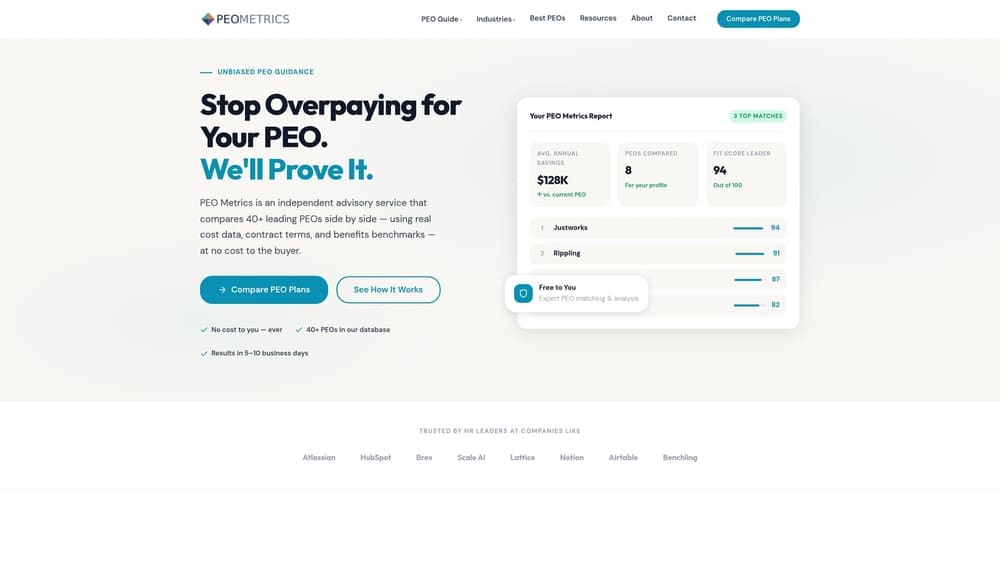
PEO Metrics is an independent PEO advisory service that sits on the buyer’s side of the table, not the vendor’s.
Where This Tool Shines
PEO Metrics isn’t a PEO. It’s the step you take before you talk to any PEO. The service compares 40+ providers across 12 dimensions including pricing structure, contract terms, workers’ comp handling, and benefits benchmarks, so you walk into vendor conversations knowing what a fair deal looks like for your specific company profile.
For distribution companies, that matters more than it does in most industries. Workers’ comp is the single biggest financial lever a PEO can offer a warehouse-heavy operation, and the difference between a PEO that includes comp in its master policy versus one that carves it out can be substantial. PEO Metrics surfaces exactly those differences, based on over $2.1 billion in benchmarked PEO spend across 850+ matched companies since 2019.
Key Features
12-Dimension Methodology: Compares PEOs on cost, contract terms, workers’ comp structure, benefits quality, compliance support, and more, not just headline pricing.
$2.1B Benchmarked: Over $2.1 billion in PEO spend benchmarked across 850+ matched companies since 2019, giving you real market data rather than vendor talking points.
Fast Turnaround: Intake takes about 8 minutes; comparison report comes back in 5-10 business days.
40+ PEOs Tracked: Covers the full market from enterprise PEOs to mid-market specialists, so you’re not limited to whoever has a good sales team.
100% Free to the Buyer: No cost, no vendor relationship, no commission structure influencing the recommendation.
Best For
Any distribution company evaluating a PEO for the first time, approaching a renewal, or questioning whether they’re overpaying. Particularly useful for companies with multi-state footprints or complex workers’ comp profiles where the wrong PEO choice has real financial consequences. Serves companies with 10-2,000 employees.
Pricing
Free to the buyer. PEO Metrics is compensated independently; there is no cost to the company requesting a comparison.
2. ADP TotalSource
Best for: Multi-state distribution companies that need enterprise-grade compliance infrastructure
ADP TotalSource is one of the largest PEOs in the US, with broad multi-state compliance coverage and a mature workers’ comp program built on ADP’s HR technology platform.
Where This Tool Shines
Scale matters in distribution, and ADP TotalSource has it. Their multi-state compliance infrastructure handles the payroll tax, SUTA, and regulatory complexity that comes with operating warehouses across several states. For distribution companies with a growing geographic footprint, that infrastructure is genuinely valuable and hard to replicate with a smaller PEO.
Their workers’ comp program is one of the more mature offerings in the PEO market. Pay-as-you-go comp under a master policy is available, which can help distribution companies with elevated mod rates access better terms than they’d find on their own. If workers’ comp is your primary driver for evaluating a PEO, ADP TotalSource belongs on your shortlist.
Key Features
Multi-State Compliance Infrastructure: Handles payroll tax filings, SUTA, and regulatory requirements across multiple states without requiring your HR team to track every jurisdiction.
Pay-As-You-Go Workers’ Comp: Workers’ comp under a master policy with pay-as-you-go options, which smooths cash flow and may improve access to competitive rates for higher-risk operations.
ADP Technology Stack: Full integration with ADP’s payroll, time tracking, and HR platform, which matters if you’re already running ADP tools elsewhere in the business.
CPEO Certification: CPEO-certified (verify current status), which means clients can maintain federal employment tax credits including WOTC, relevant for distribution companies that hire from targeted groups.
Benefits Buying Power: Large-group health benefits backed by ADP’s scale, giving smaller distribution companies access to coverage that competes with larger employers.
Best For
Distribution companies in the 50-plus employee range operating across multiple states, particularly those for whom workers’ comp structure and multi-state compliance are the primary evaluation criteria. Less well-suited to smaller operations that want a more personalized service relationship.
Pricing
Custom quotes only; pricing is not published publicly. Generally runs higher than mid-market PEOs. Get benchmarked pricing before your first call.
3. Insperity
Best for: Distribution companies competing for warehouse talent with benefits and HR support
Insperity is a full-service PEO known for high-touch HR support and competitive benefits packages, with dedicated HR specialists assigned to each client account.
Where This Tool Shines
Warehouse recruiting is a real competitive problem for many distribution companies. Insperity’s benefits packages are strong enough that they can genuinely move the needle when you’re trying to retain pickers and packers who have options. The dedicated HR specialist model also means you’re not submitting tickets and waiting; you have a named person who knows your account.
For distribution companies that run a lean HR team, or an HR team of one, Insperity’s support depth is a meaningful operational benefit. They handle compliance, risk management, and HR administration in a way that actually offloads work rather than just adding a software layer on top of it.
Key Features
Named HR Specialists: Each client account gets a dedicated HR specialist, not a rotating support queue, which matters when you have a compliance question that needs a real answer fast.
Competitive Benefits Packages: Health, dental, vision, and 401(k) options competitive with large employers, useful for distribution companies trying to close the benefits gap with larger competitors.
Compliance and Risk Management: Strong support for multi-state compliance, including regulatory updates and risk mitigation, with CPEO certification (verify current status).
Training and Development Resources: Includes training tools relevant to warehouse and operations staff, which can reduce onboarding time and support safety compliance.
CPEO Certification: Maintains federal employment tax credit eligibility for clients, including WOTC.
Best For
Distribution companies with 50 or more employees that want a high-touch HR partner and are willing to pay for it. Less suited to companies under 50 employees where the pricing may not pencil out, or to companies that want significant flexibility in how they structure HR services.
Pricing
Custom quotes; pricing sits at the higher end of the PEO market. Best value tends to appear at 50-plus employees. Benchmark before you negotiate.
4. TriNet
Best for: Distribution companies with mixed office and warehouse workforces needing a modern HR platform
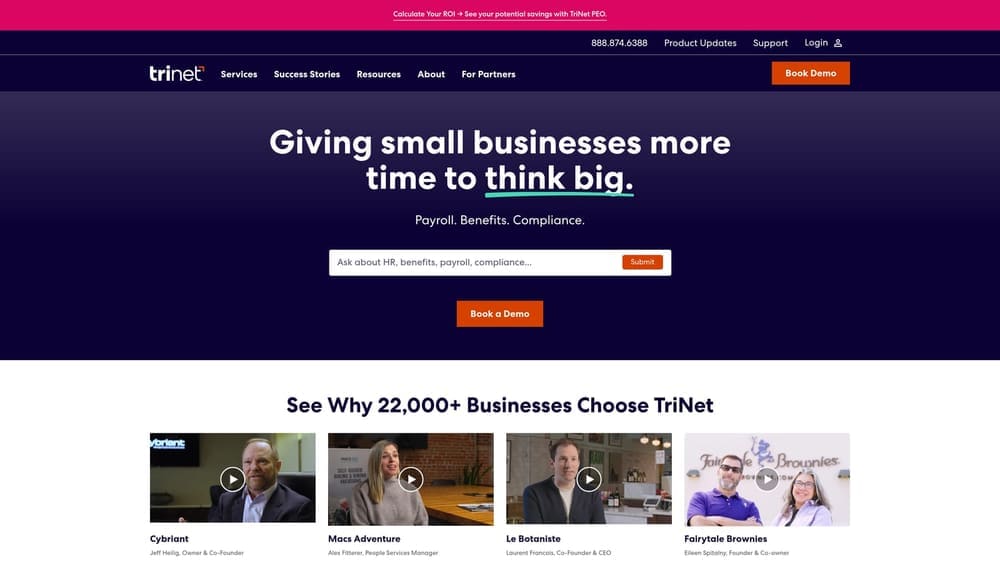
TriNet is a tech-forward PEO with industry-specific HR packages, solid benefits, and a modern platform that works reasonably well for operations that blend office staff with warehouse employees.
Where This Tool Shines
TriNet’s platform is genuinely modern. Mobile access, clean interfaces, and solid multi-state payroll and compliance support make it a reasonable choice for distribution companies that want their HR tools to work the way their other software does. For operations that have a meaningful office or management layer alongside their warehouse staff, TriNet handles the mixed workforce reasonably well.
Their benefits options are competitive, and the dedicated HR support team can handle day-to-day questions without requiring your internal team to become compliance experts.
Key Features
Industry-Specific HR Packages: Pre-configured HR packages designed for specific workforce profiles, which reduces setup time compared to building everything from scratch.
Modern HR Platform: Mobile-accessible platform for payroll, benefits administration, and compliance tracking, which matters when your managers are on a warehouse floor rather than at a desk.
Competitive Health Benefits: Medical, dental, and vision coverage with group buying power that gives smaller distributors access to better rates than they’d find on their own.
Multi-State Payroll and Compliance: Handles payroll tax filings and compliance requirements across multiple states.
Dedicated HR Support Team: HR support staff available to handle questions and compliance issues.
Best For
Distribution companies with mixed workforces, particularly those where technology usability is a priority. Companies with primarily high-hazard warehouse workforces and elevated mod rates should ask specific questions about workers’ comp terms before committing, as TriNet’s comp handling for high-risk classifications has historically been less competitive than larger PEOs.
Pricing
PEPM pricing varies by plan and headcount; custom quotes required. Compare against benchmarks before your first conversation.
5. Rippling
Best for: Tech-forward distribution companies that prioritize automation and software integration
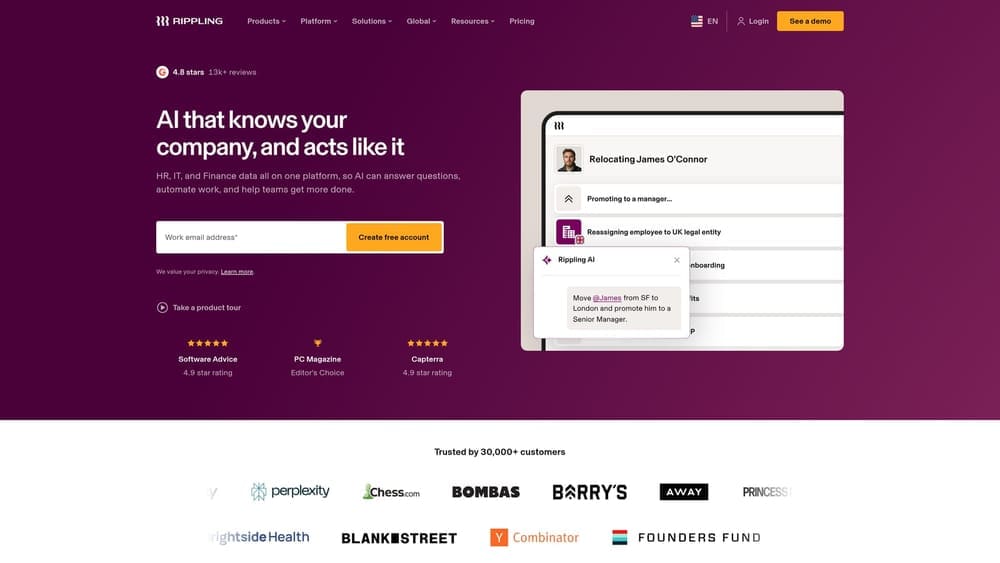
Rippling is a modular HR, IT, and finance platform with a PEO offering built around automation, software integration, and streamlined onboarding across multiple states.
Where This Tool Shines
If your distribution operation runs a lot of software and you’re tired of systems that don’t talk to each other, Rippling is worth a serious look. The platform connects HR, payroll, IT, and finance in one place, and its onboarding automation is genuinely best-in-class for a PEO. For distribution companies with high turnover and constant new-hire processing, automated onboarding and offboarding workflows can meaningfully reduce administrative load.
Multi-state compliance automation is also a real strength. The system tracks regulatory changes across states and surfaces compliance tasks automatically rather than requiring your HR team to monitor every jurisdiction.
Key Features
Unified HR, IT, and Finance Platform: Connects payroll, benefits, device management, and finance in one system, reducing the number of tools your team has to manage.
Automated Onboarding and Offboarding: Workflow automation that handles new-hire paperwork, system access, and compliance documentation, which matters when you’re onboarding warehouse staff regularly.
Multi-State Compliance Automation: Tracks regulatory requirements across states and automates compliance tasks rather than requiring manual monitoring.
Modular Architecture: Buy only the components you need; you’re not forced into a bundle that includes services irrelevant to your operation.
Third-Party Integrations: Extensive integration library for connecting Rippling with other tools already in your tech stack.
Best For
Distribution companies that prioritize technology over hands-on HR support. Rippling’s PEO offering is newer than its HR software product, and dedicated HR support is thinner than what you’d get from Insperity or ADP. If you want a software platform that handles HR administration efficiently and your team can manage without a dedicated HR partner, Rippling is a strong option. If you want someone to call when a compliance issue gets complicated, look elsewhere.
Pricing
Modular pricing; core HR starts around $8 per employee per month. PEO pricing requires a custom quote. Verify current rates directly with Rippling.
6. Justworks
Best for: Smaller distribution companies under 50 employees that want transparent, predictable pricing
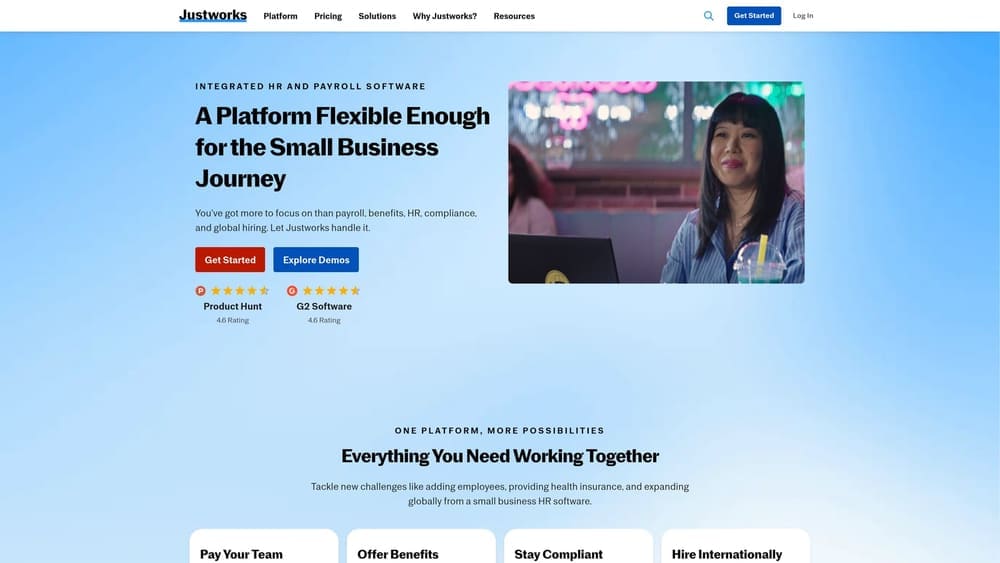
Justworks is a PEO built for smaller companies, with published PEPM pricing, straightforward contracts, and accessible benefits for workforces that don’t need enterprise-level complexity.
Where This Tool Shines
Justworks is one of the few PEOs that publishes its pricing. For a distribution company owner or HR lead who’s tired of going through a full sales process just to find out what something costs, that transparency is genuinely refreshing. The contracts are also readable, with clear exit terms that don’t require a lawyer to interpret.
For smaller distributors, the benefits access is the main draw. Justworks gives small companies access to large-group health insurance rates they couldn’t access on their own, which is a real recruiting advantage when you’re competing for warehouse staff against larger employers.
Key Features
Published PEPM Pricing: Pricing tiers are publicly available, which makes budgeting straightforward and removes the information asymmetry of a sales-only pricing model.
Large-Group Health Insurance Access: Small companies get access to health insurance rates typically reserved for larger employers.
Clear Contract Terms: Contracts are written to be understood, with exit terms that don’t trap you if your needs change.
CPEO Certification: CPEO-certified (verify current status), maintaining federal employment tax credit eligibility.
24/7 Support: Around-the-clock support for HR and payroll questions, which matters when payroll issues surface outside business hours.
Best For
Distribution companies under 50 employees with lower-risk workforce profiles. Justworks’ workers’ comp program is less mature than enterprise PEOs for high-hazard classifications, so distribution companies with significant warehouse injury history or elevated mod rates should ask specific questions about comp terms. Best fit for smaller operations where pricing clarity and contract simplicity matter more than deep HR support.
Pricing
Published pricing starts around $59 per employee per month for the basic plan; higher tiers available. Verify current rates at justworks.com before budgeting.
7. Oasis, a Paychex Company
Best for: Mid-market distribution companies already operating in the Paychex ecosystem
Oasis, a Paychex Company is Paychex’s PEO offering, built on deep payroll infrastructure with broad compliance support and scalable service tiers for mid-market operations.
Where This Tool Shines
If your distribution company is already running Paychex for payroll, Oasis is the natural path to adding co-employment services without rebuilding your HR infrastructure from scratch. The integration between Oasis and Paychex’s broader platform is the primary value proposition: payroll, tax administration, compliance, and workers’ comp all running on the same underlying system.
The compliance and tax administration support is solid, and the scalable service tiers mean you’re not forced into an enterprise package if you’re a mid-market operation that doesn’t need everything.
Key Features
Paychex Integration: Deep connection with Paychex payroll and HR tools, which reduces friction for companies already in the Paychex ecosystem.
Multi-State Compliance and Tax Administration: Handles payroll tax filings, SUTA, and regulatory compliance across multiple states.
Workers’ Comp Administration: Risk management and workers’ comp administration included, relevant for distribution companies with physical labor workforces.
Scalable Service Tiers: Service levels that scale from smaller operations to mid-market headcounts without forcing an enterprise commitment.
Paychex Benefits Network: Access to Paychex’s benefits purchasing network for health and ancillary coverage.
Best For
Mid-market distribution companies already using Paychex for payroll, or companies that want a single-vendor approach to payroll and PEO services. Worth noting: some clients report that service consistency has been uneven since Paychex acquired Oasis in 2018, and the technology can feel dated compared to newer platforms. Evaluate current service quality carefully before committing.
Pricing
Custom quotes; pricing is not published. Sits in the mid-market PEO range. Contact Oasis directly and benchmark against comparable providers before negotiating.
8. Extensis Group
Best for: Regional distribution companies with 10-150 employees that want hands-on service and contract flexibility
Extensis Group is a mid-market PEO focused on companies in the 10-150 employee range, offering personalized service, competitive workers’ comp programs, and contract terms that larger PEOs rarely match.
Where This Tool Shines
At a large PEO, a 40-person distribution company is a small account. At Extensis, it’s a real client. The client-to-staff ratios are meaningfully better than enterprise PEOs, which translates to HR generalists who actually know your account, your workforce profile, and your comp history. For regional distributors who feel like they’re getting lost in the queue at a larger provider, that service model is a genuine differentiator.
The workers’ comp program is also worth a close look. Extensis has built competitive comp offerings for moderate-risk workforces, which is relevant for distribution companies that aren’t running the highest-hazard operations but still carry more risk than an office workforce. Contract flexibility is another real strength: terms tend to be more negotiable than what you’ll find at ADP or Insperity.
Key Features
Dedicated HR Generalists: High client-to-staff ratios mean your HR generalist knows your business rather than handling your account as one of hundreds.
Competitive Workers’ Comp Programs: Workers’ comp offerings designed for moderate-risk workforces, relevant for warehouse and distribution operations without extreme hazard profiles.
Flexible Contract Terms: More negotiable contract structure than enterprise PEOs, which matters if you need exit flexibility or want to customize service terms.
Benefits Package: Medical, dental, vision, and 401(k) access that gives smaller distribution companies competitive benefits without enterprise pricing.
Regional Fit: Service model designed for companies that want a real relationship rather than a ticket system.
Best For
Regional distribution companies in the 10-150 employee range that want personalized service and don’t want to feel like a small account at a large PEO. Smaller scale than ADP or Insperity means less benefits buying power and more limited geographic coverage, so national distribution operations with complex multi-state footprints may outgrow Extensis faster than regional operators.
Pricing
Custom quotes; mid-market pricing range. Contact Extensis directly for current rates and benchmark against comparable providers before signing.
Which PEO Is Right for Your Distribution Operation
No single PEO is the right answer for every distribution company. A 15-person regional distributor with one workers’ comp class code and a single-state footprint has very different needs than a 300-person multi-state operation with a mixed warehouse and driver workforce. The criteria that matter most, headcount, state footprint, workers’ comp history, and how much HR support you actually need, point to different providers.
As a rough guide: if you’re under 50 employees and want predictable pricing, Justworks or Extensis Group are worth a close look. If you’re in the 50-300 range and need serious multi-state compliance coverage, ADP TotalSource and Insperity are the names that come up most often at that scale. If technology integration matters as much as HR support, Rippling deserves a serious evaluation. If you’re already on Paychex, Oasis is a natural next step.
Before any of those conversations, there are two distribution-specific questions worth getting answered upfront. First, how does each PEO handle workers’ comp for your specific class codes? Some include comp in the master policy on pay-as-you-go terms; others carve it out entirely. For a warehouse operation with physical labor, that distinction has real financial consequences. You can read more about how workers’ comp class code restructuring works under a PEO before you start those conversations. Second, how does the PEO handle SUTA across your states? Under co-employment, the PEO becomes the employer of record and typically absorbs SUTA under its own account. Whether that helps or hurts you depends on the PEO’s pooled rate versus your own.
If you want help thinking through compliance strategy more broadly, the PEO compliance guide for logistics companies covers adjacent territory that distribution HR teams often find useful.
Before you get on a call with any of these providers, it’s worth knowing what a fair price looks like for your specific profile. PEO Metrics has benchmarked over $2.1 billion in PEO spend across 40+ providers and 850+ matched companies since 2019. The intake takes about 8 minutes and the comparison report comes back in 5-10 business days, free.
Compare PEO Plans before your next renewal. Don’t auto-renew without knowing what else is available and what a fair rate actually looks like for a distribution company your size.
Before you sign that PEO renewal, make sure you’re not leaving money on the table.
Many businesses unknowingly overpay because of bundled fees, hidden administrative markups, and contracts designed to limit flexibility. We give you a clear, side-by-side breakdown of pricing, services, and contract terms—so you can see exactly what you’re paying for and choose the option that truly fits your business.
