
Ecommerce businesses operate in one of the more complicated compliance environments out there. You’re managing warehouse staff subject to OSHA requirements, remote customer service reps spread across a dozen states, seasonal workers who show up in October and disappear in January, and contractor relationships that may or may not hold up to IRS scrutiny. A generic PEO can handle payroll. That’s not the problem.
The problem is whether your co-employment partner actually understands the risk profile of an ecommerce operation at scale — multi-state wage and hour exposure, fulfillment center safety obligations, worker classification landmines, and the compliance chaos that comes with tripling your headcount for Q4. Most “best PEO” lists don’t account for any of that.
We evaluated providers based on their ability to handle the specific compliance and risk management challenges ecommerce companies face. Here are the providers worth a serious look, plus the comparison approach that helps you make the right call.
1. PEO Metrics
Best for: Ecommerce companies that want an unbiased, structured comparison before committing to any PEO.
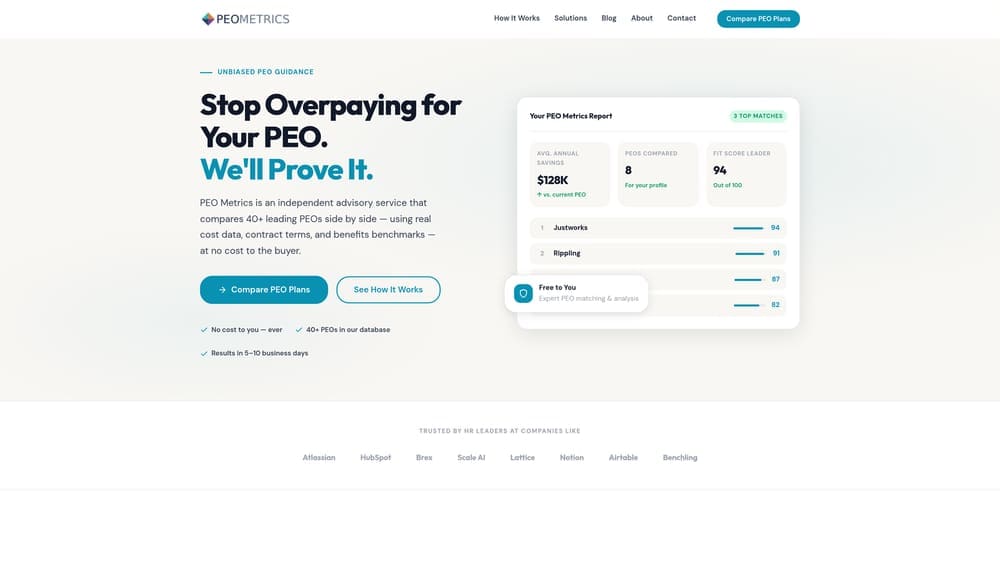
PEO Metrics is a free comparison platform that helps businesses evaluate PEO providers side-by-side using detailed metrics, pricing data, and compliance capability breakdowns.
Where This Tool Shines
Most ecommerce operators approach PEO selection the same way they approach buying software: they take a few demos, get a couple of quotes, and go with whoever followed up fastest. That process works fine for low-stakes decisions. It doesn’t work well when you’re co-employing hundreds of workers across multiple states with real liability exposure.
PEO Metrics exists to fix that. It gives you a structured, data-driven view of what different providers actually offer on compliance and risk management before you’re sitting in a contract negotiation without leverage. For ecommerce companies specifically, the ability to filter by industry-specific compliance capabilities — warehouse safety programs, multi-state complexity, seasonal workforce management — makes it far more useful than generic comparison sites.
Key Features
Side-by-Side Compliance Scoring: Compares providers on compliance and risk management capabilities, not just price, so you’re evaluating what actually matters for ecommerce operations.
Detailed Pricing Analysis: Breaks down bundled fees and administrative markups so you can see what you’re actually paying for and avoid overpaying.
Industry-Specific Filtering: Matches ecommerce-relevant compliance needs — fulfillment, seasonal hiring, multi-state exposure — with provider capabilities.
Unbiased Guidance: Not affiliated with any single PEO provider, which means the comparison isn’t skewed toward whoever pays the highest referral fee.
Best For
Ecommerce companies evaluating PEO options for the first time, or businesses approaching a contract renewal who want to confirm they’re not overpaying or underserved on compliance. Particularly valuable for operators who don’t have a dedicated HR team with PEO procurement experience.
Pricing
Free to use. No cost to compare providers, review pricing data, or get guidance on fit.
2. ADP TotalSource
Best for: Large ecommerce operations that need enterprise-grade compliance infrastructure across many states.
ADP TotalSource is ADP’s full-service PEO offering, built for organizations that need serious multi-state compliance depth and dedicated specialist support.

Where This Tool Shines
ADP TotalSource’s core advantage is infrastructure. They maintain a regulatory database covering all 50 states, and their compliance specialist teams are genuinely experienced with the kind of complexity that comes with running payroll across multiple states simultaneously. For ecommerce companies with warehouse staff in several states and remote workers scattered everywhere else, that depth matters.
Their risk management programs are also enterprise-caliber. Workers’ comp administration, safety program support, and employment practices liability coverage are built into the model rather than bolted on. If your fulfillment operations carry real injury exposure, this level of program maturity is hard to replicate with smaller providers.
Key Features
Multi-State Compliance Infrastructure: Comprehensive payroll tax compliance and employment law support across all 50 states, with regulatory updates built into the platform.
Dedicated Compliance Specialists: Assigned HR business partners and compliance specialists rather than generalist support staff.
Enterprise Risk Management: Robust workers’ comp programs, safety support, and employment practices liability coverage designed for large, complex operations.
Scalability: Built to handle hundreds to thousands of employees without service degradation — important for ecommerce companies growing fast or managing large seasonal surges.
Regulatory Database: Continuously updated coverage of state and local employment law changes across all jurisdictions.
Best For
Ecommerce companies with 200+ employees, significant multi-state complexity, or physical operations that carry meaningful OSHA and workers’ comp exposure. Not the right fit for smaller operators who’ll pay for enterprise infrastructure they don’t need.
Pricing
Custom pricing based on headcount and services selected. Reflects enterprise scope, so expect costs on the higher end of the PEO market.
3. Justworks
Best for: Growing ecommerce companies that want transparent, predictable pricing with solid multi-state compliance support.
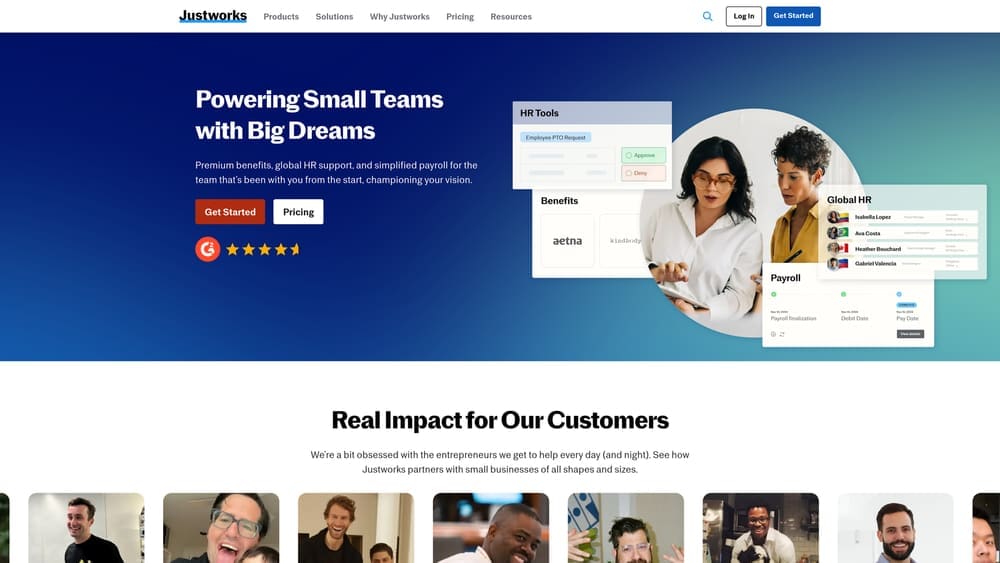
Justworks is a modern PEO built for growing businesses that need compliance coverage without the complexity or cost of enterprise-tier providers.
Where This Tool Shines
Justworks stands out on pricing transparency, which is genuinely rare in the PEO space. Their flat per-employee-per-month structure means you can model your costs accurately without worrying about administrative markups buried in a percentage-of-payroll formula. For ecommerce companies managing tight margins, that predictability has real operational value.
Their multi-state payroll tax compliance and automated filings handle the core compliance burden well. The interface is clean enough that non-HR operators — founders, office managers, ops leads — can actually use it without a steep learning curve. That matters when you’re scaling fast and don’t have a dedicated HR team managing every detail.
Key Features
Transparent Flat Pricing: Per-employee-per-month pricing with no hidden fees, making cost modeling straightforward for operators watching margins closely.
Multi-State Tax Compliance: Automated payroll tax filings across states, reducing the manual burden of hiring in new jurisdictions.
Onboarding and Offboarding Tools: Built-in compliance workflows for bringing on and separating employees, which matters during seasonal ramp-ups and wind-downs.
Large-Group Benefits Access: Health insurance and benefits at rates typically reserved for larger companies.
Operator-Friendly Interface: Designed for people who aren’t HR professionals — a real advantage for lean ecommerce teams.
Best For
Ecommerce companies in the 10-200 employee range that are expanding into new states and need reliable compliance support without paying for enterprise overhead. Less suited to businesses with heavy physical operations requiring deep OSHA or workers’ comp program management.
Pricing
Starts at $59/employee/month for the Basic plan. Pricing is publicly listed, which is unusual and worth appreciating in this space.
4. Rippling PEO
Best for: Tech-forward ecommerce companies that want compliance automation integrated directly into their existing tools and workflows.
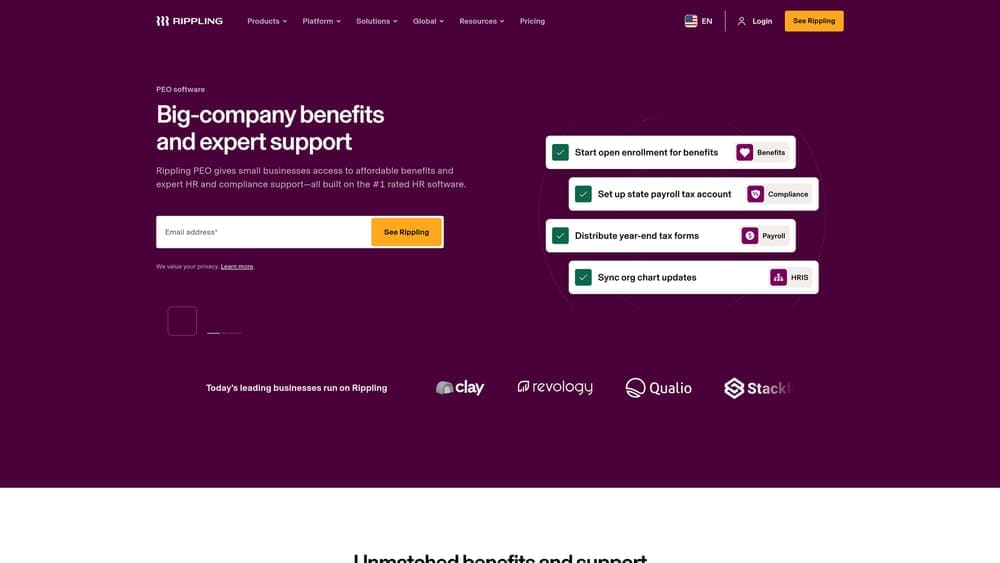
Rippling PEO combines HR, IT, and compliance management in one platform with deep automation and integrations built for modern tech stacks.
Where This Tool Shines
Rippling’s real differentiator is automation. When you hire someone in a new state, Rippling can automatically trigger state tax registration, set up payroll compliance, and handle onboarding workflows without someone manually chasing down each step. For ecommerce companies that hire aggressively in new markets — or that spin up seasonal workers across multiple states in a short window — that automation reduces both compliance risk and operational friction.
The integration depth is also notable. Rippling connects with the kind of tools ecommerce businesses actually use: accounting platforms, productivity suites, and operational software. If you want your HR and compliance data to live in the same ecosystem as the rest of your business, Rippling is built for that.
Key Features
Automated State Tax Registration: Handles new-state compliance setup automatically when you hire in a new jurisdiction — no manual filing required.
Compliance Monitoring and Alerts: Automated notifications when regulatory changes affect your workforce, so you’re not caught off guard.
Deep Integration Ecosystem: Connects with ecommerce, accounting, and productivity tools so compliance data doesn’t live in a silo.
Unified HR and IT Platform: Manages HR, payroll, device management, and app provisioning in one system — useful for distributed remote teams.
Seasonal Onboarding Automation: Workflow tools designed to scale onboarding quickly without sacrificing compliance steps.
Best For
Ecommerce companies with strong technical operations that want compliance automation rather than compliance consulting. Works best for businesses with distributed remote teams; less differentiated for companies with large physical fulfillment workforces where safety program depth matters more.
Pricing
Base platform starts around $35/employee/month; PEO services are priced as a separate add-on. Custom quotes required for full scope.
5. Paychex PEO
Best for: Ecommerce companies with physical fulfillment operations that need serious workers’ comp and OSHA compliance support.
Paychex PEO is a well-established provider with particular depth in workers’ compensation administration, workplace safety programs, and OSHA compliance.

Where This Tool Shines
Most PEO comparisons underweight workplace safety as a differentiator. For ecommerce companies running fulfillment centers or warehouses, it shouldn’t be. Paychex has built meaningful capabilities here: pay-as-you-go workers’ comp programs that smooth out cash flow, active safety and OSHA compliance support, and employee training programs designed to reduce injury rates and associated liability.
Their multi-state payroll and tax compliance infrastructure is solid, and the dedicated service representative model means you have a consistent point of contact rather than rotating through a support queue. For businesses that want a relationship-based service model rather than a self-serve platform, Paychex fits that preference.
Key Features
Workers’ Comp Administration: Pay-as-you-go options that reduce large upfront premiums and improve cash flow management for seasonal operations.
OSHA and Workplace Safety Programs: Active safety compliance support for warehouses and fulfillment centers, including training and risk mitigation resources.
Multi-State Payroll Compliance: Tax filing and employment law compliance across states, with regulatory updates built into service delivery.
Dedicated Service Representative: Assigned contact for HR administration rather than generalist support queues.
Employee Training Programs: Risk mitigation and compliance training resources, particularly valuable for physical operations with high turnover.
Best For
Ecommerce companies with physical warehouse or fulfillment operations where workers’ comp costs and OSHA compliance are real, ongoing concerns. Also a good fit for businesses that prefer relationship-based service over self-serve platforms.
Pricing
Custom pricing based on headcount, risk profile, and services selected. Consultation required for a quote.
6. TriNet
Best for: Mid-market ecommerce companies that want industry-tailored compliance guidance and strong employment practices liability coverage.
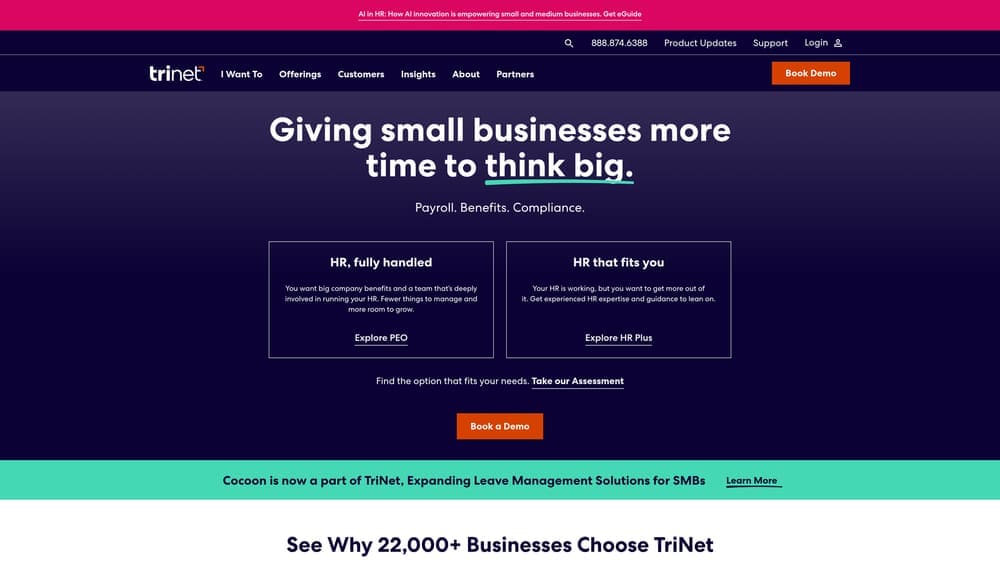
TriNet is a mid-market PEO with industry-specific compliance teams, risk management bundles, and access to large-company benefits packages.
Where This Tool Shines
TriNet’s industry vertical model is genuinely useful here. Rather than assigning generic HR generalists, they structure their compliance teams around specific industries — including retail and ecommerce operations. That means the people advising you on employment law and risk exposure actually understand the operational context, not just the regulatory text.
Their employment practices liability coverage is a meaningful differentiator for ecommerce companies managing high-volume hiring. The more employees you cycle through — especially during seasonal surges — the more exposure you carry on wrongful termination, discrimination, and wage and hour claims. TriNet’s risk management bundles address that exposure directly.
Key Features
Industry-Specific Compliance Teams: Compliance specialists with retail and ecommerce context, not just general HR knowledge.
Employment Practices Liability Coverage: Risk management protection for wrongful termination, discrimination, and wage and hour claims — important for high-volume hiring operations.
Fortune 500-Level Benefits: Access to competitive health insurance and benefits packages that help with recruiting in tight labor markets.
Strategic HR Consulting: Advisory support that goes beyond basic compliance into organizational and people strategy.
Multi-State Employment Law Guidance: Compliance support and audit assistance for businesses operating across multiple jurisdictions.
Best For
Mid-market ecommerce companies with 50-500 employees that want industry-aware compliance support and meaningful employment practices liability protection. Less suited to very small businesses that won’t use the strategic HR layer.
Pricing
Custom pricing, generally structured as a percentage of payroll. Varies by industry risk profile and services included.
7. Insperity
Best for: Established ecommerce businesses that want proactive compliance auditing and a dedicated HR consultant relationship.
Insperity is a PEO built around strategic HR partnership, with proactive compliance auditing, employment practices liability insurance, and dedicated HR consultants assigned to each account.
Where This Tool Shines
Insperity’s model is less about self-serve tools and more about a genuine advisory relationship. Each client gets a dedicated HR business performance consultant — not a support ticket system. For ecommerce companies that have grown past the “figure it out as we go” phase and want someone actively monitoring their compliance posture, that model has real value.
Their proactive compliance auditing is worth noting specifically. Rather than waiting for you to flag a problem, Insperity conducts regular assessments of your employment practices and surfaces risk before it becomes liability. For businesses that have scaled quickly and may have accumulated compliance gaps along the way, that audit function is genuinely useful.
Key Features
Dedicated HR Business Performance Consultant: A named consultant assigned to your account who understands your business over time, not a rotating support team.
Proactive Compliance Auditing: Regular assessments of employment practices and risk exposure, designed to catch problems before they escalate.
Employment Practices Liability Insurance: Legal support and coverage for employment-related claims, included in the service model.
Performance Management Tools: Organizational development resources beyond basic compliance, useful for ecommerce companies building out people operations.
Designed for Established Companies: Service model optimized for businesses in the 50-5,000 employee range with some operational maturity.
Best For
Ecommerce businesses that have scaled past startup mode and want a PEO that functions more like an embedded HR partner than a compliance vendor. Not the right fit for very early-stage companies or those that prefer a self-serve, tech-first experience.
Pricing
Custom pricing, typically percentage-of-payroll based. Requires a consultation to scope services and get a quote.
8. Amplify PEO
Best for: Ecommerce companies that want direct specialist access and flexibility without the bureaucracy of large PEO providers.
Amplify PEO is a boutique provider offering high-touch compliance support, flexible contract terms, and direct access to specialists rather than layered account management structures.
Where This Tool Shines
Larger PEOs often come with service structures that add distance between you and the people who actually know the answers. Amplify’s model removes that friction. You get direct access to compliance specialists who know your account, which means faster turnaround on questions and fewer situations where you’re re-explaining your business to someone new.
For ecommerce companies with significant seasonal fluctuation, Amplify’s flexible contract terms are worth paying attention to. Most large PEOs build contracts that favor their revenue stability, not your operational flexibility. Amplify’s willingness to work with seasonal patterns is a real structural difference, not just a marketing claim.
Key Features
Direct Specialist Access: Compliance specialists reachable directly, without navigating support queues or account management layers.
Flexible Contract Terms: Contract structures that accommodate seasonal ecommerce fluctuation rather than locking you into rigid annual commitments.
Personalized Risk Management: Workers’ comp and risk programs tailored to your specific operation rather than applied from a generic template.
Responsive Service Model: Faster turnaround on compliance questions and issue resolution compared to large enterprise PEOs.
Best For
Small to mid-sized ecommerce companies that want a more personal service relationship and contract flexibility. Also a strong option for businesses that have had frustrating experiences with large PEOs and want a provider that operates with more agility.
Pricing
Custom pricing with flexible terms available. Generally competitive with mid-market PEOs. Consultation required.
Which PEO Actually Fits Your Ecommerce Operation
There’s no single right answer here, and the honest truth is that the “best” PEO for your business depends heavily on your specific risk profile — not just your headcount.
If you’re running physical fulfillment operations with real OSHA and workers’ comp exposure, that factor should drive your evaluation more than almost anything else. Paychex and ADP TotalSource have the depth here. If your risk profile is primarily multi-state employment complexity with a distributed remote team, Rippling’s automation or TriNet’s industry-specific compliance teams may serve you better.
For companies approaching a PEO decision for the first time — or questioning whether their current provider is actually the right fit — starting with an unbiased comparison before taking vendor demos is worth the time. Most businesses that overpay for PEO services do so because they evaluated options on the provider’s terms rather than their own.
A few practical considerations before you sign anything:
Seasonal workforce complexity: If you double or triple headcount for Q4, make sure your PEO contract and service model actually accommodate that — not just technically, but operationally. Ask specifically how they handle rapid onboarding compliance at scale.
Worker classification exposure: If you use contractors, gig workers, or temp staff alongside W-2 employees, bring that up explicitly in any PEO evaluation. Classification risk is one of the most expensive compliance failures in ecommerce and it’s often underweighted in generic PEO sales conversations.
Contract flexibility: Read termination clauses carefully. Some PEO contracts make switching providers expensive and operationally painful. That matters if your business needs change.
Before you sign that PEO renewal, make sure you’re not leaving money on the table. Many businesses unknowingly overpay because of bundled fees, hidden administrative markups, and contracts designed to limit flexibility. Don’t auto-renew. Make an informed, confident decision.
