
Electrical contractors don’t fail because they can’t pull wire or read blueprints. They fail because a misclassified apprentice triggers a six-figure Department of Labor audit. Because a journeyman falls off a ladder and the workers’ comp claim spirals into a negligence lawsuit. Because prevailing wage documentation on a school project gets challenged three years later, and suddenly you’re defending wage-hour violations you didn’t know existed.
The litigation landscape for electrical contractors is fundamentally different from other trades. You’re working with live power. You’re managing crews across state lines with different licensing requirements. You’re juggling W-2 employees, 1099 subs, and apprentices under varying classification rules. And when something goes wrong—a jobsite injury, a wage dispute, a licensing board complaint—the legal exposure can be catastrophic.
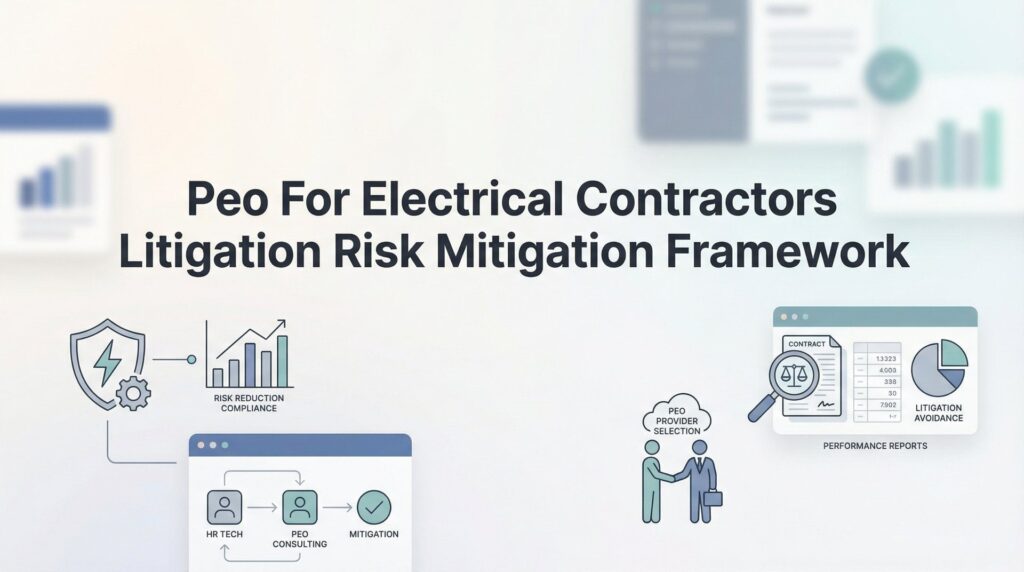
This article outlines a practical framework for using Professional Employer Organization (PEO) services specifically to reduce legal exposure in electrical contracting. Not a general PEO explainer. Not a sales pitch. A risk mitigation framework built around the realities of running crews on commercial jobsites, managing multi-state operations, and navigating the regulatory complexity that comes with the electrical trade.
The Litigation Exposure Problem Nobody Talks About
Electrical work sits at the intersection of multiple high-risk factors that don’t apply to most other businesses. Start with the obvious one: workplace injuries.
OSHA consistently identifies electrocution as one of the “Fatal Four” causes of construction deaths. Arc flash incidents, falls from elevated work platforms, and contact with overhead power lines create injury exposure that office-based businesses simply don’t face. When an electrician gets hurt, the workers’ comp claim is just the beginning. You’re also looking at potential OSHA citations, general liability claims, and in severe cases, wrongful death litigation.
The injury rate matters because it drives insurance costs and creates documentation requirements that many electrical contractors aren’t prepared to handle. Every incident needs proper reporting, investigation, corrective action documentation, and follow-up. Miss any of those steps, and you’ve handed plaintiff attorneys a roadmap for negligence claims.
Then there’s the classification nightmare. Electrical contractors routinely use a mix of direct employees, subcontractors, and apprentices. The IRS, state labor boards, and workers’ comp auditors all have different tests for determining who’s truly an employee versus an independent contractor. Get it wrong, and you’re facing back taxes, unpaid benefits, penalties, and potential fraud charges.
This gets exponentially more complicated when you work across state lines. An apprentice classification that’s defensible in Texas might fail scrutiny in California. A 1099 arrangement that works for residential service calls might violate prevailing wage requirements on a federal project. The regulatory patchwork creates constant exposure. Understanding state employment law risk becomes essential for multi-state operations.
Prevailing wage compliance deserves its own category of risk. Public projects—schools, government buildings, infrastructure work—come with Davis-Bacon requirements or state-specific prevailing wage laws. These aren’t simple hourly rates. They include fringe benefit calculations, certified payroll reporting, job classification rules, and documentation requirements that most payroll systems aren’t built to handle.
Wage-hour litigation in electrical contracting often stems from overtime calculation errors on jobs with variable schedules. Your crew works ten-hour days Monday through Thursday, then six hours on Friday. Did you calculate overtime correctly? What about travel time between jobsites? What about on-call pay for emergency service work? These aren’t theoretical questions—they’re the basis for class-action lawsuits that have cost electrical contractors millions.
The common thread across all these risks: documentation gaps and administrative complexity that outpaces the capacity of typical small-business HR infrastructure.
Building a Risk Framework Around Four Core Pillars
A PEO-based litigation risk framework for electrical contractors rests on four structural pillars. Each addresses a specific vulnerability in how most electrical contracting businesses operate.
Pillar One: Centralized Documentation and Audit Trail Creation
Most electrical contractors run on fragmented systems. Timesheets in one place, safety training records somewhere else, hiring paperwork in file cabinets, workers’ comp claims handled by the insurance broker. When litigation hits, you’re scrambling to piece together a defensible record.
A properly structured PEO relationship centralizes employment documentation in a single system. Hiring paperwork, I-9 verification, tax withholding, benefits enrollment, policy acknowledgments, safety training completion, disciplinary actions, performance reviews, and termination documentation all live in one auditable database.
This matters because employment litigation is often won or lost on documentation. Can you prove the employee signed the safety policy? Can you show progressive discipline before termination? Can you produce certified payroll records for that prevailing wage project from two years ago? Centralized documentation makes these questions answerable.
Pillar Two: Standardized Safety Protocols and OSHA Compliance
Generic safety programs don’t cut it for electrical work. You need protocols specifically designed for arc flash protection, lockout-tagout procedures, elevated work platforms, confined space entry, and trenching operations. You need site-specific hazard assessments before every job. You need documented safety meetings that cover the actual risks your crews face.
Better PEOs with construction trade experience provide safety program frameworks adapted for electrical contractors. Not office safety. Not warehouse safety. Jobsite safety for live electrical work. This includes toolbox talk templates, incident investigation procedures, OSHA 300 log management, and compliance tracking for required training (OSHA 10/30, confined space, fall protection, etc.). The approach mirrors what works for construction litigation risk mitigation more broadly.
The litigation protection comes from demonstrable safety culture. When an injury occurs, you need to show that safety wasn’t an afterthought—it was systematically implemented, tracked, and enforced. Documented safety meetings, completed training records, and corrective action follow-up create that evidence trail.
Pillar Three: Classification Guidance and Payroll Structuring
Worker misclassification is a minefield. The PEO relationship doesn’t eliminate classification risk, but it does provide professional guidance on structuring your workforce defensibly.
This includes applying the correct classification tests (IRS 20-factor test, ABC test in states that use it, state-specific electrical contractor licensing requirements), documenting the rationale for 1099 relationships, structuring subcontractor agreements with proper indemnification language, and flagging situations where classification is questionable before it becomes a problem.
On the payroll side, PEOs handle overtime calculations, prevailing wage compliance, multi-state tax withholding, and certified payroll reporting for public projects. These are complex, error-prone processes that create wage-hour litigation exposure when done incorrectly. Professional payroll administration reduces that risk substantially.
Pillar Four: Real-Time Regulatory Updates and Policy Maintenance
Employment law changes constantly. Minimum wage increases. Overtime threshold adjustments. New sick leave requirements. Changes to independent contractor tests. Updates to OSHA electrical safety standards. Most electrical contractors find out about these changes when they’re already non-compliant.
PEOs monitor regulatory changes and update policies, handbooks, and procedures accordingly. When California changes its meal break requirements, your employee handbook gets updated. When OSHA revises arc flash protection standards, your safety program reflects it. When a new state implements paid family leave, your benefits administration adapts. Staying ahead of regulatory enforcement risks requires this kind of proactive monitoring.
This pillar is about staying current without dedicating internal resources to regulatory monitoring. It’s particularly valuable for multi-state operations where keeping track of fifty different sets of employment laws is functionally impossible for a small business.
Connecting PEO Services to Your Highest-Risk Exposures
The framework only works if you map PEO services directly to your specific litigation vulnerabilities. Here’s how that works in practice for the three highest-risk areas electrical contractors face.
Workers’ Compensation Claims Management
When a PEO is the employer of record for workers’ comp purposes, they’re not just processing claims—they’re actively managing the entire lifecycle. This changes the dynamic significantly.
First, PEOs have financial incentive to control claims costs because they’re often self-insured or use large-group captive insurance arrangements. They’re motivated to identify fraudulent claims, challenge inflated medical treatment, and push for return-to-work programs. You benefit from that institutional expertise. Understanding the workers’ comp risk transfer framework helps clarify how liability actually shifts in these arrangements.
Second, PEO claims management creates consistent documentation. Incident reports follow a standard format. Medical documentation gets collected properly. Return-to-work communications are documented. Modified duty assignments are tracked. This consistency makes it much harder for claims to escalate into litigation, because the paper trail shows professional claims handling from day one.
Third, many PEOs provide dedicated claims advocates who coordinate between you, the injured worker, medical providers, and the insurance carrier. This reduces the administrative burden on your business and ensures nothing falls through the cracks—which is often where claims turn into lawsuits.
The limitation: PEOs manage the workers’ comp claim itself, but they don’t eliminate your exposure to related general liability claims or OSHA citations. If the injury resulted from a site hazard you created, that’s still your problem.
Termination Documentation and Separation Processes
Electrical contracting has high turnover. Seasonal work, project-based hiring, performance issues, failed drug tests, and no-call/no-shows create constant employee separations. Each one is a potential wrongful termination claim if not handled correctly.
PEOs provide termination process guidance that reduces exposure. This includes progressive discipline documentation (verbal warning, written warning, final warning, termination), performance improvement plan templates, separation checklists that ensure final pay and benefits are handled correctly, and exit interview procedures that document the business reason for termination. Implementing managing wrongful termination risk in co-employment should be a priority for any contractor with frequent separations.
The key is building a defensible record before termination happens. If you fire someone for repeated safety violations, you need documentation of each violation, the corrective action taken, and the employee’s acknowledgment. If you lay someone off due to project completion, you need documentation showing the economic reason, not discriminatory intent.
PEOs also handle the administrative details that create legal exposure when done wrong: final paycheck timing (varies by state), accrued vacation payout (varies by state and company policy), COBRA notification, unemployment claim responses, and reference verification procedures. These seem minor until you get sued for unpaid wages because you missed a state-specific final pay deadline.
Multi-State Compliance and Crew Mobility
Electrical contractors frequently work across state lines. Your business might be based in Arizona, but you’re bidding projects in Nevada, New Mexico, and California. Each state has different licensing requirements, employment laws, wage-hour rules, and tax obligations.
PEOs with multi-state infrastructure handle the compliance complexity: registering as an employer in each state where you have workers, withholding state income taxes correctly based on work location, tracking state-specific paid leave requirements, maintaining required state employment posters, and filing unemployment insurance in the correct jurisdictions.
This matters for litigation risk because multi-state operations create exposure in every state where you operate. A wage-hour violation in California doesn’t just affect California employees—it can trigger a broader audit of your entire payroll operation. Professional multi-state payroll administration reduces that risk.
The limitation: PEOs handle employment compliance, not trade licensing. If your electricians need to be licensed in every state where they work, that’s your responsibility to manage. The PEO can’t fix licensing violations.
The Limits of PEO Protection
Understanding what PEOs cannot protect you from is just as important as understanding what they can. Three major categories of risk remain entirely yours, regardless of the PEO relationship.
Licensing Board Actions and Professional Liability
PEOs have zero involvement in trade-specific credentialing and professional practice. If you’re operating without the required electrical contractor license, if your journeymen aren’t properly licensed, if you’re performing work outside your license classification—those are licensing board violations that the PEO relationship doesn’t touch.
Similarly, professional liability for completed electrical work remains your responsibility. If you wire a building incorrectly and it causes a fire, that’s a professional negligence claim against you and your general liability insurer. The PEO isn’t involved in your trade work quality, design decisions, or completed operations.
This distinction matters because some electrical contractors assume a PEO provides comprehensive legal protection. It doesn’t. It provides employment-related risk mitigation. Your trade practice, professional licensing, and technical work quality are separate risk categories. Understanding how co-employment actually protects your business helps set realistic expectations.
General Liability and Completed Operations Claims
The PEO relationship is about employment. It doesn’t extend to general liability coverage for property damage, bodily injury to third parties, or completed operations claims.
If your crew damages a client’s building during installation, that’s a general liability claim. If someone gets electrocuted from your completed work two years later, that’s a completed operations claim. If you cause a power outage that shuts down a manufacturing facility, that’s a business interruption claim. None of these fall under the PEO relationship.
You still need your own general liability insurance, professional liability coverage, and completed operations coverage. The PEO doesn’t replace those policies or provide coverage for those exposures.
Owner Decisions That Override PEO Guidance
The PEO can provide safety protocols, HR policies, and compliance guidance. But if you ignore that guidance and make decisions that create legal exposure, you own the consequences.
If the PEO’s safety program requires fall protection above six feet and you tell your crew to skip it to save time, that’s on you. If the PEO advises against classifying a worker as a 1099 and you do it anyway, that’s your risk. If the PEO provides termination guidance and you fire someone in violation of that guidance, you’ve created your own exposure.
The co-employment relationship means you share certain employer responsibilities, but it doesn’t eliminate your authority or accountability for business decisions. Gross negligence, intentional misconduct, and deliberate policy violations remain your liability.
This is why the framework requires active participation from ownership and field leadership. The PEO provides infrastructure and expertise, but you have to actually use it.
Choosing a PEO for Litigation Risk Reduction
Not all PEOs are equally capable of reducing litigation exposure for electrical contractors. Here’s how to evaluate providers specifically for risk mitigation capability.
Questions That Reveal Actual Construction Trade Experience
Ask for the percentage of their client base in construction trades. If it’s less than 20%, they’re a generalist provider adapting office-based programs to jobsite work. That’s not inherently disqualifying, but it means you’ll need to verify that their safety programs, workers’ comp management, and compliance infrastructure actually work for electrical contracting.
Ask about their claims history with electrical contractors specifically. What’s the average workers’ comp mod for their electrical contractor clients? What’s the claims frequency compared to industry benchmarks? If they can’t answer these questions with data, they don’t have enough electrical contractor clients to provide meaningful risk management.
Ask about legal support resources. Do they have employment attorneys on staff or on retainer? What’s included in the base service versus billable legal fees? When a wage-hour claim or EEOC complaint comes in, what’s the response process? You want a PEO that provides substantive legal support, not just referrals to outside counsel you pay for separately.
Red Flags That Indicate Weak Risk Management
Generic safety programs are the biggest red flag. If their safety manual is the same for electrical contractors, landscapers, and accounting firms, it’s useless for litigation protection. You need electrical-specific safety protocols: arc flash protection, lockout-tagout, confined space entry, trenching and excavation, ladder safety, and elevated work platform procedures.
Unclear indemnification language in the client service agreement should stop you immediately. Who’s responsible for what in a co-employment relationship? If there’s a wage-hour violation, who pays the penalties? If there’s a discrimination claim, who provides the defense? If there’s a workers’ comp fraud investigation, who handles it? These allocations should be crystal clear in the contract.
No dedicated claims advocate means you’re managing workers’ comp claims yourself with the PEO just processing paperwork. That’s not risk mitigation—that’s outsourced payroll with a workers’ comp policy attached. You want a PEO that actively manages claims from first report through closure.
Contract Provisions That Matter for Litigation Protection
Co-employment liability allocation is the most important contract provision. The agreement should clearly specify which employment-related liabilities the PEO assumes and which remain yours. In most arrangements, the PEO takes responsibility for payroll tax compliance, benefits administration, and workers’ comp claims management. You retain responsibility for hiring/firing decisions, workplace safety, and trade-specific compliance.
Defense cost coverage determines who pays legal fees when employment claims arise. Some PEOs include legal defense for covered claims (discrimination, harassment, wrongful termination) as part of the service. Others require you to pay defense costs separately. Know which model you’re getting.
Termination notice requirements affect your flexibility. Most PEO contracts require 30-90 days notice to terminate the relationship. Some include early termination penalties. Some require you to continue for a full year. If the relationship isn’t working, you need a realistic exit path that doesn’t trap you in a bad arrangement.
Premium adjustment clauses in workers’ comp coverage matter because your payroll fluctuates. Electrical contractors often have seasonal volume swings or project-based hiring. Make sure the workers’ comp premium adjusts based on actual payroll, not estimated payroll, and that you get credits for lower-than-projected headcount. Running a preparing for renewal by reviewing workers comp risk factors before contract renewal helps identify potential cost surprises.
Implementation: Making the Framework Work
The framework only delivers litigation risk reduction if you implement it properly. Three steps make the difference between theoretical protection and actual risk mitigation.
Start With a Litigation Exposure Audit
Before you select a PEO, identify your specific vulnerabilities. Review your workers’ comp claims history for the past three years. What’s your incident rate? What types of injuries are you seeing repeatedly? Where are your safety gaps?
Audit your workforce classification. How many 1099 contractors do you use? What’s the justification for each classification? Are you confident those classifications would survive IRS or state labor board scrutiny? If not, that’s a priority risk to address.
Review your multi-state operations. Where are you working? Are you registered as an employer in those states? Are you withholding taxes correctly? Do you have the required employment posters? Are you tracking state-specific paid leave requirements?
This audit tells you what to prioritize in PEO selection. If your biggest exposure is workers’ comp claims, you need a PEO with strong safety programs and claims management. If it’s multi-state compliance, you need a provider with robust payroll infrastructure across all your operating states. If it’s wage-hour risk, you need certified payroll capability and overtime calculation expertise.
Build Internal Accountability for PEO Protocols
The PEO provides the framework, but your field supervisors have to execute it. That requires training, accountability, and enforcement.
Train your foremen and project managers on the safety protocols, documentation requirements, and HR policies the PEO provides. They need to understand that toolbox talks aren’t optional, incident reports need to be filed immediately, and timekeeping has to be accurate. If field leadership doesn’t buy in, the framework fails.
Create accountability through regular audits. Review safety meeting documentation monthly. Spot-check timesheet accuracy. Verify that incident reports are being filed and investigated properly. Hold supervisors accountable for compliance gaps.
Enforce consequences when protocols aren’t followed. If a foreman repeatedly skips safety meetings, that’s a performance issue. If a project manager is sloppy with timesheet approvals, that creates wage-hour exposure. The PEO can’t fix problems you tolerate internally.
Measure Effectiveness Over Time
Track claims frequency and severity quarterly. Is your workers’ comp incident rate declining? Are claims closing faster? Are settlement costs decreasing? These metrics tell you whether the safety programs and claims management are working.
Monitor compliance audit results. If you’re getting prevailing wage audits, how are they going? Are you passing with clean findings, or are you getting cited for documentation gaps? If you’re getting wage-hour complaints, are they valid or frivolous?
Track employee turnover and termination-related claims. Is your turnover rate improving? Are wrongful termination claims decreasing? Are unemployment claim challenges successful? Better HR infrastructure should produce measurable improvements in these areas.
Use this data to refine your approach. If certain types of incidents keep happening, your safety program needs adjustment. If multi-state compliance is still creating problems, you might need a different PEO with stronger infrastructure in those states. If termination claims are still frequent, your documentation processes need tightening.
The Bottom Line on Risk Mitigation
A PEO is a risk mitigation tool, not a magic shield. It reduces employment-related litigation exposure when integrated properly, but it requires active participation from ownership and field leadership.
The framework works because it addresses the specific vulnerabilities electrical contractors face: jobsite injury exposure, worker classification complexity, multi-state compliance challenges, and wage-hour litigation risk. But it only works if you choose a PEO with actual construction trade experience, implement their protocols consistently, and hold your organization accountable for execution.
What a PEO cannot do is eliminate trade-specific professional liability, fix licensing violations, or protect you from decisions that override their guidance. You’re still responsible for the quality of your electrical work, your professional credentials, and your business judgment.
The decision to use a PEO should be based on a clear-eyed assessment of your litigation exposure and the cost of managing that risk internally versus outsourcing it to a professional organization. For many electrical contractors, especially those operating across multiple states or experiencing high workers’ comp claims, the risk reduction justifies the cost. For others with strong internal HR infrastructure and low claims history, it might not.
Before you sign that PEO renewal, make sure you’re not leaving money on the table. Many businesses unknowingly overpay because of bundled fees, hidden administrative markups, and contracts designed to limit flexibility. We give you a clear, side-by-side breakdown of pricing, services, and contract terms—so you can see exactly what you’re paying for and choose the option that truly fits your business. Contact our team
