
Federal contractors don’t just face employment law risk. They face employment law risk stacked on top of FAR compliance obligations, DCAA audit exposure, OFCCP enforcement, Service Contract Act wage determinations, and increasingly, cybersecurity requirements tied to how personnel data is handled. That’s a fundamentally different risk profile than a commercial employer of similar size.
A PEO can help with some of that. But here’s the tension that most articles on this topic gloss over: the co-employment model that makes a PEO valuable for risk mitigation in commercial environments can actually create new, compounding risk vectors for federal contractors if the arrangement isn’t structured carefully. The same shared employer status that reduces your workers’ comp exposure can muddy your OFCCP reporting obligations. The administrative fees that simplify your HR costs can draw DCAA scrutiny on a cost-reimbursable contract.
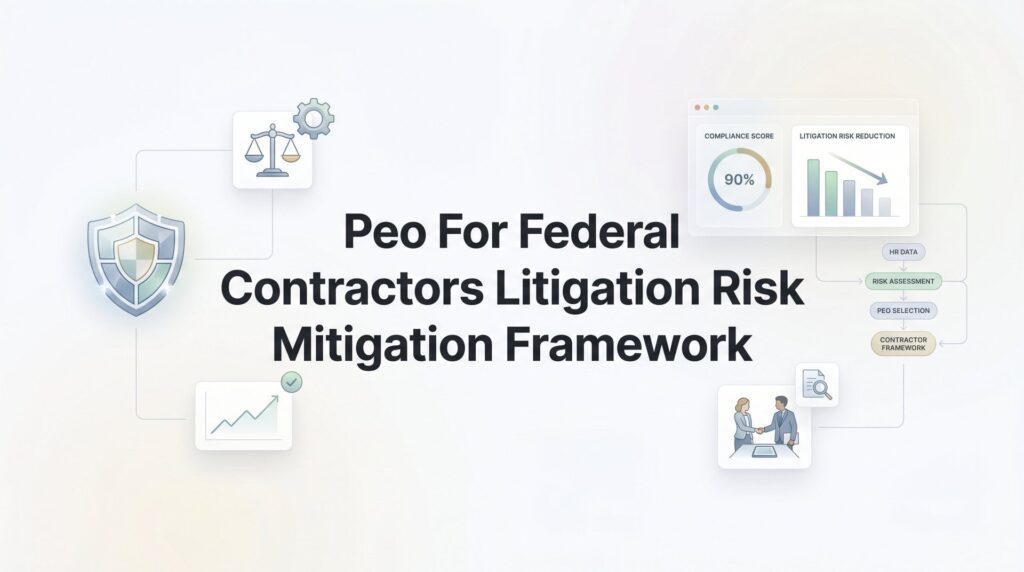
This isn’t a guide to PEOs in general. It’s a framework specifically for federal contractors evaluating whether a PEO partnership reduces their litigation surface area or expands it — and how to structure the arrangement either way.
The Regulatory Stack That Makes Federal Contracting Different
Commercial employers worry about FLSA, Title VII, ADA, and state wage laws. Federal contractors worry about all of those plus a set of overlapping obligations that most HR professionals outside the government contracting world never encounter.
Start with the Service Contract Act. If you hold a service contract valued over $2,500, you’re required to pay prevailing wages and fringe benefits as determined by Department of Labor wage determinations — and those determinations vary by locality and labor category. Getting them wrong isn’t a minor payroll error. It’s a compliance failure that can trigger back pay liability, contract debarment, and in serious cases, False Claims Act exposure.
Then there’s OFCCP. Federal contractors with 50 or more employees and contracts valued at $50,000 or more must maintain written affirmative action plans and comply with Executive Order 11246, which prohibits employment discrimination. OFCCP conducts compliance reviews that function like audits — they can pull compensation data, hiring records, and promotion histories. Failures here generate enforcement actions, not just civil suits. Understanding the full scope of regulatory enforcement risks is critical before layering a PEO into this environment.
DCAA sits in a separate lane but creates its own litigation risk. On cost-reimbursable and time-and-materials contracts, the Defense Contract Audit Agency audits labor costs against FAR Part 31 cost allowability principles. If your labor charging practices don’t hold up, you’re looking at disallowed costs, potential fraud referrals, and contract disputes that can escalate quickly.
The False Claims Act dimension deserves its own callout. When employment compliance failures on federal contracts are systematic — think widespread misclassification of labor categories or deliberate underpayment of SCA-required wages — they can cross from HR issues into qui tam territory. Whistleblower lawsuits under the FCA carry treble damages and attorney fee exposure. That’s categorically different from a standard employment discrimination claim.
One boundary worth drawing clearly: a PEO only touches the employment relationship. It has no role in bid protests, contract performance disputes, or prime-sub relationship conflicts. Contractors sometimes conflate “risk mitigation” broadly and assume a PEO covers more ground than it does. It doesn’t. The framework here is limited to employment-related litigation risk — which is still a significant surface area, but it’s a defined one.
Where Co-Employment Actually Moves the Risk Needle
With that boundary established, there are real areas where a PEO’s co-employment structure provides genuine risk transfer or mitigation for federal contractors.
Workers’ compensation and unemployment claims: PEOs typically carry their own workers’ comp policies and manage claims administration. For smaller federal contractors who don’t have the volume to negotiate favorable rates or the infrastructure to manage contested claims, this is a meaningful transfer of both cost and administrative risk. Understanding how workers’ comp risk transfer actually works under co-employment is essential before assuming the liability has fully shifted.
Termination documentation and defensibility: One of the most common sources of wrongful termination litigation is inconsistent or absent documentation. PEOs with standardized offboarding protocols create paper trails that hold up in employment disputes. This matters especially on federal contracts where employees may be terminated due to contract non-renewal — a situation that can generate unemployment disputes and, occasionally, discrimination claims if the selection process isn’t documented cleanly.
ERISA and benefits administration: Federal contractors who provide health and retirement benefits to SCA-covered employees have ERISA compliance obligations layered on top of SCA fringe benefit requirements. Small-to-mid-size contractors frequently underfund or misclassify fringe benefits, creating exposure on both fronts. A PEO managing benefits administration with SCA-aware practices can reduce this dual exposure — though you need to verify that the PEO actually understands SCA fringe benefit rules, not just standard benefits compliance.
HR compliance infrastructure: Most federal contractors under 100 employees don’t have a dedicated HR function with current employment law expertise. PEOs provide handbook policies, ADA interactive process documentation, investigation protocols for harassment complaints, and other compliance infrastructure that functions as litigation prevention. Having defensible processes in place before a claim arises is worth considerably more than responding reactively after one does.
EPLI backstop: Employment Practices Liability Insurance through a PEO arrangement can provide coverage for discrimination, harassment, and wrongful termination claims. Whether that coverage is adequate for a federal contractor’s specific exposure depends heavily on policy language — which we’ll address in the framework section.
The Risk Vectors That Can Get Worse Under a PEO
Here’s where the analysis gets more complicated, and where most surface-level PEO evaluations fall short for federal contractors.
The OFCCP headcount problem: OFCCP thresholds are based on employer headcount. When a PEO is the employer of record for payroll and tax purposes, the headcount calculation for OFCCP coverage becomes genuinely ambiguous. Are those employees attributed to the PEO or to the contractor? The answer affects whether you’re required to maintain a written affirmative action plan, and how you respond to an OFCCP compliance review. If the arrangement isn’t explicitly structured and documented, you can end up in a situation where neither party has clearly assumed the obligation — which is exactly the kind of gap OFCCP enforcement actions exploit.
Beyond headcount, OFCCP audits require the contractor to produce compensation data, applicant flow logs, and hiring decision documentation. If that data sits with the PEO and the PEO’s cooperation in an audit isn’t contractually guaranteed, you have a problem. Most PEO agreements don’t address this scenario. The broader lawsuit risk mitigation framework for PEO arrangements highlights why contractual clarity is non-negotiable.
DCAA and the administrative fee question: On cost-reimbursable contracts, labor costs must meet FAR Part 31 cost allowability standards. PEO administrative fees — typically a percentage of payroll — are a bundled cost that DCAA auditors may scrutinize. If the fee isn’t clearly allocable to allowable cost categories, auditors can challenge it as unallowable, which turns a billing structure decision into a contract dispute. This isn’t hypothetical. DCAA has historically been skeptical of management fees and administrative markups that aren’t clearly tied to allowable activities.
The documentation burden also increases. DCAA audits require labor cost records that demonstrate proper charging to contracts. If your timekeeping and labor distribution records are managed through a PEO’s platform, you need to verify that the system produces records in a format that satisfies DCAA requirements — and that you have direct access to those records during an audit without depending on PEO cooperation.
CUI, NIST 800-171, and the data custody question: If your contracts involve Controlled Unclassified Information, DFARS 252.204-7012 requires you to implement NIST SP 800-171 security controls and report cyber incidents. CMMC is being phased in through DFARS rulemaking as an additional requirement for defense contractors.
Here’s the problem: when a PEO handles personnel data for your employees, that data flows through the PEO’s systems. If any of that personnel data touches CUI-adjacent information — and it can, particularly in cleared environments — you have a data custody question that most PEO platforms are not built to answer. PEO HR platforms are not typically designed to meet NIST 800-171 controls, and most PEO agreements don’t address CMMC compliance gaps. Signing a PEO agreement without resolving this creates a compliance exposure that didn’t exist before.
Security clearance sponsorship: Clearance sponsorship must remain with the contractor, not the PEO. In a co-employment arrangement, the lines of employer control that matter for clearance purposes need to be explicitly preserved. This usually requires contract language that most standard PEO agreements don’t include by default.
Five Decision Gates Before You Sign
The framework isn’t a checklist you complete once. It’s a structured evaluation that should happen before signing any PEO agreement and revisited whenever your contract portfolio changes materially. Here are the five gates that matter most for federal contractors.
Gate 1: Contract type audit. Before evaluating any PEO, map your federal contract portfolio against the FAR clauses that affect employment obligations. FAR 52.222-41 (Service Contract Act) changes what you need from a PEO in terms of wage determination tracking and fringe benefit administration. FAR 52.222-26 (Equal Opportunity) affects OFCCP reporting obligations and how co-employment interacts with affirmative action plan requirements. DFARS 252.204-7012 (Safeguarding Covered Defense Information) creates data handling obligations that most PEO platforms can’t satisfy. Each of these clauses changes both what you need from a PEO and what risks the PEO introduces. If you don’t know which clauses are in your contracts, this analysis can’t proceed.
Gate 2: Co-employment boundary mapping. Negotiate explicitly which employer functions the PEO assumes and which remain with the contractor. This isn’t standard PEO agreement language — you’ll need to push for it. Specifically, document who is responsible for OFCCP reporting and AAP maintenance, who sponsors and manages security clearances, how contract-specific labor category assignments are handled, and what happens to employee records during a DCAA audit. Understanding how co-employment actually protects your business — and where it doesn’t — is the foundation for this negotiation.
Gate 3: Insurance and indemnification audit. Read the PEO’s EPLI policy language carefully, particularly the exclusions. Many EPLI policies exclude claims arising from government contract disputes or claims where the government is a party. Fiduciary liability coverage for benefits administration may similarly exclude SCA-related claims. If the coverage that makes the PEO arrangement attractive for risk transfer doesn’t actually extend to your federal contract exposure, you’re paying for protection you don’t have.
Gate 4: Data access and audit cooperation. Your PEO agreement should contractually guarantee your direct access to all employment records, payroll data, and labor cost documentation — without requiring PEO cooperation as an intermediary — for purposes of DCAA audits, OFCCP compliance reviews, and any government investigation. This is non-negotiable for federal contractors. If a PEO won’t agree to this, that’s a clear signal the arrangement isn’t structured for your environment.
Gate 5: SCA competency verification. Ask the PEO directly how they handle Service Contract Act wage determination updates. Ask for their process for tracking DOL wage determination revisions by locality and labor category. If the answer is vague or the PEO treats SCA compliance as a contractor responsibility they’ll “support,” that’s not sufficient. SCA underpayment liability flows to the contractor regardless of who manages payroll.
CPEO Status: What It Solves and What It Doesn’t
CPEO certification — administered by the IRS under IRC Section 7705 — provides certified tax liability transfer and requires the PEO to meet financial bonding and reporting standards. For federal contractors, CPEO status matters more than it does in purely commercial environments, but not for the reasons most people assume.
The primary benefit is in DCAA audit contexts. When DCAA questions payroll tax compliance on a cost-reimbursable contract, CPEO certification provides documented evidence that tax liability has been properly transferred and that the PEO meets IRS financial standards. It reduces one specific audit risk vector in a meaningful way.
The financial bonding requirements also provide a layer of counterparty risk protection. If a PEO becomes insolvent, the bonding provides some recourse. For federal contractors whose payroll runs through a PEO, counterparty risk is a real operational concern that CPEO status partially addresses. Similar counterparty risk considerations arise in HR risk mitigation during M&A transactions, where PEO continuity is equally critical.
What CPEO certification does not solve is equally important to understand. It doesn’t address OFCCP compliance. It doesn’t guarantee SCA wage determination accuracy. It creates no special standing with contracting officers and carries no weight in a DCAA audit of cost allowability beyond the payroll tax question. Contractors who treat CPEO status as a proxy for federal-contract-readiness are building a false assumption into their risk framework. It’s one indicator among many, not a certification of fitness for the federal contracting environment.
When a PEO Is the Wrong Tool Entirely
There are contract profiles where the co-employment model creates more litigation surface area than it removes, and being honest about that is part of the framework.
Classified contracts present an immediate problem. The personnel control requirements for classified work, combined with security clearance sponsorship obligations, create employer-of-record complications that most PEO agreements aren’t designed to handle. Trying to retrofit a PEO arrangement onto a classified contract environment is high-risk.
Cost-reimbursable contracts subject to heavy DCAA scrutiny are another profile where the math often doesn’t work. The administrative fee structure, the data access requirements, and the cost allowability questions create audit risk that may outweigh the HR compliance benefits. On firm-fixed-price contracts, DCAA isn’t auditing your labor costs, so this concern diminishes significantly.
Contracts requiring direct employer control over personnel for performance reasons — where the contracting officer expects the contractor to function as the clear, singular employer — can also create problems. In some contracting environments, a co-employment arrangement can raise questions about organizational conflicts of interest or performance accountability that create contract-level risk. The government contractors litigation risk framework explores these dynamics in broader detail.
For these situations, alternatives worth evaluating include ASO (Administrative Services Only) arrangements, which provide HR administrative support without co-employment; outside employment counsel on retainer for compliance guidance; or in-house HR capacity built around a federal contracting specialist. These structures provide compliance support without the employer-of-record complications that trigger federal-specific risks.
A practical way to think about the decision: if your revenue is primarily commercial with some federal work, a PEO arrangement often nets out as a risk reduction. If federal contracts represent your primary revenue stream and involve SCA obligations, OFCCP coverage, CUI handling, or classified work, the framework analysis frequently points away from traditional PEO co-employment. Strategies for reducing wrongful termination risk still apply regardless of which model you choose, but the structural vehicle matters. The more federal-specific your contract portfolio, the more carefully you need to evaluate whether the risk transfer you’re getting is real or theoretical.
The Bottom Line for Federal Contractors
The core insight here is simple even if the execution isn’t: litigation risk mitigation for federal contractors isn’t about finding a PEO that claims to handle everything. It’s about mapping your specific regulatory exposure, understanding exactly where co-employment helps versus where it creates new problems, and structuring the arrangement with explicit contractual boundaries that most standard PEO agreements don’t include by default.
The framework isn’t static. Every time your contract portfolio changes — new SCA-covered work, a cost-reimbursable contract, a classified program, a contract crossing the OFCCP threshold — the risk calculus shifts. What worked when your revenue was 80% commercial may not work when federal work becomes your primary book of business.
Before you sign or renew any PEO agreement, run through the five gates. Verify the insurance coverage actually extends to your exposure. Map the co-employment boundaries explicitly. Confirm data access rights in writing. And evaluate whether CPEO status is present and what it actually covers in your specific situation.
If you’re not sure whether your current or prospective PEO is actually built for the federal contracting environment, the comparison process matters. Most PEOs market broadly and federal-specific capabilities vary significantly. Don’t auto-renew. Make an informed, confident decision. The regulatory environment for federal contractors is too specific, and the consequences of a poorly structured arrangement too significant, to default to convenience.
