
Fire protection companies deal with a specific cocktail of HR headaches that most industries never think about. Your crews work with suppression systems, alarm installations, sprinkler fitting, and extinguisher servicing — all of which carry elevated workers’ comp risk classifications. Add in multi-state licensing requirements, OSHA compliance for confined spaces and hazardous materials, and the challenge of retaining NICET-certified technicians alongside office staff, and you’ve got a payroll and compliance puzzle that generic HR solutions weren’t built to solve.
A Professional Employer Organization (PEO) can take the weight off, but only if it actually understands high-risk trade work. Not every PEO will even quote fire protection contractors, and among those that will, pricing and service depth vary wildly. This list breaks down seven providers worth evaluating if you run a fire protection business, with a focus on workers’ comp handling, safety program support, and real cost considerations.
1. PEO Metrics
Best for: Fire protection companies that want to compare multiple PEOs before committing to one.
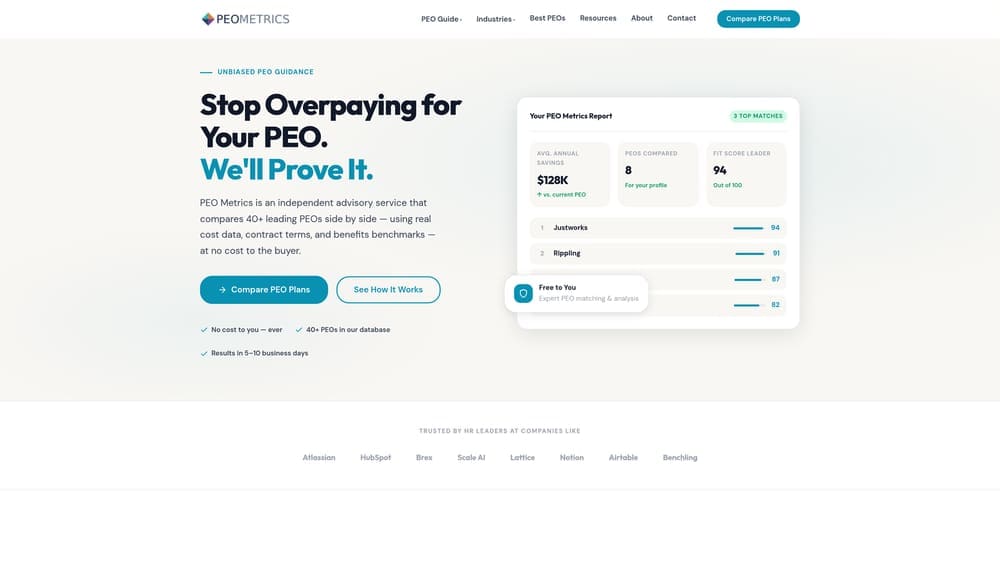
PEO Metrics is a comparison service, not a PEO itself. It’s the step you take before signing anything.
Where This Tool Shines
Most fire protection business owners evaluate PEOs by talking to one or two sales reps and picking the one that seemed most knowledgeable. That’s a reasonable approach, but it leaves a lot of money on the table. PEO pricing is notoriously opaque, and when you’re operating under elevated workers’ comp codes like 5183 for sprinkler installation, the spread between what different PEOs will charge you can be significant.
PEO Metrics gives you a structured, side-by-side view of multiple providers so you’re comparing apples to apples. If you’ve ever stared at two PEO proposals with different fee structures, bundled vs. unbundled pricing, and wondered which one is actually cheaper, this is the tool that answers that question clearly.
Key Features
Side-by-Side Provider Comparisons: Detailed metrics across multiple PEOs so you can evaluate pricing, services, and contract terms in one place.
Pricing Transparency: Breaks down quotes to show what you’re actually paying, including administrative markups that often get buried in bundled fees.
Unbiased Guidance: Not affiliated with any single PEO provider, which matters when you’re trying to get an honest read on your options.
Industry-Specific Filters: Ability to filter for providers that actually handle high-risk workers’ comp codes relevant to fire protection work.
Best For
Any fire protection company actively shopping for a PEO, or one that’s auto-renewing with a current provider and hasn’t checked whether they’re still getting a competitive deal. Particularly useful for owners who don’t have time to manage multiple sales conversations simultaneously.
Pricing
Free comparison service for businesses evaluating PEOs. No cost to use, no obligation to select any specific provider.
2. Insurity (formerly CompPay)
Best for: Fire protection contractors where workers’ comp cost and claims management is the primary pain point.
Insurity is a PEO with deep roots in workers’ compensation management for high-risk industries, including construction trades and fire protection contractors.
Where This Tool Shines
Workers’ comp is where many fire protection companies feel the most financial pressure. Codes like 5183 carry elevated per-$100-of-payroll premiums, and if your experience modification rate has crept up after a few claims, standalone coverage can get expensive fast. Insurity’s background in high-risk comp management means they’re not just processing payroll — they’re actively engaged with the risk side of your business.
The pay-as-you-go billing model is genuinely useful for contractors with fluctuating crew sizes. Instead of estimating annual payroll upfront and reconciling at audit time, you’re paying based on actual wages each period. That’s a real operational benefit for fire protection companies that ramp up during busy installation seasons.
Key Features
High-Risk NCCI Code Specialization: Experienced with the workers’ comp classifications that apply to sprinkler fitters, suppression technicians, and fire alarm installers.
Pay-As-You-Go Workers’ Comp: Billing tied to actual payroll each period, reducing year-end audit surprises.
EMR Management Support: Guidance on managing your experience modification rate over time to reduce long-term comp costs.
Safety Program Development: Resources to build or improve safety programs, which directly affects your mod rate and claim frequency.
Best For
Fire protection companies with workers’ comp as their primary cost concern, especially those with a history of claims or a mod rate above 1.0. Also a solid fit for contractors who’ve been declined or heavily surcharged by standard carriers.
Pricing
Custom quotes based on payroll volume and risk classification. Expect pricing to reflect the elevated risk profile of fire protection work.
3. Paychex PEO
Best for: Fire protection companies scaling into multiple states that need a single platform for payroll, compliance, and HR.
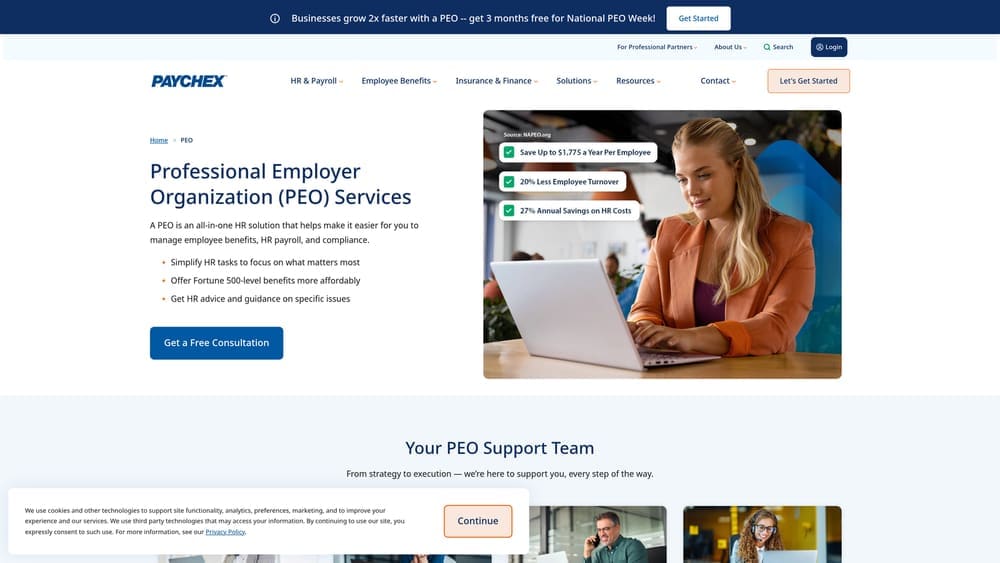
Paychex PEO is a large national PEO with dedicated risk management consultants and the infrastructure to support multi-state operations.
Where This Tool Shines
Multi-state fire protection work creates layered compliance complexity. Licensing reciprocity between states is inconsistent, payroll tax rules differ, and OSHA enforcement priorities vary by region. Paychex has the back-end infrastructure to handle that complexity without requiring your team to become experts in every jurisdiction you work in.
The dedicated HR business partner model is worth noting. Rather than calling a general support line, you get an assigned contact who learns your business. For a fire protection company managing certified technicians, apprentices, and office staff under different pay structures, that continuity matters.
Key Features
Dedicated HR Business Partner: A named contact assigned to your account who understands your workforce structure over time.
Multi-State Payroll and Tax Compliance: Handles payroll across multiple jurisdictions with built-in compliance updates.
Risk Management Consultants: Staff with experience in construction and trades, not just general HR.
Integrated Time Tracking and Job Costing: Useful for fire protection contractors tracking labor costs by project or service contract.
Large Group Benefits Access: Buying power that helps smaller fire protection firms offer competitive health and retirement benefits.
Best For
Growing fire protection companies with operations in multiple states, or those planning to expand. Works well for businesses with 25 or more employees that need a full-service HR infrastructure without building an internal HR department.
Pricing
Custom pricing on a per-employee-per-month model. Paychex is not the cheapest option, but the service depth typically justifies the cost for companies in a growth phase.
4. ADP TotalSource
Best for: Larger fire protection companies competing for NICET-certified technicians in tight labor markets.
ADP TotalSource is an enterprise-grade PEO that brings Fortune-500-level benefits packages to mid-market employers.
Where This Tool Shines
Retaining NICET-certified technicians and licensed journeyman sprinkler fitters is genuinely hard right now. These are credentialed tradespeople who have options, and they know it. Benefits quality is a real differentiator in that hiring environment. ADP TotalSource’s benefits portfolio is one of the strongest in the PEO market, which gives fire protection companies a recruiting and retention tool they couldn’t access on their own.
The compliance infrastructure is also worth noting for companies operating at scale. ADP has built-out support across all 50 states, which matters for fire protection contractors working on commercial projects in multiple jurisdictions simultaneously.
Key Features
Extensive Benefits Portfolio: Medical, dental, vision, 401(k), and supplemental benefits at group rates typically unavailable to smaller employers.
Integrated Talent Management: Recruiting and onboarding tools built into the platform, useful for managing technician hiring cycles.
50-State Compliance Support: Regulatory tracking and compliance updates across every jurisdiction.
Safety and Risk Management Resources: Dedicated support for workplace safety program development and claims management.
Employee Self-Service Portal: Mobile app that reduces administrative back-and-forth for field technicians who aren’t desk-based.
Best For
Fire protection companies with 50 or more employees, particularly those where benefits quality and talent retention are strategic priorities. Less cost-effective at smaller headcounts.
Pricing
Custom pricing; ADP TotalSource is generally positioned for companies with 50 or more employees. Expect enterprise-level pricing to match the enterprise-level service.
5. Employer Flexible
Best for: Fire protection contractors in Texas and the southern U.S. who want hands-on service without big-firm bureaucracy.
Employer Flexible is a regional PEO based in Texas with strong experience serving construction and trade contractors in southern markets.
Where This Tool Shines
There’s a real difference between a PEO that theoretically serves your industry and one that has actually worked with trade contractors in your specific regulatory environment. Employer Flexible has built its reputation in Texas and surrounding states, where construction and fire protection work is substantial and where state-specific labor regulations create real compliance challenges.
The service model is more hands-on than what you’d get from a national provider. Direct access to account managers, not a call center, means faster resolution when something goes sideways with payroll or a comp claim. For a small fire protection company without a dedicated HR person, that responsiveness is genuinely valuable.
Key Features
Regional Regulatory Expertise: Deep familiarity with Texas and southern state employment laws, licensing requirements, and workers’ comp rules.
Direct Account Manager Access: Named contacts, not a support queue, for day-to-day HR and payroll questions.
Workers’ Comp Management for Trade Contractors: Experience handling the elevated risk classifications common in fire protection and related trades.
State-Specific HR Compliance: Compliance support tailored to the jurisdictions where they actually operate, rather than generic 50-state coverage.
Best For
Small to mid-size fire protection companies operating primarily in Texas or neighboring states that want a regional partner with real trade contractor experience. If you’re operating nationally, you’ll likely outgrow the geographic coverage.
Pricing
Custom quotes; competitive for small to mid-size firms within their service area. Worth getting a quote to compare against national providers, especially if you’re in their core Texas market.
6. Oasis (a Paychex Company)
Best for: Mid-size fire protection companies where OSHA compliance and HR advisory depth are the primary needs.
Oasis is a mid-market-focused PEO backed by Paychex’s resources, known for detailed compliance consulting and HR advisory services.
Where This Tool Shines
OSHA compliance is not optional in fire protection. Confined space entry, hazardous materials handling, fall protection for sprinkler fitters working at height — these aren’t edge cases, they’re routine parts of the job. Oasis has built a reputation for deep OSHA compliance consulting rather than just checking regulatory boxes, which is a meaningful distinction for fire protection employers who’ve dealt with citations or near-miss incidents.
The HR advisory model positions Oasis as more of a strategic partner than a payroll processor. For a fire protection company that’s grown to the point where informal HR practices are creating liability, having dedicated specialists available is worth more than the cost savings of a bare-bones PEO.
Key Features
Deep OSHA Compliance Consulting: Substantive support for the specific OSHA standards that apply to fire protection field work, not just general awareness.
Dedicated HR Advisory Specialists: Named HR professionals who provide guidance on employment decisions, not just compliance checklists.
Mid-Market Benefits Administration: Buying power appropriate for companies in the 20-500 employee range.
Workplace Safety Program Development: Structured support for building safety programs that reduce claim frequency and protect your mod rate.
Multi-State Regulatory Tracking: Compliance monitoring for companies operating across state lines with varying licensing and employment requirements.
Best For
Fire protection companies with 20 to 500 employees where OSHA compliance and HR advisory support are genuine operational priorities. The Paychex backing provides stability and resource depth without the full enterprise pricing of ADP TotalSource.
Pricing
Custom pricing. Typically serves companies in the 20-500 employee range, with pricing that reflects the advisory service depth.
7. CoAdvantage
Best for: Smaller fire protection companies that want PEO access without long-term lock-in or rigid contract terms.
CoAdvantage is a flexible PEO that works with specialty contractors and offers more accommodating contract terms than many larger providers.
Where This Tool Shines
One of the legitimate frustrations with PEOs is the contract structure. Many providers lock you in for a year or more, and exiting mid-term can be costly and operationally disruptive. CoAdvantage is known for more flexible terms, which reduces the risk of trying a PEO for the first time. For a fire protection company that’s never used a PEO before and isn’t sure if it’s the right fit, lower commitment terms are a real practical benefit.
They’re also willing to quote niche trade classifications that some larger PEOs decline or price prohibitively. That willingness to engage with specialty contractor work, including fire protection, makes them worth a call if you’ve been turned away or quoted unreasonable rates elsewhere.
Key Features
Flexible Contract Terms: Less rigid lock-in periods compared to many national PEO providers, reducing commitment risk for first-time PEO users.
Willingness to Quote Niche Classifications: More accommodating toward specialty trade contractors, including fire protection work, than some larger competitors.
Payroll Processing with Job-Level Reporting: Useful for fire protection contractors tracking labor costs by job site or service contract type.
Workers’ Comp Under Master Policy: Access to the PEO’s master workers’ comp policy with claims management support included.
Best For
Fire protection companies with 5 to 100 employees, particularly those exploring a PEO for the first time or those that have been declined by other providers due to risk classification. The flexible terms make it a lower-risk entry point into the PEO model.
Pricing
Custom quotes. Generally accessible for smaller companies, and the flexible contract structure means you’re not overcommitting before you’ve tested the relationship.
Matching the Right PEO to Your Fire Protection Business
The honest answer is that there’s no single best PEO for fire protection companies. The right fit depends on your headcount, where you operate, and what’s actually costing you the most right now.
Here’s a rough framework for thinking through it:
Under 25 employees: CoAdvantage and Employer Flexible (if you’re in Texas or the South) are worth prioritizing. Flexible terms and regional expertise matter more at this stage than enterprise infrastructure. Insurity is worth evaluating if workers’ comp cost is your primary driver.
25 to 75 employees: Paychex PEO and Oasis are well-suited to this range. You’re large enough to benefit from dedicated HR support and multi-state compliance tools, but not so large that you need full enterprise pricing. This is also the range where benefits quality starts to matter for technician retention.
75 or more employees: ADP TotalSource becomes more cost-justified at this scale. The benefits portfolio and compliance infrastructure are built for employers competing at a higher level for credentialed talent.
If workers’ comp relief is your primary need, prioritize Insurity and CoAdvantage. If OSHA compliance and HR advisory depth matter most, Oasis is worth a close look. If you’re scaling into multiple states and need a platform that won’t break under the complexity, Paychex PEO is the most proven option for that scenario.
There’s also a candid caveat worth stating clearly: a PEO isn’t the right move for every fire protection company. If you’ve already secured excellent standalone workers’ comp rates through a specialty carrier, a PEO may add administrative cost without meaningful savings. If your workforce is unionized, PEOs typically cannot co-employ union members, which makes the arrangement unworkable. And if you do significant government contract work, the co-employment structure can create complications with prevailing wage requirements that aren’t worth the tradeoff.
Before you sign that PEO renewal, make sure you’re not leaving money on the table. Many fire protection businesses overpay because of bundled fees, hidden administrative markups, and contracts designed to limit flexibility. PEO Metrics gives you a clear, side-by-side breakdown of pricing, services, and contract terms so you can see exactly what you’re paying for. Don’t auto-renew. Make an informed, confident decision.
