
Retail businesses operate in one of the most legally exposed environments in the U.S. employment landscape. You’re managing a high-turnover hourly workforce, running public-facing operations where injuries happen, navigating scheduling laws that vary by city, and terminating employees regularly in environments where documentation is often rushed or incomplete. That combination doesn’t just create HR headaches — it creates lawsuit exposure that compounds quietly until it doesn’t.
Most retail operators know they’re exposed. What they don’t have is a structured way to reduce that exposure systematically. A PEO can help with this, but only if the co-employment relationship is built with litigation risk specifically in mind. There’s a meaningful difference between a PEO that handles payroll and benefits and a PEO that actually reduces your lawsuit vulnerability in retail-specific ways.
This article is about the latter. We’re going to walk through what a retail litigation risk mitigation framework looks like inside a PEO relationship, where the real protection comes from, and how to tell whether a PEO you’re evaluating actually has retail-grade capabilities or is just using that language in their sales deck.
Retail’s Litigation Profile Is Its Own Category
The lawsuit categories that hit retail hardest aren’t random. They follow the structural characteristics of the industry itself, which means if you understand the structure, you can anticipate the exposure.
Wage and hour violations are the most consistent source of employment litigation in retail. Variable scheduling, split shifts, part-time status changes, missed break requirements, and overtime miscalculation for employees whose hours fluctuate week to week — these create fertile ground for claims. Predictive scheduling laws have added another layer of complexity in cities like New York, Chicago, Seattle, San Francisco, and Philadelphia, as well as statewide in Oregon. If your managers are making last-minute schedule changes without documenting them properly, you’re building liability with every shift swap.
Workers’ compensation in retail involves a mix of risk classes that most operators don’t think about carefully enough. Cashiers, stock room employees, and delivery personnel each carry different risk profiles and different classification codes. When those roles blur in practice — which they frequently do in smaller stores — workers’ comp audits become a real problem. Understanding how workers’ comp risk transfers work through a PEO is essential for retail operators navigating these classification challenges.
Discrimination, harassment, and wrongful termination claims are elevated in retail partly because of turnover. The EEOC consistently identifies the retail trade sector among the top industries for discrimination and harassment charges filed. High turnover means more terminations, more terminations mean more opportunities for claims, and rushed terminations mean less documentation to defend against them.
ADA exposure comes from two directions in retail: physical accessibility complaints about store premises and accommodation requests from employees that don’t get handled correctly. The public-facing nature of retail makes both more likely than in an office environment.
The seasonal and part-time workforce model amplifies all of this. When employees cycle through quickly, onboarding gets compressed, documentation gets skipped, and the paper trail that would defend a termination or a wage dispute simply doesn’t exist. Add multi-location complexity — different managers with different levels of HR training, different state and local labor laws applying to different stores, inconsistent policy enforcement across locations — and you have a compliance environment that’s genuinely difficult to manage without external infrastructure.
This is the baseline problem a PEO framework needs to address. Not generic HR support. Retail-specific litigation exposure.
The Framework Components and How They Connect
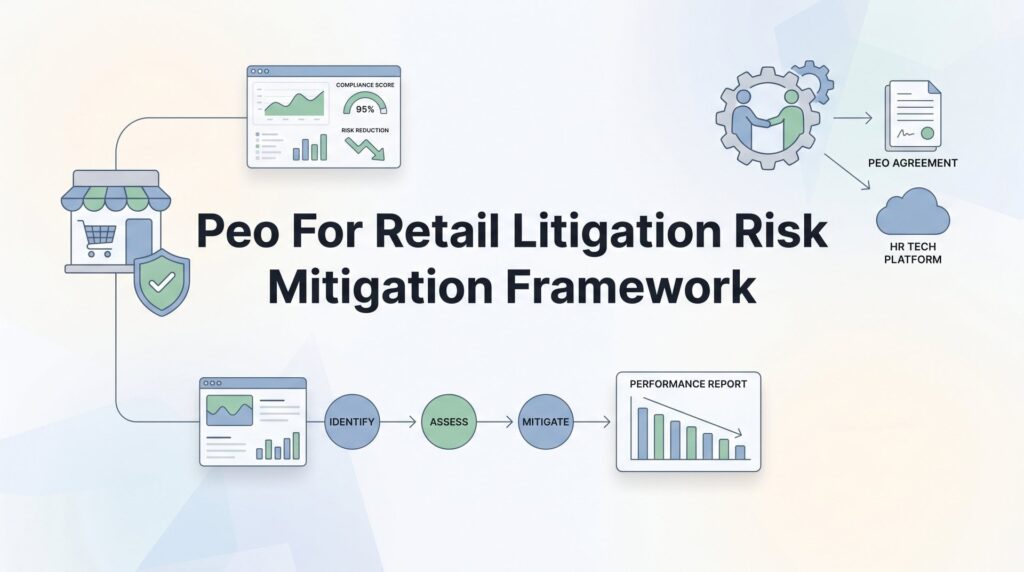
A litigation risk mitigation framework inside a PEO isn’t a single product or feature. It’s a set of connected systems that, when they work together, reduce your exposure at multiple points in the employment lifecycle. Here’s what that actually looks like.
Proactive compliance audits are the starting point. A PEO with real retail capabilities should be auditing your wage and hour practices, your classification of part-time and seasonal workers, your break compliance records, and your scheduling documentation on a regular basis — not just when you onboard. The goal is to catch vulnerabilities before they become claims.
Standardized documentation workflows are where most of the practical protection lives. This means onboarding checklists that actually get completed, progressive discipline templates designed for hourly workers, time-stamped schedule change records, and incident reporting workflows that create a defensible paper trail. The documentation system has to be simple enough that a store manager under pressure will actually use it — otherwise it exists in theory but not in practice.
EPLI coverage structuring is the insurance layer, and we’ll go deeper on this in the next section. The short version: Employment Practices Liability Insurance through a PEO can cover wrongful termination, harassment claims, and retaliation suits, but the specifics matter enormously for retail.
Claims management protocols determine what happens when a complaint is filed. A good PEO should have a defined process for responding to EEOC charges, handling workers’ comp claims, and managing the early stages of employment disputes. How quickly they respond and how well they document the response can materially affect outcomes.
Manager training is the piece most PEOs underinvest in, and it’s arguably the most important for retail. Courts have generally held that PEOs share liability for employment practices they control or influence — like benefits administration and payroll compliance — but not for day-to-day supervisory decisions made by the client’s managers. This means the place where most retail litigation actually originates (a manager making a bad termination call, mishandling a harassment complaint, or skipping a break log) is exactly where PEO liability ends and yours begins. Understanding how co-employment actually protects your business is critical to setting realistic expectations about where PEO coverage begins and ends.
The co-employment boundary matters here and deserves direct attention. The PEO shares employer liability for the employment practices it controls. You retain liability for what your managers do on the floor. That split is where most misunderstandings happen during PEO evaluations, and where retailers get surprised when a claim arises and the PEO’s coverage doesn’t apply the way they expected.
A retail-specific framework has to account for this boundary explicitly. A generic compliance program designed for office workers doesn’t address predictive scheduling exposure, tip credit issues, or the documentation gaps that come from managing a 40-person store with a two-person management team.
EPLI, Workers’ Comp, and the Insurance Layer Most Retailers Get Wrong
PEO-provided EPLI is a real benefit, but it’s not a blanket. Understanding what it covers and what it doesn’t is essential before you assume you’re protected.
Standard EPLI through a PEO typically covers wrongful termination claims, discrimination and harassment suits, and retaliation complaints. For retail, these are common exposure points, so the coverage is genuinely useful. The problem is the exclusions, and they vary significantly by carrier and by the specific master policy the PEO uses.
One of the most important exclusions to check: wage and hour defense costs. Many EPLI policies exclude wage and hour claims entirely, or cover only defense costs but not settlements. Given that wage and hour litigation is among the most common employment lawsuit categories in retail, a policy that doesn’t cover it is a significant gap. A broader understanding of PEO lawsuit risk mitigation can help you identify these coverage gaps before they become costly surprises.
Other common exclusions include claims arising from conduct that occurred before the PEO relationship started, claims related to ERISA violations, and in some cases, claims involving independent contractors. If your retail operation uses contractors or gig workers in any capacity, verify how those individuals are treated under the policy.
Workers’ compensation structuring through a PEO can deliver real cost savings for retail — but it requires getting the role classification right. PEOs can reclassify roles to access better rates, and retail has meaningful variation across its workforce. Cashier roles carry different risk codes than warehouse or stock room work, which carries different codes than delivery. When those distinctions are properly documented and classified, you may see rate improvements. When they’re not, you’re exposed during audits.
The broader insurance pooling benefit is real: PEOs aggregate their client base to access group rates that a standalone retail business typically can’t match. But that benefit only materializes if the PEO’s master policy actually covers retail-specific exposures. Some PEOs are built primarily around office-based or professional services clients, and their insurance structures reflect that. A retail business pooled into that group isn’t necessarily getting retail-appropriate coverage — it may just be getting cheaper coverage that still has the same gaps.
The practical question to ask any PEO: what percentage of your client base is in retail or similarly structured industries, and how does your master workers’ comp and EPLI policy address retail-specific risk classifications? If they can’t answer that clearly, that’s diagnostic information.
Documentation and Termination: The Highest-Leverage Defense You’re Probably Underinvesting In
If you had to pick one area where retail businesses consistently fail on litigation defense, it’s documentation. Not because operators don’t know it matters, but because the conditions of retail management make consistent documentation genuinely hard. Managers are understaffed, turnover is high, and the pressure to move fast outcompetes the discipline to document.
A PEO-supported documentation framework has to be designed with that reality in mind. That means simple, standardized templates that don’t require legal training to complete. It means digital systems with time-stamped entries that can’t be retroactively altered. It means clear workflows that integrate into how managers already operate, rather than requiring a separate process they’ll skip under pressure.
For retail specifically, the documentation framework should include:
Progressive discipline templates for hourly workers. These need to reflect the realities of retail employment — attendance issues, performance problems during seasonal rushes, conduct incidents in customer-facing roles. Generic corporate progressive discipline templates often don’t translate well to hourly retail environments.
Schedule change records with timestamps. In jurisdictions with predictive scheduling laws, undocumented last-minute schedule changes are a direct liability. The record needs to show when the change was made, who authorized it, and whether required notice was given.
Break compliance logs. Missed meal and rest break claims are common in retail, particularly in states with strict break requirements like California. If you can’t demonstrate that breaks were offered and taken, you’re defending against a presumption of violation.
Incident reporting workflows. Workplace injuries, customer complaints about employee conduct, internal harassment reports — each of these needs a documented response trail that shows the incident was taken seriously and handled according to policy.
Termination is where documentation failures become most expensive. The pattern in retail is predictable: a manager decides an employee needs to go, the termination happens quickly, and the documentation is thin or nonexistent. Then a wrongful termination or discrimination claim follows, and there’s nothing in the file to defend the decision. Retailers facing this pattern should explore proven strategies to reduce wrongful termination risk through structured PEO-supported processes.
A PEO should provide a pre-termination review process — a step where the proposed termination is reviewed against the documentation record before it happens. This isn’t bureaucracy for its own sake. It’s the step that catches the termination that looks retaliatory on paper even if it wasn’t, or the one where the progressive discipline record doesn’t support the decision being made. Skipping this step is one of the most expensive shortcuts a store manager can take, and it happens constantly in retail because the pace of operations discourages it.
If your PEO isn’t providing a structured pre-termination review process, that’s a gap worth addressing directly.
How to Tell If a PEO’s Retail Litigation Framework Is Real
PEOs will often describe themselves as having strong compliance capabilities. The question is whether those capabilities are actually built for retail or whether they’re generic infrastructure dressed up with retail-friendly language. Here’s how to separate the two.
Ask for retail-specific compliance playbooks. Not general HR policy templates — retail-specific guidance that addresses predictive scheduling compliance, tip credit rules where applicable, multi-state wage and hour requirements, and documentation workflows designed for hourly worker management. If they hand you the same playbook they give to a tech company, that’s your answer.
Ask about their claims history in retail. A PEO with meaningful retail experience should be able to speak to the types of claims their retail clients encounter, how those claims are typically handled, and what their track record looks like. They won’t share confidential client data, but they should be able to speak to patterns and outcomes at a general level. Vague answers here are a red flag.
Ask how manager training is delivered. There’s a meaningful difference between a PEO that provides an online compliance portal and one that actively trains your store managers on documentation protocols, termination procedures, and harassment response. An online portal that nobody logs into doesn’t reduce your litigation exposure. Ask specifically: how do you ensure managers are actually trained and applying the documentation standards?
Watch for these red flags:
Treating retail like every other industry. If the PEO sales conversation doesn’t differentiate between your retail operation and a professional services firm, they haven’t thought carefully about your risk profile. Reviewing a comparison of top PEOs for retail compliance can help you benchmark what retail-specific capabilities should actually look like.
Inability to clearly articulate co-employment liability boundaries. If they can’t explain specifically which claims fall under shared liability and which remain entirely with you, you’re going to be surprised when a claim arises.
EPLI policies with retail-unfriendly exclusions. Specifically: no wage and hour defense coverage, broad exclusions for conduct by supervisors, or policies that don’t cover multi-location operations consistently. Retailers operating across multiple locations face compounding compliance challenges that a multi-location litigation framework should specifically address.
There are also situations where a PEO isn’t the right litigation risk solution at all. If you have fewer than ten employees, the cost structure of a PEO engagement typically doesn’t make sense relative to the compliance benefit. If your primary litigation exposure is product liability rather than employment law, a PEO addresses the wrong risk category. And if you’re dealing with complex, industry-specific legal issues that require specialized employment counsel, a PEO’s compliance infrastructure is a complement to that counsel, not a replacement for it.
Building the Framework, Not Just Buying It
A litigation risk mitigation framework isn’t something a PEO hands you on day one. It’s something you build together over time, and it only works if the retailer holds up their end of it.
The PEO provides the infrastructure: compliance audits, documentation systems, EPLI coverage, claims management protocols, and training resources. But that infrastructure requires active maintenance on your side. Managers need to actually follow termination protocols. Break compliance logs need to actually be kept. Schedule changes need to actually be documented. If those behaviors don’t happen consistently, the framework exists on paper but not in practice — and it won’t protect you when a claim arises.
The businesses that get the most litigation risk protection from a PEO relationship are the ones that treat the PEO’s compliance infrastructure as a system to operate, not a service to consume passively. That means enforcing documentation standards across locations, holding managers accountable for following pre-termination review processes, and reviewing compliance audit findings rather than filing them.
If you’re evaluating PEO providers, retail litigation capabilities should be an explicit evaluation criterion — not an assumed benefit. Ask the questions outlined in this article. Compare providers on the specifics of their EPLI coverage, their retail compliance playbooks, and their manager training delivery. Don’t assume that because two PEOs offer similar pricing, they offer similar litigation protection.
The stakes in retail are high enough that this comparison is worth doing carefully. Don’t auto-renew. Make an informed, confident decision. The right PEO for your retail litigation exposure isn’t necessarily the one you’re already using — it’s the one that’s actually built for your risk profile.
