
SaaS companies face a compliance puzzle that most industries don’t. You’re hiring engineers across multiple states, onboarding fast, dealing with equity compensation structures, and navigating data privacy requirements that touch HR data directly. A generic PEO won’t cut it.
Enterprise buyers are increasingly scrutinizing vendor employment practices during due diligence. Your HR compliance posture can slow down or kill deals. And the distributed workforce model that defines most SaaS companies creates layered compliance exposure: multi-state tax obligations, IP assignment agreements, contractor misclassification risk, and SOC 2 considerations that extend to your PEO’s own systems.
The tools below were evaluated specifically for how well they handle the compliance and risk management challenges SaaS companies actually face. Not just payroll. Not just benefits. The full picture.
1. PEO Metrics
Best for: SaaS companies that want to compare PEO providers on compliance depth before talking to sales.
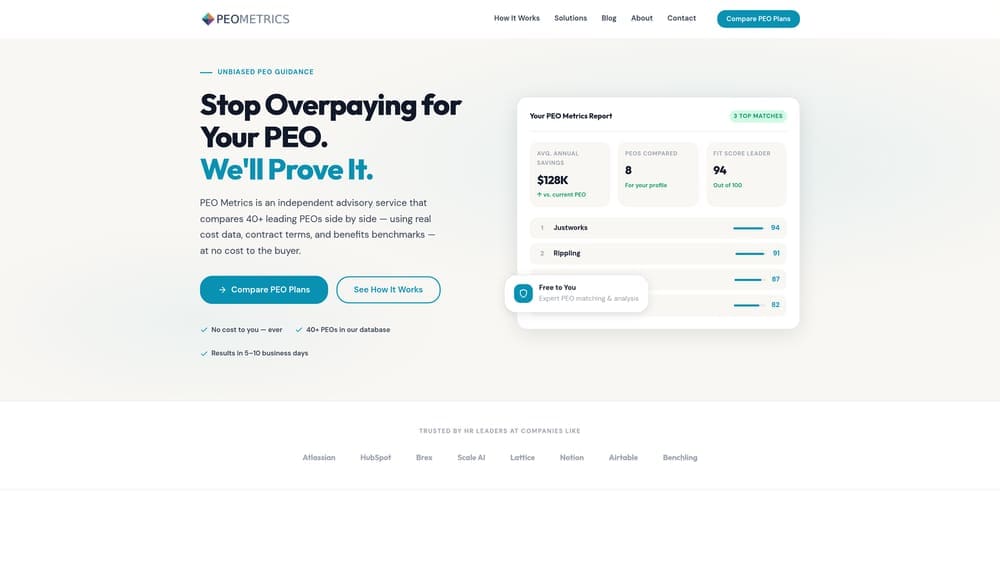
PEO Metrics is an unbiased PEO comparison platform that helps SaaS companies evaluate and shortlist providers based on compliance capabilities, risk management infrastructure, and transparent pricing data.
Where This Tool Shines
Most businesses evaluate PEOs by talking to sales reps, which means they’re comparing polished pitches instead of actual capabilities. PEO Metrics flips that. You get structured, side-by-side comparisons built around the criteria that matter for compliance-heavy environments: multi-state coverage, risk management depth, integration capability, and contract flexibility.
For SaaS companies specifically, this matters because the compliance requirements you’re navigating (SOC 2 vendor considerations, IP assignment workflows, equity comp handling across states) aren’t questions most PEO sales teams are equipped to answer upfront. Having a neutral framework to evaluate providers before you enter a sales cycle saves time and protects you from signing a contract that looks good on paper but doesn’t deliver on compliance specifics.
Key Features
Side-by-Side Compliance Comparisons: Compare PEO providers on compliance-specific metrics rather than generic feature checklists.
Pricing Transparency: Cost benchmarking helps you understand what you should be paying and identify hidden administrative markups before they show up on invoices.
Unbiased Guidance: PEO Metrics isn’t affiliated with any single provider, so the recommendations aren’t shaped by referral fees or preferred partnerships.
Data-Driven Matching: Matching is based on your company size, industry, and specific compliance needs rather than generic fit criteria.
Best For
SaaS companies at any stage that are evaluating PEOs for the first time, switching providers, or approaching a renewal and want to verify they’re not overpaying. Particularly useful for companies where compliance depth is a real requirement, not just a checkbox.
Pricing
Free comparison service. No cost to evaluate and compare providers through the platform.
2. Rippling PEO
Best for: Tech-native SaaS companies that want HR, IT, and compliance automated in a single connected platform.
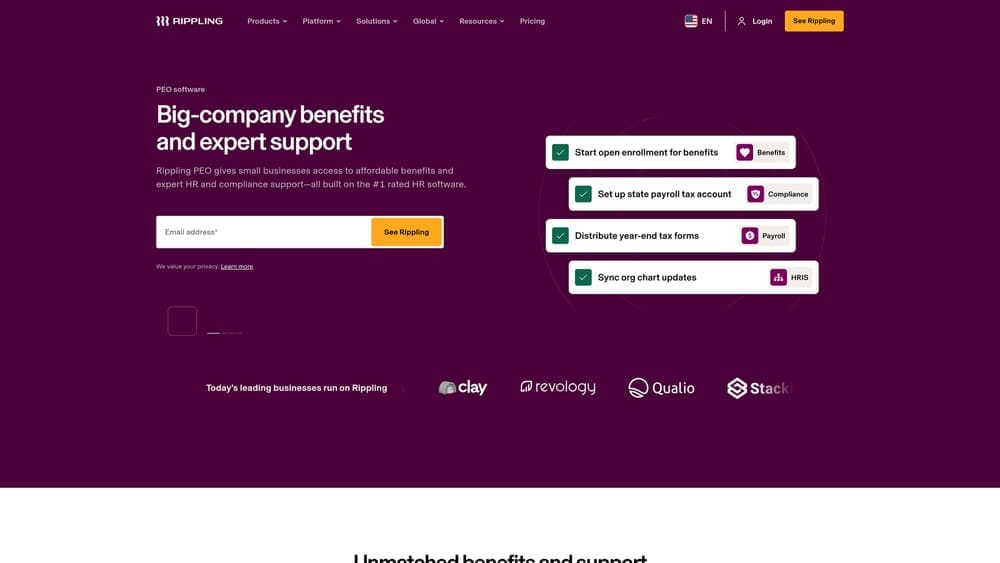
Rippling PEO is a tech-native PEO that bundles payroll, benefits, compliance automation, and IT management into one unified system.
Where This Tool Shines
Rippling’s core advantage for SaaS companies is the integration depth. Most PEOs handle HR in isolation. Rippling connects onboarding to device provisioning, app access, and compliance workflows simultaneously. When you hire an engineer in a new state, Rippling can handle the tax registration, push the IP assignment agreement for signature, and set up their GitHub and AWS access in the same flow.
The policy automation engine is worth calling out. It tracks state-specific employment law changes and can automatically update your policies when regulations shift. For a SaaS company with employees across five or ten states, that’s meaningful risk reduction without requiring a dedicated compliance person to monitor every jurisdiction.
Key Features
Multi-State Tax Registration: Automated registration and compliance filings across all active states without manual intervention.
IT and Device Management: Device provisioning and app access integrated directly into onboarding workflows.
Native SaaS Integrations: Connects with Slack, GitHub, AWS, Carta, and most tools already in your tech stack.
Policy Automation Engine: Monitors state employment law changes and updates policies accordingly.
Unified Employee Lifecycle: From offer letter to offboarding, including app deprovisioning and compliance documentation.
Best For
Growth-stage SaaS companies with distributed teams who want a single system handling HR and IT compliance together. Especially strong for companies hiring rapidly across new states.
Pricing
Custom pricing; typically starts around $35/employee/month for PEO services. Final cost depends on headcount and modules selected.
3. Justworks
Best for: Early-stage SaaS companies that want compliance basics handled with transparent, predictable pricing.
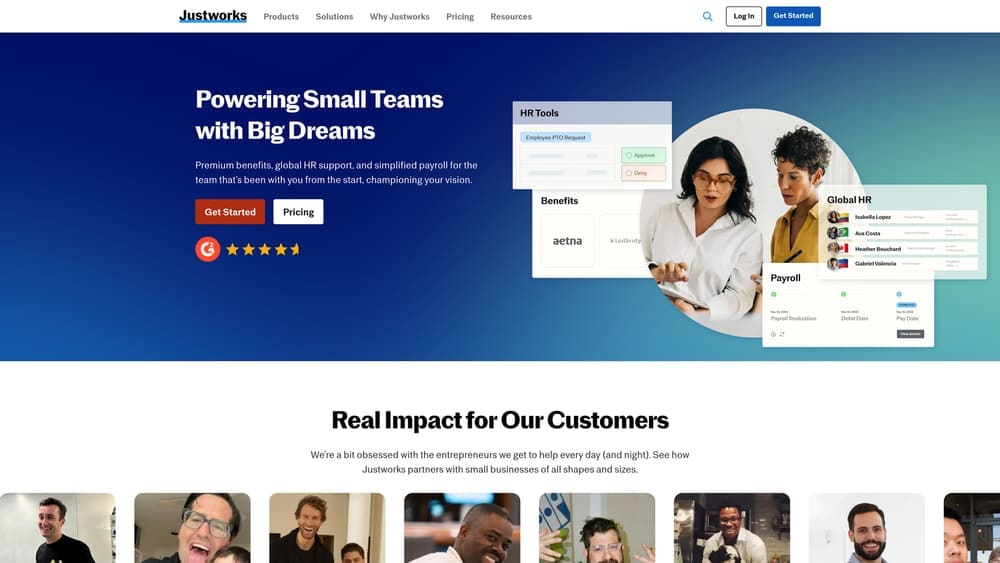
Justworks is a straightforward PEO with flat per-employee pricing and a clean interface, popular with startups that want compliance handled without operational complexity.
Where This Tool Shines
Justworks earns its reputation for simplicity. The pricing model is genuinely transparent, which is unusual in the PEO space. You know what you’re paying per employee before you sign anything. For early-stage SaaS companies that are still figuring out headcount trajectory, predictable costs matter more than enterprise feature depth.
The compliance coverage is solid for companies operating in a limited number of states. Multi-state payroll, employment law compliance support, and access to large-group health insurance plans are all included. It’s not the most sophisticated compliance infrastructure on this list, but for a 15-40 person SaaS company, it covers the fundamentals well.
Key Features
Flat Per-Employee Pricing: No hidden fees or percentage-of-payroll surprises — you see the number upfront.
Multi-State Payroll and Tax Compliance: Handles filings and registrations across your active operating states.
Large-Group Health Insurance Access: Benefits packages that punch above your headcount weight.
Built-In Time Tracking and PTO: Compliance-relevant time management tools included in the platform.
Employment Law Compliance Support: Guidance and documentation tools for staying current across operating states.
Best For
Seed to Series A SaaS companies with under 100 employees who want clean compliance infrastructure without a steep learning curve or opaque pricing. Less suited for companies with complex multi-state footprints or regulated verticals.
Pricing
Starts at $59/employee/month (Basic plan); $109/employee/month (Plus plan, which includes benefits administration).
4. TriNet
Best for: SaaS companies that want a PEO with a dedicated technology industry vertical and compliance teams who understand tech-specific risk.
TriNet is a PEO with a dedicated technology industry practice, offering compliance guidance tailored to the specific risk profile of SaaS and tech companies.
Where This Tool Shines
TriNet’s technology vertical is a real differentiator, not just a marketing label. Their HR specialists assigned to tech clients actually understand equity compensation structures, contractor misclassification risk in software development contexts, and the kinds of employment practices questions that surface during enterprise due diligence. That domain knowledge matters when you’re navigating a nuanced compliance issue at 11pm before a board meeting.
The benefits packages are genuinely competitive with what Big Tech offers, which is important for SaaS companies recruiting against larger employers. Comprehensive health, dental, vision, and supplemental options that help you compete for engineering talent without building your own benefits infrastructure.
Key Features
Technology Industry Specialization: Dedicated compliance guidance built around the risk profile of SaaS and tech businesses.
Enterprise-Grade Benefits: Benefits packages competitive with larger tech employers, accessible at smaller headcounts.
Employment Practices Liability Coverage: Risk management infrastructure that includes EPLI to cover wrongful termination and related claims.
Compliance Document Management: HR platform with organized storage and tracking for compliance documentation.
Strategic HR Consulting: Access to HR advisors with experience scaling tech teams through growth inflection points.
Best For
Series A through Series C SaaS companies that need a PEO partner with real tech industry expertise and benefits packages strong enough to support competitive recruiting. Also well-suited for companies facing enterprise customer due diligence on employment practices.
Pricing
Custom pricing based on headcount and services selected; generally uses a percentage-of-payroll model. Request a quote directly for accurate figures.
5. Insperity
Best for: Mid-market SaaS companies that want dedicated HR support and deep risk management infrastructure.
Insperity is a full-service PEO with dedicated HR business partners and comprehensive risk management capabilities, suited for SaaS companies past the startup phase.
Where This Tool Shines
Insperity’s model is built around the dedicated HR specialist relationship. You’re not submitting tickets to a shared service center. You have an assigned HR professional who knows your company, your employment history, and your compliance obligations. For a 75-200 person SaaS company dealing with a termination dispute, a leave of absence situation, or a multi-state compliance question, that relationship has real operational value.
The risk management depth is also notable. Workers’ compensation administration, employment practices liability guidance, and multi-state compliance monitoring are all part of the core service. Insperity tends to be stronger on the risk containment side than on technology integration, which is worth weighing depending on your priorities.
Key Features
Dedicated HR Specialist: A named HR professional assigned to your account rather than a shared support queue.
Comprehensive Risk Management: Workers’ compensation, EPLI, and proactive compliance monitoring built into the service.
Performance Management Tools: Employee development and performance infrastructure included in the platform.
Multi-State Compliance Monitoring: Ongoing tracking of regulatory changes across your operating states with proactive updates.
Mid-Market Track Record: Established experience with companies in the 50-500 employee range navigating growth-stage complexity.
Best For
SaaS companies in the 50-300 employee range that prioritize dedicated HR support and risk management depth over technology integration sophistication. Particularly strong for companies where HR compliance exposure is high and self-service isn’t adequate.
Pricing
Custom pricing; typically structured as a per-employee-per-month fee. Pricing reflects the dedicated service model, so expect higher costs than self-service alternatives.
6. ADP TotalSource
Best for: SaaS companies operating across all 50 states that need the deepest regulatory coverage available.
ADP TotalSource is an enterprise-grade PEO backed by ADP’s compliance infrastructure, offering comprehensive regulatory coverage for companies with complex multi-state or multi-entity footprints.
Where This Tool Shines
ADP’s scale translates directly into compliance coverage breadth. Dedicated compliance teams in every state, Fortune 500-level benefits buying power, and reporting infrastructure designed for audit readiness. If your SaaS company has employees in 20 states and your enterprise clients are asking detailed questions about your HR compliance practices, ADP TotalSource has the documentation and infrastructure to back up your answers.
The integration with ADP’s broader ecosystem is also worth noting. If you’re already using ADP for payroll or have plans to transition off PEO at some point, staying within the ADP platform family reduces migration friction. That exit flexibility matters more than most companies realize when they’re signing a PEO contract.
Key Features
All-50-State Compliance Coverage: Dedicated compliance teams and regulatory expertise across every U.S. jurisdiction.
Fortune 500 Benefits Access: Large-group buying power that gives smaller SaaS companies access to premium benefits packages.
Audit-Ready Reporting: Robust analytics and documentation tools designed for compliance audits and due diligence requests.
ADP Ecosystem Integration: Connects with ADP’s broader payroll, HR, and workforce management products.
Safety and Risk Management Consultants: Dedicated specialists for workers’ compensation and workplace risk programs.
Best For
SaaS companies with large distributed teams, complex multi-state operations, or enterprise clients who conduct detailed vendor compliance audits. Also a good fit for companies planning to eventually transition off PEO and wanting to stay in the ADP ecosystem.
Pricing
Custom pricing; generally higher than smaller PEOs, reflecting the enterprise infrastructure and compliance depth. Best suited for companies where that investment is justified by regulatory exposure.
7. Paychex PEO
Best for: SaaS companies that need flexibility to scale PEO services up or down as their compliance needs shift.
Paychex PEO is a modular PEO that lets companies add or remove service components as their needs change, which is particularly useful during rapid growth or contraction cycles.
Where This Tool Shines
The modular service model is Paychex’s most distinctive feature for SaaS companies. Most PEOs bundle everything together, which means you’re paying for services you don’t need and locked into a structure that doesn’t adapt well to headcount volatility. Paychex lets you configure the service level more granularly, which matters when you’re scaling from 30 to 150 employees in 18 months or navigating a reduction in force.
The payroll tax compliance infrastructure is reliable across multiple jurisdictions, and the compliance tracking dashboards give HR teams visibility into their regulatory status without requiring a dedicated compliance officer to interpret the data.
Key Features
Modular Service Model: Add or remove PEO components as your compliance and HR needs evolve over time.
Multi-Jurisdiction Payroll Tax Compliance: Strong track record handling payroll tax filings across complex state footprints.
Compliance Tracking Dashboards: HR platform with visibility into compliance status across your operating states.
Pay-As-You-Go Workers’ Comp: Workers’ compensation administration with flexible payment options tied to actual payroll.
Retirement Plan Administration: 401(k) and retirement plan management included as part of the service.
Best For
SaaS companies with variable headcount trajectories or those that want the flexibility to right-size their PEO relationship over time. Also useful for companies that want strong payroll compliance without committing to a full-service PEO model.
Pricing
Custom pricing; structured flexibly based on services selected. Final cost varies significantly depending on which modules are active.
8. Engage PEO
Best for: SaaS companies in regulated verticals like healthtech or fintech that need hands-on compliance consulting rather than a self-service model.
Engage PEO is a white-glove PEO focused on proactive risk management and compliance, particularly suited for companies operating in higher-risk or regulated industries.
Where This Tool Shines
Engage PEO’s model is built around proactive compliance rather than reactive support. They conduct ongoing compliance audits and risk assessments rather than waiting for you to flag a problem. For a healthtech or fintech SaaS company where employment compliance intersects with industry-specific regulatory requirements, that proactive posture has real value.
The dedicated account management model means your compliance questions go to someone who knows your business, not a general support queue. This is especially relevant for companies where employment practices liability exposure is higher than average, whether due to rapid hiring, contractor-heavy workforces, or complex equity structures.
Key Features
Proactive Compliance Auditing: Regular risk assessments and compliance reviews rather than reactive issue management.
EPLI Focus: Employment practices liability insurance emphasis with dedicated guidance on minimizing exposure.
Hands-On HR Compliance Consulting: Consultative model rather than self-service, with specialists engaged in your compliance program.
Custom Risk Management Programs: Tailored risk frameworks for companies in regulated or higher-risk verticals.
Dedicated Account Management: Compliance-specialized account managers rather than generalist support staff.
Best For
SaaS companies in regulated verticals (healthtech, fintech, legaltech) with 25 or more employees where compliance risk is elevated and a self-service platform isn’t adequate. Also well-suited for companies that have experienced compliance issues and want a more hands-on partner going forward.
Pricing
Custom pricing; typically suited for companies with 25 or more employees. The white-glove model is reflected in the cost structure.
Picking the Right Compliance-Focused PEO for Your Stage
The honest answer is that no single PEO on this list is right for every SaaS company. The compliance priorities of a 20-person seed-stage startup are genuinely different from a 200-person Series C company preparing for an enterprise sales motion that includes HR compliance due diligence.
Here’s a practical way to think about it by stage and need:
Early-stage (under 50 employees): Justworks is the easiest entry point with transparent pricing. If you want tech-native integration depth from day one, Rippling is worth the additional investment.
Growth-stage (50-200 employees, multi-state): TriNet’s technology vertical expertise and Rippling’s automation depth are both strong fits here. If you’re already dealing with enterprise due diligence on your employment practices, TriNet’s domain knowledge is particularly valuable.
Mid-market (200-500 employees, complex compliance needs): Insperity and ADP TotalSource offer the risk management infrastructure and dedicated support that companies at this stage typically need. ADP is the right call if you’re operating across many states or anticipate transitioning off PEO eventually.
Regulated verticals at any stage: Engage PEO’s proactive compliance model is worth serious consideration if you’re in healthtech, fintech, or any vertical where employment compliance intersects with industry regulation.
One thing worth flagging: many SaaS companies outgrow PEO arrangements somewhere between 150 and 300 employees and transition to standalone HR infrastructure. When you’re evaluating providers, ask specifically about exit flexibility and data portability. The contract terms on the way out matter as much as the service terms on the way in.
If you’re still narrowing down your shortlist, our roundup of the best PEO companies compares providers across compliance depth, pricing transparency, and service quality to help you decide.
Before you sign anything or auto-renew an existing contract, it’s worth doing a proper comparison. Bundled fees, administrative markups, and contract structures that limit flexibility are common in this space, and most companies don’t discover the problem until they’re already locked in.
Don’t auto-renew. Make an informed, confident decision. A side-by-side comparison of pricing, services, and contract terms gives you the clarity to choose a PEO that actually fits your compliance needs and your budget — not just the one with the best sales pitch.
