
Security companies operate in a compliance environment most industries never touch. Between state-by-state guard licensing requirements, weapons permit coordination, high-risk workers’ comp classifications, and the added layer of government contract obligations, the HR risk profile is genuinely different from a typical employer. A generic PEO that mostly serves white-collar clients can actually make things worse — either by pricing armed guard classifications punitively or by missing the industry-specific regulatory requirements entirely.
This list focuses on PEO providers and evaluation tools that are equipped to handle enterprise compliance and risk management for security firms. We looked at workers’ comp handling for high-risk NCCI codes, multi-state licensing coordination, onboarding infrastructure for high-turnover workforces, and experience with security industry clients specifically. Here are the options worth evaluating.
1. PEO Metrics
Best for: Security companies comparing PEO providers side-by-side before committing to a contract
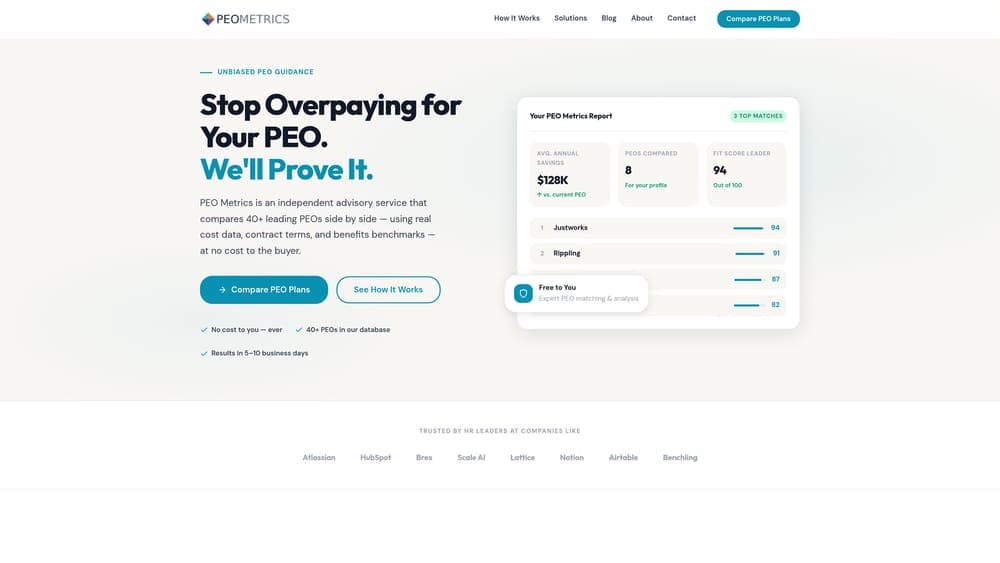
PEO Metrics is an unbiased PEO comparison platform built to help businesses evaluate providers using detailed data rather than sales pitches.
Where This Tool Shines
The challenge for security companies isn’t just finding a PEO — it’s finding one that actually understands your risk profile and won’t price you out of the arrangement six months in. PEO Metrics addresses this by letting you filter and compare providers based on industry-specific criteria, including compliance capabilities, workers’ comp structuring, and experience with high-risk client industries like security services.
Because PEO Metrics isn’t affiliated with any single provider, the comparisons aren’t shaped by referral incentives. That matters when you’re trying to evaluate whether a PEO’s workers’ comp approach uses a master policy pool (which can inflate your costs if you’re grouped with riskier classifications) versus a standalone policy arrangement that reflects your actual claims history.
Key Features
Side-by-Side Provider Comparisons: Detailed breakdowns of compliance capabilities, service models, and pricing structures across multiple PEO providers at once.
Industry-Specific Filtering: Narrow results to PEOs with documented experience serving security company clients, not just general industry categories.
Transparent Pricing Analysis: Helps identify hidden administrative markups and bundled fee structures that are common in PEO contracts for high-risk classifications.
Workers’ Comp Evaluation: Compares how different PEOs structure workers’ comp for high-risk codes — a critical cost driver for armed and unarmed guard operations.
Unbiased Guidance: No provider affiliations or referral fees shaping the recommendations.
Best For
Security company operators and HR leaders who are either entering a PEO arrangement for the first time or evaluating whether their current PEO is actually competitive. Particularly useful before a contract renewal when you suspect you may be overpaying.
Pricing
Free comparison service. Contact PEO Metrics directly for details on the full scope of the evaluation process.
2. ADP TotalSource
Best for: Larger security firms needing enterprise-grade compliance infrastructure and broad workers’ comp carrier access
ADP TotalSource is the largest PEO in the US, with deep regulatory resources and a broad network of workers’ comp carriers across all 50 states.
Where This Tool Shines
Scale matters in workers’ comp, and ADP TotalSource’s size gives it real leverage with carriers — which translates to more competitive rate options for companies carrying high-risk classification codes like 7380 (armed guards) or 7382 (unarmed guards). Their dedicated risk management teams are experienced with the documentation requirements that come with government contract compliance, which is a genuine differentiator for defense-adjacent security operations.
The reporting infrastructure is also worth noting. Security firms working on government contracts often face specific record-keeping obligations, and ADP’s enterprise-grade reporting tools are built to handle that kind of structured documentation at scale.
Key Features
Dedicated Risk Management Teams: In-house compliance and risk specialists, not just a general HR helpline.
Broad Workers’ Comp Carrier Network: Access to multiple carriers allows for competitive rate shopping rather than defaulting to a single policy pool.
Government Contract Compliance Reporting: Enterprise reporting tools designed to meet documentation requirements for regulated contracts.
50-State Payroll and Regulatory Compliance: Full multi-state infrastructure for security companies operating across multiple jurisdictions.
Background Check and Screening Integrations: Built-in screening tools relevant to security industry hiring requirements.
Best For
Mid-to-large security firms with multi-state operations, government contract obligations, or a significant volume of armed guard classifications where workers’ comp cost management is a priority. Smaller operations may find the platform more than they need.
Pricing
Custom pricing. Typically requires a minimum of five employees and uses a percentage-of-payroll model. Contact ADP directly for a quote based on your workforce size and risk classifications.
3. Vensure Employer Solutions
Best for: Security companies scaling through acquisition or operating across a wide geographic footprint
Vensure Employer Solutions is a large-scale PEO with broad geographic coverage and documented experience serving high-risk, blue-collar industries including security services.
Where This Tool Shines
Vensure has built its business around industries that mainstream PEOs often avoid or price punitively. That includes security, construction, and other physical-labor classifications where workers’ comp exposure is real. Their risk management and safety program support is built into the service model rather than treated as an add-on, which matters when you’re managing a workforce that works armed and largely unsupervised on client sites.
For security companies growing through acquisition — a common growth path in the private security industry — Vensure’s infrastructure is designed to absorb new entities and integrate them into a unified payroll and compliance structure without a complete rebuild.
Key Features
Multi-State Compliance Infrastructure: Payroll, tax filing, and regulatory compliance across all 50 states, including states with complex private security licensing requirements.
High-Risk Workers’ Comp Experience: Familiarity with physical-labor classification codes and the claims patterns that come with security industry work.
Acquisition-Ready Scalability: Platform designed to integrate new business units without major structural disruption.
Dedicated Risk Management and Safety Programs: Structured safety program support as part of the core service offering.
Best For
Security companies with 50 or more employees, active multi-state operations, or a growth strategy that involves acquiring other security firms. Also a strong fit for companies that have been declined or priced out by more conservative PEO providers.
Pricing
Custom pricing based on headcount and risk profile. Typically uses a percentage-of-payroll model. Contact Vensure for a quote specific to your classification mix.
4. CoAdvantage
Best for: Security operations with high-turnover hourly workforces needing efficient onboarding and offboarding at scale
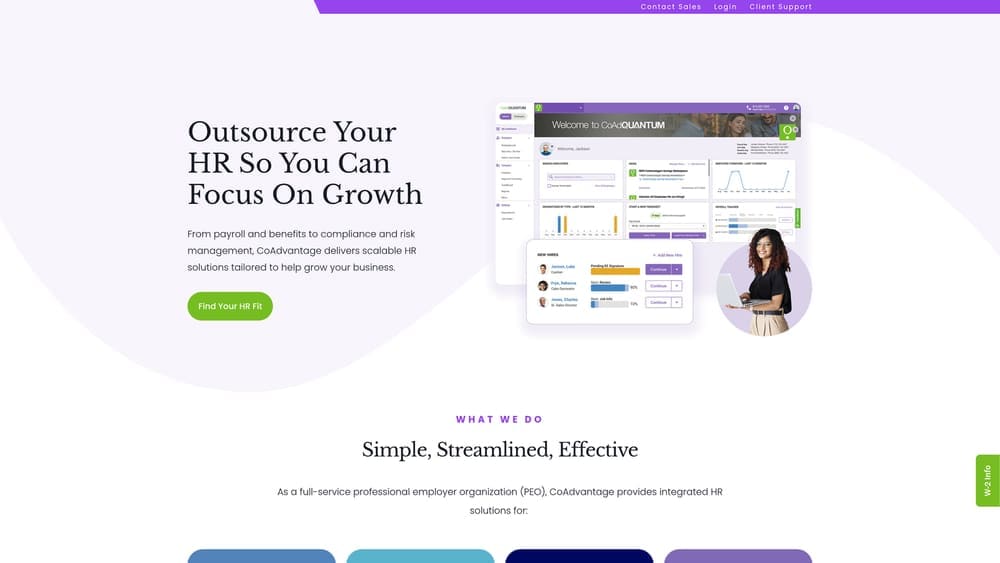
CoAdvantage is a PEO built around industries with high-turnover hourly workforces, with strong onboarding automation and workers’ comp management for physical-labor classifications.
Where This Tool Shines
Guard turnover is a real operational cost in the security industry. Every time a guard leaves and needs to be replaced, there’s licensing verification, onboarding documentation, and compliance paperwork involved — and in some states, specific training requirements before a guard can work a post. CoAdvantage’s onboarding workflows are built to handle this kind of volume without creating an administrative backlog.
Their workers’ comp management also reflects experience with physical-labor classification codes, which means they’re less likely to miscategorize your workforce or pool your claims with unrelated industries in ways that inflate your experience modification rate over time.
Key Features
High-Volume Onboarding and Offboarding Automation: Streamlined workflows designed for industries where headcount fluctuates frequently.
Physical-Labor Workers’ Comp Management: Classification code expertise for hourly security and physical-labor workforces.
Shift-Based Payroll Processing: Payroll infrastructure optimized for hourly and irregular scheduling patterns common in security operations.
Labor Law Compliance Support: HR compliance monitoring focused on adherence to employment law across active jurisdictions.
Best For
Security companies with significant hourly workforce churn, multiple contract sites with varying staffing levels, or operations where the administrative burden of constant onboarding is a recognized problem.
Pricing
Custom pricing. Contact CoAdvantage for a quote based on your headcount, industry classification, and service needs.
5. Oasis (a Paychex Company)
Best for: Mid-market security firms that want enterprise compliance tools without fully enterprise-level complexity
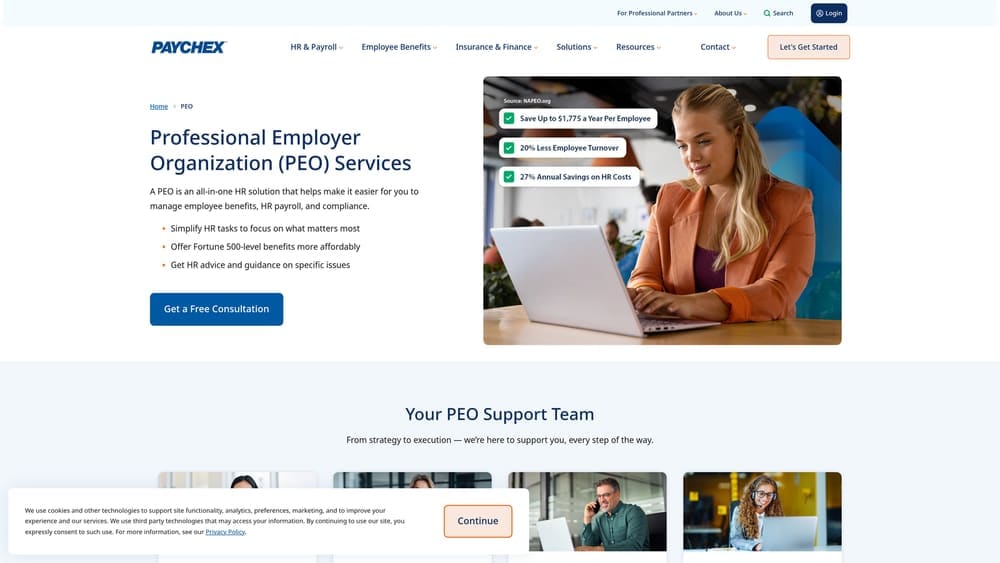
Oasis is a mid-market PEO backed by Paychex infrastructure, offering structured compliance workflows and solid HR technology at a scale that works for growing security companies.
Where This Tool Shines
The Paychex backing gives Oasis a level of regulatory intelligence that smaller standalone PEOs can’t match. Their compliance update infrastructure means that when a state changes its private security licensing requirements or updates drug testing mandates, the compliance alerts reach your HR team proactively rather than after the fact. That kind of early warning matters in an industry where a licensing lapse can pull a guard off a post immediately.
The risk management modules are integrated directly into the HR platform rather than bolted on as a separate service, which makes it easier to connect compliance documentation with payroll and benefits administration in one workflow.
Key Features
Paychex-Backed Compliance Alerts: Regulatory update infrastructure that monitors employment law and industry-adjacent compliance changes across active states.
Integrated Risk Management Modules: Risk tools built into the HR platform, not offered as a separate add-on service.
Multi-State Tax Filing and Payroll: Handles payroll compliance across multiple state jurisdictions with established accuracy infrastructure.
Large-Group Benefits Access: Benefits administration with access to group health insurance rates that smaller security companies couldn’t access independently.
Best For
Security companies in the 25-200 employee range that need more compliance depth than a basic PEO provides but aren’t yet at the scale where full ADP TotalSource infrastructure makes sense.
Pricing
Custom pricing. Generally structured as a per-employee-per-month fee plus a percentage-of-payroll component for workers’ comp. Contact Oasis for a specific quote.
6. PrestigePEO
Best for: Security companies in the Northeast and Southeast that want hands-on HR support rather than a self-service platform
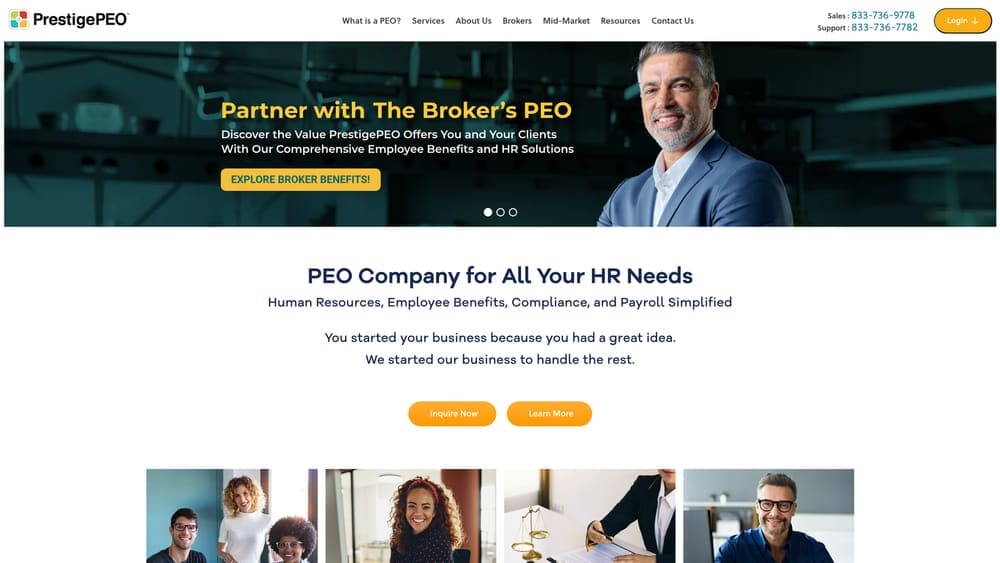
PrestigePEO is a service-focused PEO with dedicated HR specialists and proactive compliance support, with particular strength in the Northeast and Southeast US.
Where This Tool Shines
Most PEOs route compliance questions through a general call center. PrestigePEO assigns dedicated HR specialist teams to each client, which means the person handling your compliance questions actually knows your company’s classification mix, your active states, and your contract history. For security companies managing armed guard classifications alongside unarmed personnel across multiple client sites, that institutional knowledge matters.
Their claims advocacy on the workers’ comp side is another practical differentiator. When a guard files a claim, having an HR partner actively managing the process — rather than leaving it entirely to the carrier — can meaningfully affect both the outcome and the long-term cost impact on your experience modification rate.
Key Features
Assigned HR Specialist Teams: Dedicated point-of-contact model rather than rotating call-center support.
Proactive Compliance Monitoring: Regulatory tracking and alerts for employment law changes across active states.
Workers’ Comp Claims Advocacy: Active involvement in claims management, not just policy administration.
Employee Handbook and Policy Development: Custom policy documentation support, including security-specific operational policies.
Best For
Security companies with 10-150 employees that prioritize responsive, knowledgeable HR support over platform sophistication. Particularly well-suited for operators in PrestigePEO’s core geographic markets.
Pricing
Custom pricing based on company size and risk profile. Contact PrestigePEO for a quote.
7. ExtensisHR
Best for: Security firms with non-standard compliance requirements that need a flexible, customizable service model
ExtensisHR is a flexible PEO partner that customizes compliance workflows around client-specific regulatory requirements, including specialized security industry needs.
Where This Tool Shines
Not every security company fits the same compliance template. A firm doing defense-adjacent contract work with ITAR implications has different documentation requirements than a commercial property security company. ExtensisHR’s model is built around configuring the service around the client rather than fitting the client into a standard product package. That flexibility is genuinely useful when your compliance environment doesn’t follow a generic script.
Their risk management consulting component goes beyond standard HR compliance into workplace safety program development — which is relevant for security companies managing armed personnel, use-of-force policies, and incident reporting obligations that most PEOs have no experience structuring.
Key Features
Customizable Compliance Workflows: Service configuration tailored to client-specific regulatory requirements rather than a one-size model.
Dedicated HR Manager with Industry Experience: Single point-of-contact with relevant background rather than generalist support.
Flexible Service Scope: Choose which HR functions to outsource and retain control over others — useful for companies with existing in-house HR capacity.
Risk Management Consulting: Workplace safety program development that can address security-specific operational risks.
Best For
Security companies with complex or non-standard compliance requirements, those doing government contract work with specific documentation obligations, or firms that have existing HR staff and want a PEO to fill specific gaps rather than replace the function entirely.
Pricing
Flexible packages based on services selected and company size. Contact ExtensisHR for a customized quote.
8. Justworks
Best for: Smaller security operations that prioritize pricing transparency and clean technology over deep industry specialization
Justworks is a transparent, flat-rate PEO platform with straightforward compliance tools and clear pricing, suited for smaller security operations with lower risk complexity.
Where This Tool Shines
Justworks stands out on pricing transparency in an industry where opaque fee structures are the norm. Flat per-employee-per-month pricing means you know exactly what you’re paying before you sign, which makes budgeting predictable. For a smaller security company that’s still building out its compliance infrastructure, that clarity has real operational value.
The honest caveat: Justworks is built for a broader market and doesn’t carry the same depth of high-risk workers’ comp specialization or multi-state security licensing expertise that some of the other providers on this list offer. If your operation is primarily unarmed guards in one or two states without government contract complexity, Justworks can work well. If you’re managing armed classifications across eight states with ITAR implications, you’ll likely need more specialized infrastructure.
Key Features
Flat Per-Employee Pricing: Transparent, predictable fee structure with no hidden administrative markups.
Simple Onboarding and Offboarding: Clean workflows for adding and removing employees without significant administrative overhead.
Multi-State Employment Compliance Tools: Built-in compliance support for companies operating across multiple state jurisdictions.
Large-Group Health Insurance Access: Benefits administration with access to group rates that smaller employers can’t typically access independently.
Best For
Smaller security operations, typically under 50 employees, with primarily unarmed classifications, limited multi-state complexity, and a preference for self-service technology over dedicated HR support.
Pricing
Starts at $59 per employee per month for the Basic plan. A Plus plan is available at a higher tier. Pricing is published upfront, which is unusual in the PEO market.
Picking the Right PEO When Your Risk Profile Isn’t Generic
The security industry doesn’t get a standard PEO experience, and that’s actually the core problem. Most PEO providers built their infrastructure around white-collar or low-risk clients. When a security company comes in with armed guard classifications, multi-state licensing obligations, and government contract documentation requirements, many providers either decline the business or price it in ways that make the arrangement economically painful.
The providers on this list are equipped to handle varying degrees of that complexity. A few things to keep in mind as you evaluate.
Workers’ comp structure matters more than almost anything else. Whether a PEO uses a master policy pool or can place your workers’ comp on a standalone policy will have a significant long-term impact on your experience modification rate. Ask this question directly before you sign anything.
Not every PEO on this list is right for every security company. Justworks works well for smaller, simpler operations. ADP TotalSource and Vensure are better suited for larger, multi-state firms with complex risk profiles. ExtensisHR and PrestigePEO are strong fits when you need customized support rather than a standardized platform. CoAdvantage earns its spot if high-turnover onboarding is your biggest operational headache.
Before you commit to any provider, compare them side-by-side. PEO contracts are typically multi-year arrangements with real switching costs. Signing with the wrong provider because you didn’t have enough comparative data is an expensive mistake that’s entirely avoidable.
Before you sign that PEO renewal, make sure you’re not leaving money on the table. Many security companies unknowingly overpay because of bundled fees, hidden administrative markups, and contracts structured to limit flexibility. PEO Metrics gives you a clear, side-by-side breakdown of pricing, services, and contract terms so you can see exactly what you’re paying for before you commit. Don’t auto-renew. Make an informed, confident decision.
