

Warehousing is one of the harder industries to place with a PEO. You have high-turnover hourly workforces, workers’ comp class codes that carry real weight on pricing, OSHA recordkeeping obligations, and seasonal headcount swings that most standard PEO contracts were never built to handle.
The wrong PEO charges you a flat PEPM that ignores your experience modification factor, locks you into a 12-month contract with a painful exit clause, and underdelivers on benefits that actually matter to warehouse workers. Some PEOs will decline high-mod warehousing clients outright. Others will take your business and then price your comp program so aggressively at renewal that you wish they hadn’t.
The right PEO handles pay-as-you-go workers’ comp, scales with your headcount, and gives you real HR infrastructure without a bloated admin fee. Getting there requires comparing options before you sign, not after. That is what this list is for. Each vendor below gets a genuine strength and a genuine limitation. No filler, no marketing summaries.
1. PEO Metrics
Best for: Warehousing companies that want an independent, side-by-side comparison before committing to any PEO.
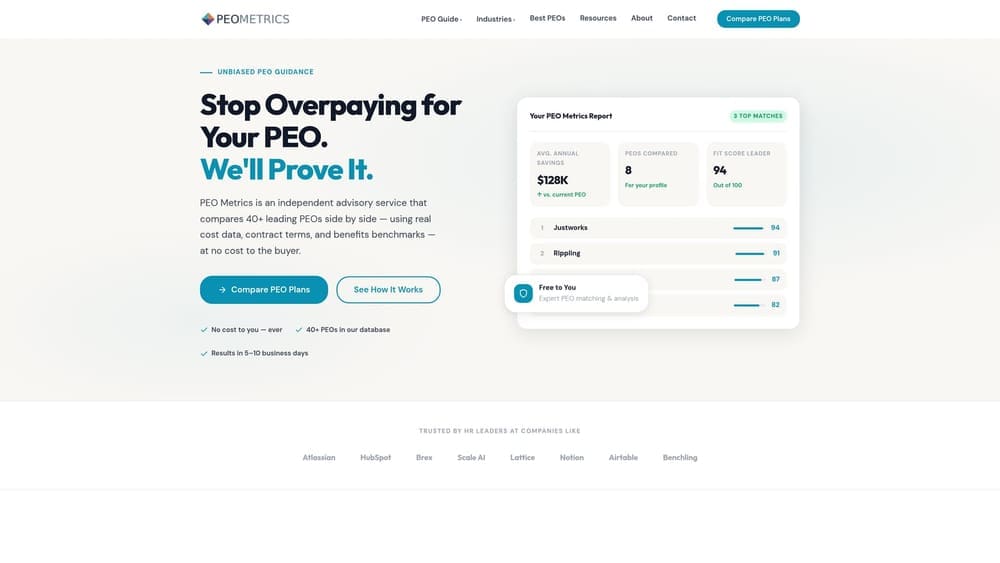
PEO Metrics is an independent PEO advisory service that compares 40+ providers side by side on cost data, contract terms, and benefits benchmarks, always free to the buyer.
Where This Tool Shines
For warehousing companies specifically, the value is in what PEO Metrics includes that generic comparison sites skip: workers’ comp class code analysis, comp program quality, and contract exit term review. Those three dimensions alone can save a warehousing operator significant money, because most PEO pricing mistakes in this industry come from signing with a provider whose comp program was not built for NCCI class codes 8292 or 8810.
The intake takes about eight minutes. A report comes back in 5-10 business days. PEO Metrics has matched 850+ companies since 2019 and benchmarked $2.1B in spend, which means the comparison you get is grounded in real market data, not vendor-supplied talking points.
Key Features
12-Dimension Methodology: Covers workers’ comp program quality, contract terms, benefits benchmarks, and cost data in a single structured comparison.
40+ PEOs Tracked: Broad enough to surface regional options alongside nationals, which matters for warehousing companies with specific geographic footprints.
Workers’ Comp Class Code Analysis: Directly relevant to warehousing operations where comp exposure drives a significant portion of total PEO cost.
Contract Exit Term Review: Flags the clauses that trap warehousing operators when headcount drops seasonally or they want to switch providers.
Free to the Buyer: No fee, no obligation. The service covers companies with 10-2,000 employees, including high-turnover industrial operations.
Best For
Any warehousing company evaluating a PEO for the first time, preparing for a renewal negotiation, or unhappy with their current provider’s handling of workers’ comp pricing. This is the right starting point before you talk to any vendor directly.
Pricing
Free to the buyer. PEO Metrics is compensated by the PEO selected, not by the buyer, and the advisory process carries no cost or obligation to the company being matched.
2. ADP TotalSource
Best for: Mid-size to large warehousing operations with multi-state footprints and meaningful workers’ comp exposure.
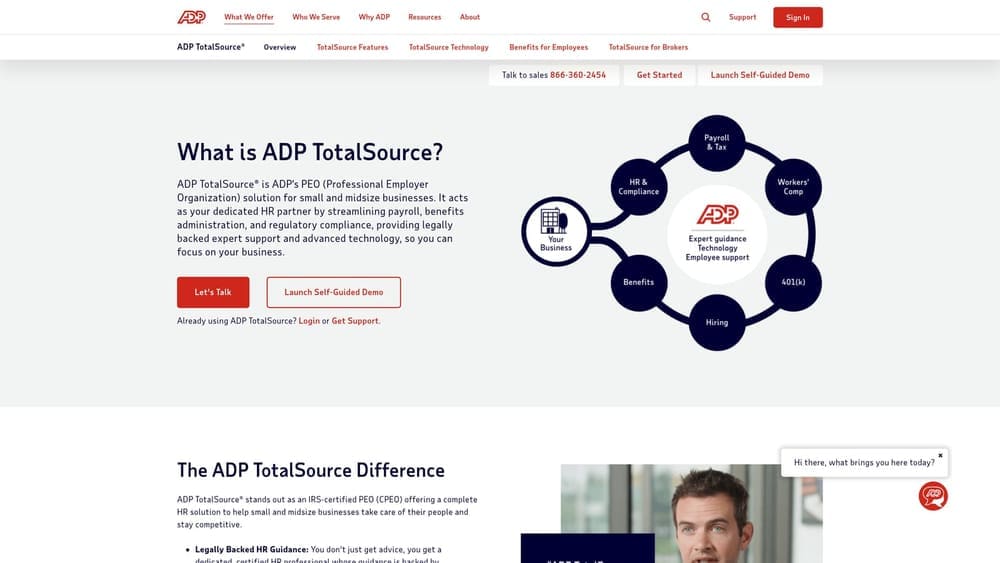
ADP TotalSource is one of the largest PEOs in the country, with a broad workers’ comp program, multi-state compliance infrastructure, and OSHA safety support that matters for warehousing operations.
Where This Tool Shines
ADP TotalSource runs one of the largest PEO workers’ comp programs in the market. For warehousing companies, that scale matters because it gives them more flexibility in underwriting higher-risk class codes and experience modification factors that smaller PEOs might decline or price punitively. Their pay-as-you-go comp option is particularly useful for operations where payroll fluctuates week to week with overtime and seasonal headcount.
Multi-state compliance is another genuine differentiator. Distribution companies operating across several states face SUTA complexity, state registration requirements, and varying OSHA standards. ADP TotalSource handles that infrastructure at a level that regional PEOs and payroll providers typically cannot match.
Key Features
Pay-As-You-Go Workers’ Comp: Premiums calculated each pay period on actual payroll rather than estimated annual payroll, which reduces cash flow strain for variable warehouse operations.
Multi-State Compliance: SUTA management and state registration support for distribution companies operating across multiple locations.
OSHA Safety Program Support: Risk management resources and safety program assistance relevant to forklift safety, ergonomics, and recordkeeping under 29 CFR 1904.
CPEO Certification: IRS-certified PEO status provides tax liability protections for co-employment arrangements.
Large-Group Health Benefits: Access to group health, dental, and vision at rates typically unavailable to smaller employers.
Best For
Warehousing and distribution companies with 50 or more employees, multi-state operations, or elevated workers’ comp exposure. Smaller operations may find the pricing less competitive than regional alternatives.
Pricing
Custom quote required. PEPM pricing varies by headcount and workers’ comp exposure. Pricing is not published and negotiation is part of the process, which is one reason to get a benchmarked comparison before entering that conversation.
3. Insperity
Best for: Warehousing operators focused on employee retention who want a named HR contact, not a call center.
Insperity is a full-service PEO with a dedicated HR specialist model and strong large-group benefits access, suited to warehousing operators focused on workforce stability.
Where This Tool Shines
Insperity’s dedicated HR specialist model is the most meaningful differentiator for warehousing clients. You get a named HR contact who learns your business, your workforce profile, and your comp situation. That relationship matters when you are managing high-turnover hourly workers and need HR support that responds quickly rather than routing you through a generic support queue.
Their large-group benefits access is also genuinely competitive. Warehousing companies that want to use benefits as a retention tool, particularly health coverage that hourly workers will actually value, find Insperity’s benefits portfolio one of the stronger options in the PEO market.
Key Features
Dedicated HR Specialist: A named HR contact assigned to each client account, not a shared service center.
Large-Group Health Benefits: Access to health, dental, and vision rates that reflect Insperity’s scale across their client base.
Workers’ Comp Program: Risk management support and comp coverage, though the program is better suited to moderate-risk profiles than very high-mod operations.
CPEO Certification: IRS-certified status for tax liability protections.
Payroll and Time-Tracking: Tools designed to handle hourly workforces, including the tracking complexity that comes with warehouse shift structures.
Best For
Warehousing companies with stable or growing headcount, a genuine retention challenge, and the budget to pay for a premium service model. Less suited to operations with very high comp mod rates or tight margins where cost is the primary constraint.
Pricing
Custom quote; generally priced at the higher end of the PEO market. Companies with significant workers’ comp exposure may find the total cost less competitive than ADP TotalSource or regional alternatives.
4. TriNet
Best for: Warehousing businesses with a mixed hourly and salaried workforce that need differentiated benefits tiers.
TriNet is a PEO with industry-specific HR packages and a strong technology platform, serving businesses with mixed workforce structures.
Where This Tool Shines
TriNet’s strength is its technology platform and its ability to support differentiated benefits structures for workforces that include both hourly warehouse staff and salaried managers or logistics coordinators. If your HR challenge is partly about offering competitive benefits to retain salaried talent while keeping costs manageable for the hourly side, TriNet handles that complexity better than most.
Their time and attendance integration and multi-state payroll compliance are solid. For warehousing companies that have grown to a point where managing multiple benefit tiers is becoming administratively painful, TriNet’s platform reduces that burden.
Key Features
Industry-Specific HR Packages: Differentiated benefits tiers that can accommodate mixed hourly and salaried workforces.
Technology Platform: Time and attendance integration with payroll processing and HR management in a single system.
Multi-State Payroll and Compliance: Support for warehousing companies operating across multiple states.
Group Health and Ancillary Benefits: Access to health, dental, vision, and supplemental benefits through TriNet’s group purchasing.
Dedicated Customer Support: Named support contacts rather than purely self-service.
Best For
Warehousing and distribution companies with a meaningful salaried component alongside their hourly workforce, particularly those where benefits differentiation is a retention priority. Pure hourly operations with high comp exposure may find better fits elsewhere.
Pricing
Custom quote; PEPM model with pricing that varies by industry classification and headcount. TriNet has historically been oriented toward professional services, so warehousing-specific comp program pricing is worth scrutinizing closely before signing.
5. Rippling
Best for: Warehousing operations with high turnover that need automated onboarding and offboarding at scale.
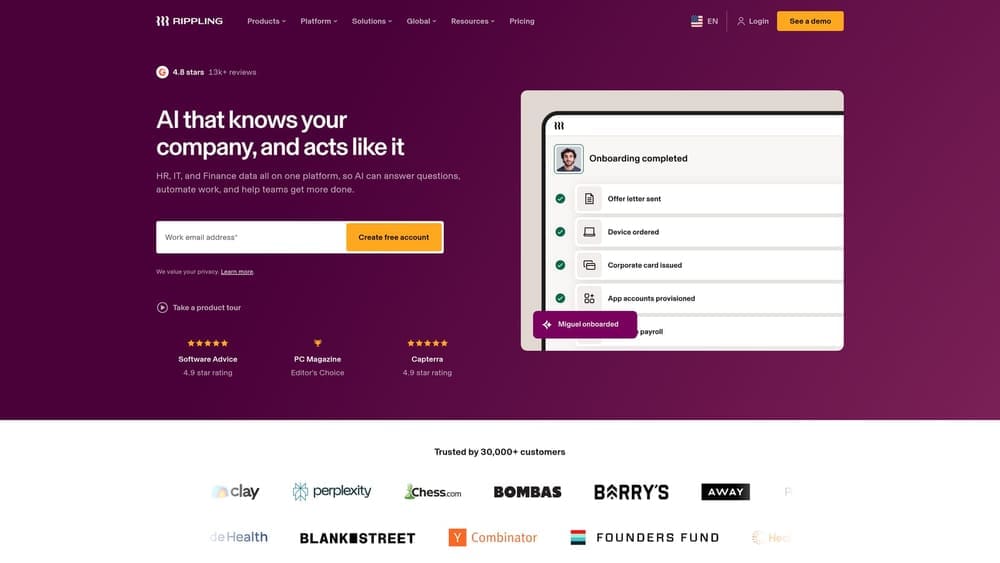
Rippling is a technology-first PEO with the strongest software platform in the market for automating the HR workflows that high-turnover warehouse environments generate constantly.
Where This Tool Shines
If you are onboarding and offboarding warehouse workers at volume, Rippling’s automation capabilities are genuinely ahead of the legacy PEOs. New hire paperwork, benefits enrollment, payroll setup, and system access can all be triggered from a single workflow. For a warehouse operation that brings on 20 seasonal workers in a week and then offboards them two months later, that automation reduces the administrative burden significantly.
Rippling also integrates with time-tracking, scheduling, and warehouse management systems better than most PEOs. If your operation already uses specific software for floor management or logistics, the integration options are worth evaluating.
Key Features
Automated Onboarding and Offboarding: Workflow automation for high-turnover environments where manual HR processing creates real bottlenecks.
System Integrations: Connections with time-tracking, scheduling, and warehouse management software.
Payroll Flexibility: Same-day and next-day payroll processing options for variable warehouse payrolls.
PEO and ASO Options: Flexibility to choose full co-employment or an administrative services model depending on your preference.
Unified Platform: HR, payroll, and device management in a single system, which reduces the number of tools your managers need to learn.
Best For
Warehousing operations where turnover-driven administrative volume is the primary pain point and where technology-first HR management fits the culture. Less suited to operations that want a hands-on HR specialist relationship or that have complex workers’ comp situations requiring experienced underwriting.
Pricing
Custom quote; modular pricing based on features selected. Because Rippling’s pricing scales with the modules you activate, the total cost can vary significantly depending on which integrations and features your operation actually needs.
6. Justworks
Best for: Smaller warehousing operations that want transparent, predictable monthly costs and solid benefits access.
Justworks is a straightforward PEO with published flat-rate pricing and strong benefits access for smaller employers that want to know exactly what they are paying before the invoice arrives.
Where This Tool Shines
Justworks publishes their pricing on their website, which is genuinely unusual in the PEO market. For a smaller warehousing company that has been burned by opaque fee structures or surprise charges at renewal, that transparency is a real operational benefit. You can model your costs before you ever get on a sales call.
Their benefits access is also competitive for smaller employers. A warehouse operation with 15 to 40 employees that could not previously offer competitive health coverage will find Justworks’s large-group access meaningful for recruitment and retention.
Key Features
Transparent Flat-Rate Pricing: PEPM pricing published on their website, allowing cost modeling before any sales conversation.
Simple Payroll Platform: Clean interface designed for straightforward payroll processing without excessive complexity.
24/7 Customer Support: Around-the-clock support access, which matters for warehouse operations running multiple shifts.
Workers’ Comp Coverage: Included in the base plan, though the program is better suited to lower-risk employers.
Best For
Smaller warehousing operations, typically under 50 employees, with moderate workers’ comp exposure and a priority on pricing transparency. Warehousing companies with high experience modification factors or complex comp situations may find Justworks unable to accommodate them at competitive rates.
Pricing
Published flat-rate PEPM; check justworks.com for current pricing tiers. One of the few PEOs where you can get a reliable cost estimate before speaking with a sales representative.
7. Employer Flexible
Best for: Regional warehousing and distribution operators in Texas and the broader South and Southwest.
Employer Flexible is a regional PEO with a hands-on service model and direct experience with industrial and distribution clients in their core markets.
Where This Tool Shines
Employer Flexible’s industrial client base is the differentiator here. Their workers’ comp program is designed for higher-risk classifications, which means warehousing companies with elevated mod rates are more likely to find a workable arrangement than they would with PEOs whose programs were built around lower-risk professional services employers.
Their contract structures tend to be more flexible than the large nationals, with less rigid exit terms. For a warehousing company that has seasonal headcount swings and is nervous about minimum headcount guarantees, that flexibility is worth asking about specifically during the sales process.
Key Features
Industrial Client Experience: Established track record with distribution and warehousing operations in their core markets.
Flexible Contract Structures: Less rigid exit terms than some national PEOs, relevant for operations with seasonal headcount variability.
Dedicated HR and Payroll Support: Local market knowledge with hands-on service rather than a national call center model.
Workers’ Comp Program: Designed for higher-risk industrial classifications, including warehousing.
Benefits Administration: Health and ancillary benefits for hourly workforces, structured for the industrial employer market.
Best For
Warehousing and distribution companies with primary operations in Texas and the South or Southwest, particularly those with elevated comp exposure that have been declined or priced out by national PEOs. Not a strong fit for operations with significant presence outside Employer Flexible’s core geographic markets.
Pricing
Custom quote; regional pricing may be competitive versus national PEOs in their core markets, particularly for higher-risk industrial classifications where national programs price more aggressively.
8. Oasis (a Paychex Company)
Best for: Warehousing companies already operating in the Paychex ecosystem that want to step up to a PEO arrangement.
Oasis is a PEO backed by Paychex infrastructure, offering nationwide reach and workers’ comp coverage for employers already familiar with Paychex’s payroll and HR systems.
Where This Tool Shines
If your warehouse operation already runs payroll through Paychex, Oasis is the most natural transition path to a full PEO arrangement. The infrastructure is shared, the data migration is simpler, and your team is already familiar with the platform. For a company that is ready to move from payroll-only to co-employment without rebuilding its HR stack from scratch, that continuity has real value.
Nationwide reach is another genuine strength. Multi-state warehousing and distribution companies get consistent payroll processing, tax filing, and compliance support across all their locations without having to manage multiple regional relationships.
Key Features
Paychex Infrastructure: Payroll, tax filing, and compliance built on Paychex’s established platform.
Nationwide Reach: Multi-state support for warehousing companies operating across multiple locations.
Pay-As-You-Go Workers’ Comp: Option to calculate comp premiums each pay period on actual payroll rather than annual estimates.
Benefits Administration: Health, dental, and retirement plan options through the Paychex benefits ecosystem.
HR Support Services: Employee handbook assistance and HR support alongside payroll administration.
Best For
Warehousing companies already using Paychex for payroll that want to add co-employment benefits without switching platforms. Also suited to multi-state distribution operations that value Paychex’s compliance infrastructure. Less suited to buyers who want a distinctly separate, dedicated PEO service model.
Pricing
Custom quote; pricing reflects the Paychex ecosystem integration. As with all PEOs on this list, get at least two competing quotes before signing, regardless of how convenient the Paychex transition appears.
Which PEO Is Right for Your Warehouse Operation
The right answer depends on your size, your comp exposure, your geographic footprint, and how much administrative complexity you are willing to manage yourself. Here is how to think through it.
If you are a first-time buyer with under 50 employees, start with PEO Metrics to map your options across 40+ providers before you talk to any vendor. Then evaluate Justworks for pricing transparency or Rippling for onboarding automation, depending on whether cost predictability or HR workflow efficiency is your bigger pain point.
If you run a mid-size operation with a multi-state footprint, ADP TotalSource and Insperity are worth serious conversations. ADP for comp program depth and multi-state compliance. Insperity if retention and a dedicated HR relationship matter more than getting the lowest possible PEPM. In either case, get competing quotes before you negotiate.
If you are a regional operator in Texas or the South and Southwest, Employer Flexible deserves a direct comparison against the nationals. Their industrial client experience and flexible contract terms are genuine advantages for warehousing companies that have found national PEOs inflexible on comp pricing or exit terms.
If your workforce is a mix of hourly warehouse staff and salaried managers, TriNet handles that complexity better than most. If you are already on Paychex, Oasis is a natural next step, but still compare it against at least two alternatives before signing. Convenience is not a reason to skip the comparison.
The consistent advice across every scenario: do not sign with the first PEO that quotes you, and do not evaluate PEOs on PEPM alone. The fee structure, comp program, contract exit terms, and OSHA support matter just as much as the monthly rate. A lower PEPM with a punishing exit clause and a comp program that reprices aggressively at renewal is not a better deal.
PEO Metrics compares 40+ providers across 12 dimensions, free to the buyer, with a report back in 5-10 business days. If you are a warehousing company evaluating PEOs right now, that is the right starting point. Don’t auto-renew. Make an informed, confident decision.
Before you sign that PEO renewal, make sure you’re not leaving money on the table.
Many businesses unknowingly overpay because of bundled fees, hidden administrative markups, and contracts designed to limit flexibility. We give you a clear, side-by-side breakdown of pricing, services, and contract terms—so you can see exactly what you’re paying for and choose the option that truly fits your business.
