
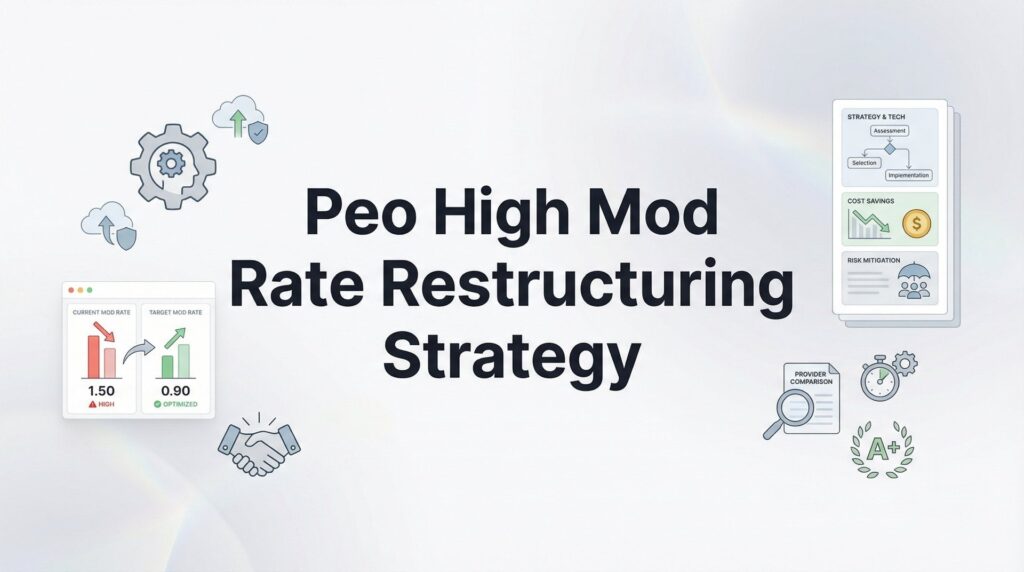
When your experience modification rate climbs above 1.0, it signals more than just a workers’ comp problem—it’s a flashing warning light about your entire PEO relationship. High mod rates don’t just inflate your insurance premiums; they can trigger PEO contract renegotiations, limit your provider options, and fundamentally change your cost structure.
The good news? A high mod rate isn’t a permanent sentence.
With the right restructuring approach, businesses can systematically address the underlying issues while optimizing their PEO arrangement for better outcomes. This guide walks through seven practical strategies that go beyond generic safety advice, focusing specifically on how to restructure your PEO relationship when mod rates become problematic.
Whether you’re considering switching providers, renegotiating terms, or fundamentally changing how you manage risk within your current arrangement, these strategies address the real decision factors: cost implications, operational tradeoffs, and when restructuring makes sense versus when it doesn’t.
1. Audit Your Current PEO’s Claims Management Before Making Any Moves
Before you blame yourself for a high mod rate, you need to understand whether your PEO is actually managing claims effectively. Not all PEOs handle workers’ compensation with the same level of sophistication, and poor claims management can inflate your mod rate even when your actual workplace safety is reasonable.
Request specific performance metrics from your current PEO. You want to see average claim closure times, the percentage of claims that go to litigation, and how quickly they initiate return-to-work conversations after an injury. Many PEOs will give you generic safety resources but fail to actively manage individual claims once they’re filed.
Ask for a claims-by-claims breakdown of the past three years. Look for patterns: Are there claims that stayed open longer than industry norms? Were there multiple claims from the same employee that might indicate fraud or inadequate investigation? Did your PEO challenge any classifications or dispute any claims on your behalf?
This audit tells you whether restructuring your PEO relationship will actually help. If your PEO is dropping the ball on claims management, switching providers or renegotiating service levels makes sense. If they’re doing everything right and you still have a high mod rate, your problem is operational—not contractual—and you need different solutions. Understanding when co-employment actually helps with high mod rates can clarify your next steps.
2. Separate Your Mod Rate Reality from Your PEO’s Pooled Risk Structure
Here’s where PEO structures get complicated: some PEOs use master policies where your claims experience gets pooled with other clients, while others issue standalone policies where your individual mod rate applies directly to your premiums.
If you’re in a pooled arrangement, your actual claims history might be better or worse than the rate you’re paying. You could be subsidizing other businesses with poor safety records, or you could be benefiting from their good experience. Understanding which situation applies fundamentally changes your restructuring strategy.
Request documentation showing whether your workers’ comp policy is individual or pooled. If it’s pooled, ask how your specific claims experience compares to the pool average. Some PEOs will provide this breakdown; others won’t, which tells you something about transparency. Learning how PEO workers comp cost allocation models work helps you understand what you’re actually paying for.
If you discover you’re in a pooled arrangement and your individual experience is actually better than the pool rate you’re paying, you have serious negotiating leverage. You can push for a standalone policy within your current PEO, or you can use this data when shopping for a new provider who will rate you individually.
Conversely, if you’re already rated individually and your mod rate is legitimately high, switching PEOs won’t magically fix the problem. Your experience follows you. In that case, focus on operational improvements rather than provider changes.
3. Restructure Job Classifications to Reflect Actual Risk Exposure
Workers’ compensation premiums are calculated based on job classification codes, and each code carries a different base rate reflecting the typical injury risk for that type of work. Misclassification—whether accidental or systemic—can inflate your costs significantly.
Conduct a classification audit with someone who understands workers’ comp codes at a granular level. Walk through your actual workforce and compare assigned codes to what employees actually do day-to-day. You’re looking for situations where someone spends most of their time on administrative work but is classified under a higher-risk code because their job title sounds physical.
Common problem areas include office staff who occasionally help with warehouse tasks getting classified as warehouse workers, or supervisors who rarely touch equipment being coded as operators. The workers’ comp system classifies based on actual duties performed, not job titles.
If you find misclassifications, this becomes part of your PEO restructuring conversation. Some PEOs resist reclassification because it requires paperwork and potential premium adjustments. If your current provider won’t cooperate on legitimate reclassifications, that’s a red flag worth considering when evaluating other options.
Proper classification won’t directly change your mod rate for past years, but it reduces your base premium going forward, which improves your overall cost structure even while you’re working to bring the mod rate down through other means. A solid cost structure modeling template can help you quantify these savings.
4. Negotiate Return-to-Work Program Integration Into Your PEO Contract
Return-to-work programs are one of the most effective tools for controlling workers’ comp costs because they reduce claim duration and total payout amounts. The problem is that many PEOs offer RTW support as a vague promise rather than a structured program with clear accountability.
When restructuring your PEO relationship, demand specific RTW commitments in writing. You want defined timelines for when the PEO’s claims team will contact injured employees, documented processes for identifying modified duty opportunities, and regular check-ins to monitor progress.
Push for integration between your operational managers and the PEO’s claims handlers. RTW programs fail when there’s no communication between the people managing claims and the people who actually know what modified work is available. Your PEO should be asking you about light-duty options within days of a claim, not weeks.
Some businesses discover their PEO has no real RTW infrastructure—they just tell injured workers to stay home until they’re fully recovered. That approach maximizes claim costs and guarantees your mod rate stays high.
If your current PEO can’t or won’t provide structured RTW support, this becomes a key differentiator when evaluating other providers. Ask prospective PEOs for specific examples of how they’ve managed RTW cases, what their average time-to-return metrics look like, and how they’ll coordinate with your team.
5. Time Your PEO Transition Around Rating Anniversary Dates
Experience modification rates are calculated using a three-year rolling period, excluding the most recent year. This timing matters enormously when you’re restructuring your PEO relationship, because switching providers at the wrong time can lock you into unfavorable rates longer than necessary.
Understand your current rating period and when your oldest high-claims year will roll off. If you had a particularly bad year that’s about to age out of the calculation, waiting a few months to switch providers could result in a significantly better mod rate with your new arrangement. Building a mod rate forecasting model helps you predict exactly when improvements will hit your bottom line.
Conversely, if you’ve recently implemented safety improvements and your claims frequency has dropped, you want those improvements reflected in your mod rate as quickly as possible. Switching providers might accelerate recognition of that improvement if your current PEO is slow to update ratings.
When evaluating transition timing, also consider your policy renewal date. Moving mid-policy-term often triggers fees, prorated adjustments, and administrative complications. Aligning your PEO change with your natural renewal period keeps things cleaner and gives you maximum negotiating leverage.
Map out a timeline showing when each year of claims experience enters and exits your mod rate calculation. Use that timeline to identify the optimal window for making provider changes, renegotiating contracts, or implementing operational improvements that will have maximum rating impact.
6. Evaluate Whether Leaving Your PEO Entirely Makes Financial Sense
Sometimes the best restructuring strategy is abandoning the PEO model altogether. When your mod rate is high, PEO pricing becomes less competitive because you’re paying for bundled services on top of already-elevated workers’ comp premiums.
Calculate what direct workers’ comp coverage would cost at your current mod rate. Get quotes from standalone carriers and compare the total cost—including any administrative burden you’d take on—against your current PEO fees. Many businesses discover that once their mod rate crosses a certain threshold, the PEO’s bundled pricing stops making economic sense.
Factor in what you’re actually using from your PEO beyond workers’ comp. If you’re primarily there for compliance support and payroll, those services can be purchased separately for less than the markup embedded in PEO pricing, especially when your workers’ comp costs are inflated.
The break-even analysis changes based on your headcount. Smaller businesses often benefit from PEO economies of scale even with higher mod rates, while larger businesses may find that bringing HR functions in-house or using unbundled vendors delivers better value. A thorough PEO vs internal HR cost modeling analysis reveals the true numbers.
Don’t forget to account for the transition costs: setting up direct payroll, establishing your own workers’ comp policy, and potentially hiring additional HR support. These are one-time expenses, but they affect your first-year economics.
If the math shows leaving the PEO saves money even after transition costs, that becomes your negotiating position. Present the analysis to your current PEO and see if they’ll restructure pricing to keep you. If not, you have a clear path forward.
7. Build Mod Rate Improvement Milestones Into Your Next PEO Contract
Whether you’re staying with your current PEO or switching to a new one, the next contract you sign should include specific accountability for mod rate improvement. Vague promises about safety support aren’t enough—you need measurable commitments tied to outcomes.
Structure your agreement with performance milestones. Define what “active claims management” means in concrete terms: response times, RTW initiation deadlines, and quarterly claims reviews. Tie contract renewal or pricing adjustments to whether these milestones are met.
Include provisions that address what happens if your mod rate doesn’t improve within a defined period. Some businesses negotiate rate reduction triggers—if the mod rate drops below a certain threshold, the PEO’s fees decrease proportionally. Others build exit clauses that let them leave without penalty if claims management targets aren’t hit. Using a scenario analysis financial model helps you evaluate different contract structures before committing.
Push for transparency requirements. Your contract should guarantee regular reporting on claims status, mod rate projections, and specific actions the PEO is taking to manage your experience. If they can’t commit to this level of visibility, they probably can’t deliver meaningful improvement.
Consider splitting your contract term into shorter renewal periods while your mod rate is problematic. Annual renewals give you more frequent opportunities to reassess whether the relationship is working, rather than locking into multi-year agreements that become expensive to exit.
The goal is creating shared accountability. Your PEO should have skin in the game when it comes to improving your workers’ comp experience, not just collecting fees regardless of outcomes.
Making Your Next Move Count
Restructuring your PEO relationship around a high mod rate isn’t a single decision—it’s a sequence of strategic moves. Start with the audit to understand whether your current PEO is part of the problem or doing everything possible with a genuinely difficult claims history.
From there, the path forward depends on what you find. Some businesses will negotiate better terms and stay. Others will discover that switching providers or leaving the PEO model entirely delivers better outcomes.
The key is making these decisions based on actual data about your specific situation, not generic advice about safety programs. Request the claims breakdown. Calculate the real costs. Map your rating timeline. Compare your options with actual numbers in front of you.
Whatever path you choose, build accountability into your next arrangement. Mod rate improvement should be a shared goal with measurable milestones, not something you hope happens over time. If a PEO won’t commit to specific claims management standards and transparent reporting, that tells you how seriously they’ll take your workers’ comp costs going forward.
Before you sign that PEO renewal, make sure you’re not leaving money on the table. Many businesses unknowingly overpay because of bundled fees, hidden administrative markups, and contracts designed to limit flexibility. We give you a clear, side-by-side breakdown of pricing, services, and contract terms—so you can see exactly what you’re paying for and choose the option that truly fits your business.
