
Picture this: an employee calls your HR manager on a Tuesday afternoon with a harassment complaint against their supervisor. Your HR lead listens, takes notes, and then freezes. Does she open an investigation internally? Does she loop in the PEO first? If the PEO gets involved, who actually leads the process? And if this thing escalates to a formal EEOC charge, who’s calling the shots?
Nobody wrote that down. So now you’ve got a real compliance clock ticking, two parties with overlapping authority, and no clear answer on who acts first.
This is exactly the problem a hybrid escalation governance model is designed to solve. In a hybrid PEO arrangement, you’ve kept internal HR staff for day-to-day operations while the PEO handles payroll, benefits administration, compliance infrastructure, and co-employment liability. That split makes sense operationally. But it creates a persistent structural problem: when something goes sideways, both parties technically have employer responsibilities, and neither has a clean, documented mandate for who leads.
The governance model is the answer. It’s not a contract amendment or a policy manual. It’s a decision-authority framework that defines who handles what, what triggers escalation from one tier to the next, and who has final call at each level. Done right, it prevents delays, closes compliance gaps, and eliminates the finger-pointing that happens when a situation falls between the cracks.
This article walks through what the model looks like in practice, how to build escalation triggers that hold up under pressure, where businesses consistently get it wrong, and how to know when the hybrid approach itself has run its course.
The Decision Authority Gap in Co-Employment
Co-employment means both you and the PEO are legal employers of your workforce, but for different purposes. The PEO typically holds employer-of-record status for payroll, tax filings, and benefits. You retain control over day-to-day operations, job assignments, and workplace culture. On paper, this division looks clean. In practice, the line between “advisory” and “action authority” gets blurry fast. For a deeper look at how this relationship actually functions, see our guide on how a PEO works.
In a fully outsourced model, the PEO handles most HR decisions and you defer to them. Simple enough. In a hybrid model, you’ve got internal HR staff who are actively managing employees, building culture, and handling routine issues. The PEO exists alongside them, not above them. That’s where the authority gap opens up.
The friction shows up most clearly in four situations:
Employee terminations: Your HR lead wants to move forward on a termination. The PEO, as co-employer, has risk exposure if the termination is challenged. Who approves the final decision? Who documents the process? If the answer is “we’ll figure it out when we get there,” you’ve already lost ground.
Workplace investigations: Harassment, discrimination, hostile work environment claims. These require prompt, documented, legally defensible responses. If your internal HR team starts an investigation without looping in the PEO, and the PEO’s standard process would have handled it differently, you’ve potentially created inconsistency that undermines the outcome.
Benefits disputes: An employee claims they were incorrectly enrolled or denied coverage. Your HR team thinks it’s an administrative error. The PEO thinks it’s a plan design question. The employee is waiting. Nobody owns the resolution timeline.
Compliance responses: An agency inquiry arrives — OSHA, DOL, a state wage board. These have hard deadlines. If your team assumes the PEO handles it because it’s “a compliance thing,” and the PEO assumes you’re managing it because it’s “your employee,” the deadline passes before anyone acts.
The cost of this ambiguity isn’t hypothetical. It shows up as slow EEOC responses, inconsistent disciplinary records, duplicated effort on some tasks and dropped responsibility on others. The governance model doesn’t eliminate complexity. It eliminates ambiguity about who’s responsible for navigating that complexity.
The Three-Tier Structure: What This Model Actually Looks Like
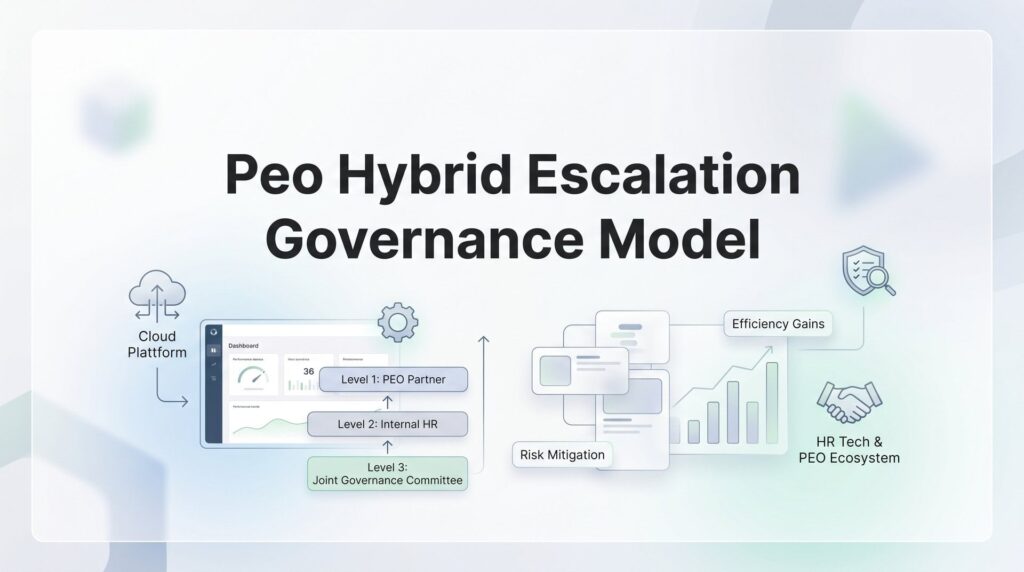
A functional hybrid escalation governance model organizes HR decision authority into three tiers based on complexity, risk, and required expertise. Each tier has defined ownership, escalation triggers, and response expectations.
Tier 1 — Internal HR Ownership: Routine, low-risk HR activity handled entirely by your internal team. Onboarding logistics, basic policy questions, scheduling, routine PTO requests, standard performance check-ins. The PEO may provide the infrastructure (handbook templates, HRIS tools, benefits enrollment systems), but your team owns execution. No escalation needed unless something unusual surfaces. If you’re still figuring out how to divide responsibilities between your team and the PEO, our guide on using a PEO with your internal HR department covers the integration in detail.
Tier 2 — Shared Jurisdiction: Situations where both parties have legitimate involvement and neither can act unilaterally without risk. Performance management with potential legal exposure (written warnings, PIPs, demotion decisions), complex leave administration (FMLA, ADA accommodations, state-specific leave laws), benefits enrollment disputes, and compensation adjustments that affect benefits eligibility. At Tier 2, your internal HR team leads the process but is required to notify and consult the PEO before finalizing any decision. The PEO’s role here is advisory but documented.
Tier 3 — PEO-Led or Jointly Escalated: High-stakes situations with legal, regulatory, or significant financial exposure. Workplace investigations involving protected class complaints, workers’ compensation disputes, EEOC charges, agency audits, terminations with litigation risk, and multi-state compliance events. At Tier 3, the PEO takes a leadership role in process management, often with external legal counsel looped in. Your internal HR team shifts to a supporting and documentation role.
The “governance” part of this model is what most businesses skip. Defining tiers is straightforward. The harder work is specifying three things for each tier: who has final decision authority, what specific conditions trigger movement from one tier to the next, and what the response timeline commitments are.
Without those elements, you have a conceptual framework, not an operational one. A complaint involving a protected class doesn’t automatically sort itself into Tier 3 because you drew a box on a diagram. It gets there because someone saw a defined trigger condition, followed a documented notification protocol, and handed off authority according to a written standard.
This is also where the hybrid model differs meaningfully from full PEO outsourcing. When you outsource HR entirely, escalation is simpler because the PEO owns the process end-to-end. You trade control for simplicity. The hybrid model preserves your operational involvement, but that involvement only adds value if the governance structure is explicit. Without it, you get the worst of both worlds: shared liability without shared clarity.
Building Escalation Triggers That Hold Up
The most common governance failure isn’t the absence of a framework. It’s escalation triggers that depend on someone’s judgment call about severity. “Escalate when it feels serious enough” isn’t a trigger. It’s a gap.
Effective triggers are event-based, not subjective. They define specific conditions that require escalation regardless of how the situation feels in the moment. A few examples that translate well across industries:
Any complaint involving a protected class characteristic (race, gender, religion, age, disability, national origin, sexual orientation) automatically moves to Tier 2 with immediate PEO notification required within 24 hours.
Any termination involving an employee with 12 or more months of tenure, a recent accommodation request, or a prior complaint on file moves to Tier 3 before any separation paperwork is issued.
Any agency inquiry with a response deadline (EEOC, DOL, state labor board, OSHA) triggers immediate joint escalation to Tier 3 on receipt, regardless of whether the issue seems minor.
These aren’t arbitrary. They’re designed to catch the situations most likely to generate legal exposure before they spiral. The goal is to remove discretion from the escalation decision itself — not from the resolution, but from the question of whether to escalate at all. For a detailed walkthrough of how claims move through a PEO’s process, see our piece on the employee claim escalation process.
Here’s where a lot of businesses miss a practical step: mapping these triggers to your actual PEO service agreement. Most PEO contracts define what the PEO will and won’t handle, but that language rarely gets translated into internal workflow. Your contract might specify that the PEO leads workplace investigations involving co-employment liability. But if your internal HR team doesn’t have a documented trigger that says “protected class complaint = PEO notification within 24 hours,” the contract language doesn’t help you in the moment.
To illustrate how this works operationally: say an employee raises a wage-and-hour concern with your HR manager, claiming they weren’t paid correctly for overtime hours over the past two months. Here’s how a documented escalation path handles it.
Step one: Your HR manager logs the complaint and checks the trigger matrix. Wage-and-hour complaints involving potential back-pay liability are a defined Tier 2 trigger. She notifies the PEO’s client services team within 24 hours using the designated communication channel (not a casual Slack message — a formal notification in the HRIS or via email with a documented timestamp).
Step two: Internal HR and the PEO jointly assess the scope. Is this a payroll processing error? A policy interpretation issue? A potential class-wide exposure? That assessment determines whether it stays at Tier 2 or escalates to Tier 3.
Step three: If the assessment reveals potential back-pay liability across multiple employees, it escalates to Tier 3. The PEO takes the lead on resolution process. Internal HR supports with records and employee communication. A response timeline is set and documented.
The SLAs matter here. Each step should have a defined response window. If the PEO doesn’t respond to a Tier 2 notification within 48 hours, what happens? Who follows up? That’s not bureaucracy. That’s accountability.
Four Ways Businesses Undermine Their Own Governance
You can design a solid governance framework and still watch it fail in practice. Here’s where it breaks down most often.
Treating the PEO as a backstop, not a co-participant. This is the most common mistake. Internal HR manages a situation for two weeks, hits a wall, and then calls the PEO to clean it up. By that point, the documentation is inconsistent, the employee has formed expectations about how the process is being handled, and the PEO’s ability to mitigate risk is significantly reduced. Early involvement isn’t about giving up control. It’s about preserving options.
No written RACI matrix. RACI stands for Responsible, Accountable, Consulted, Informed. It’s a simple framework for mapping who does what in a given scenario. Many hybrid PEO arrangements operate on verbal understandings that work fine until there’s turnover on either side, a new compliance domain enters the picture, or a situation involves overlapping jurisdictions (state leave law plus federal ADA plus your PEO’s benefits plan, for example). Verbal agreements don’t survive staff changes. A written RACI matrix does.
No state-specific overlays. Some compliance obligations can’t be delegated to a PEO regardless of your service agreement. California’s mandatory harassment prevention training timelines, New York’s pay transparency requirements, state-plan OSHA states with their own inspection and reporting protocols — these create employer obligations that sit with you specifically, not with the co-employer relationship. Businesses operating across multiple states face this challenge acutely, as we’ve explored in our coverage of multi-state payroll governance. Your governance model needs to identify which compliance tasks are state-specific and non-delegable, and assign clear internal ownership for those.
Building the model and never testing it. A governance document that lives in a shared drive and gets reviewed at annual renewals is not an operational tool. It’s a filing artifact. The next section covers how to actually pressure-test the model before a real situation forces you to.
Making the Model Operational: Documentation, Testing, and Accountability
A governance model is only as good as the people using it under pressure. That means the documentation needs to be specific enough to be actionable, and the model itself needs to be tested before a real compliance event hits.
The governance document should include, at minimum: escalation tier definitions with specific examples, named roles tied to actual people (not just titles — “HR Director” is less useful than “Sarah Chen, HR Director, primary contact for Tier 2 notifications”), communication channels for each escalation type, response time commitments at each tier, and a defined review cadence.
On that last point: quarterly reviews are the right frequency for most mid-size businesses. Annual reviews miss too much. Staffing changes, regulatory updates, PEO service changes, and lessons from actual escalations all need to feed back into the model regularly. If you’re only reviewing it once a year, you’re operating on outdated assumptions for most of that year.
Tabletop exercises are the most underused tool in this space. The concept is borrowed from emergency management: you gather the key stakeholders, present a simulated scenario, and walk it through your escalation tiers in real time. Not to practice the resolution — to test the process. Where does it slow down? Where does someone say “I didn’t know that was my responsibility”? Where does the RACI matrix break down because two people thought the other was accountable?
Run one simulated OSHA inquiry. Run one discrimination complaint scenario. Run a termination with potential retaliation exposure. You’ll find the gaps before they cost you.
Governance performance should also be part of your formal PEO relationship review. If escalations are consistently slow on the PEO’s side, if notifications go unacknowledged, if Tier 3 situations get handed back to internal HR without clear rationale, those are signals worth documenting. They’re also leverage in service renegotiations. A PEO that can’t demonstrate responsiveness within agreed SLAs is a PEO whose contract terms deserve scrutiny. If you’re evaluating providers or considering a switch, how a PEO structures escalation support and client communication is one of the most practically important factors to compare, and one of the most overlooked. Our top PEO providers comparison covers several of these operational dimensions.
When the Governance Model Tells You It’s Time to Change the Structure
Here’s a signal worth paying attention to: if your governance model is becoming more complex than the HR function it’s trying to govern, something is off.
A well-designed governance model should simplify decision-making, not add overhead to it. If you’re spending meaningful time managing the model itself — updating RACI matrices, resolving authority disputes, re-training staff on escalation paths — the hybrid structure may have reached its operational ceiling.
Two inflection points usually trigger this reassessment. The first is headcount growth. As your workforce scales, the volume of Tier 2 and Tier 3 events increases, and so does the cost of shared-authority coordination. At some point, the efficiency case for full PEO management or a fully in-house HR team with dedicated HR technology becomes stronger than the hybrid split. Building a PEO vs internal HR cost model can help you quantify that inflection point objectively.
The second is operational complexity. Multi-state workforces, rapid hiring cycles, unionization activity, or frequent regulatory changes can push the governance model past its practical limits. When your escalation framework needs more maintenance than your actual HR operations, it’s worth asking whether the hybrid structure is still serving you.
Your governance model’s performance data is actually useful here. Escalation frequency by tier, average response times, instances of misrouted decisions, recurring gaps in the RACI matrix — these tell you whether the model is working or whether the underlying structure needs to change. If the data points toward a full transition, our PEO transition guide walks through the practical steps. That’s a more objective basis for the decision than gut feel or a frustrating incident that pushed someone over the edge.
The Operating System Your Co-Employment Needs
A hybrid PEO arrangement only works well when decision authority is explicit, documented, and regularly tested. The governance model isn’t bureaucracy for its own sake. It’s the operating system that keeps co-employment from becoming co-confusion.
If you don’t have one, start with the escalation tiers. Define what internal HR owns, what requires PEO consultation, and what triggers full PEO involvement. Add event-based triggers. Build a RACI matrix. Document response time commitments. Run a tabletop exercise before the next compliance event runs you.
Then audit your PEO relationship against it. Does your provider respond within agreed timelines? Do they have a clear escalation contact? Do they understand your state-specific obligations? These operational factors matter as much as pricing and benefits packages, and they’re rarely part of how businesses compare providers at renewal time.
If you’re heading into a renewal or evaluating alternatives, don’t just compare rates and benefit offerings. Compare governance support, escalation responsiveness, and contract clarity around co-employment authority. That’s where the real operational risk lives.
Don’t auto-renew. Make an informed, confident decision. PEO Metrics gives you a clear, side-by-side breakdown of providers on pricing, services, and contract terms — including the operational dimensions that most comparison tools skip entirely.
