
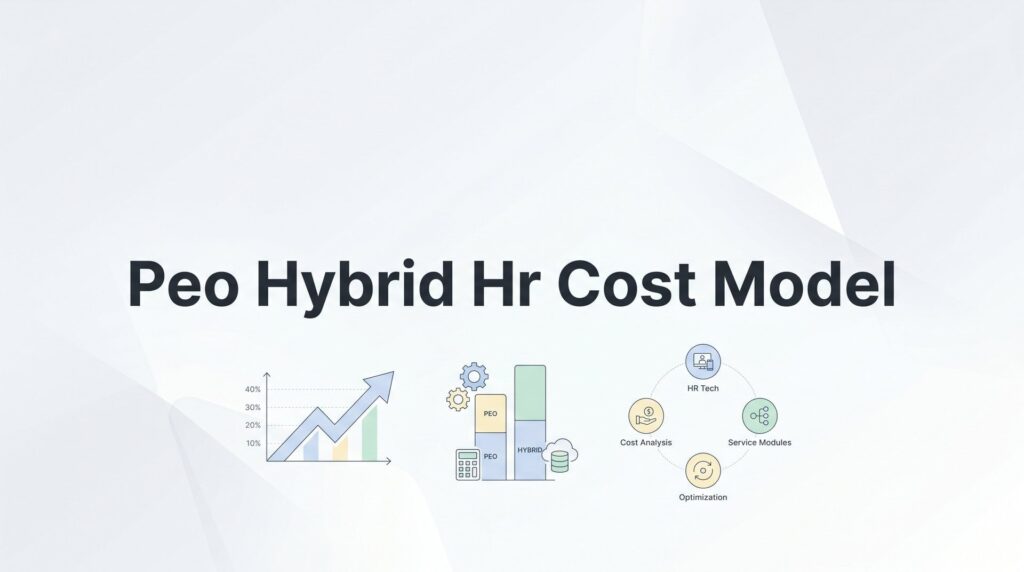
Most businesses don’t make a clean choice between running HR entirely in-house or handing everything to a PEO. They end up somewhere in between. A PEO handles payroll and workers’ comp. An internal HR manager owns recruiting and employee relations. Benefits administration gets split depending on who negotiated what. It works, mostly — but it creates a cost structure that almost nobody has actually mapped out clearly.
That’s the hybrid HR cost model. And the honest truth is that pricing transparency for hybrid arrangements is significantly worse than for standard full-service PEO contracts. Most PEOs aren’t eager to explain how their bundled margins work when you start carving out services. Most companies aren’t calculating the real loaded cost of what they’re keeping in-house either.
What follows is a practical breakdown of how hybrid HR cost models actually work: what you’re paying on both sides of the split, where the hidden costs accumulate, and how to model the full picture before you commit to a structure that may or may not be saving you money.
Why Hybrid Pricing Doesn’t Work the Way You’d Expect
A hybrid HR model, for the purposes of this article, means you’re using a PEO for some functions — typically payroll processing, tax administration, workers’ comp, and compliance infrastructure — while retaining others in-house. Recruiting, HR business partner support, performance management, and sometimes benefits administration stay with your internal team.
This is different from a full co-employment arrangement where the PEO effectively handles the entire HR function and you’re buying a bundled service. In a hybrid setup, you’re a partial buyer. And that distinction matters enormously when you look at what you’re actually paying.
Here’s the thing most PEO sales conversations gloss over: PEO pricing is designed around bundled service delivery. Whether the fee is structured as a percentage of payroll or a flat per-employee-per-month rate, the PEO is pricing across its entire service offering. Compliance support, HR advisory, benefits administration, payroll — the margins on each individual service line subsidize the others. When you carve out services, the PEO’s per-employee fee rarely drops proportionally, because the cost model wasn’t built that way.
Think of it like a cable bundle. You can sometimes negotiate to drop a few channels, but the base rate doesn’t fall by a third just because you stopped watching those channels. The provider built the package assuming you’d pay for the whole thing.
So when a business says “we’re going hybrid to save money,” the first question worth asking is: save money compared to what? Compared to a full-service PEO engagement, maybe. Compared to a well-run in-house HR operation, maybe not. The hybrid model doesn’t inherently reduce your costs — it shifts your cost structure from a single bundled line item to two separate cost centers that require different accounting discipline to manage.
That shift is where most businesses lose visibility. The PEO invoice is easy to see. The fully loaded cost of your internal HR team — salaries, benefits, technology, training, and the time spent coordinating with the PEO — is much harder to quantify. And if you’re not measuring both sides with equal rigor, you’re not actually managing your hybrid cost model. You’re just assuming it works.
The Two Cost Buckets — and the Third One Nobody Talks About
Running a hybrid HR model means you’re carrying two distinct cost buckets simultaneously. Understanding what’s in each one is the starting point for any honest cost analysis.
The PEO-side costs are what show up on the contract: per-employee fees or payroll percentage charges covering whatever services you’ve outsourced. Payroll processing, tax filing, workers’ comp pooling, compliance support, and whatever HR advisory services are included in your tier. This side feels concrete because there’s an invoice. But even here, the costs are less transparent than they appear. Workers’ comp premiums embedded in PEO pricing often include administrative markups that aren’t broken out. Benefits administration fees may be bundled into the per-employee rate without clear disclosure. It’s worth requesting a line-item breakdown before assuming the invoice tells the whole story.
The in-house costs are what you’re carrying for the functions you’ve retained. This means the fully loaded cost of your internal HR staff — not just base salary, but employer-side benefits, payroll taxes, and any management overhead. Add to that the technology stack you’re running: an ATS for recruiting, a performance management platform, potentially a separate HRIS if the PEO’s system doesn’t cover your retained functions. Training costs, employment law counsel for issues that fall outside the PEO’s scope, and any HR consulting you bring in on an ad-hoc basis all belong here too.
Companies routinely underestimate the in-house side because the costs are distributed across multiple budget lines. The HR manager’s salary sits in headcount. The ATS is a software subscription. The employment attorney is a legal expense. Nobody adds them up and compares the total to what a full-service PEO would cost. That’s a real gap.
The coordination tax is the third cost bucket, and it’s the one that gets almost no attention. When you split HR responsibilities between an internal team and a PEO, you create operational handoff points. Someone has to reconcile payroll data between your systems. Someone has to make sure the PEO has accurate headcount information when you hire or terminate. Someone has to field questions about what the PEO covers versus what your HR team handles — and those questions come up constantly, especially around benefits, leave policies, and compliance issues.
This coordination overhead doesn’t appear on any invoice. It shows up as hours your HR team spends on administrative back-and-forth instead of higher-value work. It shows up as errors when the handoffs aren’t clean. In some cases, it shows up as duplicate data entry across systems that don’t talk to each other.
Technology duplication is a specific version of this problem worth calling out. Many PEOs require you to operate within their HRIS or payroll platform. If you’re retaining functions in-house, you may also be paying for separate tools — an ATS, a benefits enrollment platform, a performance system — that don’t integrate cleanly with the PEO’s environment. Analyzing your HR infrastructure costs across parallel systems is a real expense that often gets discovered after the contract is signed.
Honest Scenarios: Where the Savings Are Real and Where They Disappear
Hybrid models do generate genuine savings in specific situations. The key is being clear-eyed about whether your situation actually matches those scenarios.
Where hybrid can work financially: Companies with experienced internal HR leadership that only need the PEO for benefits buying power and workers’ comp pooling are often good candidates. If your HR team is competent on compliance, doesn’t need hand-holding on employee relations issues, and is primarily using the PEO as an insurance and benefits vehicle, you’re getting real value without paying for advisory services you don’t use. The PEO’s ability to pool workers’ comp risk and negotiate group benefits rates is a genuine financial advantage that’s hard to replicate at small-to-mid scale. If that’s the core of what you need, a hybrid arrangement can make sense.
Where the savings evaporate: The most common failure mode is when your in-house HR team still leans on the PEO for compliance guidance, state-specific employment questions, or ad-hoc support. If that’s happening, you’re effectively paying twice. You’re paying the PEO’s per-employee fee, which includes a margin for advisory and compliance support. And you’re paying your internal HR team’s fully loaded cost, including the hours they spend coordinating with the PEO to get answers. Neither side is fully owning the function, and the coordination overhead is real.
This pattern is more common than most companies realize. HR teams at the 50-150 employee range often have one or two generalists who are good at a lot of things but still rely on the PEO as a backstop. That reliance isn’t free. It’s baked into the PEO fee whether you acknowledge it or not. Running a thorough PEO ROI and cost-benefit analysis can reveal whether you’re actually getting value from both sides of the arrangement.
The headcount threshold factor: Hybrid models tend to make more financial sense when your internal HR capacity is already justified by organizational complexity, not just PEO cost avoidance. If you’re building out an internal HR team because the business genuinely needs dedicated people — not just to reduce PEO spend — then layering a targeted PEO relationship on top of that team can be efficient. If you’re hiring internal HR staff primarily to reduce PEO fees, run the full cost comparison carefully. The break-even is often less obvious than it first appears.
How to Actually Model Your Hybrid Costs Before You Commit
The right way to approach this is with a function-by-function accounting exercise before you sign anything. It’s not complicated, but it requires discipline.
Start by listing every HR function your business needs: payroll processing, tax filing, benefits administration, workers’ comp, recruiting, onboarding, compliance, employee relations, performance management, HR reporting, leave management, terminations. For each one, assign it to either the PEO or your internal team. Be specific — “compliance” isn’t one thing. State-specific employment law compliance is different from federal reporting compliance, which is different from I-9 management.
Once you’ve assigned each function, estimate the fully loaded cost of each. For PEO-side functions, request a line-item breakdown from the provider. Not all PEOs will provide this willingly, but it’s a reasonable ask and worth pushing for. If a PEO refuses to unbundle their pricing even for analysis purposes, that tells you something about how the contract will work in practice. Using a cost structure modeling template can help you organize this analysis systematically. Watch for minimum service tier requirements that effectively prevent you from carving out services without paying for them anyway.
For in-house functions, calculate the actual loaded cost: salary plus benefits plus employer taxes plus any technology specific to that function. Add a realistic estimate of coordination overhead — how many hours per week does your team spend on handoffs, reconciliation, and communication with the PEO? Assign a dollar value to that time.
One scenario most businesses skip: model what happens if the PEO relationship ends. If you’ve outsourced payroll and workers’ comp to a PEO, and that relationship terminates, what does it cost to bring those functions back in-house or transition to a standalone provider? This isn’t a hypothetical — PEO contracts end, PEOs get acquired, pricing changes at renewal. Building a scenario analysis financial model that accounts for these contingencies is essential if your hybrid model depends on a PEO relationship that would be expensive to exit.
Also review contract language carefully for penalties around partial service adoption. Some PEO agreements include minimum employee counts, minimum service tiers, or administrative fees that apply regardless of which services you’re actually using. These terms can significantly change the math on a hybrid arrangement.
When Hybrid Is Actually the Wrong Structure
There are situations where a hybrid model creates more problems than it solves, and it’s worth being direct about them.
Full PEO engagement is often cheaper for smaller companies that don’t have dedicated HR staff. If you’re under 30-40 employees and relying on a part-time HR generalist or an office manager handling HR tasks, a full-service PEO frequently delivers more value at lower total cost than trying to maintain a hybrid structure. Understanding how much a PEO actually costs at different company sizes can help clarify whether the hybrid approach makes sense for your headcount.
Heavily regulated industries deserve extra scrutiny here. If you’re operating in healthcare, financial services, construction, or any sector with significant employment law complexity, splitting compliance responsibilities between an internal team and a PEO creates gray areas. The co-employment framework means the PEO retains certain employer-of-record responsibilities, but if the contract doesn’t clearly define who owns what, compliance issues can fall between the cracks. That ambiguity has real legal and financial consequences. A clean full-service arrangement with clear accountability is often worth the premium.
On the other end of the spectrum: companies that have genuinely outgrown the PEO’s value proposition are sometimes running hybrid models out of inertia rather than strategy. If you’ve built an internal HR team that handles most functions competently, and you’re primarily keeping the PEO for benefits pooling that’s no longer meaningfully cheaper than what you could negotiate directly, you may be paying hybrid fees for a relationship that no longer earns them. That’s a different problem, but it’s worth running a cost variance analysis periodically.
The compliance ambiguity risk is worth emphasizing one more time. In a hybrid setup, the division of duties between your internal team and the PEO needs to be explicit in the contract — not assumed. If it’s not clearly documented, you don’t have a hybrid model. You have a compliance liability waiting to surface.
Putting the Numbers Together
A hybrid HR cost model isn’t inherently better or worse than a full PEO engagement. It’s a different cost structure that demands more active management and clearer accounting on both sides.
The businesses that run hybrid models successfully are the ones who’ve actually done the math — not just on the PEO invoice, but on the fully loaded cost of retained functions, the coordination overhead between the two sides, and the exit cost if the PEO relationship changes. They’ve also been clear-eyed about where they’re actually getting value from the PEO versus where they’re paying for services they don’t use.
Before assuming a hybrid setup saves money, map your actual costs across both buckets. Request line-item pricing from your PEO rather than accepting a bundled rate. Calculate the real loaded cost of what you’re keeping in-house. And make sure your contract clearly defines who owns what — because ambiguity in a hybrid arrangement doesn’t stay theoretical for long.
If you’re evaluating PEO providers and want to find ones that offer genuine flexibility for hybrid arrangements rather than penalizing partial service adoption, the comparison work matters. Bundled fees, hidden administrative markups, and contracts designed to limit flexibility are common. Don’t auto-renew. Make an informed, confident decision.
