
Most businesses running a hybrid HR model hit the same wall around the 12-18 month mark. You’re paying a PEO for a bundle of services, maintaining internal HR staff for the pieces that don’t fit neatly into that bundle, and somewhere in the middle, work is getting duplicated, ownership is unclear, and costs are quietly leaking out of both sides.
A hybrid HR optimization framework isn’t something you buy. It’s a stack of tools and processes you assemble to make the PEO-plus-internal-HR split actually function. That means auditing what your PEO covers vs. what stays in-house, identifying where you’re overpaying for services you barely use, and building a model that can evolve as your headcount and complexity change.
The tools below were selected based on practical relevance to hybrid PEO environments, cost transparency, integration capability, and one key question: does this tool actually help you make decisions, or does it just generate more dashboards? Here are the tools worth considering.
1. PEO Metrics
Best for: Auditing your current PEO setup and comparing alternatives before renewing
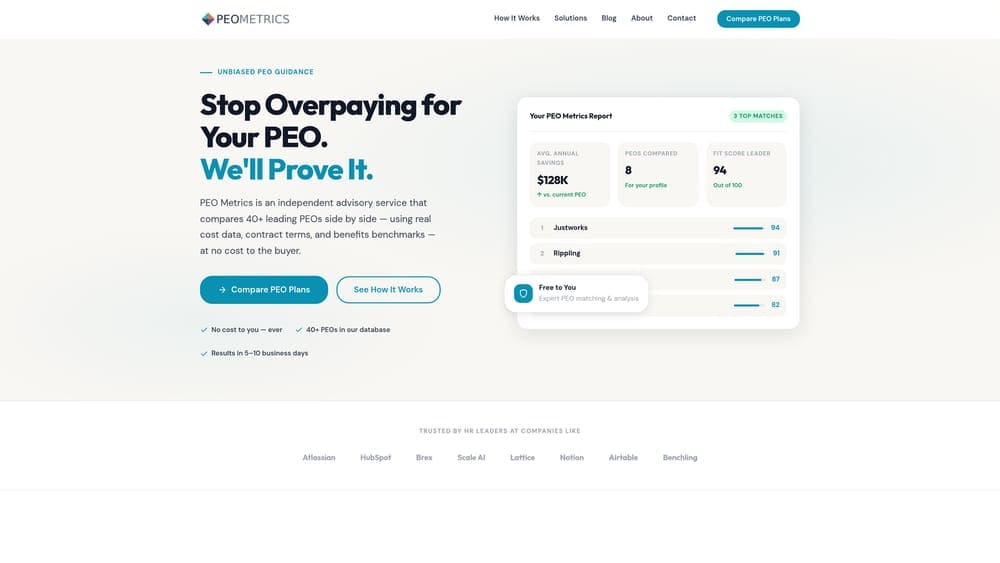
PEO Metrics is an unbiased PEO comparison platform built to give businesses real visibility into what they’re paying for and whether they’re getting fair value.
Where This Tool Shines
The biggest challenge in hybrid HR optimization isn’t figuring out which tools to add. It’s understanding what your PEO is actually delivering. Most businesses don’t have a clean picture of what they’re paying per service, which functions are underused, and how their current provider stacks up against alternatives. PEO Metrics is designed specifically to surface that information.
Unlike PEO brokers who earn commissions on placements, PEO Metrics operates as an independent resource. That distinction matters when you’re trying to make a genuinely informed decision about your HR structure rather than being steered toward a vendor relationship that benefits the advisor more than your business.
Key Features
Side-by-Side Provider Comparisons: Granular service-level breakdowns across multiple PEO providers so you can see exactly where the differences are.
Pricing Transparency: Analysis that reveals what you’re actually paying for each service component, not just the blended per-employee rate.
Unbiased Guidance: No broker commissions, no vendor relationships that skew recommendations.
Service Allocation Analysis: Helps you identify which PEO services are worth keeping vs. which functions make more sense to bring in-house.
Best For
Any business approaching a PEO renewal, considering a provider switch, or trying to rationalize a hybrid HR model. This is the logical starting point before investing in any other tool on this list. You need to know what your PEO covers before you can build around it intelligently.
Pricing
Free comparison resources available. Contact PEO Metrics directly for detailed analysis and side-by-side breakdowns tailored to your situation.
2. Rippling
Best for: Businesses that want one platform to manage both PEO and non-PEO HR functions simultaneously
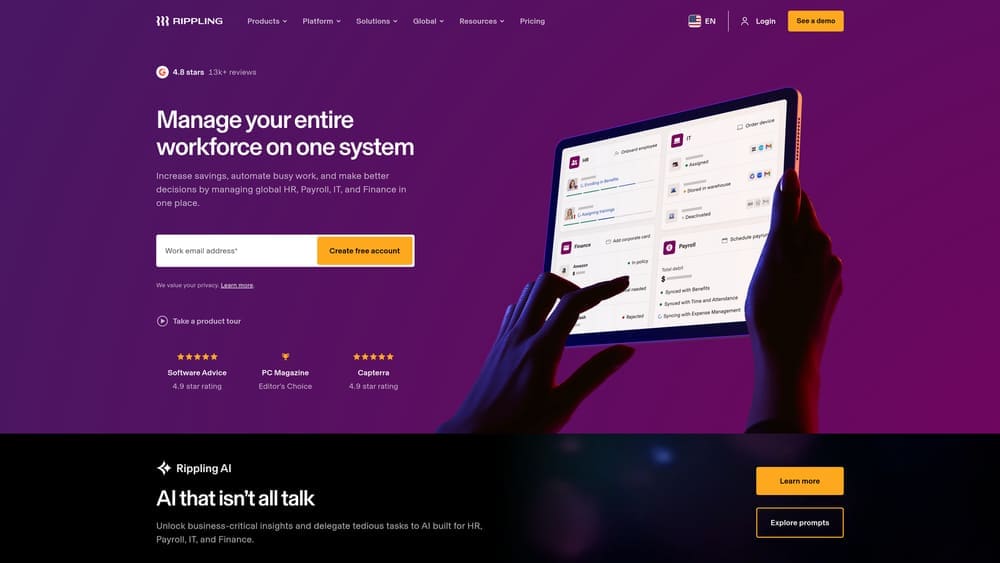
Rippling is a unified workforce management platform built around modularity, letting you use PEO services for some functions while running others independently.
Where This Tool Shines
The practical headache in most hybrid setups is that your PEO portal handles some things, your internal systems handle others, and nothing talks to each other cleanly. Rippling’s architecture is specifically designed to avoid that problem. You can run payroll and benefits through Rippling’s PEO while managing IT provisioning, contractor payments, or performance tracking internally on the same platform.
The transition path is also worth noting. If you decide to reduce your PEO dependency over time, Rippling doesn’t require a full re-platforming. You can dial back PEO services and absorb those functions into the standalone platform without disrupting your employee experience or data continuity.
Key Features
Modular Service Structure: Toggle between PEO and standalone HR operations by function without switching platforms.
Multi-State Compliance Automation: Monitors compliance requirements across states automatically as your workforce grows.
Native Cross-Functional Integrations: Connects HR, finance, and IT operations in one unified system.
Clean Migration Path: Structured off-ramp if you eventually decide to exit the PEO model entirely.
Best For
Growing businesses with distributed teams who need flexibility to adjust which HR functions stay with a PEO and which move in-house as headcount and complexity increase. Particularly useful for companies that anticipate their HR model evolving over the next 12-24 months.
Pricing
Core platform starts at $8/user/month. PEO pricing varies by headcount and service configuration; contact Rippling for a detailed quote.
3. Deel
Best for: Hybrid HR teams managing international employees or contractors that domestic PEOs can’t cover
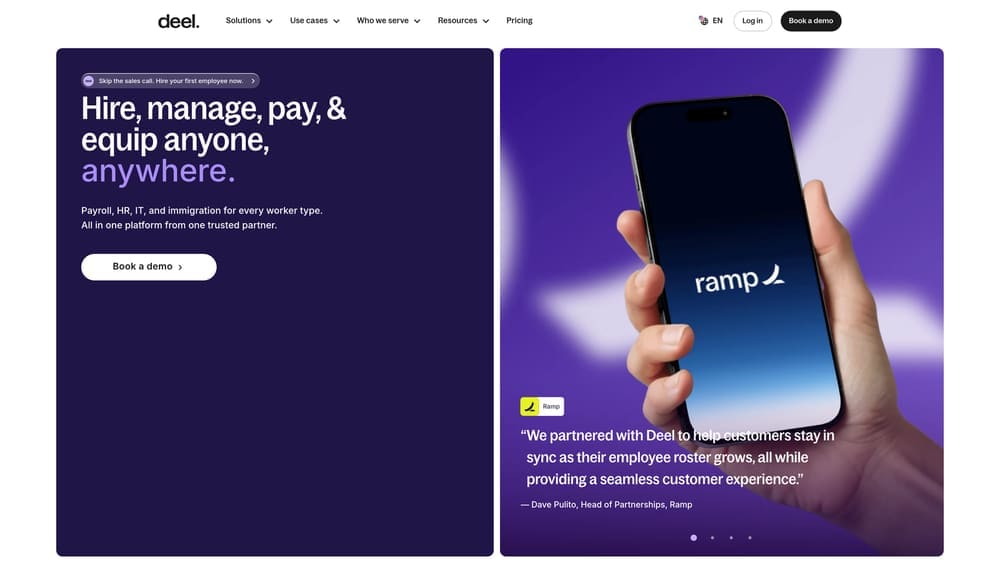
Deel is a global employment and contractor management platform that handles the international piece most domestic PEOs simply don’t support.
Where This Tool Shines
Domestic PEOs are built for U.S. employment. The moment you have a contractor in Germany, a full-time employee in Canada, or a remote hire in Brazil, your PEO’s coverage ends and you’re on your own. Deel fills that gap with Employer of Record services in 150+ countries and localized contractor compliance management.
In a hybrid model, Deel typically sits alongside your domestic PEO rather than replacing it. Your U.S. workforce stays on the PEO; your international workforce runs through Deel. The integration capability matters here because you want both systems feeding into a single source of truth for headcount, costs, and compliance status.
Key Features
Global EOR Coverage: Employer of Record services across 150+ countries with locally compliant employment contracts.
Contractor Compliance Management: Localized contractor agreements and payment handling that reduce misclassification risk.
HRIS and Payroll Integrations: Connects with existing internal systems so global and domestic workforce data stays consolidated.
Domestic PEO Gap Coverage: Handles the international employment scenarios that U.S.-focused PEOs aren’t built for.
Best For
Companies with any international workforce component. If you have even a handful of contractors or employees outside the U.S., Deel prevents the compliance exposure that comes from improvising international employment arrangements.
Pricing
Contractor management starts at $49/month per contractor. Employer of Record services start at $599/month per employee. Volume pricing available.
4. BambooHR
Best for: SMBs that need a clean internal HRIS to cover the employee experience functions PEOs routinely underdeliver
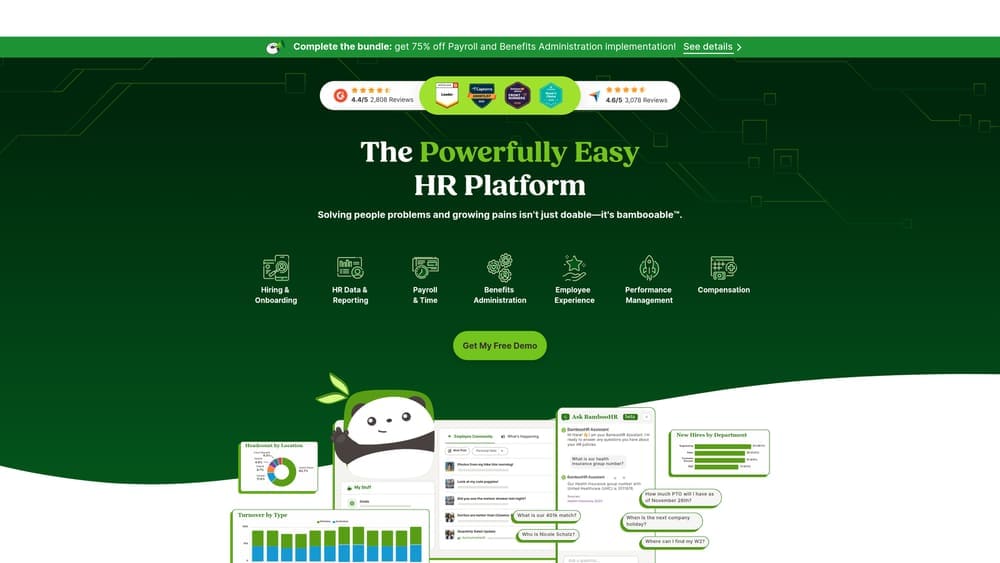
BambooHR is an intuitive HRIS for small and mid-sized businesses that handles onboarding, performance reviews, and people operations with a level of polish most PEO portals don’t come close to matching.
Where This Tool Shines
Here’s a common frustration with PEOs: the administrative backbone is solid, but the employee-facing experience is often clunky. New hire onboarding through a PEO portal typically feels generic. Performance reviews, if supported at all, are basic. BambooHR is built specifically to solve that problem, giving your internal HR team tools that actually reflect your company culture and workflows.
In a hybrid setup, BambooHR sits on the in-house side of the equation. Your PEO handles payroll processing, benefits administration, and compliance filings; BambooHR handles the human side of HR that shapes how employees actually experience working at your company.
Key Features
Branded Onboarding Workflows: Customizable new hire experiences that feel like your company, not a generic PEO portal.
Performance Management: Goal tracking, review cycles, and manager feedback tools built for ongoing development conversations.
Employee Self-Service: PTO requests, document access, and personal information management in one clean interface.
People Analytics: Reporting on the HR metrics PEO dashboards typically ignore, including turnover trends and engagement signals.
Best For
SMBs with 10-500 employees who want to elevate the internal HR experience without rebuilding their entire HR stack. Especially valuable when employee retention and culture are priorities that a PEO alone isn’t positioned to support.
Pricing
Contact BambooHR for current pricing. Generally estimated in the $6-$9/employee/month range for SMBs depending on modules and headcount.
5. Workday Adaptive Planning
Best for: HR and finance teams that need to model the real cost of different PEO service configurations
Workday Adaptive Planning is an enterprise-grade financial planning tool that lets you run actual scenarios on what your hybrid HR model costs under different configurations.
Where This Tool Shines
Most hybrid HR cost decisions get made on gut feel or rough spreadsheet math. Adaptive Planning brings rigor to that process. You can model the full cost comparison between keeping a service with your PEO vs. building it in-house, including loaded labor costs, technology overhead, and compliance risk exposure. That kind of modeling is what separates a real optimization framework from a list of tools.
The collaborative planning capability is also underrated. When HR and finance are working from the same model, conversations about PEO renewals and service scope changes become grounded in shared data rather than departmental assumptions.
Key Features
PEO vs. In-House Scenario Modeling: Build and compare cost scenarios across different hybrid HR configurations.
Workforce Planning Integration: Tie headcount projections directly to financial forecasts so HR decisions reflect real budget impact.
Cross-Functional Collaboration: HR and finance teams work from the same planning environment with shared visibility.
Real-Time Spend Dashboards: Track hybrid HR costs in real time against planned budgets.
Best For
Mid-market and enterprise organizations where HR costs are significant enough to warrant rigorous financial modeling. Less practical for very small businesses but increasingly valuable as headcount and complexity grow.
Pricing
Enterprise pricing; contact Workday directly for quotes. Generally positioned for mid-market and above given the investment required.
6. Mineral (formerly ThinkHR)
Best for: Getting an independent compliance check on what your PEO is and isn’t actually covering
Mineral is a compliance intelligence platform with live HR advisor access that functions as an independent layer of compliance verification alongside your PEO.

Where This Tool Shines
PEOs take on co-employer liability, but that doesn’t mean they’re proactively flagging every compliance issue relevant to your business. Mineral gives your internal HR team direct access to certified HR advisors who can answer specific questions, review policies, and flag gaps your PEO may not have surfaced. Think of it as a second opinion that doesn’t cost you a lawyer’s hourly rate.
The continuously updated compliance content library is also useful for HR teams managing multi-state workforces, where the regulatory landscape shifts frequently enough that relying solely on PEO guidance creates real exposure.
Key Features
Live HR Advisor Access: Direct line to certified HR professionals for compliance questions and policy review.
Compliance Content Library: State and federal compliance content updated in real time as regulations change.
Employee Training Courses: Harassment prevention, safety training, and other required courses built into the platform.
Independent Compliance Verification: Useful specifically as a check on PEO guidance rather than a replacement for it.
Best For
Businesses that want compliance confidence beyond what their PEO provides, particularly those operating across multiple states or in industries with heightened regulatory complexity. Also valuable for smaller HR teams that don’t have deep compliance expertise in-house.
Pricing
Pricing varies by company size. Often bundled through insurance brokers or HR platforms. Contact Mineral directly for standalone pricing.
7. Paychex Flex
Best for: Businesses that want flexibility to move between full PEO co-employment and ASO without switching platforms
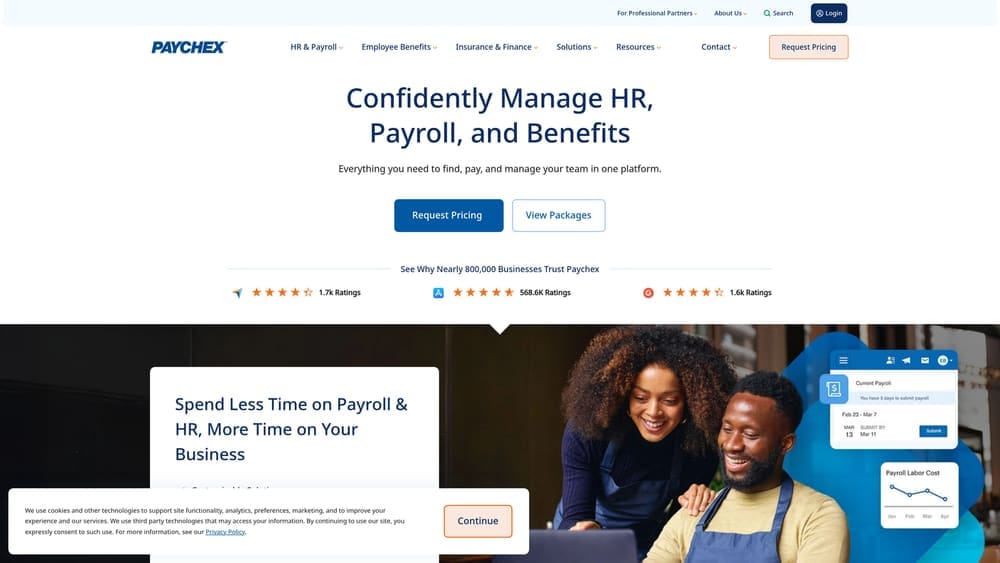
Paychex Flex is a payroll and HR platform that uniquely supports movement between PEO and ASO (administrative services only) service models on the same underlying system.
Where This Tool Shines
One of the real operational risks in hybrid HR is getting locked into a model that’s hard to adjust. Paychex Flex reduces that risk by keeping you on the same platform whether you’re operating under full PEO co-employment or a lighter ASO arrangement where you retain employer-of-record status. That continuity matters because changing HR platforms is expensive and disruptive.
For businesses that are actively evaluating how much PEO coverage they actually need, Paychex Flex gives you room to experiment. You can scale back PEO services without losing the system infrastructure you’ve built, which makes the cost-benefit analysis of different service levels much more practical to act on.
Key Features
PEO-to-ASO Flexibility: Move between co-employment and administrative services only without re-platforming your HR stack.
Scalable Payroll and Benefits Administration: Core HR operations that grow with your business regardless of service model.
Multi-State Compliance Tools: Built-in compliance support for employers with employees across multiple states.
Platform Continuity: Same system, same data, same employee experience across different service configurations.
Best For
Businesses that are actively questioning whether full PEO co-employment is the right long-term model and want the operational flexibility to adjust without a full system migration. Also useful for companies that have outgrown a smaller PEO but aren’t ready to go fully in-house.
Pricing
Custom pricing based on services and headcount. Contact Paychex directly for a quote tailored to your specific service configuration.
8. Lattice
Best for: HR teams that need to own performance, engagement, and career development internally because their PEO doesn’t meaningfully address them
Lattice is a people management platform built around the strategic HR functions that most PEOs either don’t offer or offer in a form that’s too generic to be useful.
Where This Tool Shines
PEOs are strong on compliance and administrative efficiency. They’re typically weak on the strategic people management work that actually drives retention and performance. If your internal HR team is trying to build a real performance culture while your PEO handles the administrative backend, Lattice gives them the tools to do that without cobbling together spreadsheets and manual review processes.
The engagement survey capability is particularly useful in a hybrid model because it gives you direct visibility into how employees feel about their experience, independent of what your PEO is reporting. That data informs decisions about which HR functions are working and which need more internal attention.
Key Features
Performance Review Cycles: Customizable review frameworks that fit your company’s actual culture and cadence.
Engagement Surveys: Pulse and annual surveys with analytics that surface actionable insights rather than just sentiment scores.
OKR and Goal Tracking: Connect individual goals to company objectives with real visibility into progress.
Career Development Planning: Growth frameworks and development conversations that give employees a reason to stay.
Best For
Companies where retention and performance are business-critical priorities that can’t be delegated to a PEO. Particularly valuable for businesses scaling through a growth phase where culture and talent development need dedicated infrastructure.
Pricing
Performance management module starts at $11/person/month. Additional modules available; contact Lattice for full platform pricing.
9. Zapier
Best for: Eliminating the manual data transfers and double-entry that make hybrid HR setups inefficient
Zapier is a no-code workflow automation platform that connects the PEO systems and internal HR tools that don’t natively talk to each other.
Where This Tool Shines
Here’s the unglamorous reality of most hybrid HR setups: someone on the HR team is manually exporting data from the PEO portal and importing it into the internal HRIS every week. New hire information gets entered twice. Termination records get out of sync. Benefits enrollment data lives in three places. Zapier solves this at the operational level by automating the data flows between systems that weren’t built to integrate natively.
The no-code builder matters specifically because HR teams shouldn’t need IT support to set up basic automation. If your team can manage a spreadsheet, they can build a Zapier workflow that eliminates hours of manual work each week.
Key Features
Broad App Connectivity: Connects thousands of applications including major HRIS, payroll, and PEO platforms.
Automated Data Syncing: Keeps employee records consistent between your PEO portal and internal HR systems without manual intervention.
No-Code Workflow Builder: HR teams can build and manage automations without engineering support.
Error Reduction: Eliminates the data entry mistakes that come from manual CSV exports and re-entry across systems.
Best For
Any hybrid HR operation where data lives in more than one system. Practically, that’s almost every business running a PEO alongside internal HR tools. The ROI calculation is straightforward: if your team spends meaningful time on manual data transfers, Zapier pays for itself quickly.
Pricing
Free tier available with limited automations. Paid plans start at $19.99/month. Team and enterprise plans available for higher automation volumes.
Choosing the Right Stack for Your Hybrid Model
No single tool on this list solves hybrid HR optimization on its own. The point is to build a stack where each tool handles a distinct layer of the problem: auditing what your PEO delivers, filling the gaps it leaves, automating the operational friction between systems, and giving your internal HR team the strategic tools to do the work a PEO can’t.
If you’re just starting this process, the sequence matters. Start with the audit. You can’t build an intelligent hybrid model until you know what your current PEO is actually covering and what you’re paying for it. That’s where PEO Metrics does its best work, before you’ve committed to adding or changing anything else.
From there, the decisions branch based on your specific gaps. Distributed international workforce? Deel becomes a priority. Employee experience is suffering because the PEO portal is clunky? BambooHR or Lattice fills that gap depending on whether your focus is operational or strategic. Data living in disconnected systems? Zapier is the fastest fix. Considering whether to reduce your PEO scope over time? Workday Adaptive Planning and Paychex Flex both support that kind of deliberate transition.
The businesses that get the most value from a hybrid model are the ones that treat it as an active operating decision rather than a set-and-forget contract. That means reviewing your PEO service scope at least annually, tracking which services you’re actually using, and being willing to restructure the split when the math stops working.
Before you sign that PEO renewal, make sure you’re not leaving money on the table. Many businesses unknowingly overpay because of bundled fees, hidden administrative markups, and contracts designed to limit flexibility. Don’t auto-renew. Make an informed, confident decision.
