
You sign with a PEO, breathe a sigh of relief, and assume HR is handled. Then six months later, someone gets terminated without proper documentation, a state paid leave deadline slips past, or your employee handbook still references a law that changed two years ago. Nobody’s pointing fingers — both sides genuinely thought the other one had it.
That’s not a PEO failure. That’s an oversight structure failure. And it happens constantly, even in well-run companies with solid PEO partners.
Every PEO relationship creates a layered HR structure where responsibilities are divided between your internal team and the provider. The problem is that most PEO contracts are good at defining what the PEO will do — and much less clear about who’s responsible for monitoring whether it’s actually getting done. That gap is where liability lives.
This article breaks down how oversight actually works across the three layers of a typical PEO arrangement, where accountability tends to collapse, and how to build a structure that keeps things from falling through the cracks. If you’re looking for a broader overview of how PEO service layers are structured, the foundational guide covers that framework — this page goes deeper into the oversight and accountability dimension specifically.
Why Every PEO Relationship Creates an Oversight Problem by Default
The co-employment model is built on a split. The PEO becomes the employer of record for tax and benefits purposes, while you retain control over day-to-day operations. On paper, it sounds clean. In practice, the split is rarely clean at all.
Some HR functions transfer clearly. Payroll processing, tax deposits, workers’ comp administration, benefits enrollment mechanics — these move to the PEO and they own them. You’re not running payroll anymore. That’s real.
But a large portion of HR functions land in ambiguous territory. Performance management, disciplinary processes, culture, compliance monitoring for state-specific laws, employee classification decisions — these don’t transfer neatly. The PEO may offer tools, templates, or advisory support, but ownership isn’t always defined. And when ownership isn’t defined, both parties tend to assume the other one is watching.
This is the structural problem. PEO service agreements are generally written to define scope of service, not oversight accountability. The contract tells you what the PEO will process or administer. It rarely tells you who’s responsible for catching a problem before it becomes a liability. Understanding exactly what a PEO service agreement covers is the first step toward identifying these gaps.
The real-world cost of this ambiguity isn’t abstract. A missed state filing deadline triggers penalties. An outdated handbook creates exposure in a wrongful termination case. A termination handled without proper progressive discipline documentation turns into an unemployment claim dispute or worse. None of these outcomes require bad intent from either party — they just require nobody to be clearly watching.
The IRS recognizes that in a co-employment arrangement, both the PEO and the client company can be held liable for employment tax obligations. That shared liability doesn’t disappear because the contract implies the PEO is handling it. And that principle extends well beyond payroll taxes — it applies to compliance obligations across the board. Businesses working with an IRS certified PEO gain some additional protections here, but the oversight responsibility doesn’t vanish.
What makes this harder is that most business owners come into a PEO relationship with a mental model of “outsourcing.” They expect the PEO to own HR the way an IT vendor owns the server. But that’s not what co-employment is. NAPEO, the National Association of Professional Employer Organizations, is explicit that PEOs provide HR services but do not replace the client’s management responsibilities. The oversight structure doesn’t disappear — it restructures. And if you don’t understand how it restructures, you’re flying blind.
Mapping the Three Oversight Layers in a Typical PEO Arrangement
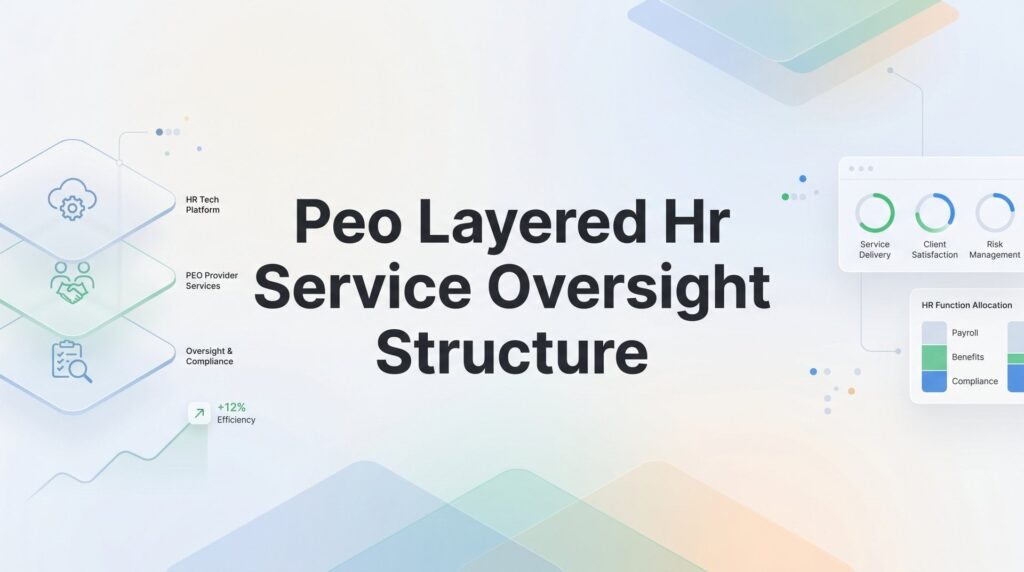
Once you accept that oversight doesn’t transfer wholesale, the next step is getting specific about what goes where. Most PEO arrangements break down into three distinct layers, and each one carries different accountability expectations.
Layer 1: PEO-Owned Oversight
This is the layer where the PEO holds primary accountability and should be self-auditing without you having to ask. Functions here include payroll processing accuracy, federal and state tax deposits, workers’ compensation policy administration, benefits enrollment mechanics, and ACA reporting compliance.
For these functions, your job is to receive reporting and verify it, not to manage the process. A good PEO will have defined SLAs, reporting cadences, and audit trails for everything in this layer. If yours doesn’t, that’s a gap worth addressing directly.
The mistake businesses make here is assuming that because the PEO owns it, they don’t need to look at it. You still need to review payroll registers, verify tax deposit confirmations, and check benefits enrollment accuracy. Owning a function and executing it flawlessly are two different things. For a deeper look at what’s typically included in that payroll layer, this breakdown of PEO payroll services is worth reviewing.
Layer 2: Shared Oversight
This is the messy middle, and it’s where most failures happen. Shared oversight covers functions where both parties have real skin in the game but neither side has been designated the clear owner.
State employment law compliance is the most common example. FMLA tracking, OSHA recordkeeping, employee classification decisions, leave management, and state-specific pay transparency or sick leave laws all live here. The PEO may have tools to support compliance, but if nobody’s explicitly monitoring whether those tools are being applied correctly for your specific state footprint and workforce, the gap is open.
The reason this layer is so dangerous is precisely because it feels covered. You’re paying a PEO that has a compliance team. Surely they’re watching this. But “having a compliance team” and “actively monitoring your specific state and industry obligations” are different things. Many PEOs operate at a federal baseline and rely on clients to flag state-specific issues — which only works if the client knows what to flag.
Layer 3: Client-Retained Oversight
This layer covers functions the PEO explicitly does not own, even if they offer advisory support. Hiring decisions, performance reviews, disciplinary actions, termination calls, workplace culture, strategic workforce planning — these stay with you. Full stop.
The problem is that business owners often mistake PEO advisory support in these areas for PEO ownership. The PEO might provide a termination checklist. That doesn’t mean they’re responsible for ensuring the termination was properly documented or legally defensible. You are.
Getting clear on which layer each function belongs to is the foundation of a functional oversight structure. Without that map, you’re operating on assumptions — and assumptions are expensive.
Where Shared Oversight Breaks Down
Layer 2 deserves its own deeper look because it’s where liability tends to accumulate quietly over time. The failures aren’t usually dramatic. They’re slow drift.
State-specific leave law compliance is one of the most common breakdown points. Most PEOs handle FMLA competently — it’s federal, it’s well-defined, and they’ve built processes around it. But state paid leave mandates are a different story. These laws vary significantly by state, update frequently, and require specific notice, tracking, and coordination requirements that go beyond federal baseline. Understanding what falls under PEO HR compliance services versus what remains your responsibility is critical for managing this layer.
If your PEO isn’t particularly strong in your specific state footprint, there’s a real chance they’re providing general guidance while newer state-level requirements go unmonitored. You won’t know until an employee files a complaint or a state agency sends a notice.
Employee classification is another Layer 2 landmine. The PEO processes payroll for the workers you designate as employees or contractors. But the decision about how to classify someone is yours. And misclassification liability — the back taxes, penalties, and potential wage claims that come with it — typically lands on the client company, not the PEO. If nobody’s periodically reviewing your contractor population against current IRS and state classification standards, that exposure is growing.
The employee handbook situation is subtler but worth calling out directly. Many PEOs provide handbook templates as part of their service package. That sounds like a value-add, and it often is. But a template built around federal requirements and generic best practices is not the same as a handbook customized for your state, your industry, and your specific policies. A comprehensive PEO services overview can help you understand where template-based deliverables end and true customized compliance begins.
The common thread across all of these: the PEO provided a service that looked like coverage, but the monitoring of whether that service remained accurate, current, and applicable to your situation defaulted back to you — without anyone explicitly saying so.
Building an Oversight Accountability Map Before You Sign
The best time to solve this problem is before the contract is signed. The second-best time is right now, if you’re already in a PEO relationship and haven’t done this work.
A simple RACI-style responsibility matrix is the most practical tool here. For every significant HR function, you want to define who’s Responsible (doing the work), Accountable (owns the outcome), Consulted (needs to be looped in), and Informed (receives updates). You don’t need a formal project management framework — you just need clarity on who owns what and who’s watching.
Start by listing every HR function that matters to your business: payroll processing, tax deposits, benefits administration, FMLA tracking, state leave compliance, I-9 management, OSHA recordkeeping, employee classification review, handbook maintenance, unemployment claims, workers’ comp claims, termination documentation, performance review processes. Then assign each one to a layer and define the accountability structure.
During PEO evaluation, the questions you ask will tell you a lot about provider quality. Push for specific answers, not general reassurances:
Who monitors state law changes for my specific locations? A strong PEO will name a process, a team, and a cadence. A weak one will say “our compliance team stays on top of that.”
Who updates the employee handbook, and how often? If the answer is “we provide a template and you customize it,” that’s fine — but you need to know that going in, not after a compliance issue surfaces.
Who handles I-9 compliance audits? I-9 errors are a common audit finding and the liability is yours. If the PEO doesn’t have a defined process for periodic I-9 audits, you need one internally.
Who disputes unemployment claims on our behalf? This one gets overlooked constantly. If the PEO handles it, what’s the process? What documentation do they need from you? Who coordinates the response?
Vague answers to these questions aren’t a personality flaw — they’re a signal about how the provider thinks about accountability. Strong PEOs have defined answers because they’ve built processes around them. If you need a structured approach to vetting providers, this guide on how to evaluate and select a certified PEO walks through the decision framework in detail.
This exercise also serves as a quality differentiator during PEO selection. Providers who can walk you through their SLAs, escalation paths, and reporting cadences for each oversight layer are demonstrating operational maturity. That’s worth paying attention to.
Keeping the Oversight Layers From Drifting Over Time
Even if you build a solid accountability map at the start, oversight structures drift. People change on both sides, service delivery evolves, and the day-to-day grind makes it easy to assume things are running smoothly until they’re not.
A quarterly oversight audit is the most practical counter to this. It doesn’t have to be exhaustive — a focused review of what the PEO is actually delivering against what the contract promises, with particular attention to Layer 2 functions. Pull the compliance reports. Review the handbook update log. Check whether state law changes from the past quarter have been addressed. Verify that unemployment claims are being handled and documented properly.
Most companies set-and-forget after PEO onboarding. The problems surface during a DOL audit, an employee lawsuit, or an unemployment hearing — not during a quiet Tuesday afternoon. By then, the gap has been open for months or years.
The single highest-ROI move for companies under 150 employees is assigning an internal HR point person specifically to own the PEO relationship and monitor the shared-oversight layer. This doesn’t have to be a full-time role. A fractional HR professional or even a senior operations manager with defined responsibilities can fill this function. For practical guidance on structuring that internal role alongside your PEO, this integration guide on using a PEO with internal HR covers the coordination model in depth.
This person’s job isn’t to duplicate what the PEO does. It’s to maintain the oversight map, ask the right questions during quarterly reviews, and escalate when something looks off. That’s a few hours a month, not a full headcount addition.
When oversight drift becomes persistent, it’s worth asking harder questions. Not every gap means the PEO is bad — sometimes it’s a communication issue, a scope misunderstanding, or a function that needs to be explicitly added to the service agreement. But if you’re consistently finding Layer 2 failures despite raising them, that’s a legitimate signal to renegotiate, consider switching providers, or evaluate whether certain functions should come back in-house. If you reach that point, having a clear PEO exit and cancellation plan ensures you don’t create new gaps during the transition.
The PEO model works best when both parties are operating with clear accountability. When one side is perpetually filling the other’s gaps, the economics and the risk profile of the relationship start to look different. That’s a real conversation worth having, and it’s better to have it proactively than after something goes wrong.
The Bottom Line on Oversight
A PEO doesn’t eliminate your HR oversight responsibilities. It restructures them. The companies that get real value from PEO relationships are the ones who understand exactly which layer each function lives in, who’s accountable for monitoring it, and how they’ll know when something slips.
The ones who struggle are the ones who signed a contract assuming “HR is handled” and never built the oversight structure to match the complexity of co-employment.
Getting this right isn’t complicated, but it does require intentionality. Map the layers. Define accountability before you sign. Assign an internal owner for the shared layer. Run quarterly audits. Ask hard questions when answers are vague.
And when you’re evaluating PEO providers, pay close attention to how they talk about oversight. Do they have defined processes, SLAs, and reporting cadences? Or do they give you reassuring generalities about dedicated support teams? That difference tells you a lot about what your oversight structure will actually look like in practice.
Before you sign that PEO renewal, make sure you’re not leaving money on the table. Many businesses unknowingly overpay because of bundled fees, hidden administrative markups, and contracts designed to limit flexibility. PEO Metrics gives you a clear, side-by-side breakdown of pricing, services, and contract terms so you can see exactly what you’re paying for and choose the option that truly fits your business. Don’t auto-renew. Make an informed, confident decision.
