
You’ve collected three PEO proposals. One charges $149 per employee per month and calls it “comprehensive.” Another quotes $89 PEPM but lists a dozen add-on fees. The third offers “full-service HR” at $195 PEPM with no itemization at all.
Which one is actually the better deal? Without understanding how PEOs layer their services, you’re comparing three different languages with no translation guide.
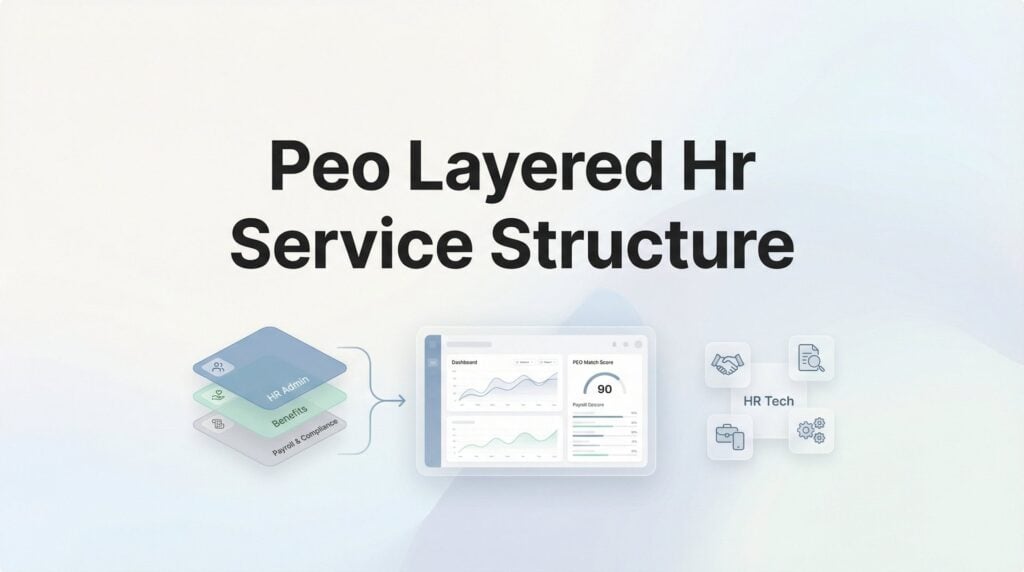
Every PEO organizes services into tiers—foundation, compliance, benefits, strategic HR—but they package and price these layers differently. One provider bundles everything into a flat rate. Another charges separately for each layer. A third includes some layers in the base price but hides others in percentage markups or administrative fees.
This isn’t accidental. The layered structure gives PEOs flexibility to appear competitive while protecting margins. Understanding how these layers work transforms PEO evaluation from guessing games into informed purchasing decisions.
The Foundation Layer: What Every PEO Must Provide
This is the non-negotiable core. Payroll processing, tax filing, and the co-employment relationship that makes everything else legally possible.
Every PEO handles payroll—running checks, direct deposits, managing deductions. They file your federal, state, and local payroll taxes under their EIN. They become the employer of record for tax purposes, which means they’re on the hook if something goes wrong with tax compliance.
This layer is essentially commoditized. The basic functions don’t vary much between providers. What does vary is the technology platform, integration capabilities, and reporting depth.
A basic PEO might give you payroll processing with standard reports. A more sophisticated platform offers real-time labor cost tracking, job costing integration, custom approval workflows, and API connections to your accounting system. Those differences matter operationally, but they don’t change the fundamental service.
Here’s where pricing gets interesting. Some PEOs price this layer separately—$40 to $60 PEPM for payroll and tax administration. Others bundle it into a minimum fee structure where you can’t isolate what you’re paying for foundation services versus everything else.
The bundled approach sounds simpler until you realize you’re paying for payroll capabilities you don’t use. If you run payroll weekly but the platform supports daily processing, multi-state tax filing, and complex union reporting—you’re subsidizing features that don’t benefit your business.
Separate pricing gives you visibility. Bundled pricing gives the PEO margin protection.
Technology platform quality matters more than most businesses realize upfront. A clunky payroll system means your team spends extra hours on manual workarounds. Poor integration means duplicate data entry between payroll and accounting. Limited reporting means you can’t analyze labor costs by department, project, or location.
When you’re comparing foundation layer costs, ask what the platform actually does beyond basic payroll. Can employees access pay stubs and W-2s through a mobile app? Does the system handle tip reporting, commission tracking, or piece-rate calculations if your business needs those? How long does it take to add a new hire or process an off-cycle check?
The foundation layer is where PEOs make their money on volume. Processing payroll for 50 employees costs them roughly the same as processing for 500, so their per-employee margin improves as you grow. This is also why negotiation leverage at this layer is limited—PEOs have minimum profitability thresholds they won’t cross.
What you can negotiate: reporting customization, integration support, and implementation timelines. What you can’t negotiate much: the base PEPM rate for standard payroll and tax filing.
The Compliance Layer: Where Variability Lives
This is where PEO proposals start diverging significantly. The compliance layer includes workers’ comp administration, unemployment claims management, OSHA compliance support, and HR regulatory guidance.
Every PEO says they handle compliance, but what that actually means varies dramatically based on your industry, state footprint, and risk profile.
Workers’ comp is the biggest variable. PEOs obtain a master workers’ comp policy and add your employees to it. You pay a rate based on your industry classification codes, but that rate gets modified by your claims experience. A construction company with a clean safety record might pay less through a PEO than they would independently. A company with frequent claims might pay significantly more.
Here’s the part most proposals don’t make clear: your workers’ comp cost through a PEO includes the actual insurance premium plus administrative fees plus potential experience modifiers. Some PEOs disclose these components separately. Others present a blended rate that makes it impossible to see what you’re actually paying for insurance versus administration.
Unemployment claims management sounds straightforward until you’re dealing with it. When a former employee files for unemployment, someone has to respond to the state agency, provide documentation, and potentially attend hearings. PEOs handle this, but the quality of that handling varies.
A basic PEO might provide form letters and generic guidance. A strong PEO actively contests questionable claims, maintains detailed documentation, and helps you reduce your unemployment tax rate over time by winning cases. The difference shows up in your state unemployment insurance rate, which can vary by several percentage points.
OSHA compliance support ranges from “we’ll send you a poster” to “we’ll conduct site audits and help you develop safety programs.” If you’re in a high-risk industry, this distinction matters. If you’re an office-based service business, you probably don’t need extensive OSHA support regardless of what the PEO includes.
HR regulatory guidance is the vaguest component. Every PEO claims they keep you compliant with employment law. What does that mean practically?
Some PEOs provide access to a compliance hotline where you can ask questions. Others assign a compliance specialist who proactively alerts you to regulatory changes affecting your business. The best PEOs audit your policies annually and help you update handbooks, classification decisions, and leave administration practices. Understanding what’s actually covered requires examining PEO HR compliance services in detail.
The compliance layer has hidden cost drivers most businesses don’t anticipate. Your claims experience affects workers’ comp rates. Your turnover affects unemployment insurance costs. Your industry and growth trajectory affect how much compliance support you actually need.
A restaurant group expanding into new states needs robust multi-state compliance guidance. A stable 30-person software company probably needs minimal ongoing compliance support beyond annual policy reviews.
This is where PEO proposals often include risk surcharges that aren’t obvious upfront. If your industry has higher-than-average workers’ comp claims, you’ll pay more. If you operate in states with complex employment regulations, you might trigger additional compliance fees. If your employee count crosses certain thresholds, you may suddenly face new regulatory requirements that increase costs.
When evaluating the compliance layer, map what’s included against what you actually need. Don’t pay for multi-state compliance expertise if you only operate in one state. Don’t pay for extensive safety program development if you’re a low-risk office environment.
The Benefits Layer: Where Buying Power Gets Complex
PEOs market benefits access as a primary value proposition. Join our master health plan and get Fortune 500 benefits at small business prices. Sounds compelling until you examine how benefits are actually structured and priced.
PEOs approach benefits in two ways: master health plans or broker arrangements.
Master health plans mean the PEO negotiates directly with insurance carriers on behalf of all their client companies. Your employees join a large risk pool, which theoretically gives you better rates than you could negotiate independently. The PEO administers enrollment, manages carrier relationships, and handles claims issues.
Broker arrangements mean the PEO partners with insurance brokers who present multiple carrier options. You’re still accessing group rates, but you have more choice in plan design and carrier selection. The PEO handles administration but doesn’t own the carrier relationship.
Neither approach guarantees savings. Your actual benefits cost depends on your employee demographics, claims history, and geographic location. A young, healthy workforce in a competitive insurance market might get better rates independently than through a PEO’s master plan. An older workforce with chronic conditions might benefit from the PEO’s risk pooling.
Here’s what gets buried in benefits pricing: administrative fees. PEOs charge for benefits administration in several ways.
Per-employee-per-month (PEPM) fees are the most transparent. You pay a flat monthly charge for each employee enrolled in benefits—typically $8 to $25 PEPM depending on the complexity of plan administration.
Percentage markups are less visible. The PEO adds a percentage to your insurance premiums—usually 3% to 8%—as their administrative fee. On a $500,000 annual benefits spend, a 5% markup costs you $25,000 that doesn’t show up as a separate line item.
Renewal timing affects your costs in ways most businesses don’t anticipate. PEOs typically renew benefits on their own schedule, not yours. If you join a PEO mid-year, you might get stuck with their current plan until the next renewal cycle, even if it’s more expensive than your previous coverage.
Ancillary benefits—dental, vision, life insurance, disability, 401(k)—are usually structured as add-ons. Some PEOs bundle these into premium service packages. Others price them separately, giving you flexibility to choose what you actually want.
The 401(k) component deserves specific attention. PEOs typically partner with retirement plan providers and offer access to their platform. You’ll pay plan administration fees, recordkeeping fees, and often investment management fees. These costs can be higher than what you’d pay working directly with a 401(k) provider, especially if you have significant plan assets.
When evaluating the benefits layer, get clear answers on administrative fee structures. Ask whether benefits pricing is locked in or subject to annual increases beyond normal premium inflation. Understand what happens if you want to change carriers or plan designs mid-contract.
The benefits layer is where many businesses discover they’re paying for convenience they don’t value. If you have a strong internal HR person who can manage benefits administration, you might not need the PEO’s full benefits platform. If you already have competitive benefits through an existing broker relationship, the PEO’s offering might not improve your position.
The Strategic HR Layer: Where Premium Pricing Lives
This is the top tier where PEOs differentiate themselves and justify premium pricing. Strategic HR services include dedicated HR business partners, custom policy development, performance management systems, employee training platforms, and organizational development consulting.
In theory, this layer gives small businesses access to HR expertise they couldn’t afford to hire internally. A dedicated HR business partner who knows your company, understands your industry, and provides proactive guidance on people management challenges.
In practice, service quality at this layer varies more than any other. What “dedicated support” actually means differs dramatically between PEOs.
Some PEOs assign you a named HR business partner who’s available by phone and email during business hours. Others provide access to a shared team where you might talk to different people each time you call. The best PEOs give you a dedicated partner who conducts quarterly business reviews, proactively identifies HR risks, and helps you develop people strategies aligned with business goals.
Custom policy development sounds valuable until you realize many PEOs use template handbooks with minimal customization. You get a legally compliant employee handbook, but it reads like every other company’s handbook and doesn’t reflect your actual culture or operational needs.
Performance management systems and employee training platforms are increasingly common in premium PEO packages. You get access to software for goal setting, performance reviews, and online training courses. The question is whether you’ll actually use these tools or whether they’re shelfware that makes the proposal look comprehensive.
Here’s the catch with strategic HR services: they often come with usage limits or response time caveats buried in the service agreement. “Unlimited HR support” might mean unlimited questions but not unlimited project work. “Dedicated business partner” might mean dedicated to 20 other clients with response times measured in days, not hours.
When does paying for this layer make sense? If you’re a growing company and don’t have internal HR expertise, strategic HR services provide real value. If you’re dealing with complex people issues—restructuring, performance management, compensation design—having experienced HR support prevents expensive mistakes.
When doesn’t it make sense? If you have a strong internal HR manager, you’re paying for redundant services. If your people management needs are straightforward—hiring occasionally, managing basic benefits, handling routine questions—you don’t need strategic consulting.
The strategic HR layer is where PEOs make their highest margins. These services are labor-intensive for them to deliver but scale poorly, so they charge premium rates. It’s also the layer where marketing promises most often exceed actual delivery.
Before paying for premium HR services, talk to current clients about their actual experience. How responsive is the HR business partner? How often do they proactively reach out versus just responding to requests? What happens when you need help outside normal business hours?
Reading Any Proposal Through the Layered Lens
Now that you understand the four layers, you can decode any PEO proposal regardless of how they package and price their services.
Start by mapping their offering to these layers. What sits in their base package? What’s optional? What’s not mentioned at all?
A proposal that bundles everything into one PEPM rate is hiding the actual cost allocation across layers. You can’t see whether you’re paying $40 for foundation services and $110 for strategic HR you won’t use, or $90 for foundation and compliance with minimal strategic support.
A proposal that itemizes each layer separately gives you visibility but might look more expensive than a bundled competitor—even if the total cost is the same.
PEOs use three common packaging strategies: good-better-best tiers, modular pricing, and all-inclusive flat rates.
Good-better-best tiers (Bronze/Silver/Gold or Essential/Professional/Enterprise) give you choices but often create decision paralysis. The entry tier usually lacks something important, pushing you toward the middle tier. The top tier includes services most businesses don’t need, but the pricing makes the middle option look like the smart compromise.
Modular pricing lets you select specific services across layers. You might choose foundation and compliance services but decline strategic HR support. This approach maximizes flexibility but requires you to understand exactly what you need—and PEO salespeople aren’t incentivized to help you buy less.
All-inclusive flat rates promise simplicity: one price, everything included. The risk is paying for services you don’t use and having no flexibility to adjust as your needs change.
Negotiation leverage varies by layer. Foundation services are largely fixed—PEOs have minimum margins they won’t compromise. Compliance services have some flexibility depending on your risk profile. Benefits administration fees are negotiable, especially if you’re bringing a large employee base. Strategic HR services have the most negotiation room because delivery costs vary and PEOs want to close deals. A comprehensive PEO contract negotiation guide can help you identify where to push.
What’s actually negotiable in most PEO contracts: implementation fees, contract length commitments, administrative fee percentages on benefits, and access levels for strategic HR services. What’s rarely negotiable: base payroll processing rates, workers’ comp insurance costs, and health insurance premiums.
When comparing proposals, create a simple matrix. List the four layers down the left side. For each PEO, note what’s included, what’s optional, and what’s missing. Assign approximate costs to each layer based on their pricing structure. This exercise reveals whether proposals are genuinely comparable or whether you’re looking at different service models entirely.
When Layered Structures Work Against You
The layered model creates value when you need services across multiple tiers and benefit from integrated delivery. It creates waste when you’re paying for layers you don’t need or could source better independently.
Common waste scenarios: paying for compliance services you already handle internally, benefits you can source cheaper through an independent broker, or strategic HR consulting you’ll never actually use.
If you have an experienced HR manager on staff, you’re duplicating strategic HR services by paying a PEO for the same expertise. Your internal person handles policy development, employee relations, and performance management. The PEO’s strategic HR layer becomes expensive redundancy. Understanding how to balance these roles requires knowing how to use a PEO alongside your internal HR department.
If you already have strong broker relationships and competitive benefits, moving to a PEO’s benefits platform might increase costs rather than reduce them. You lose your existing carrier relationships and potentially face higher administrative fees through the PEO’s structure.
If your compliance needs are minimal—stable workforce, single state, low-risk industry—you’re subsidizing compliance infrastructure you don’t require. A basic payroll provider with standard compliance support might serve you better at lower cost.
Service overlap with existing vendors is common but rarely addressed in PEO sales conversations. You might already have workers’ comp insurance through an independent agent, payroll through a dedicated provider, and HR support through a consulting relationship. Switching to a PEO means terminating those relationships and potentially paying exit fees or losing favorable terms you’ve negotiated.
The deeper you integrate with a PEO’s layered services, the harder it becomes to leave. If they handle your workers’ comp, health insurance, 401(k), and HR policies, unwinding that relationship takes months and creates operational risk. You’re locked in not by contract terms but by practical switching costs. Before committing, understand the full PEO exit and cancellation process.
This is why maintaining flexibility matters. If you’re uncertain whether you need all layers, start with foundation and compliance services. Add benefits and strategic HR later if you discover genuine need. Most PEOs resist this approach because they make better margins on fully bundled relationships, but it protects you from paying for services you won’t use.
Making Structure Work for Your Business
Understanding layered service structures transforms PEO evaluation from comparing marketing promises to analyzing actual value delivery at each tier.
The right structure depends on what your company genuinely needs, not what sounds impressive in a sales presentation. A 15-person software company with minimal compliance complexity doesn’t need the same service layers as a 100-person manufacturing operation with multi-state workers’ comp exposure.
Before engaging with PEO providers, map your current HR spend and pain points to these four layers. Where are you spending money today? Where are you experiencing operational problems? What capabilities do you lack internally?
If your biggest pain point is payroll errors and tax filing mistakes, focus on foundation layer quality. If you’re struggling with workers’ comp claims and unemployment costs, prioritize compliance layer expertise. If benefits are eating your budget, examine whether a PEO’s pooled buying power actually improves your position.
Don’t let PEOs sell you layers you don’t need. The bundled “comprehensive solution” that includes everything might be comprehensive waste if you only need half the services. Push for modular pricing that lets you select specific layers. If the PEO won’t unbundle, that tells you something about their business model and flexibility.
The layered structure isn’t inherently good or bad. It’s a framework that helps you see what you’re actually buying and whether it aligns with what you actually need. Use it to cut through sales language and evaluate proposals based on substance rather than packaging.
Before you sign that PEO renewal, make sure you’re not leaving money on the table.
Many businesses unknowingly overpay because of bundled fees, hidden administrative markups, and contracts designed to limit flexibility. We give you a clear, side-by-side breakdown of pricing, services, and contract terms—so you can see exactly what you’re paying for and choose the option that truly fits your business.
