
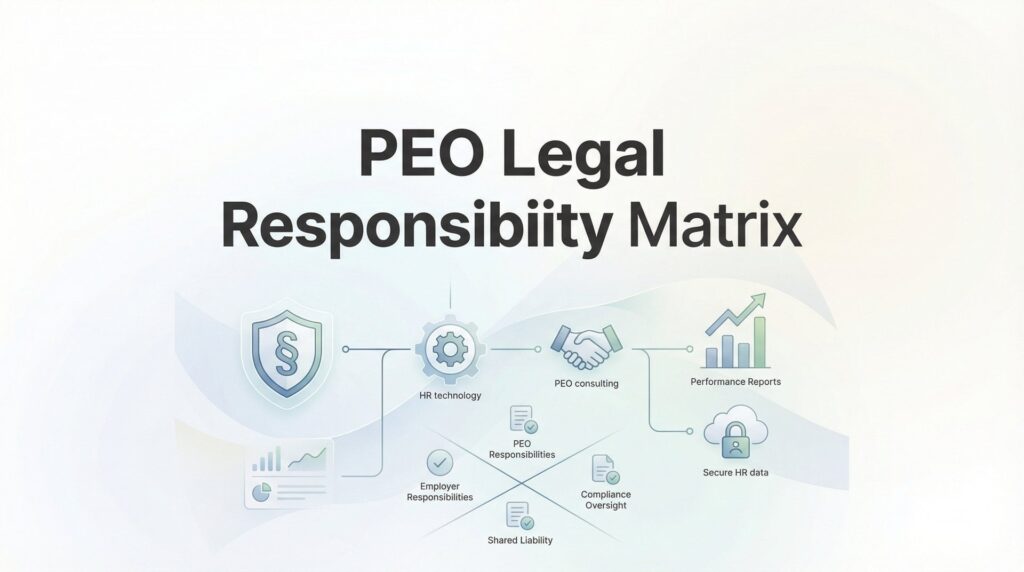
When you enter a co-employment relationship, the question “who’s legally responsible for what?” becomes surprisingly murky. A PEO legal responsibility matrix maps out exactly which party—you, the PEO, or both jointly—owns each employment obligation. Without this clarity, you risk assuming the PEO handles something they don’t, or duplicating efforts on tasks they’ve already covered.
The stakes are real. Most businesses discover responsibility gaps only after an incident occurs—a wrongful termination claim where both parties thought the other was handling documentation, or a workplace injury where neither party filed the required reports because each assumed the other would.
This guide walks through practical strategies for building and maintaining a responsibility matrix that actually protects your business. We’ll focus on the real decision points: where liability splits get complicated, how to document gray areas, and what to negotiate before signing. Think of this as creating a shared operating manual for your co-employment relationship—one that prevents expensive surprises down the road.
The most overlooked part? Making sure your contract’s indemnification clauses actually back up the responsibility assignments you’ve agreed to. A matrix is only as good as the financial protections behind it.
1. Map the Three Responsibility Categories Before Anything Else
The Challenge It Solves
Most PEO relationships start with vague understandings about “shared employment responsibilities” without defining what that actually means. You’ll hear phrases like “we handle HR” or “you retain control of your workforce,” but these generalities fall apart when specific situations arise. Who decides if an employee qualifies for FMLA? Who’s responsible if payroll taxes get filed incorrectly? Without a clear categorization system, every incident becomes a negotiation about whose problem it is.
The Strategy Explained
Start by creating three distinct buckets: exclusive client responsibilities, exclusive PEO responsibilities, and joint responsibilities. This framework forces clarity before you need it. Exclusive client responsibilities typically include hiring decisions, daily work direction, performance management, and core business operations. Exclusive PEO responsibilities generally cover payroll tax filing, benefits carrier relationships, workers’ compensation claims processing, and compliance reporting. Joint responsibilities—the tricky category—include termination decisions, workplace safety programs, harassment prevention, and regulatory compliance oversight.
The key is being exhaustive. Don’t just list the obvious items. Include edge cases like who handles unemployment claims responses, who maintains personnel files, who responds to EEOC charges, and who manages background check compliance. Every employment-related task should land in one of these three categories. Understanding the co-employment legal structure helps clarify how these responsibilities typically divide.
Implementation Steps
1. Create a spreadsheet with three columns labeled “Client Only,” “PEO Only,” and “Joint Responsibility.”
2. List every employment-related function you can think of, starting with payroll, benefits, compliance, safety, hiring, termination, and employee relations.
3. Assign each function to a column based on your PEO contract language and initial discussions with your account team.
4. Flag any item where the assignment feels unclear or where your contract doesn’t explicitly address it—these become negotiation points.
Pro Tips
Don’t assume standard industry practices apply to your specific contract. Two PEOs might handle the same responsibility completely differently. When you find items that don’t fit cleanly into one category, that’s a signal you need more specific contract language, not a reason to force it into a bucket. Document those ambiguities separately and address them in your contract review.
2. Audit Your Contract’s Responsibility Language Line by Line
The Challenge It Solves
PEO contracts are often written with intentionally vague language that protects the PEO while leaving clients exposed. Phrases like “PEO will assist with compliance” or “Client retains ultimate authority” sound clear until you need to determine who’s actually on the hook when something goes wrong. This ambiguity works in the PEO’s favor during disputes, leaving you holding liability you thought you’d transferred.
The Strategy Explained
Read your contract as if you’re looking for loopholes—because that’s exactly what you need to find and close. Pay special attention to sections covering compliance obligations, termination procedures, workplace safety, and discrimination prevention. Look for words like “assist,” “support,” “coordinate,” or “advise”—these are red flags indicating shared responsibility without clear ownership.
When you find vague language, request a clarification addendum that explicitly states who performs which actions and who bears legal responsibility if those actions aren’t performed correctly. For example, if the contract says the PEO “assists with workers’ compensation claims,” the addendum should specify whether that means they file all required reports, or just provide you with forms to file yourself. A thorough service agreement legal review catches these issues before they become problems.
Implementation Steps
1. Highlight every section of your contract that mentions responsibilities, obligations, or duties related to employment matters.
2. For each highlighted section, write down in plain language what you think it means in practice—who does what, by when, and what happens if it’s not done.
3. Send your interpretations to your PEO contact and ask for written confirmation that your understanding is correct.
4. Where your PEO’s response differs from your interpretation, negotiate specific language changes or request a signed addendum that clarifies the responsibility assignment.
Pro Tips
Pay particular attention to indemnification clauses—these determine who pays when legal issues arise. If a clause says the PEO indemnifies you for “matters within PEO’s control,” make sure there’s a clear definition elsewhere in the contract of what falls within their control. Generic indemnification language often collapses under pressure because neither party can prove who was supposed to handle what.
3. Build State-Specific Compliance Overlays
The Challenge It Solves
Co-employment liability varies significantly by state, but most PEO contracts use standardized national language that doesn’t account for jurisdictional differences. California’s joint employer standards impose different obligations than Texas or Florida. If you operate in multiple states, your responsibility matrix needs to reflect these variations—otherwise you’re building a compliance framework on assumptions that don’t match your actual legal exposure.
The Strategy Explained
Layer state-specific requirements onto your base responsibility matrix. Start by identifying which states you have employees in, then research how each state treats co-employment relationships. Some states hold PEOs and clients jointly liable for certain violations regardless of contract language. Others allow more flexibility in allocating responsibilities. California, for instance, has specific rules about who can be considered the employer of record for different purposes.
This isn’t about becoming a compliance expert—it’s about knowing where your contract’s responsibility assignments might conflict with state law. When they do conflict, state law typically wins, meaning your matrix needs to reflect reality, not just what your contract says. Companies with distributed workforces should review strategies for PEOs handling multi-state compliance.
Implementation Steps
1. List every state where you have employees, including states where you might expand in the next 12 months.
2. For each state, identify key employment law areas where co-employment creates specific obligations: workers’ compensation, unemployment insurance, wage and hour rules, and discrimination laws.
3. Add a “State-Specific Notes” column to your responsibility matrix and document where state law imposes joint liability or assigns responsibility differently than your contract suggests.
4. Schedule a review with an employment attorney in your highest-headcount states to validate your understanding and identify gaps.
Pro Tips
Don’t wait until you’re expanding to a new state to understand its co-employment rules. Build the state overlay into your decision-making process before you hire there. Some PEOs have stronger compliance infrastructure in certain states than others—if you’re planning to grow significantly in California or New York, make sure your PEO’s responsibility assignments in those states actually match their operational capabilities.
4. Create a Termination Decision Tree
The Challenge It Solves
Termination decisions represent the highest-risk area in co-employment relationships. Most wrongful termination claims hinge on who made the decision, what documentation existed, and whether proper procedures were followed. When both you and your PEO have a role in terminations, the lines of responsibility get blurry fast. Did the PEO approve the termination, or just process the paperwork? Who’s responsible if required notices weren’t given? This ambiguity creates legal exposure for both parties.
The Strategy Explained
Build a detailed decision tree that maps out every step of the termination process and assigns clear ownership at each stage. Start with the decision to terminate—typically the client’s exclusive right—then move through documentation requirements, legal review, notice periods, final pay calculations, benefits termination, and post-termination obligations like COBRA administration and unemployment claim responses.
The tree should answer specific questions: Who reviews the employee’s file before termination? Who confirms compliance with any employment agreements or state-specific requirements? Who conducts the termination meeting? Who calculates final pay and ensures it’s delivered on time? Who handles the benefits cutoff and COBRA notices? Understanding how a PEO reduces legal exposure helps frame why this documentation matters.
Implementation Steps
1. Map out your current termination process from the moment you decide to terminate through 30 days post-termination.
2. At each step, assign responsibility to either you, your PEO, or both (with clear roles for joint steps).
3. Identify decision points where legal review is required and specify who conducts that review—your PEO’s HR team, your employment attorney, or both.
4. Document timing requirements for each step, especially final pay deadlines and notice periods that vary by state.
5. Create a simple checklist based on your decision tree that you can follow for every termination to ensure nothing falls through the cracks.
Pro Tips
Test your decision tree with a few hypothetical scenarios: terminating someone on FMLA leave, firing for cause versus layoffs, and handling resignations that might be constructive discharge. If your tree doesn’t clearly show who’s responsible at each step in these complex situations, you’ve found gaps that need addressing before a real termination occurs.
5. Document the ‘Gray Zone’ Responsibilities Explicitly
The Challenge It Solves
Certain employment responsibilities don’t fit cleanly into “you handle it” or “PEO handles it” categories. FMLA administration, ADA accommodation requests, harassment investigations, and workplace safety programs typically require coordination between both parties. These gray zones create the most confusion and risk because when something goes wrong, both parties can credibly claim the other was supposed to handle it. Without explicit documentation, you’re setting up finger-pointing when you can least afford it.
The Strategy Explained
For every gray zone responsibility, assign both a primary owner and a support role. The primary owner has ultimate accountability for ensuring the task gets done correctly and on time. The support role provides specific, defined assistance. For example, with FMLA administration, the PEO might be primary owner—they track leave time, send required notices, and maintain documentation—while you’re in a support role providing information about the employee’s schedule and job duties.
The key is being specific about what each role entails. “PEO handles FMLA” isn’t enough. Instead: “PEO receives all FMLA requests, determines eligibility, sends required notices, tracks leave usage, and maintains the FMLA file. Client provides job descriptions, reports attendance, and coordinates return-to-work logistics.” Review the legal obligations you still own as a PEO client to ensure nothing falls through the cracks.
Implementation Steps
1. Identify your top gray zone areas: FMLA, ADA accommodations, harassment/discrimination complaints, workplace safety, wage and hour compliance, and background check procedures.
2. For each area, break down the responsibility into specific tasks rather than treating it as a single bucket.
3. Assign primary and support roles for each task, being explicit about what “support” means—providing information, reviewing decisions, or something else.
4. Document communication protocols: How does information flow between you and your PEO? Who initiates? What’s the expected response time?
Pro Tips
The most common mistake is assuming “joint responsibility” means both parties do everything together. That’s a recipe for duplication and gaps. Instead, joint responsibility should mean coordinated handoffs with clear ownership at each stage. When documenting gray zones, focus on the handoff points—where does the baton pass from you to the PEO or vice versa? Those transitions are where things typically break down.
6. Establish Quarterly Responsibility Reviews
The Challenge It Solves
Your responsibility matrix isn’t static. Laws change, your business grows, new compliance requirements emerge, and incidents reveal gaps you didn’t anticipate. If you build your matrix once and never revisit it, you’ll discover it’s outdated exactly when you need it most—during an audit, investigation, or lawsuit. Regular reviews keep your matrix aligned with reality and give you a structured opportunity to address emerging issues before they become problems.
The Strategy Explained
Schedule quarterly reviews of your responsibility matrix with your PEO account team. These aren’t casual check-ins—they’re structured sessions with a specific agenda. Review any incidents that occurred since the last meeting where responsibility was unclear. Discuss upcoming regulatory changes that might shift obligations. Update the matrix to reflect any business changes like new locations, new employee classifications, or new service offerings that create different compliance requirements.
Use these reviews to test your matrix against real scenarios. Walk through a recent termination, a workers’ compensation claim, or a benefits enrollment issue and verify that what actually happened matches what your matrix says should happen. When you find discrepancies, that’s your signal to update either your matrix or your actual practices. Following legal oversight best practices ensures these reviews stay productive.
Implementation Steps
1. Schedule recurring quarterly meetings with your primary PEO contact and anyone on your team who handles HR or compliance matters.
2. Create a standard agenda: review incidents since last meeting, discuss regulatory updates, confirm any business changes affecting employment, and test the matrix against recent real-world scenarios.
3. Maintain a running log of matrix updates with dates and reasons for changes—this documentation proves you’re actively managing the relationship, which matters if you ever face regulatory scrutiny.
4. After each review, send a summary email to your PEO contact confirming any responsibility changes or clarifications discussed, creating a paper trail of your evolving agreement.
Pro Tips
Don’t let your PEO turn these into sales meetings about additional services. Keep the focus on responsibility clarity and gap identification. If your PEO can’t commit to quarterly reviews or treats them as unnecessary, that’s a red flag about their commitment to true partnership. The best PEO relationships involve regular, substantive discussions about who’s handling what—not just annual contract renewals.
7. Negotiate Indemnification Clauses That Match Your Matrix
The Challenge It Solves
Your responsibility matrix defines operational ownership, but indemnification clauses determine financial responsibility when things go wrong. Many businesses carefully document who handles what, then sign contracts with indemnification provisions that don’t actually back up those assignments. You might have a matrix showing the PEO owns payroll tax compliance, but if your indemnification clause only covers “willful misconduct” by the PEO, you could still be on the hook financially for their mistakes.
The Strategy Explained
Review your contract’s indemnification provisions alongside your responsibility matrix. For every item where the PEO has exclusive or primary responsibility, there should be corresponding indemnification language that protects you if they fail to perform that responsibility correctly. The standard matters: Does the PEO indemnify you for negligence, or only for gross negligence or willful misconduct? The higher the standard, the less protection you have.
Negotiate for indemnification that matches the responsibility assignment. If your PEO owns workers’ compensation claims management, they should indemnify you for claims-related penalties and fines resulting from their errors—not just from intentional wrongdoing. If you share responsibility for something like workplace safety, the indemnification should clearly split financial exposure based on who failed to perform their assigned role. A comprehensive PEO contract negotiation guide covers these provisions in detail.
Implementation Steps
1. Pull out your contract’s indemnification section and read it carefully, noting what triggers the PEO’s obligation to protect you financially.
2. Cross-reference each exclusive PEO responsibility in your matrix against the indemnification language—is there coverage if they fail to perform that responsibility?
3. Identify gaps where the PEO has operational responsibility but limited or no financial responsibility if they make mistakes.
4. Before renewal, request specific indemnification language for high-risk areas like payroll tax compliance, benefits administration, and workers’ compensation—these are where PEO errors can create significant financial exposure for you.
Pro Tips
Pay attention to caps on indemnification. Some contracts limit the PEO’s financial responsibility to the amount of fees you’ve paid them. If you pay $100,000 annually but face a $500,000 penalty for their payroll tax mistake, a capped indemnification clause leaves you exposed for $400,000. Negotiate for either uncapped indemnification or caps that actually reflect your potential exposure. Also verify that your PEO carries errors and omissions insurance sufficient to back up their indemnification promises—a contractual promise to indemnify means nothing if they can’t actually pay. Choosing an IRS certified PEO provides additional federal tax liability protections.
Making Your Matrix Work in Practice
Building a PEO legal responsibility matrix isn’t a one-time exercise—it’s an ongoing governance tool that evolves with your business and regulatory environment. The businesses that get burned are the ones who assume their PEO contract handles everything, then discover critical gaps when facing an audit or lawsuit.
Start with the foundational three-category mapping to establish clear buckets for every employment responsibility. Then layer in state-specific requirements, because your contract’s generic language doesn’t override jurisdictional law. The termination decision tree and gray zone documentation address the highest-risk areas where ambiguity creates real exposure.
The most overlooked step? Making sure your indemnification clauses actually back up the responsibility assignments you’ve agreed to. Operational responsibility without financial protection leaves you holding the bag when your PEO makes mistakes in areas they’re supposed to own.
If your current PEO can’t provide clear answers about who owns what, or if they resist quarterly reviews and explicit documentation, that’s a negotiation point before renewal—or a reason to compare alternatives. The relationship only works when both parties understand and accept their respective obligations.
Before you sign that PEO renewal, make sure you’re not leaving money on the table. Many businesses unknowingly overpay because of bundled fees, hidden administrative markups, and contracts designed to limit flexibility. We give you a clear, side-by-side breakdown of pricing, services, and contract terms—so you can see exactly what you’re paying for and choose the option that truly fits your business. Don’t auto-renew. Make an informed, confident decision.
