
You’ve probably heard “loss prevention program” thrown around during PEO sales calls—usually positioned as a premium feature that’ll save you money and reduce risk. But here’s what most business owners don’t get: the actual structure of these programs varies wildly between providers, and whether you need robust loss prevention depends entirely on your specific risk profile. A construction company with a history of workers’ comp claims should care deeply about how a PEO structures its loss control services. A remote-first software company? Probably not.
The challenge is that loss prevention sounds like insurance jargon until you realize it directly affects your workers’ compensation premiums—the number that actually shows up on your P&L. The structure of a PEO’s loss prevention program determines whether you’re getting proactive risk management that lowers your experience modification rate, or just reactive claims handling that doesn’t move the needle. Let’s break down what these programs actually look like, how they differ between providers, and when they should influence your PEO decision.
The Three Layers That Make Up Most Loss Prevention Programs
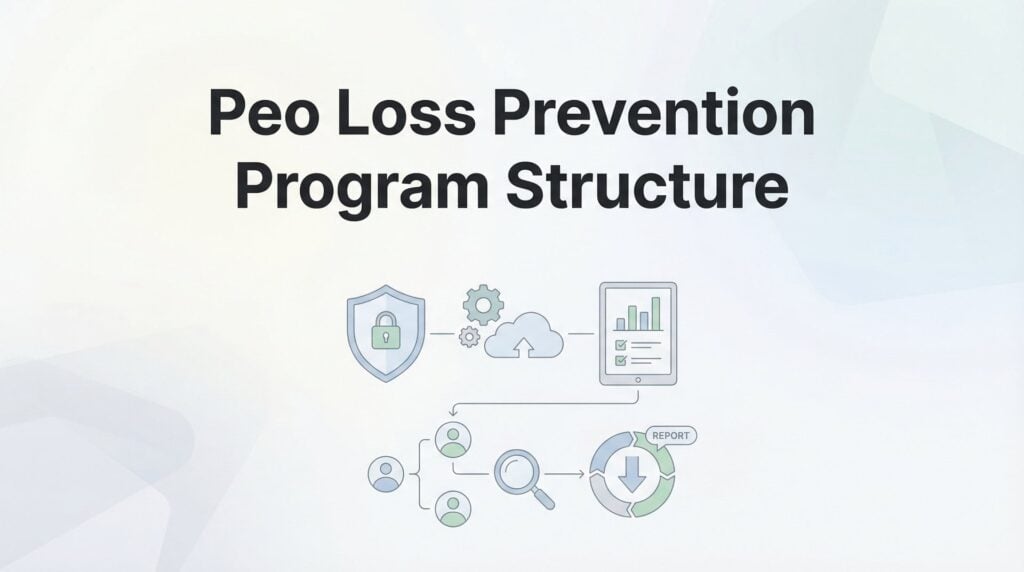
Nearly every PEO markets some version of loss prevention, but the actual structure typically breaks down into three core components. Understanding what each layer does—and doesn’t do—helps you evaluate whether a provider’s program matches your needs.
Safety Audits and Workplace Assessments: This is the foundation layer. A loss control specialist (either employed by the PEO or contracted) conducts site visits to identify workplace hazards, evaluate compliance with OSHA standards, and recommend corrective actions. In theory, this happens before incidents occur. In practice, many PEOs only conduct initial assessments during onboarding, then annual follow-ups unless something triggers additional scrutiny. The value here depends entirely on whether the auditor understands your industry’s specific risks and whether their recommendations are actionable rather than generic checkbox exercises.
Claims Management and Return-to-Work Programs: This is where most PEOs actually deliver value, because it’s where costs get controlled after an incident happens. When an employee gets injured, the PEO’s claims team coordinates medical treatment, manages communications with the workers’ comp carrier, and—critically—develops return-to-work plans to get employees back on modified duty as quickly as medically appropriate. Every day an injured employee stays home is a day your claim costs increase. Effective claims management includes nurse case management to ensure appropriate treatment, fraud detection to catch questionable claims early, and aggressive return-to-work coordination. The structure here matters: does the PEO have in-house claims specialists, or are they just forwarding reports to the insurance carrier?
Ongoing Compliance Monitoring and Training: The third layer involves continuous safety training, regulatory updates, and compliance support. This might include toolbox talks, online safety modules, OSHA recordkeeping assistance, and alerts about changing regulations in your industry. The structural difference between providers is whether this is proactive outreach or just access to a resource library you’ll never use. Some PEOs assign dedicated safety coordinators who check in quarterly. Others give you a login to a training portal and call it a day.
Here’s what actually matters: these three components only reduce costs if they lower your experience modification rate—the multiplier applied to your workers’ comp premiums based on your claims history. If a PEO’s loss prevention program prevents incidents or reduces claim severity, your mod rate improves over time and premiums drop. If the program is purely reactive, you’re paying for services that don’t change your risk profile. Most business owners focus on the wrong question during PEO evaluation. They ask “Do you offer loss prevention?” when they should ask “How does your program structure specifically reduce mod rates for businesses like mine?”
Why Program Structure Varies Wildly Between PEO Providers
Not all loss prevention programs are built the same, and the differences correlate directly with PEO size and specialization. Understanding these structural variations helps you set realistic expectations.
Large national PEOs typically maintain dedicated loss control departments with in-house specialists, claims managers, and safety coordinators. They have the scale to employ certified safety professionals, invest in proprietary training platforms, and conduct regular site visits across their client base. The advantage is consistency and resources. The disadvantage is that you’re one of thousands of clients, so personalized attention depends on your size and risk profile. If you’re a 15-person company in a low-risk industry, you’re probably getting the basic tier of service regardless of what the sales deck promised.
Regional PEOs often outsource loss prevention to third-party administrators or insurance carriers. This isn’t necessarily bad—some TPAs specialize in loss control and deliver excellent service. But the structural difference means your loss prevention contact isn’t employed by your PEO, which can create communication gaps and slower response times. You’re also more dependent on the quality of that specific TPA relationship. If the PEO switches carriers or TPAs, your entire loss prevention program might change mid-contract.
Industry-specific PEOs frequently have the most robust loss prevention for their niche. A PEO focused exclusively on construction understands fall protection, scaffolding standards, and trade-specific hazards in ways a generalist provider never will. Their loss control specialists have seen your exact risk scenarios hundreds of times. The same applies to healthcare-focused PEOs with needlestick protocols and patient-handling training, or manufacturing PEOs with machine guarding expertise. If you operate in a high-risk industry, this specialization often delivers more value than a larger PEO’s generalist approach.
Then there’s the master policy factor. When you join a PEO, you’re typically covered under their master workers’ comp policy, pooled with other client companies. This pooling can work in your favor if you’re a higher-risk business joining a pool with better overall experience. But it also means you’re sharing risk exposure with other employers. If the PEO’s overall client base has poor safety performance, that affects the rates and resources available to everyone. Some PEOs structure their loss prevention programs specifically to manage this pooled risk—they’re more aggressive about loss control because one client’s bad claims year affects the entire pool’s renewal rates. Understanding workers’ comp policy term structure helps you evaluate how these pooling arrangements affect your specific situation.
Questions That Reveal Whether Loss Prevention Is Real or Just Marketing
During the PEO evaluation process, most providers will tout their loss prevention capabilities. Here’s how to separate substance from sales pitch.
Ask whether you’ll have a dedicated loss control specialist or shared resources. “Dedicated” doesn’t necessarily mean one person assigned only to you—that’s unrealistic unless you’re a large client. But it should mean a specific contact who knows your business, conducts your site visits, and manages your safety program. If the answer is “you’ll work with our loss control department,” that usually means you’re calling a general queue when you need something. Also ask how that specialist is assigned. Is it based on geography, industry, or client size? Industry-based assignment usually delivers better results.
Get specific about site visit frequency. Many PEOs promise regular safety audits but don’t define “regular.” Push for concrete commitments: how many site visits per year, under what circumstances, and who conducts them. If the answer is “as needed” or “upon request,” that’s a red flag. Proactive loss prevention includes scheduled visits, not just reactive responses when something goes wrong. Also ask whether site visits are included in your admin fee or billed separately. Some PEOs include one annual visit, then charge for additional assessments.
Claims management response time matters more than most business owners realize. When an employee gets injured, the first 24-48 hours determine whether you’re dealing with a minor claim or an expensive nightmare. Ask how quickly their claims team responds to incident reports. Do you have after-hours access to a nurse case manager? What’s the protocol for serious injuries requiring immediate coordination? PEOs with strong loss prevention programs have clear escalation procedures and 24/7 claims support. Those treating it as an add-on service might not return your call until the next business day. A thorough workers’ comp program evaluation checklist can help you systematically assess these capabilities.
Request documentation of their track record. This is where most PEOs get vague, but it’s the most important question. Ask for aggregate experience modification rate improvements across their client base, claims frequency data by industry, or case studies showing measurable results. If they can’t provide any quantitative evidence that their loss prevention program actually reduces claims, you’re looking at marketing materials, not proven risk management. Some PEOs will share anonymized client data showing mod rate trends over time. Others will deflect with general statements about “industry-leading safety.” The difference tells you everything.
Red flags include: refusing to provide specific contact information for loss control staff, inability to explain how their program differs from competitors, lack of industry-specific expertise for your business type, and vague answers about site visit frequency or claims response protocols. If the sales rep can’t clearly articulate the loss prevention structure during the proposal stage, it’s probably because there isn’t much structure to explain.
When Loss Prevention Should Actually Drive Your PEO Decision
Here’s the reality: loss prevention program structure should heavily influence your PEO choice only if you have meaningful workplace risk to mitigate. For many businesses, it’s a nice-to-have feature that doesn’t justify paying premium admin fees.
Loss prevention becomes a high-priority evaluation factor if you’re dealing with an elevated experience modification rate. If your current mod rate is above 1.0, you’re already paying higher workers’ comp premiums than the industry average. A PEO for high insurance mod rates can help bring that number down over time through better claims management and proactive risk reduction. The math works because even modest mod rate improvements generate real premium savings that offset higher PEO fees. This is especially true if you’ve had recent claims that are still affecting your three-year experience period.
High-risk industries should prioritize loss prevention structure. If you’re in construction, manufacturing, healthcare, warehousing, or any field with significant physical workplace hazards, the quality of your PEO’s loss control program directly impacts your profitability. These industries face higher base workers’ comp rates, so effective loss prevention delivers proportionally larger savings. You also face greater regulatory scrutiny and compliance requirements, making ongoing safety support valuable beyond just claims cost reduction.
Businesses with a history of workplace injuries need to evaluate loss prevention capabilities carefully. If you’ve had multiple claims in recent years, you’re either doing something structurally wrong with your safety protocols or you’re in an inherently risky business that needs better risk management. Either way, a PEO with robust loss prevention can help break that pattern. Look specifically for providers with strong return-to-work programs and proactive safety training, not just claims processing.
On the flip side, loss prevention should be a lower priority for professional services firms, remote-first companies, and businesses with minimal physical workplace risk. If your team works primarily from home offices or in low-risk office environments, you’re unlikely to see meaningful ROI from premium loss prevention services. Your baseline workers’ comp costs are already low, and your claims frequency is minimal. Paying extra for dedicated loss control specialists and frequent site visits doesn’t make financial sense. You’re better off choosing a PEO based on payroll accuracy, benefits options, and HR support—factors that actually matter for your operational model.
The cost-benefit calculation matters. Robust loss prevention programs aren’t free—they’re typically reflected in higher administrative fees or per-employee charges. A PEO charging $150 per employee per month with strong loss prevention might cost $30-40 more per employee than a provider with basic services. For a 25-person company, that’s $9,000-12,000 annually. Understanding PEO pricing and cost structure helps you determine whether premium loss prevention services justify the additional expense for your specific situation.
Getting Actual Value From Loss Prevention After You Join
Most businesses underutilize their PEO’s loss prevention resources, then wonder why they’re not seeing results. The program structure matters, but so does your engagement with it.
Actually use the resources available. Many PEOs provide safety training modules, toolbox talk materials, OSHA compliance checklists, and incident investigation templates—but most clients never access them. If you’re paying for loss prevention through your admin fees, assign someone internally to engage with these tools regularly. Schedule quarterly safety meetings using the PEO’s materials. Require new hires to complete relevant safety training. Use the compliance checklists to conduct internal audits between the PEO’s site visits. The businesses that see measurable mod rate improvements are the ones treating loss prevention as an ongoing operational priority, not a service they passively receive.
Set clear expectations with your PEO on reporting cadence and communication. During onboarding, establish how often you’ll receive safety reports, when site visits will occur, and how claims updates will be communicated. If your PEO promises quarterly safety reviews, hold them to it. If they’re supposed to provide monthly claims status reports, follow up when they don’t arrive. Loss prevention programs drift into reactive mode when clients don’t demand proactive service. The squeaky wheel gets better loss control support. A well-structured PEO onboarding implementation process sets the foundation for this ongoing accountability.
Track whether the program delivers measurable results. You should see improvement in specific metrics over time: reduced claims frequency, lower average claim costs, decreasing lost-time incidents, and—most importantly—improving experience modification rates. If you’ve been with a PEO for two years and none of these numbers have moved, their loss prevention program isn’t working for you. Either you’re not engaging with it properly, or the program isn’t as robust as promised. Request a formal review with your loss control specialist to identify gaps. Tools like a loss ratio improvement calculator can help you quantify whether you’re getting real value.
If loss prevention isn’t delivering, you have options. Start by escalating internally within the PEO—request a different loss control specialist, ask for additional site visits, or demand more aggressive claims management. If that doesn’t work, this becomes a legitimate contract issue. Many PEO agreements include service level commitments around loss prevention. If they’re not meeting those commitments, you may have grounds to renegotiate fees or exit the contract. At minimum, it’s a data point for your next PEO evaluation cycle.
Making the Right Call for Your Business
Loss prevention program structure matters—but only if you have real workplace risk exposure and you’re willing to actively engage with the program. The most sophisticated loss control services won’t reduce your workers’ comp costs if your team never attends the safety training, ignores the audit recommendations, or treats claims management as someone else’s problem.
Evaluate loss prevention as one factor in your broader PEO decision, weighted appropriately for your industry and risk profile. If you’re in construction with a poor mod rate, this should be a primary selection criterion. If you’re a remote marketing agency, focus on payroll accuracy and benefits administration instead. The worst decision is choosing a PEO primarily because they talked a good game about loss prevention during the sales process, then realizing six months later that you’re paying for services you don’t need or can’t effectively use.
Before you sign that PEO renewal, make sure you’re not leaving money on the table. Many businesses unknowingly overpay because of bundled fees, hidden administrative markups, and contracts designed to limit flexibility. We give you a clear, side-by-side breakdown of pricing, services, and contract terms—so you can see exactly what you’re paying for and choose the option that truly fits your business. Don’t auto-renew. Make an informed, confident decision.
