
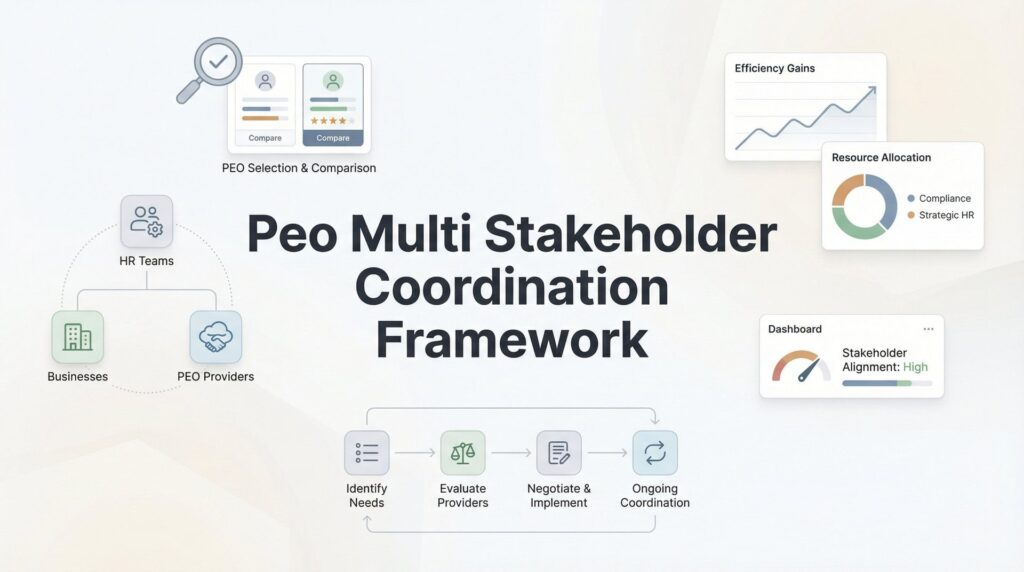
Getting everyone on the same page during a PEO engagement is harder than it looks. You’ve got finance worried about cost visibility, HR concerned about service quality, operations focused on day-to-day functionality, and leadership wanting strategic oversight. When these stakeholders aren’t coordinated, you end up with duplicated efforts, missed deadlines, finger-pointing when things go wrong, and a PEO relationship that never reaches its potential.
This guide breaks down practical coordination frameworks that business owners and HR leaders can implement immediately—no corporate jargon, just approaches that work in the real world where people are busy and attention is limited.
1. Establish a Single Point of Accountability
The Challenge It Solves
When everyone is responsible for the PEO relationship, no one actually is. You’ve probably seen this: finance thinks HR is handling a payroll discrepancy, HR assumes operations is dealing with a benefits question, and leadership expects someone else to be monitoring service quality. Meanwhile, the issue sits unresolved for weeks.
The co-employment model creates natural ambiguity because responsibilities are shared between your company and the PEO. Without a clear owner on your side, that ambiguity becomes paralysis.
The Strategy Explained
Appoint one person as your PEO Relationship Owner with real decision authority. Not a committee. Not a “team approach.” One person who wakes up every day knowing the PEO relationship is their responsibility.
This doesn’t mean they handle every detail personally. It means they’re the central hub—the person who knows what’s happening, who’s working on what, and who makes the call when stakeholders disagree. They own outcomes, not just coordination.
The right person typically sits in HR or operations and has enough organizational credibility to get finance and leadership to listen. They need access to leadership when escalation is necessary, but they shouldn’t need permission for routine decisions.
Implementation Steps
1. Name the person explicitly in writing and communicate their authority to all stakeholders—including your PEO account team.
2. Define their decision scope clearly: What can they approve without consultation? What requires finance sign-off? What goes to leadership?
3. Give them a monthly budget for the PEO relationship and authority to make decisions within that threshold without additional approvals.
4. Schedule a weekly 15-minute check-in where they update you on anything that needs attention—keep it brief and action-focused.
Pro Tips
Don’t pick someone who’s already underwater with other responsibilities. This role requires mental bandwidth to think strategically, not just react to problems. And make sure your PEO knows who this person is—they should be the primary contact for everything except specialized technical questions.
2. Create Stakeholder-Specific Communication Channels
The Challenge It Solves
Finance doesn’t need to know about every benefits enrollment issue. HR doesn’t need every invoice detail. Leadership doesn’t want daily operational updates. But when everyone gets the same information dump, important signals get lost in noise.
The result? Finance misses a cost overrun because it was buried in an HR operational report. Leadership doesn’t hear about a service quality problem until it’s escalated by an angry employee. HR can’t answer a basic question because the relevant data went only to finance.
The Strategy Explained
Tailor information flow to what each stakeholder group actually needs to do their job. Finance gets cost data and invoice reconciliation. HR gets service metrics and employee issue resolution. Leadership gets strategic performance indicators and risk flags.
This isn’t about hiding information—anyone can request details. It’s about making sure each group gets the signal without the noise. Think of it like setting up different views of the same database rather than sending everyone the full data export.
Implementation Steps
1. Ask each stakeholder group what decisions they make that require PEO data, then work backward to determine what information they need.
2. Set up separate communication rhythms: Finance gets monthly cost reports with variance analysis. HR gets weekly service metrics. Leadership gets quarterly strategic reviews.
3. Create templates for each stakeholder group that highlight what matters to them—don’t make them hunt through generic status reports.
4. Establish one shared location where all detailed information lives for anyone who wants to dig deeper, but don’t force everyone to consume it.
Pro Tips
Test your communication design by asking stakeholders: “Can you make your decisions with what you’re getting?” If they’re constantly asking for additional context or clarification, your channels aren’t tailored enough. And remember—less frequent, more relevant communication beats constant updates that get ignored.
3. Map Decision Rights Before Problems Arise
The Challenge It Solves
A payroll error affects 20 employees. Who decides whether to process an off-cycle correction or wait until the next regular cycle? Your health insurance renewal comes in 8% higher than expected. Who has authority to push back or accept it? An employee files a workers’ comp claim that looks questionable. Who determines the investigation approach?
When these situations arise and decision rights aren’t clear, you get delays, duplicated effort, and frustration. People either step on each other’s toes or wait for someone else to act.
The Strategy Explained
Pre-define who owns which decisions and set clear escalation triggers based on dollar amounts and risk levels. The goal isn’t to create bureaucracy—it’s to eliminate the “Who should handle this?” conversation that wastes time every single time something comes up.
Think about the decisions that actually occur in a PEO relationship: service issues, cost variances, compliance questions, contract changes, employee escalations. For each category, determine who has primary authority and under what conditions they need to consult or escalate.
Implementation Steps
1. List the 10-15 most common decision types in your PEO relationship based on the past year’s experience.
2. For each decision type, assign one primary decision-maker and define when they must consult others (e.g., “HR owns benefits decisions under $5,000 per year impact, must consult finance above that threshold”).
3. Identify 3-5 clear escalation triggers: dollar thresholds, legal risk, employee impact scale, or regulatory implications.
4. Document this in a simple one-page matrix and share it with all stakeholders and your PEO account team—they need to know who to contact for what.
Pro Tips
Don’t try to map every possible decision. Focus on the recurring ones and the high-stakes ones. Everything else can follow a default rule: “PEO Relationship Owner decides, consults as needed.” And review your decision map quarterly—as your relationship matures, some decisions that required escalation early on can be pushed down.
4. Build a Shared Metrics Dashboard Everyone Trusts
The Challenge It Solves
Finance has one version of PEO costs. HR has a different employee satisfaction metric. Leadership is looking at yet another set of numbers. When stakeholders are working from different data sources, every conversation devolves into arguing about whose numbers are right instead of making decisions.
The PEO provides reports, but they’re often formatted for their purposes, not yours. You need metrics that answer your specific questions in a format that doesn’t require translation every time.
The Strategy Explained
Create a single source of truth for PEO performance data that all stakeholders reference. This isn’t about building a complex analytics system—it’s about agreeing on 8-10 key metrics, where they come from, and how they’re calculated.
The dashboard should answer the questions each stakeholder group asks repeatedly: What are we actually paying? How fast are issues getting resolved? Are we staying compliant? How satisfied are employees with PEO services?
Implementation Steps
1. Identify the top 3 questions each stakeholder group asks about PEO performance, then find or create metrics that answer them.
2. Determine the data source for each metric (PEO reports, your internal systems, employee feedback) and who’s responsible for updating it monthly.
3. Build a simple dashboard—a shared spreadsheet works fine—that shows current performance, trend direction, and flags anything outside acceptable ranges.
4. Schedule a 30-minute session where you walk all stakeholders through the dashboard logic so everyone understands what they’re looking at and trusts the methodology.
Pro Tips
Resist the temptation to track everything. More metrics don’t create better decisions—they create confusion. Start with 6-8 metrics that matter most and add others only when you have a specific decision that requires them. And update your dashboard on a consistent schedule so stakeholders know when to check it.
5. Run Quarterly Alignment Sessions
The Challenge It Solves
Monthly status updates keep everyone informed, but they don’t create strategic alignment. Six months into your PEO relationship, finance is frustrated about costs, HR is concerned about service quality, and leadership is questioning whether this was the right decision—but no one has actually sat down together to discuss whether expectations were realistic in the first place.
Without regular strategic conversations, small misalignments compound into major disconnects. What finance considers an unacceptable cost variance might be completely reasonable given a business change HR knows about but never communicated.
The Strategy Explained
Hold quarterly sessions that go beyond status updates to address priorities, expectations, and course corrections. These aren’t project meetings—they’re strategic conversations about whether the PEO relationship is delivering what your business needs and what adjustments are required.
Bring together your key stakeholders (finance, HR, operations, leadership) for 90 minutes. Review what’s working, what’s not, whether your priorities have shifted, and what that means for how you’re using the PEO.
Implementation Steps
1. Schedule these sessions at the beginning of each quarter and protect the time—don’t let them get bumped for operational urgencies.
2. Send a pre-read 48 hours before that covers: performance against your key metrics, major issues from the past quarter, upcoming changes that affect the PEO relationship, and 2-3 discussion questions.
3. Structure the meeting: 30 minutes reviewing performance data, 45 minutes discussing strategic questions, 15 minutes agreeing on action items and priority adjustments.
4. Document decisions and send a summary within 24 hours so everyone’s clear on what changed and why.
Pro Tips
Don’t let these sessions become complaint sessions. Acknowledge problems, but spend most of your time on forward-looking questions: Are our priorities still right? What’s changing in our business that affects what we need from the PEO? Where should we be investing more attention? And invite your PEO account lead to every other session—they need to hear this strategic context directly.
6. Develop Conflict Resolution Protocols
The Challenge It Solves
Finance wants to cut PEO costs by moving to a lower service tier. HR argues that service quality is already borderline and cutting further will create employee problems. Both have legitimate concerns. Without a pre-agreed way to resolve this tension, the decision either gets delayed indefinitely or gets made based on who has leadership’s ear that week.
These conflicts are predictable—they happen in almost every PEO relationship. Cost versus service. Speed versus thoroughness. Flexibility versus control. When you’re resolving them from scratch every time, it’s exhausting and inconsistent.
The Strategy Explained
Establish pre-agreed tiebreaker criteria for common tensions before conflicts arise. This doesn’t mean finance or HR “wins” automatically—it means you’ve already decided what factors matter most when these tensions surface.
Think of it like setting up decision rules: “When cost and service quality conflict, we prioritize service quality unless the cost difference exceeds 15% of budget.” Or: “When speed and thoroughness conflict on compliance matters, thoroughness wins every time.”
Implementation Steps
1. Identify the 3-4 most common tensions in your PEO relationship based on past experience (cost vs. service, speed vs. accuracy, flexibility vs. consistency are typical).
2. For each tension, define your tiebreaker criteria—what factors tip the decision one way or the other? Be specific enough to actually guide decisions.
3. Document these protocols and share them with all stakeholders so everyone knows the ground rules before conflicts arise.
4. Include an escalation path: If the tiebreaker criteria don’t clearly resolve the conflict, who makes the final call?
Pro Tips
Your protocols will never cover every situation, and that’s fine. The goal is to handle 70-80% of conflicts quickly so you can spend time on the genuinely novel situations. And revisit your protocols annually—as your business changes, your priorities might shift, and your cost accounting methods should reflect that.
7. Create Onboarding Handoffs That Don’t Drop the Ball
The Challenge It Solves
Your finance lead who understood the PEO contract inside and out just left the company. The new person is smart but has no context on why certain decisions were made, what the escalation protocols are, or who owns what. For the next three months, things fall through cracks because institutional knowledge walked out the door.
Personnel changes are inevitable. When they happen in key stakeholder roles, your PEO coordination framework can collapse if knowledge transfer doesn’t happen systematically.
The Strategy Explained
Build knowledge transfer processes for when stakeholder personnel changes occur. This isn’t about creating massive documentation that no one reads—it’s about capturing the essential context someone needs to step into a stakeholder role effectively.
Think about what a new person in each stakeholder role needs to know: Who are the key contacts? What decisions do they own? What are the current priorities? What problems are we actively managing? Where is information stored?
Implementation Steps
1. Create a simple onboarding checklist for each stakeholder role (finance, HR, operations, leadership) that covers: key contacts, decision authorities, current priorities, common issues, and where to find detailed information.
2. Maintain a “PEO Relationship Context” document that gets updated quarterly with: major decisions made and why, ongoing issues, upcoming changes, and lessons learned—this becomes the knowledge base for new stakeholders.
3. When a stakeholder role changes, schedule a 60-minute handoff meeting with the outgoing person, incoming person, and your PEO Relationship Owner to transfer context that isn’t in writing.
4. Have the new stakeholder shadow the PEO Relationship Owner for their first month to see how decisions actually get made in practice.
Pro Tips
Don’t wait until someone gives notice to think about knowledge transfer. Update your context document quarterly when things are fresh in everyone’s mind. Building a solid HR standardization roadmap helps ensure consistent processes regardless of personnel changes. And when a new stakeholder joins, give them a quick win in their first two weeks—a decision they can make or a problem they can solve—so they build confidence in the framework quickly.
Where to Start: Your First 30 Days
You don’t need to implement all seven strategies at once. Start with the foundation.
Begin with strategy #1—appoint a clear PEO Relationship Owner with actual authority. This single step eliminates most coordination friction because it ends the “who’s handling this?” confusion. Make sure everyone knows who this person is and what they’re empowered to decide.
Then move to strategy #3—map your top 10 decisions and who owns them. Spend an hour with your key stakeholders identifying the decisions that come up repeatedly and agreeing on who has primary authority for each. Document it in a simple one-page matrix.
These two steps alone will eliminate most coordination friction. The remaining strategies can be layered in over the next quarter as you build momentum.
Remember: the goal isn’t perfect process documentation. It’s making sure the right people can make the right decisions quickly, without stepping on each other or letting things fall through cracks. Your coordination framework should feel like it’s removing obstacles, not creating them.
If your current PEO relationship feels like constant firefighting with no one clearly in charge, these strategies will help. If you’re evaluating PEOs and want to set up coordination properly from the start, even better—it’s much easier to build these frameworks during implementation than to retrofit them later.
Before you sign that PEO renewal, make sure you’re not leaving money on the table. Many businesses unknowingly overpay because of bundled fees, hidden administrative markups, and contracts designed to limit flexibility. We give you a clear, side-by-side breakdown of pricing, services, and contract terms—so you can see exactly what you’re paying for and choose the option that truly fits your business. Don’t auto-renew. Make an informed, confident decision.
