
You’ve been with your PEO for two years. Benefits are solid. Compliance feels handled. But your recruiting process is still a mess of spreadsheets and email threads because the PEO’s applicant tracking is basically a digital filing cabinet. Or maybe payroll runs smoothly, but you’re using a separate time tracking tool because the PEO’s clock-in system doesn’t work for your shift-based operation. Sound familiar?
This is the moment many growing businesses realize that one vendor can’t be best-in-class at everything. The all-in-one PEO promise starts showing cracks—not because the PEO is bad, but because your operational needs have evolved beyond what any single generalist provider can deliver.
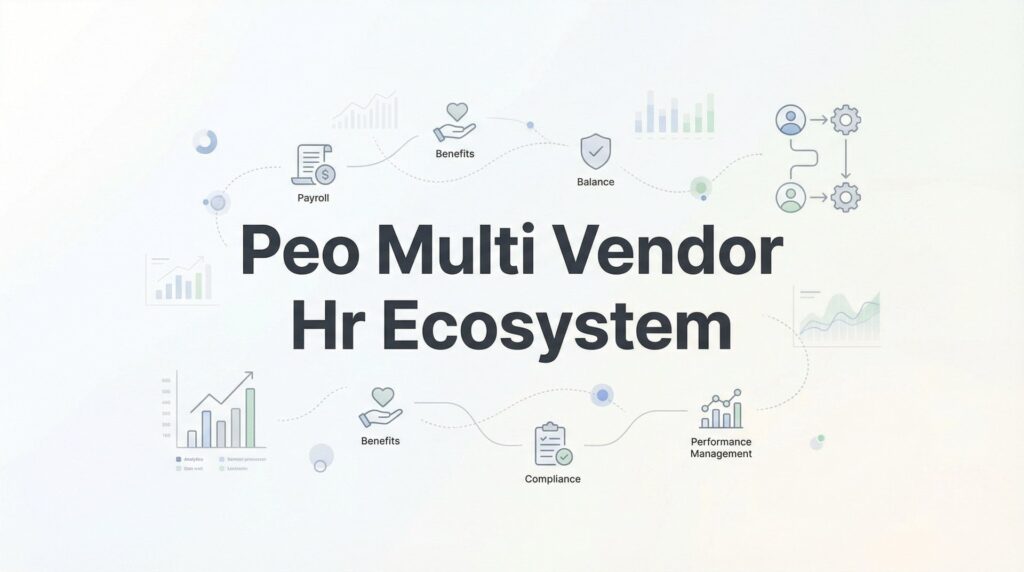
The solution isn’t necessarily ditching your PEO. It’s building what’s called a multi-vendor HR ecosystem: keeping the PEO as your compliance and benefits backbone while layering specialized tools on top for recruiting, performance management, scheduling, or whatever specific function is holding you back. This approach works brilliantly for some businesses and creates expensive chaos for others. The difference comes down to understanding when this complexity pays off and how to structure it so you’re not just trading one set of problems for another.
When the Bundled Model Stops Working
PEOs built their business model on convenience. One contract, one vendor relationship, one integrated system handling payroll through benefits. For a 20-person company with straightforward HR needs, that bundled approach is exactly what you want. But somewhere between 50 and 150 employees, specific operational pain points start outweighing the simplicity advantage.
The most common breaking point is recruiting. Most PEO applicant tracking systems feel like they were built in 2010 and haven’t been updated since. You can post jobs and collect resumes, but the candidate experience is clunky, the hiring manager collaboration tools are nonexistent, and forget about sophisticated pipeline analytics. If you’re hiring more than a handful of people per year, you’re probably already supplementing with something better.
Time and attendance is another frequent friction point. If you run retail locations, manufacturing shifts, or field service operations, you need real-time clock-in/clock-out with geofencing, shift swapping, and schedule optimization. What most PEOs offer is basic timekeeping that technically checks the compliance box but doesn’t actually help you run operations efficiently.
Performance management is where the gap gets particularly obvious. The PEO gives you annual review templates and a place to store documentation. What you actually need is continuous feedback loops, goal tracking that connects to business objectives, and development planning that doesn’t feel like HR paperwork. Those are fundamentally different products.
Industry-specific compliance creates another category of gaps. If you’re in healthcare and need credential tracking, or construction with certified payroll requirements, or professional services with project-based time allocation for client billing—your PEO’s generalist tools probably aren’t built for those workflows. They’ll handle the regulatory basics, but the operational support isn’t there. Companies managing multi-state payroll compliance often discover these limitations first.
Here’s the key distinction: sometimes you’re hitting genuine PEO limitations, and sometimes you’re just not using what you have effectively. Before you start adding vendors, make sure you’ve actually explored your current PEO’s capabilities. Many businesses discover features they didn’t know existed or realize they can customize workflows they assumed were fixed. The multi-vendor path makes sense when you’ve genuinely outgrown what’s available, not when you haven’t fully utilized what you’re already paying for.
Building Your Stack Without Breaking Everything
If you’re going multi-vendor, the PEO stays at the center. That’s not negotiable. They’re your employer of record, they hold the benefits contracts, they file your payroll taxes. Everything else orbits around that core.
What typically stays with the PEO: payroll processing, tax filing, benefits enrollment and administration, workers’ compensation, core HR compliance (I-9s, new hire reporting, COBRA), and basic employee records. These are the functions where the co-employment relationship matters most and where fragmentation creates real legal risk.
What commonly moves to specialized vendors: applicant tracking and recruiting, performance management and employee development, time and attendance for complex scheduling needs, learning management systems, employee engagement surveys, and industry-specific compliance modules.
The most common configuration we see is PEO plus a standalone ATS. Companies using Greenhouse, Lever, or even simpler tools like JazzHR get dramatically better recruiting outcomes than trying to force the PEO’s basic system to work. The integration is usually straightforward—once someone’s hired in your ATS, their data flows to the PEO for onboarding and payroll setup.
PEO plus performance management tools is another frequent pairing. Lattice, 15Five, Culture Amp—these platforms do one thing really well, and that thing isn’t something PEOs have invested heavily in building. You’re tracking goals, running continuous feedback cycles, and managing development conversations in the specialized tool, while the PEO maintains the official personnel file.
For shift-based businesses, adding Deputy, When I Work, or similar scheduling platforms on top of the PEO is almost standard practice. Employees clock in through the scheduling app, hours sync to the PEO for payroll processing. It works because the integration point is clean: approved hours go one direction, pay stubs come back the other.
The integration question determines whether this approach is viable or a nightmare. Some PEOs offer actual APIs with real-time data sync. Others give you CSV exports you’ll manually upload weekly. That difference matters enormously when you’re trying to keep employee data consistent across systems.
Ask specifically: How does employee demographic data sync? What happens when someone gets a raise or changes departments—does that update automatically across connected systems? If an employee updates their address in the PEO portal, does it flow to your other tools? When you terminate someone in your HRIS, do their access permissions revoke everywhere?
The worst-case scenario is manual data bridging. If you’re re-entering information across platforms or running weekly reconciliation spreadsheets, you haven’t actually solved a problem—you’ve just redistributed the administrative burden. The multi-vendor approach only works when the connective tissue is strong enough that your HR team isn’t spending half their time being human middleware.
What This Actually Costs You
The per-employee-per-month math changes when you’re stacking vendors. Your PEO might charge $150 per employee monthly. Add a recruiting platform at $8 per employee. Performance management at $6 per employee. Time tracking at $5 per employee. You’re now at $169 per employee per month, which is a 13% increase in your HR tech spend.
That calculation assumes you’re getting the multi-vendor discount pricing, which often requires annual contracts and minimum seat counts. If you’re a 75-person company trying to add a tool that’s priced for 100+ employees, you might be paying list rates that make the economics look much worse. Understanding how much a PEO actually costs becomes critical when layering additional vendors.
The hidden costs are where this gets expensive in ways you won’t see on the invoice. Integration maintenance isn’t free—even good API connections require monitoring, troubleshooting when something breaks, and updates when either vendor changes their system. If you don’t have someone technical managing this, you’re either paying your PEO for integration support or hiring implementation consultants.
Duplicate data entry still happens more than vendors admit. Employee addresses, emergency contacts, department codes—these details live in multiple systems, and keeping them synchronized requires either perfect integration or manual labor. Most companies end up with some version of both, which means HR administrative time that could be spent on strategic work is instead spent on data hygiene.
Vendor management overhead is real. You’ve now got multiple renewal cycles to track, multiple support teams to contact when something breaks, multiple security reviews to conduct, multiple invoices to reconcile. If you’re a 50-person company with one HR person, that coordination burden might consume 10-15% of their capacity.
The financial breakeven depends on what you’re solving for. If adding a $500/month ATS helps you fill positions 30% faster and reduces recruiting agency fees by $20,000 annually, the ROI is obvious. If you’re adding a performance management platform because it feels like the thing growing companies should have, but you’re not actually changing how managers lead their teams, you’re just adding cost.
Consolidation often makes more financial sense than businesses initially assume. A PEO that charges $180 per employee but includes robust recruiting, performance management, and time tracking might be cheaper than a $150 base PEO plus three separate point solutions—especially when you factor in the integration and management overhead.
The Operational Headaches Nobody Mentions
Your employees don’t care about your HR tech strategy. They care that they have four different logins, three different places to update their personal information, and no clear answer about which system to use for what.
Onboarding becomes a scavenger hunt. New hires get credentials for the PEO portal to enroll in benefits and set up direct deposit. Then separate logins for the time tracking app. Another account for the performance management platform. Maybe another for the learning management system if you’re running training programs. Each one has different password requirements and different mobile app experiences. A well-planned PEO onboarding process can mitigate some of this complexity.
Self-service gets fragmented. An employee wants to request time off—do they do that in the PEO system or the scheduling app? They need to update their W-4—is that in the payroll portal or the HRIS? They want to see their performance review history—which platform stores that? When the answer to basic questions is “it depends,” you’ve created friction that shows up as help desk tickets and employee frustration.
The compliance liability gaps are less obvious but more dangerous. Let’s say you’re using a third-party time tracking system for your hourly employees. Someone works 45 hours, but there’s a sync delay and the PEO only processes 40 hours for payroll. Who’s responsible for catching that overtime violation—you, the time tracking vendor, or the PEO? The answer is you, but the accountability gets murky when multiple systems touch the data.
Leave management across vendors creates particularly messy scenarios. An employee requests FMLA leave through the PEO’s benefits portal. But their manager approves time off through the scheduling system. The systems don’t talk to each other in real-time. The employee gets paid for days they shouldn’t have been, or worse, doesn’t get paid for protected leave they’re entitled to. You’re now dealing with a compliance issue that exists purely because of how you structured your vendor ecosystem.
Data discrepancies compound over time. The PEO shows someone as full-time. Your performance management system has them tagged as part-time because that’s what they were when they started and nobody updated it. Your time tracking app has them in the wrong department. Six months later, you’re trying to run a headcount report or analyze turnover by department, and the data doesn’t match across systems. Reconciling that mess requires manual investigation that could have been avoided with a single source of truth.
The internal HR bandwidth required to manage this complexity is consistently underestimated. You need someone who understands how all the pieces connect, knows which vendor to contact for which issue, can troubleshoot when integrations break, and maintains the processes that keep data consistent. If you’re a 60-person company with one HR generalist who’s also handling recruiting and employee relations, adding vendor coordination responsibilities might be the thing that breaks them.
Making It Work When You Commit to It
If you’re going down the multi-vendor path, treat it like the operational project it is—not a simple software purchase.
Establish clear data ownership before you sign any contracts. The PEO is the source of truth for: legal names, Social Security numbers, hire dates, compensation, benefits elections, tax withholdings, and employment status. Everything flows from there. Your other systems can cache that data for their purposes, but they don’t own it.
For everything else, decide explicitly. Is the time tracking system the source of truth for hours worked, or is it the PEO after hours are approved? Is the performance management platform authoritative for job titles and departments, or is that the PEO’s domain? These decisions seem trivial until you have conflicting data and no clear process for resolving it.
Build written processes for common scenarios. When you hire someone: they get entered in the ATS first, then flow to the PEO for onboarding, then provisioned in the time tracking and performance systems. When someone gets promoted: compensation changes in the PEO, job title updates flow to connected systems, manager relationships update in the performance platform. When someone leaves: termination processes in the PEO, access revokes across all connected tools, historical data gets archived according to your retention policy. Proper PEO accounting policy documentation helps formalize these workflows.
Document those workflows and assign clear ownership. If the recruiting manager creates the offer in the ATS but HR processes it in the PEO, who’s responsible for making sure the salary matches? If a manager changes someone’s schedule in the time tracking app, who verifies it syncs correctly for payroll? These handoffs are where errors happen.
Run quarterly ecosystem audits. Pick a random sample of employees and verify their data is consistent across all systems. Check that terminated employees actually lost access everywhere. Review integration logs for sync failures. Look for duplicate accounts or orphaned records. This kind of proactive data hygiene prevents the slow drift that makes your systems unreliable over time.
Plan for vendor changes. When you’re on a single PEO, switching providers is painful but conceptually simple—you migrate everything at once. When you’ve got a PEO plus four specialized tools, changing any piece requires thinking through the ripple effects. If you switch PEOs, do your current integrations still work? If you replace your ATS, does the new one connect to your PEO the same way? Build enough flexibility into your vendor contracts that you’re not locked into a broken ecosystem.
The companies that make multi-vendor work are the ones who treat it as an ongoing operational responsibility, not a one-time implementation project. They have someone who owns the ecosystem, they invest in the integration layer, and they’re realistic about the management overhead. When that infrastructure exists, the benefits of best-of-breed tools can genuinely outweigh the complexity costs.
Why Some Businesses Should Just Find a Better PEO
If you’re under 50 employees, the multi-vendor approach is almost certainly more complexity than you need. You don’t have the HR bandwidth to manage vendor coordination, and the operational problems you’re trying to solve probably don’t justify the overhead. Your energy is better spent finding a PEO whose native capabilities better match your needs.
Company size isn’t the only factor—it’s about organizational capacity. A 40-person tech startup with a dedicated HR operations person and an engineering team that can manage integrations might handle a multi-vendor ecosystem fine. A 100-person manufacturing company with an office manager who handles HR as 30% of their job probably can’t. Businesses approaching the 100-employee threshold often face this decision point.
If your frustration is with your PEO’s customer service, responsiveness, or strategic guidance, adding more vendors doesn’t fix that. You’re just multiplying the number of support relationships you need to manage. The better move is finding a PEO that operates the way you need them to.
Sometimes what looks like a technology limitation is actually a process problem. You think you need a better ATS, but really you need to define a consistent hiring process. You think you need performance management software, but what you actually need is manager training on giving feedback. Buying tools doesn’t solve organizational capability gaps.
The consolidation trend is real. We’re seeing businesses that went all-in on best-of-breed HR tech around 2020-2022 now moving back toward fewer, more comprehensive platforms. The integration fatigue is real. The vendor management burden is real. The employee experience fragmentation is real. What seemed like an obvious win—getting the best tool for each function—turned into operational drag that outweighed the functional benefits.
Some PEOs have dramatically improved their native capabilities in the past few years, particularly around recruiting and performance management. Before you assume you need to layer on third-party tools, actually demo what your current PEO offers or what’s available from their competitors. A thorough comparison of top PEO providers might reveal options you hadn’t considered. You might find that switching to a PEO with stronger built-in features gives you 80% of what you wanted from specialized tools without any of the integration complexity.
The alternative to multi-vendor isn’t necessarily staying with a mediocre all-in-one solution. It’s finding the right all-in-one solution—a PEO whose strengths align with your operational priorities and whose weaknesses are things you can live with.
Making the Call That Fits Your Business
The multi-vendor HR ecosystem works for a specific type of company: large enough to have dedicated HR operations capacity, complex enough that specialized tools deliver measurable value, and sophisticated enough to manage the integration and coordination overhead. If that describes you—if you’ve genuinely outgrown what any single PEO can provide and you have the internal infrastructure to manage multiple vendors—then building a best-of-breed stack makes sense.
For everyone else, the smarter path is finding a PEO whose native capabilities better match what you actually need. That might mean leaving a provider whose benefits administration is great but whose recruiting tools are terrible, in favor of one that’s strong across the functions that matter most to your business. It might mean accepting that no single vendor will be perfect at everything and choosing which compromises you can live with.
The questions to ask yourself: Are the pain points you’re experiencing fundamental limitations of your PEO, or are they things you could solve with better configuration, training, or process design? Do you have the internal HR capacity to coordinate multiple vendors, manage integrations, and maintain data consistency? Will the specialized tools you’re considering deliver enough operational value to justify the added complexity? Are you solving for actual business needs or just buying tools that feel like what growing companies should have?
If you’re honest about those questions, the right answer becomes clearer. Sometimes that answer is building a carefully structured multi-vendor ecosystem. More often, it’s finding a better single-vendor solution that lets you focus on running your business instead of managing your HR tech stack.
Before you sign that PEO renewal, make sure you’re not leaving money on the table. Many businesses unknowingly overpay because of bundled fees, hidden administrative markups, and contracts designed to limit flexibility. We give you a clear, side-by-side breakdown of pricing, services, and contract terms—so you can see exactly what you’re paying for and choose the option that truly fits your business. Don’t auto-renew. Make an informed, confident decision.
