
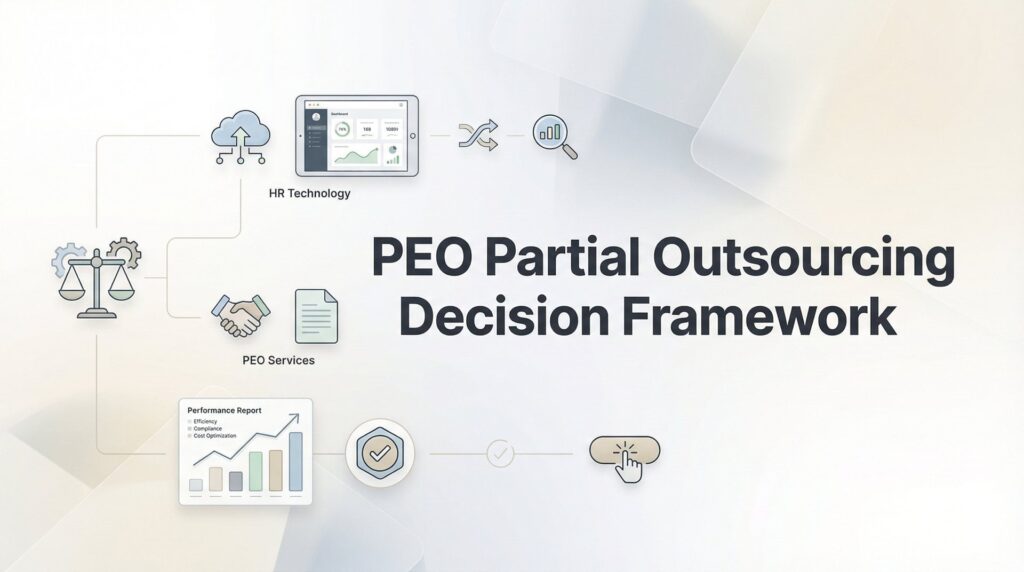
Most PEO conversations assume an all-or-nothing choice: either you outsource everything to a PEO or you keep building your internal HR infrastructure. But that binary framing misses how most businesses actually operate.
Partial outsourcing—where you hand off specific functions like benefits administration or payroll while retaining others like recruiting or employee relations—is often the smarter play. The challenge is figuring out which functions to outsource and which to keep.
Get it wrong, and you end up paying PEO fees for services you could handle better internally, or you’re drowning in compliance work you should have offloaded.
This framework walks through the seven decision factors that separate a well-structured partial outsourcing arrangement from an expensive mess. We’re not covering PEO basics here—if you need that foundation, start with our comparison of top PEO providers. This is for business owners who already understand what a PEO does and are now asking the harder question: which pieces of HR actually make sense to outsource for my specific situation?
1. Map Your HR Functions by Compliance Exposure
Start by categorizing every HR function you currently handle by its regulatory risk level. Not all HR work carries the same compliance burden, and that difference should drive your outsourcing decisions.
Payroll tax compliance in a multi-state environment is fundamentally different from recruiting compliance. One mistake in payroll tax withholding can trigger penalties that compound quickly. A misstep in how you word a job posting is fixable without major financial exposure.
Creating Your Compliance Heat Map
List out every HR function your business currently manages: payroll processing, benefits administration, workers compensation, unemployment claims, recruiting, onboarding, performance management, employee relations, policy development, and training.
Now categorize each one as high, medium, or low compliance exposure. High-exposure functions typically involve tax obligations, regulatory filings, or areas where errors trigger automatic penalties. Medium-exposure functions have compliance components but more room for correction. Low-exposure functions are primarily operational with minimal regulatory oversight.
For most businesses, high-exposure functions include payroll tax administration, benefits compliance (especially ACA reporting), workers comp administration, and unemployment insurance management. These are your prime candidates for outsourcing because the cost of getting them wrong exceeds the cost of handing them off. Understanding what PEO compliance protection actually covers helps you identify which risks transfer and which remain yours.
Why This Matters More Than You Think
The compliance landscape shifts constantly. States change tax rates, reporting requirements evolve, and federal regulations get updated without much notice. When you keep high-exposure functions in-house, you’re betting that someone on your team will catch every change that affects your business.
That’s a reasonable bet if you have a dedicated HR compliance specialist. It’s a risky bet if your office manager is handling payroll between answering phones and ordering supplies.
Use your compliance heat map as the foundation for every other decision in this framework. The functions that land in the high-exposure category deserve serious outsourcing consideration, regardless of what else you decide to keep internal.
2. Assess Internal Capability vs. Actual Capacity
Just because someone on your team can perform an HR function doesn’t mean they should. This distinction between capability and capacity is where most partial outsourcing decisions go wrong.
Your office manager might be perfectly capable of running payroll. She’s detail-oriented, she understands the software, and she’s been doing it for three years without major issues. But if she’s also managing vendor relationships, coordinating office operations, and supporting the leadership team, payroll is competing for time with everything else on her plate.
The Real Capacity Question
For each HR function you’re considering keeping in-house, ask yourself: does the person handling this have adequate time to do it well, stay current on changes, and handle exceptions without everything else suffering?
Adequate time means more than just processing the regular workflow. It means time to research compliance updates, troubleshoot problems, respond to employee questions, and handle the inevitable exceptions that pop up.
If your answer involves phrases like “she makes it work” or “he squeezes it in,” you’re looking at a capacity problem masquerading as capability. The decision between PEO versus in-house HR often comes down to whether your team has genuine bandwidth or is just surviving.
The Opportunity Cost Nobody Calculates
When your most capable people spend time on administrative HR functions, they’re not spending that time on work that directly grows the business. That opportunity cost is real even if it doesn’t show up on a spreadsheet.
Think about what your office manager, controller, or operations lead could accomplish with an extra 10-15 hours per month. Could they improve customer service? Streamline operations? Support a new product launch? That’s the actual cost of keeping certain functions internal.
This doesn’t mean you should outsource everything administrative. It means you should be honest about whether the person handling each function has genuine capacity or is just really good at juggling.
3. Calculate the True Cost of Keeping Functions In-House
Most businesses dramatically underestimate what it actually costs to manage HR functions internally. They see the PEO quote and compare it against the salary of whoever currently handles HR work. That comparison misses most of the real costs.
The true cost of keeping an HR function in-house includes direct labor, software and systems, training and professional development, error correction and penalties, and leadership time spent overseeing the function.
Breaking Down the Hidden Costs
Start with software. If you’re running payroll internally, you’re paying for payroll software, tax filing services, and probably integration tools to connect everything. Benefits administration requires enrollment platforms, carrier connections, and compliance tracking tools. Each function you keep internal comes with its own software stack.
Training costs are ongoing, not one-time. Employment law changes, tax regulations shift, and software platforms update constantly. Someone needs to stay current, which means conferences, webinars, professional memberships, or consulting fees when things get complicated.
Error correction is the cost nobody wants to acknowledge until it happens. A payroll tax filing mistake might cost you penalties, interest, and professional fees to fix it. A benefits enrollment error during open enrollment can mean manually correcting dozens of employee records. These aren’t daily occurrences, but they’re also not rare.
The Leadership Time Tax
Every HR function someone else handles still requires oversight from leadership. You’re reviewing payroll before it runs, approving benefits decisions, answering questions about policies, and stepping in when problems escalate.
That oversight time is expensive. If you’re spending five hours a month managing HR issues that a PEO would handle, what’s the actual dollar value of those five hours? For most business owners, it’s significantly higher than they initially estimate.
Build a real cost comparison that includes all of these factors. A solid cost accounting comparison between internal HR and PEO expenses reveals the true gap. Then compare that total against what you’d pay a PEO to handle the same function. The gap is often smaller than you expect, and sometimes the PEO option is actually cheaper once you account for everything.
4. Evaluate Strategic vs. Administrative Functions
Not all HR work carries the same strategic weight. Some functions directly shape your culture, require deep institutional knowledge, or give you competitive advantage. Others are administrative necessities that need to be done correctly but don’t differentiate your business.
This distinction should heavily influence what you keep internal versus what you outsource. The functions that require institutional knowledge and directly impact how your business operates are usually worth keeping in-house, even if outsourcing them would be slightly cheaper.
What Makes a Function Strategic
Recruiting is strategic for most businesses because who you hire fundamentally shapes what you can accomplish. The ability to spot talent, sell your company to candidates, and move quickly on good people requires understanding your business at a level that’s hard to outsource.
Performance management is strategic because it’s how you develop people, identify problems, and build accountability. An outsourced HR provider can give you templates and track documentation, but they can’t have the conversations that actually matter.
Employee relations is strategic because how you handle conflicts, complaints, and interpersonal issues directly impacts retention and culture. You need institutional knowledge to navigate these situations well.
What’s Purely Administrative
Payroll processing is administrative. It needs to be accurate and timely, but there’s no competitive advantage in having your team calculate paychecks versus having a PEO do it. The same logic applies to benefits enrollment, COBRA administration, and unemployment claims management.
If you’re primarily looking to offload benefits work, understanding when PEO benefits administration outsourcing makes sense can clarify your options.
Make a clear list of which functions fall into each category for your specific business. Then default to keeping strategic functions internal and outsourcing administrative ones, unless other factors in this framework push you in a different direction.
5. Identify Integration Friction Points
Partial outsourcing creates handoff points between the functions you keep internal and the functions the PEO manages. These handoffs are where things break down if you don’t plan for them upfront.
The most common friction point is new hire onboarding. If you’re keeping recruiting internal but outsourcing payroll and benefits, someone needs to coordinate the transition from offer acceptance to first paycheck. Information has to flow from your hiring manager to the PEO, benefits elections need to happen on schedule, and paperwork needs to be completed before the start date.
Mapping the Handoffs
For every function you’re considering outsourcing, identify where it touches functions you’re keeping internal. Then ask: what information needs to transfer between these functions, who’s responsible for making that transfer happen, and what breaks if the handoff fails?
If you outsource benefits administration but keep employee relations internal, you need a clear process for how benefits questions get routed. Does the employee contact the PEO directly, or do they come to you first? If they come to you, how do you escalate issues you can’t resolve?
If you outsource payroll but keep time tracking internal, you need reliable integration between your time tracking system and the PEO’s payroll platform. Manual data entry creates errors and eats up the time savings you’re paying for. Knowing how to integrate a PEO with your internal HR department helps you design these handoffs correctly from the start.
Building Integration into the Contract
Before you finalize any partial outsourcing arrangement, document exactly how these handoffs will work. Get specific about response times, communication protocols, and system integrations.
Some PEOs handle partial arrangements smoothly because they’ve built processes for it. Others assume you’re outsourcing everything and get confused when you want to retain certain functions. Ask detailed questions during the sales process about how they handle split arrangements.
The goal isn’t to eliminate all friction. It’s to anticipate where friction will occur and build processes that minimize it. The businesses that struggle with partial outsourcing are usually the ones that didn’t think through the handoffs until problems started appearing.
6. Factor in Your Growth Trajectory
The right outsourcing decision today might be the wrong decision eighteen months from now. Your growth trajectory—both headcount and geographic expansion—should influence which functions you outsource and when.
A business with 25 employees in one state can reasonably keep most HR functions internal if they have someone capable and willing to manage them. That same business at 75 employees across three states will find the compliance burden overwhelming.
Headcount Inflection Points
Certain employee counts trigger new compliance requirements that shift the outsourcing calculation. At 50 employees, ACA reporting kicks in. At 100 employees in some states, additional leave laws apply. Each threshold adds complexity that makes outsourcing more attractive.
If you’re at 40 employees today but expect to hit 60 within the year, plan for the post-50 reality now. Understanding the unique considerations at the 100-employee mark helps you anticipate what’s coming. Don’t build an HR operating model that works for your current size but breaks under the compliance load you’ll face soon.
The same logic applies to hiring velocity. If you’re adding five employees per month, the administrative load of onboarding, benefits enrollment, and payroll setup compounds quickly. Functions that were manageable with slow growth become bottlenecks with rapid hiring.
Geographic Expansion Changes Everything
Operating in multiple states dramatically increases HR complexity. Each state has its own tax requirements, wage and hour rules, leave laws, and unemployment insurance systems. What was straightforward compliance work in one state becomes a multi-jurisdiction puzzle.
If you’re planning to hire remotely or open locations in new states, that expansion should push you toward outsourcing high-compliance functions earlier than you otherwise would. Companies pursuing rapid multi-state expansion often find PEO support essential for managing the compliance complexity. The cost of getting multi-state compliance wrong is significant, and the learning curve is steep.
Look at where you expect to be in 12-24 months, not just where you are today. If your growth trajectory or geographic expansion plans will substantially change your HR complexity, factor that into your outsourcing decisions now. It’s easier to set up the right structure upfront than to scramble when you’ve outgrown your current approach.
7. Negotiate the Partial Service Contract Correctly
Most PEO contracts are structured assuming you’re outsourcing everything. If you want a partial arrangement, you need to negotiate it explicitly and get the pricing, scope, and exit terms right.
The default PEO sales pitch bundles everything together: payroll, benefits, workers comp, HR support, compliance assistance, and technology access. That bundle makes sense for some businesses, but if you only need specific pieces, you shouldn’t pay for the full package.
Pushing Back on Bundled Pricing
Ask for per-function pricing that breaks out what you’re paying for each service. Some PEOs will resist this because their pricing model depends on the bundle, but others will negotiate, especially if it means winning your business versus losing it to a competitor. A thorough PEO contract negotiation approach gives you leverage to secure terms that match your partial outsourcing needs.
Be specific about what you’re keeping internal and what you want the PEO to handle. If you’re retaining recruiting and employee relations, make sure those functions aren’t included in the fee structure. If you’re only outsourcing payroll and benefits administration, the pricing should reflect that limited scope.
Watch for administrative fees that don’t scale with the services you’re actually using. Some PEOs charge platform fees or technology access fees that apply regardless of which functions you outsource. Those fees might be reasonable if you’re using the full platform, but they’re harder to justify for a limited arrangement.
Building in Exit Flexibility
Partial outsourcing should give you the flexibility to adjust which functions you outsource as your business changes. Your contract should allow you to add or drop specific services without terminating the entire relationship.
Get clear terms on what happens if you want to bring a function back in-house or add a new function to the PEO’s scope. Some contracts lock you into a specific service bundle for the full term, which defeats the purpose of a partial arrangement.
Ask about the transition process if you decide to change what’s outsourced. How much notice do you need to give? What support does the PEO provide during the transition? What data do you get back if you bring a function internal?
The businesses that get partial outsourcing right are the ones that treat the contract negotiation seriously. Don’t accept the standard template. Push for terms that match your specific situation and give you room to adjust as your needs change.
Putting It All Together
Start with the compliance heat map. That’s where most businesses find the clearest outsourcing wins. Functions with high regulatory exposure and significant penalty risk are almost always worth handing off, especially if you’re operating in multiple states or growing quickly.
Then work through capacity and cost calculations for the functions that land in the middle. Be honest about whether your team has genuine capacity or is just really good at juggling. Account for the hidden costs—software, training, error correction, leadership time—that make in-house management more expensive than it appears.
The goal isn’t to outsource as much as possible or as little as possible. It’s to build an HR operating model where each function sits in the right place.
For most businesses in the 25-150 employee range, partial outsourcing means handing off payroll, benefits administration, and workers comp while keeping recruiting, performance management, and employee relations internal. But your specific situation—industry, growth rate, geographic footprint, internal capabilities—should drive the final configuration.
Before signing any PEO contract, use this framework to map exactly which functions you’re outsourcing and why. That clarity protects you from scope creep and gives you negotiating leverage on pricing. It also ensures you’re not paying for services you could handle better internally or drowning in compliance work you should have offloaded.
Before you sign that PEO renewal, make sure you’re not leaving money on the table. Many businesses unknowingly overpay because of bundled fees, hidden administrative markups, and contracts designed to limit flexibility.
We give you a clear, side-by-side breakdown of pricing, services, and contract terms so you can see exactly what you’re paying for and choose the option that truly fits your business. Don’t auto-renew. Make an informed, confident decision.
