
You get your first bank statement after switching to a PEO and something looks wrong. A lump sum disappeared from your operating account three days ago—much larger than your old payroll—but your employees didn’t get paid until yesterday. The timing doesn’t line up with what you expected. Your accountant is asking questions about how to record it. And you’re wondering where that money actually went for those 72 hours.
This is the payroll clearing account at work. It’s the invisible mechanism that makes PEO payroll processing possible, but most business owners don’t understand how it works until they’re already in a contract. The clearing account isn’t just an accounting detail—it affects your cash flow, your tax liability exposure, and how you reconcile your books every month.
Here’s what you actually need to know about how PEOs handle your payroll funds, what happens between the time money leaves your account and when your people get paid, and what to verify so you’re not caught off guard.
How the Money Actually Moves
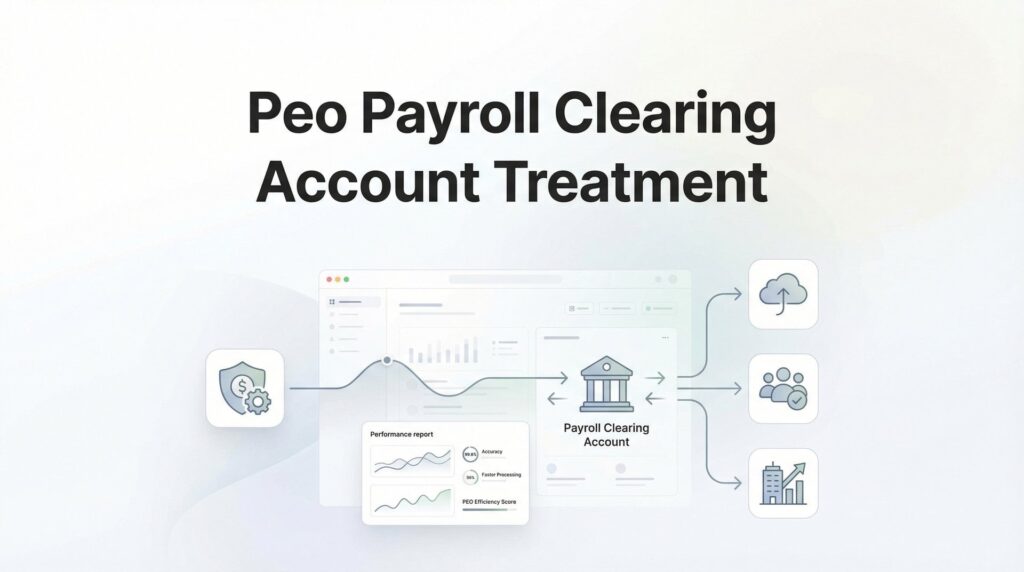
When you run payroll through a PEO, your funds don’t go directly to your employees. They flow into the PEO’s payroll clearing account first—a centralized holding account where money from dozens or hundreds of client companies pools together before being distributed.
Here’s the typical sequence. You approve payroll on Monday for a Friday payday. The PEO calculates the total amount needed: net wages for employees, employer and employee tax withholdings, benefits deductions, workers’ comp premiums, and their administrative fees. That full amount gets debited from your operating account on Wednesday—two days before payday.
Those funds sit in the PEO’s clearing account for 48 hours. On Friday, the PEO initiates ACH transfers to employee bank accounts, remits tax payments to the IRS and state agencies, pays health insurance carriers, and moves funds to their own accounts for fees earned. Your employees see their deposits Friday morning. Tax authorities receive payments according to their deposit schedules. But your cash left your account two days earlier.
This isn’t the PEO holding your money hostage. It’s how aggregated payroll processing works at scale. The clearing account allows the PEO to batch transactions across all their clients, meet banking processing windows, and ensure funds are available when payments need to go out. They’re managing timing risk—if they waited until Friday to pull funds and your ACH failed, your employees wouldn’t get paid.
The aggregation also creates efficiency. Instead of initiating 50 separate tax payments to the IRS for 50 different clients, the PEO can consolidate those into fewer, larger transactions while maintaining detailed records of which portion belongs to which client. The same applies to benefit payments and insurance premiums.
But this efficiency comes with opacity. You can’t see the clearing account. You can’t verify that your funds are segregated from other clients’ money. You’re trusting the PEO’s internal controls to accurately track what portion of that pooled account belongs to you and to disburse it correctly. Understanding how a PEO works at a fundamental level helps you ask the right questions about these processes.
The timing lag also varies. Some PEOs pull funds three business days before payday. Others pull five days early, particularly around holidays when banking windows compress. If you’re running weekly payroll, you might have funds leaving your account almost continuously. That creates cash flow pressure you didn’t have when you processed payroll in-house and controlled the exact timing.
Recording This in Your Books
The clearing account creates a reconciliation headache because the timing of cash movement doesn’t match the timing of expense recognition. Your accountant needs to handle this correctly or your financial statements will be wrong.
When the PEO debits your account on Wednesday for Friday payroll, you’re not recording a payroll expense yet. You’re recording a prepaid expense or a clearing liability—depending on how your accountant structures it. The actual payroll expense gets recognized on Friday when employees earn the wages, even though the cash left two days earlier. This is where understanding PEO accrual accounting treatment becomes essential.
Here’s what that looks like in practice. Wednesday’s journal entry: debit Prepaid Payroll, credit Cash. Friday’s journal entry: debit Payroll Expense (and all related tax expenses), credit Prepaid Payroll. If your accountant records the full expense on Wednesday when cash moves, your P&L timing is off and you’re overstating expenses in one period while understating them in another.
The PEO’s invoice adds another layer. Most PEOs send a detailed invoice after payroll runs, breaking down gross wages, taxes, benefits, and fees. That invoice becomes your source document for the expense entries. But the invoice date, the cash movement date, and the pay period end date are often three different days. Matching these up requires discipline.
Month-end gets messy when payroll spans the cutoff. If your pay period ends March 31 but payday is April 2, you need to accrue the expense in March even though the cash won’t leave until late March or early April. The PEO’s invoice might not arrive until mid-April. You’re estimating the accrual, then reversing it and recording actuals the following month. This is standard accrual accounting, but the PEO clearing account makes it more complex because you have less visibility into the components.
Year-end is worse. You need to ensure all payroll expenses for the calendar year are recorded in the correct year for tax reporting, even if the cash movement or PEO invoice falls in January. If your accountant isn’t carefully tracking pay period dates vs. funding dates, you’ll have timing errors that create tax return headaches.
Reconciliation also requires matching the PEO’s invoice details to your general ledger accounts. The PEO lumps everything into one debit from your bank account, but you need to split that into wages, payroll taxes, health insurance, 401(k) contributions, workers’ comp, and PEO fees across multiple expense accounts. A solid PEO payroll reconciliation process prevents these categorization errors from compounding over time.
Where Your Tax Liability Actually Sits
The clearing account structure exposes a critical risk: who’s liable if payroll taxes don’t get remitted to the IRS? The answer depends entirely on whether your PEO is a Certified Professional Employer Organization.
If you’re working with a CPEO—certified by the IRS under Section 7705—the CPEO is liable for federal employment taxes. The IRS holds them responsible if taxes aren’t paid. Your business is protected. The CPEO’s certification requires bonding, quarterly financial reviews, and annual audits to ensure they have the controls and capital to meet tax obligations. The clearing account funds are subject to those safeguards. Understanding the IRS certified PEO requirements and protections helps you evaluate this critical distinction.
If you’re working with a non-certified PEO, you’re still on the hook. The IRS can come after your business if the PEO collects payroll taxes from you, deposits them in the clearing account, and then fails to remit them to the government. It doesn’t matter that you paid the PEO. The IRS treats you as the employer and expects those taxes to be paid. If the PEO goes bankrupt or misappropriates funds, you’re liable for the shortfall plus penalties and interest.
This isn’t theoretical. Non-certified PEOs have collapsed, leaving client businesses responsible for unpaid payroll taxes that were supposedly already paid. The clearing account model makes this worse because your money is pooled with other clients’ funds. If the PEO has cash flow problems, they might use clearing account funds to cover operational expenses instead of remitting taxes. You won’t know until the IRS sends a notice.
Ask your PEO directly: Are you IRS-certified as a CPEO? If yes, verify it on the IRS website. If no, understand that you’re accepting tax liability risk. The CPEO vs PEO comparison breaks down exactly what protections you gain with certification. Then ask: How are client funds segregated in the clearing account? Are they held in trust? What audit rights do I have to verify tax remittance?
Most non-certified PEOs won’t give you detailed answers about fund segregation. They’ll say it’s proprietary or that their internal controls are sufficient. That’s not good enough when your business is liable for six figures in unpaid payroll taxes if something goes wrong.
Also ask about FDIC coverage. If the clearing account is pooled across clients, FDIC insurance is typically limited to $250,000 per institution, not per client. If the PEO is holding millions in aggregated payroll funds and the bank fails, you could lose money. Some PEOs use sweep accounts or third-party trust arrangements to extend FDIC coverage, but most don’t advertise this unless you ask.
Red flags: The PEO won’t confirm their CPEO status. They can’t explain how funds are segregated. They refuse to provide evidence of timely tax remittance. They’ve changed banks multiple times in recent years. Any of these should make you reconsider the relationship.
Managing Cash Flow When Funds Leave Early
The clearing account timing creates a cash flow gap you need to plan for. If you’re used to holding payroll funds in your account until payday, losing access to that cash two or three days early might not sound significant. But when you’re running tight on working capital, those extra days matter.
Let’s say you run biweekly payroll with a $100,000 gross payroll each cycle. The PEO pulls funds on Wednesday for Friday payday. That’s $100,000 leaving your account 48 hours earlier than it did when you processed payroll in-house. If you’re managing cash flow day-to-day—waiting for customer payments to clear before covering expenses—that timing shift can create overdraft risk.
It’s worse if you’re running weekly payroll. You might have one payroll funding cycle ending just as the next one starts. Your operating account is continuously being debited for upcoming payroll while you’re still waiting for revenue to replenish it. The PEO’s funding schedule doesn’t care about your cash conversion cycle. Understanding the PEO impact on operating expenses helps you model these timing effects accurately.
You can negotiate funding timing with some PEOs, but not all. Larger PEOs with rigid operational processes won’t adjust their funding windows. Smaller or mid-sized PEOs might offer flexibility—pulling funds one day before payday instead of three, or allowing you to fund via wire on payday morning for same-day processing. Ask before you sign the contract, because changing it later is difficult.
Another option: maintain a separate payroll funding account. Transfer the exact amount needed into that account a few days before the PEO’s debit date, keeping your main operating account insulated from the timing lag. This adds a manual step, but it gives you better control over cash flow and makes reconciliation cleaner.
If your business has seasonal cash flow—revenue concentrates in certain months while payroll is consistent year-round—the clearing account timing can create strain during lean months. You’re funding payroll three days early when you can least afford to. Plan for this. Build a payroll reserve or arrange a line of credit that covers the timing gap during slow periods.
Some businesses don’t realize how much cash flow cushion they’ve lost until they’re in a bind. When you controlled payroll timing in-house, you could strategically delay processing by a day or two if cash was tight. With a PEO, that flexibility is gone. The clearing account debit happens on their schedule, not yours.
When This Model Doesn’t Fit Your Business
The clearing account structure works fine for most businesses, but there are scenarios where it creates real operational problems that outweigh the benefits of using a PEO.
If you’re running a seasonal business with highly variable cash flow—landscaping, retail, hospitality—the rigid funding schedule can be painful. You’re required to fund payroll three days early even during months when revenue is minimal and you’re burning through cash reserves. The PEO won’t adjust their funding timeline based on your seasonal needs. You either maintain a large cash cushion year-round or you’re constantly stressed about covering the payroll debit.
Businesses with very tight cash conversion cycles face similar issues. If you’re a contractor who doesn’t get paid until 60 days after completing work, but you need to fund payroll every two weeks, the clearing account timing makes a bad situation worse. You’re already fronting labor costs for two months—now you’re fronting them an extra three days on top of that. Running a PEO ROI and cost-benefit analysis helps quantify whether the trade-offs make sense for your specific situation.
Audit-heavy industries—government contractors, nonprofits, healthcare—sometimes struggle with clearing account opacity. Auditors want detailed documentation of payroll expenses, tax remittances, and benefit payments. The PEO’s consolidated invoice and pooled clearing account make it harder to provide the transaction-level detail auditors expect. You’re dependent on the PEO producing reports that satisfy your auditor’s requirements, and not all PEOs have robust enough systems to do that cleanly. Understanding the PEO impact on audit procedures before you sign helps you avoid surprises.
Some PEOs offer alternative arrangements if you push for them. A few will allow you to fund payroll on payday instead of days in advance, though they’ll typically charge a premium for that accommodation or require you to use a specific bank they partner with. Others offer trust account arrangements where your funds are legally segregated instead of pooled, providing better protection and audit trail—but again, this usually costs extra.
Ask whether these options exist before you sign. Most PEOs won’t volunteer them because their standard clearing account model is more profitable and operationally simpler. But if your business has specific cash flow constraints or audit requirements, it’s worth negotiating.
The clearest sign this model isn’t working: you’re constantly scrambling to cover the payroll debit, or your accountant is spending hours every month reconciling PEO transactions that don’t match your internal records. If the administrative burden of managing the clearing account timing outweighs the value the PEO provides, you’re in the wrong arrangement.
You might be better off with a payroll provider that doesn’t use a PEO co-employment model—where you retain full control of timing and funds never leave your account until payday. The PEO vs payroll company comparison helps you understand when each option makes more sense. You lose some of the compliance and HR support a PEO provides, but you gain cash flow control and accounting simplicity.
What to Do Next
If you’re already working with a PEO, start by confirming their CPEO status and understanding exactly when they pull funds relative to payday. Look at your last three months of bank statements and map out the timing lag. Then sit down with your accountant and make sure your books are recording the transactions correctly—expense recognition on payday, not when cash moves.
Ask your PEO for a detailed breakdown of how their clearing account works. Where are funds held? Are they segregated or pooled? What happens if the bank fails? Can you verify that taxes were remitted on time? If they won’t answer these questions clearly, that’s a problem worth escalating.
Set up a reconciliation process that matches the PEO’s invoice to your general ledger every pay period. Don’t let these pile up. If you wait until year-end to reconcile, you’ll find discrepancies you can’t easily resolve. Catch timing differences and categorization errors immediately.
If you’re evaluating PEOs, make clearing account practices part of your due diligence. Ask how many days before payday they pull funds. Ask whether they’re certified. Ask what happens if you need to delay funding due to cash flow constraints. The answers will tell you whether their operational model fits your business reality.
This isn’t just accounting housekeeping. The clearing account structure affects your cash flow, your tax liability exposure, and your ability to maintain accurate financial records. Understanding how it works and what to watch for is part of protecting your business when you hand payroll processing to a third party.
Before you sign that PEO renewal, make sure you’re not leaving money on the table. Many businesses unknowingly overpay because of bundled fees, hidden administrative markups, and contracts designed to limit flexibility. We give you a clear, side-by-side breakdown of pricing, services, and contract terms—so you can see exactly what you’re paying for and choose the option that truly fits your business. Don’t auto-renew. Make an informed, confident decision.
