
Most businesses sign a PEO agreement and assume payroll taxes are handled. And technically, they are — the PEO files under its own FEIN, submits the deposits, manages the forms. But “handled” and “your risk is gone” are two very different things, and that distinction can cost you real money when something goes wrong.
A missed deposit window. A worker classification dispute that predates the PEO relationship. A multi-state footprint where unemployment tax rates are assigned differently than you expected. None of these are rare edge cases. They show up in audits, in contract disputes, and in renewal conversations where the PEO’s definition of “liability” turns out to be narrower than yours.
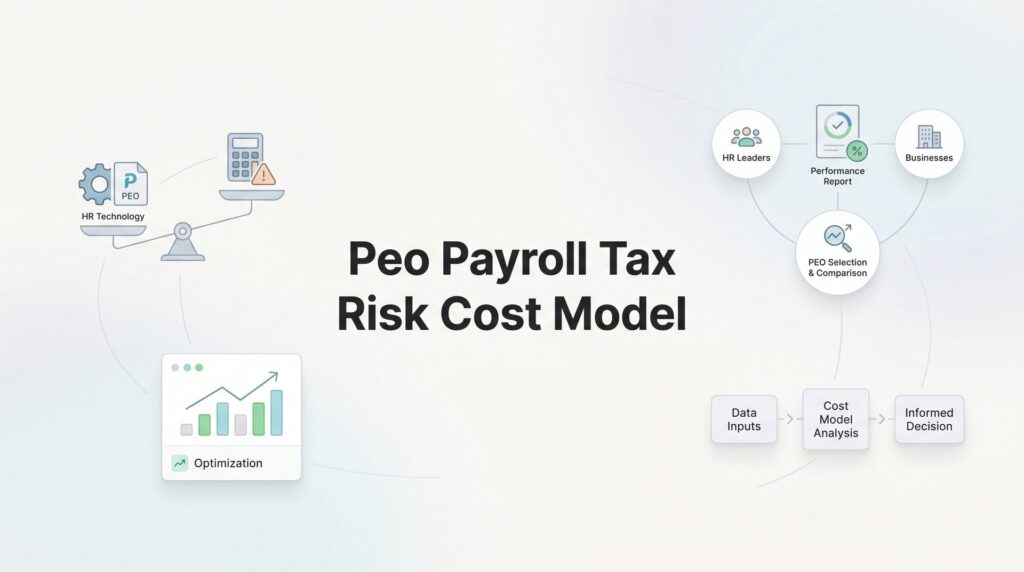
This article is about building a practical cost model that maps your actual payroll tax risk exposure under a PEO arrangement. Not a theoretical exercise — a working framework you can use to evaluate proposals on risk-adjusted cost, not just headline pricing. If you’re still getting familiar with how PEO pricing structures work overall, start with the foundational PEO pricing guide first. This piece assumes you’re past the basics and ready to go deeper on the tax risk layer specifically.
Where Payroll Tax Risk Actually Lives
The co-employment structure creates an interesting split. The PEO is the employer of record for federal and state payroll tax filing purposes. It files Forms 940 and 941 under its own FEIN, not yours. That sounds like it removes you from the equation — but the service agreement, not the filing structure, determines who actually bears financial responsibility when something breaks.
This is the part most businesses miss. Filing responsibility and financial liability are not the same thing. A PEO can file every form correctly and still have a contractual structure that passes penalties back to you under certain conditions.
There are three core risk buckets worth modeling separately, because each one has different cost drivers and different contractual treatment:
Tax deposit timing risk. The IRS imposes tiered penalties under IRC §6656 for late payroll tax deposits. The penalty starts at 2% for deposits 1-5 days late and escalates to 15% for amounts still unpaid more than 10 days after the first IRS notice. If a deposit error is caused by a data submission delay on your end (late hours reporting, payroll changes submitted after cutoff), many PEO agreements explicitly carve that liability back to you. Understanding how PEO payroll tax penalty protection works is essential before you evaluate any proposal.
Worker classification risk. If you bring workers into a PEO arrangement who were previously misclassified as independent contractors, that pre-existing liability doesn’t disappear. The PEO becomes the employer of record going forward, but back-tax exposure for the misclassification period typically stays with you. The DOL and IRS have both increased scrutiny of worker classification in recent years, which makes this a live risk for any company with a contractor-heavy history.
Multi-state nexus and SUTA apportionment risk. If your workforce spans multiple states, unemployment tax treatment can vary significantly depending on how your PEO handles state-level rate assignment. This is complex enough to warrant its own section — and it’s the variable most businesses never think to model.
The key takeaway here: when a PEO sales rep says “we handle payroll taxes,” ask the follow-up question. Handle means file. It doesn’t automatically mean absorb. Get the distinction in writing before you sign anything.
Building the Cost Model: Inputs That Actually Matter
A payroll tax risk cost model doesn’t need to be a spreadsheet nightmare. It needs to be directionally accurate enough to compare providers on something other than sticker price. Here are the variables that drive meaningful differences in exposure.
Headcount and payroll volume. These are your baseline multipliers. Higher payroll volume means larger absolute penalty exposure on deposit timing issues, and more employees means more surface area for classification disputes. A 20-person company and a 150-person company face fundamentally different risk scales even if their PEO agreements look identical.
Number of states. Every state you operate in adds a layer of unemployment tax complexity. Some states let PEOs file under a master rate; others require client-level experience tracking. The more states you’re in, the more this variable matters in your model. Companies navigating this should review how PEO multi-state payroll compliance actually works across jurisdictions.
Worker classification mix. If your workforce includes workers who have recently transitioned from 1099 to W-2, or if you have ongoing contractor relationships that run parallel to your PEO-covered workforce, you carry classification risk that most PEO agreements won’t indemnify. Estimate the payroll volume associated with those workers and treat it as unprotected exposure.
Historical tax notice frequency. If you’ve received IRS or state tax notices in the past few years, that’s a signal your processes have gaps. Even under a PEO, if those gaps relate to data you supply (payroll changes, new hire reporting, hours), the liability can still land with you.
Once you have those inputs, you can estimate exposure per bucket. For deposit timing risk, use the IRS penalty tiers as your framework: take your average per-period payroll tax deposit amount and calculate what a 10% penalty (the tier that applies when deposits are more than 15 days late) would cost you annually if one deposit cycle went wrong. That’s your baseline exposure figure for this bucket.
For SUTA exposure, the calculation depends heavily on your state mix and the PEO’s rate assignment approach — more on that in the next section.
One structural note: the PEO’s pricing model matters here. A percentage-of-payroll fee structure means the PEO’s revenue scales with your payroll, which gives them more financial skin in the game on tax accuracy. A flat per-employee-per-month structure doesn’t scale that way. Neither is inherently better, but the pricing structure does affect which party absorbs more risk at different payroll levels, and understanding PEO cost allocation methodology is worth factoring into your model.
Also worth knowing: if your PEO holds IRS CPEO (Certified Professional Employer Organization) designation, that meaningfully shifts federal employment tax liability. Under the CPEO program — established by the Tax Increase Prevention Act of 2014 and effective since 2017 — the CPEO assumes sole liability for federal employment taxes during the service period. That’s a real differentiator when you’re modeling federal tax risk, and it’s a question worth asking every provider you’re evaluating.
SUTA Rate Assignment: The Variable Most Models Ignore
State unemployment tax rates are assigned based on an employer’s experience rating — essentially, your claims history. The longer you operate with low unemployment claims, the better your rate gets. It’s a system designed to reward stability.
Here’s where PEOs complicate that.
Many PEOs pool all client employees under their own master SUTA account in states that allow it. Florida and Georgia are examples of states that explicitly permit this kind of master rate reporting. When you’re pooled, your employees’ claims history gets folded into the PEO’s aggregate experience rating, and you pay the PEO’s blended rate — not a rate derived from your own history.
That’s a good deal if your claims history is bad. If your rate would be high on a standalone basis, the PEO’s pooled rate might actually be lower. But if you’ve spent years building a clean claims history and your standalone rate is well below average, you could end up paying more under a pooled arrangement than you would on your own. This is a documented tradeoff in PEO industry literature, and it’s not a small number — SUTA rates vary meaningfully across states and experience tiers.
The state-by-state variation adds another layer. Some states require client-level experience rating even when a PEO is involved, which means your history follows you regardless of the PEO arrangement. Others let the PEO’s rate apply universally. If your workforce spans multiple states, you may be in a pooled arrangement in some states and client-rated in others — which means you need to model each state separately to get an accurate picture. Conducting a thorough state employment law risk review before signing is critical for multi-state employers.
The NAPEO (National Association of Professional Employer Organizations) and individual state workforce agency websites are the authoritative sources for how each state handles PEO SUTA rate assignment. It’s worth pulling the rules for every state in your footprint before you finalize a PEO comparison.
The exit risk is the part almost nobody thinks about until it’s too late. If you’ve been under a PEO’s pooled SUTA rate for several years and then leave the PEO, your standalone rate doesn’t pick up where it left off. In many states, you’ll be treated as a new employer and assigned the default new employer rate — which is often higher than what you would have earned by building your own experience history over those same years. That’s a real cost that belongs in your total cost of ownership model, not just the annual comparison.
What the Service Agreement Actually Says About Risk
This is where most businesses spend the least time and take the most risk. The PEO contract is where the financial liability actually gets allocated — and the language is often written to protect the PEO, not you.
A few clauses to examine closely:
Indemnification scope for payroll tax errors. Some PEO agreements include broad indemnification for tax penalties caused by PEO filing errors. Others include carve-outs that shift liability back to you if the error resulted from late or incorrect data you submitted. Read this carefully. If your payroll changes are due on Tuesday and you submit on Thursday, and a deposit is late as a result, many agreements treat that as a client-caused error — meaning the penalty is yours. Understanding common PEO contract liability risks can help you spot these traps before they cost you.
Limitation of liability caps. Many PEO contracts cap the PEO’s total financial liability at a fixed amount — sometimes a multiple of fees paid, sometimes a flat dollar figure. If the IRS penalty on a deposit error exceeds that cap, you’re carrying the remainder. This is a real exposure gap that most businesses don’t discover until they’re in a dispute. Calculate what your maximum plausible penalty exposure looks like under the IRS tiered structure, then compare it to the contract’s liability cap. If the gap is meaningful, it belongs in your risk model.
Pre-existing liability exclusions. Almost every PEO agreement excludes liability for tax issues that predate the service relationship. This is reasonable from the PEO’s perspective, but it means any classification exposure or back-tax liability from your history before the PEO is entirely yours. Make sure you’ve done a clean audit of your pre-PEO exposure before signing — don’t assume the PEO relationship wipes the slate.
A practical framework for scoring contractual risk transfer: categorize each provider’s agreement into one of three tiers. Full absorption means the PEO takes on tax penalty liability with minimal carve-outs. Shared liability means penalties are split or carved out based on fault. Pass-through means most penalty risk flows back to you regardless of who caused the error. Then assign a rough dollar estimate to each tier based on your payroll volume and the IRS penalty tiers. Building a proper PEO financial modeling template gives you a risk-adjusted cost comparison, not just a fee comparison.
A Scenario Walkthrough: Putting the Model Together
To make this concrete, consider a hypothetical: a 60-person company operating in three states, with roughly $4.5 million in annual payroll. About 10 of those workers recently converted from contractor to W-2 status. The company has received two state tax notices in the past three years. This is a realistic profile for a mid-sized business evaluating PEO options.
Running through the risk buckets:
Deposit timing risk. At $4.5M annual payroll, the company’s semi-weekly federal deposit obligation is substantial. A single deposit delay of more than 15 days — even one caused by a payroll data submission issue — could trigger a 10% IRS penalty on that deposit amount. Depending on the payroll cycle, that’s a meaningful four-figure exposure per incident. Under a PEO agreement with a client-error carve-out, that cost lands with the company, not the PEO.
Worker classification exposure. The 10 recently converted workers represent a pre-PEO classification risk window. If the IRS or DOL were to examine that transition, back-tax liability for the contractor period would fall outside the PEO’s indemnification scope entirely. Estimating the payroll equivalent for those workers over the prior two years gives you a baseline figure for this bucket. Proper payroll tax liability accounting helps quantify this exposure accurately.
SUTA rate differential. In two of the three states, the PEO uses pooled master rate reporting. If the company’s standalone experience rate in those states is below the PEO’s pooled rate, they’re paying more than they would independently. In the third state, client-level rating is required, so their own history applies. Without modeling each state separately, this cost difference is invisible in the proposal comparison.
Now imagine two PEO proposals come in with nearly identical per-employee-per-month pricing. One holds CPEO designation and has broad indemnification language with a high liability cap. The other is not CPEO-certified and has a client-error carve-out plus a liability cap well below the company’s estimated maximum penalty exposure.
On paper, the proposals look similar. After running the risk model, the gap in net cost position is significant — and the decision becomes straightforward. A thorough PEO ROI and cost-benefit analysis that includes risk-adjusted figures makes the right choice clear. That’s the point of doing this analysis. Not precision to the penny, but enough directional clarity to make a genuinely informed choice.
Questions to Ask Before You Sign
Payroll tax risk is quantifiable. Ignoring it doesn’t make it go away — it just means you’re evaluating PEO proposals with incomplete cost data and hoping the fine print works in your favor.
Before you sign or renew, ask every provider these questions directly and get the answers in writing:
“What is your tax penalty indemnification scope, and what are the carve-outs?” You want to know exactly what triggers liability shifting back to you.
“Are you a CPEO, and how does that affect federal employment tax liability during the service period?” CPEO status is a meaningful differentiator — if they don’t have it, understand what that means for your federal tax exposure.
“How are SUTA rates assigned in each state where my employees work?” Get the answer for each state in your footprint. Don’t accept a general answer.
“What is your contractual liability cap, and how is it calculated?” Then compare that cap to your estimated maximum penalty exposure under the IRS tiered structure.
“If I exit the PEO, what happens to my SUTA experience rating in pooled states?” Understand the exit cost before you’re in it.
The goal isn’t to find a PEO that’s risk-free — that doesn’t exist. The goal is to understand the actual risk allocation before you sign, price it into your comparison, and choose a provider whose contract structure genuinely matches the protection they’re selling you in the pitch.
If you’re comparing multiple providers right now, don’t rely on proposal summaries alone. Get into the contract language, run the risk buckets, and make sure you’re comparing total cost positions — not just the number on the cover page. Don’t auto-renew. Make an informed, confident decision.
