
You sit through a PEO sales presentation and hear “shared services” mentioned three times. It sounds efficient. Maybe even sophisticated. But what does it actually mean when you need help with a payroll issue on Friday afternoon or have a compliance question that can’t wait until next week?
Here’s the reality: shared services architecture means the HR team supporting your company is also supporting dozens—sometimes hundreds—of other businesses at the same time. They’re juggling competing priorities, working through ticket queues, and spreading expertise across a client base where your urgent need might be someone else’s routine request.
This isn’t inherently good or bad. It’s a structural tradeoff. Shared services give you access to capabilities and buying power you couldn’t afford alone. But they also mean you’re not the only one in line. Understanding how this architecture actually functions—and whether it fits your operational reality—matters more than most PEO contracts acknowledge upfront.
How PEOs Actually Structure Shared Services
The shared services model starts with a simple economic principle: if you can spread fixed costs across more clients, everyone pays less. A PEO hires specialists in payroll processing, benefits administration, and compliance monitoring. Instead of one company bearing the full cost of that expertise, dozens of client companies share it.
Think of it like a law firm. You don’t get your own attorney sitting in your office full-time. You get access to legal expertise when you need it, billed in increments, with other clients doing the same. The firm maintains the infrastructure—research tools, case management systems, support staff—and distributes those costs across everyone they serve.
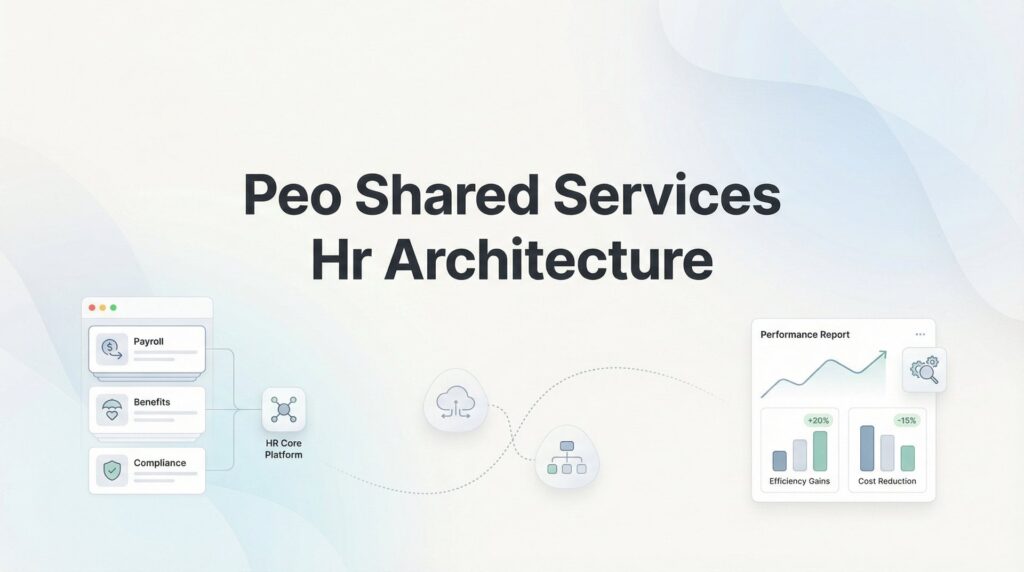
PEOs work similarly. They build centralized teams organized either by function or geography. You might have a payroll processing team in one location, a benefits administration team in another, and compliance specialists working remotely across multiple states. These teams operate through shared technology platforms where your company data sits alongside everyone else’s, partitioned but not isolated.
The technology layer is what makes this scalable. One benefits administrator can manage open enrollment for twenty companies simultaneously because the platform standardizes workflows, automates notifications, and routes exceptions through ticketing systems. The same principle applies to payroll processing, tax filing, and compliance monitoring.
Where PEOs differentiate is in how they layer account management on top of shared services. Some assign you a dedicated account representative who acts as your single point of contact but doesn’t actually process your payroll or handle your benefits enrollment. They’re a coordinator who routes your requests to the shared service teams.
Other PEOs skip the dedicated rep entirely. You submit tickets directly into the shared queue. Your requests get prioritized based on urgency, complexity, and sometimes—though they won’t say this explicitly—your contract value and company size.
The co-employment structure itself creates shared architecture by design. When a PEO becomes the employer of record for your workforce, they’re simultaneously the employer of record for their entire client base. That means compliance monitoring, tax obligations, and regulatory reporting happen at the PEO level across all clients. They can’t maintain separate, isolated systems for each company even if they wanted to. The model requires pooled infrastructure.
What Shared Support Actually Feels Like
Let’s say you discover a payroll discrepancy on Thursday afternoon. An employee’s commission wasn’t calculated correctly, and payday is Friday. You submit a ticket to your PEO. What happens next depends entirely on how their shared services queue is functioning that day.
If it’s a slow week and your issue is straightforward, you might get a response within hours and a resolution before payroll runs. If it’s year-end and half their client base is submitting W-2 corrections simultaneously, your ticket sits in the queue behind dozens of others. The team isn’t ignoring you. They’re working through competing priorities across multiple clients who all feel equally urgent.
This is the core operational reality of shared services: response time isn’t just about your issue’s urgency. It’s about everyone else’s urgency too.
Open enrollment seasons create predictable bottlenecks. Every client company goes through benefits elections roughly the same time each year. The shared benefits team that seemed responsive in July is suddenly underwater in November. Your questions about HSA contribution limits or dependent eligibility get queued behind similar questions from fifty other companies.
Year-end processing hits the same way. Tax document preparation, annual compliance filings, and benefits reporting all converge in Q4 and Q1. The shared teams that handle these functions are stretched thin across their entire client base. If you need something customized or have an unusual situation, it takes longer to resolve because the team is optimizing for volume, not complexity.
Most PEOs operate tiered support models even if they don’t explicitly advertise them. Larger clients with higher contract values often get priority routing or access to senior specialists. Smaller companies get standard queue treatment. Your company’s size and contract tier affect how quickly shared teams respond and how much flexibility they offer when you need something outside standard procedures.
The account rep layer—when it exists—helps buffer some of this. A dedicated rep can escalate your issue, provide context to the shared team, and follow up on your behalf. But they don’t actually process your payroll or resolve your compliance question. They’re navigating the same shared services infrastructure you would be, just with more internal knowledge about how to move things along.
Where Pooled Resources Actually Deliver
Here’s what shared services architecture makes possible: a 30-person company gets access to benefits plans typically reserved for employers with 500+ employees. The PEO pools buying power across their entire client base, negotiating with insurance carriers as if they’re a single large employer. You piggyback on that scale.
This isn’t theoretical. Small businesses consistently pay more for health insurance when they buy directly from carriers. The risk pool is smaller, the administrative costs are higher relative to premium volume, and there’s no negotiating leverage. A PEO’s shared architecture spreads that risk and cost across hundreds of companies, bringing your per-employee premiums down.
The same principle applies to retirement plans, supplemental benefits, and voluntary offerings. A standalone 401(k) for a small company comes with high administrative fees and limited investment options. Through a PEO’s pooled plan, you get institutional pricing and professional plan administration that would cost significantly more if you contracted for it independently.
Compliance expertise works the same way. Hiring an in-house HR manager who truly understands multi-state employment law, ACA reporting requirements, and evolving workplace regulations costs $80,000 to $120,000 annually plus benefits. Most companies under 100 employees can’t justify that expense.
A PEO spreads that HR compliance expertise across their client base. They employ specialists who monitor regulatory changes, update policies, and ensure compliance across all the companies they serve. You get access to that knowledge without bearing the full cost of the headcount.
Technology investments follow the same logic. Building or buying an integrated HRIS platform that handles payroll, benefits, time tracking, and compliance costs hundreds of thousands of dollars for a standalone implementation. PEOs amortize those technology costs across their entire client base. You get access to enterprise-grade systems at a fraction of what they’d cost to implement independently.
The shared model also creates knowledge transfer that benefits everyone. When one client faces a complex compliance issue—say, navigating paid family leave requirements in a new state—the PEO’s solution becomes institutional knowledge that helps the next client facing the same situation. You benefit from problems other companies already solved.
Where Shared Architecture Creates Real Friction
You need to make an offer to a candidate by end of business today. The compensation package includes a sign-on bonus with a specific vesting schedule and a relocation reimbursement structured as a forgivable loan. You reach out to your PEO to get the offer letter and employment agreement drafted.
The shared services team responds that they use standard templates. Custom compensation structures require legal review, which takes 5-7 business days. The candidate accepts another offer while you’re waiting.
This is where shared services architecture breaks down. The model optimizes for standardization because that’s what makes it economically viable. One benefits administrator can manage twenty companies if they’re all using similar plan structures and enrollment processes. Introduce customization and the efficiency collapses.
Your company becomes an edge case. The shared team has to route your request to someone with more expertise, research how to implement what you’re asking for, and potentially escalate for approval. All of this takes time because it’s happening outside their standard workflow.
Control over timing is another friction point. You want to process an off-cycle bonus payment for your sales team before a long weekend. The shared payroll team has a cutoff schedule that applies across all clients. Your request doesn’t fit their processing calendar, so it gets pushed to the next cycle. The timing that made sense for your business doesn’t align with the PEO’s operational schedule.
Or you’re implementing a new commission structure that requires custom calculations. The shared services team explains that their payroll system handles standard commission formulas, but complex calculations need to be done externally and imported as flat amounts. You’re now maintaining a separate spreadsheet and doing manual work that you assumed would be automated.
Reporting is another common frustration. You need specific data cuts for a board presentation or investor update. The PEO’s reporting tools generate standard reports that work for most clients. Custom reporting requires submitting a request, explaining exactly what you need, and waiting for someone to pull the data manually. If you need iterative changes or discover the initial report doesn’t quite capture what you wanted, you’re back in the queue.
The larger your company gets or the more complex your needs become, the more these limitations surface. Shared services work well when your requirements fit the standard model. They create friction when you need flexibility, speed, or customization that doesn’t scale across the PEO’s entire client base.
Figuring Out If Shared Services Fit Your Reality
Before you commit to a PEO contract, you need to understand exactly how their shared services operate and whether that structure aligns with your actual needs. Start with questions about response times and service level agreements.
Ask specifically: What’s your average response time for routine requests versus urgent issues? How do you define urgent? What happens during peak periods like open enrollment or year-end? Do SLAs vary based on company size or contract tier?
Most PEOs will give you general timeframes. Push for specifics. If they say “24-48 hours for most requests,” ask what percentage of requests actually get resolved in that window. Ask how they handle situations where your urgent need conflicts with other clients’ priorities.
Dig into their team structure. How many clients does each specialist typically support? Are teams organized by function or geography? Do you get a dedicated account rep, and if so, what can they actually do versus what gets routed to shared teams?
Test their flexibility on customization. Describe specific scenarios from your business—unusual compensation structures, complex leave policies, multi-state operations with varying requirements—and ask how they’d handle them. Listen for whether they’re problem-solving with you or explaining why their standard approach should work fine.
Red flags emerge when PEOs minimize the shared nature of their services or suggest that dedicated support means something it doesn’t. If they’re vague about how many clients each team member supports or can’t articulate clear escalation paths, that’s telling.
Another warning sign: they position their technology platform as the solution to all service questions. Technology enables shared services, but it doesn’t replace human judgment and flexibility. If every answer involves pointing you to a portal or self-service tool, consider whether that matches your team’s capacity to handle HR administration independently.
Assess your internal HR capability honestly. If you have someone who can handle routine administration and just needs expert backup for complex issues, shared services might work well. If you’re relying on the PEO to be your entire HR function and need responsive, hands-on support, shared architecture may create more frustration than value.
Company size matters, but not in the way you might think. It’s not just about headcount—it’s about complexity. A 50-person company with straightforward needs might thrive with shared services. A 50-person company with multi-state operations, variable compensation, and complex leave policies might struggle.
Making Shared Services Work Better
If you decide shared services fit your needs, structure the relationship to minimize friction from the start. Negotiate specific SLAs during contract discussions, not after you’ve signed. Define response times for different request types. Establish what constitutes an urgent issue and how those get prioritized.
Get escalation paths in writing. When the standard shared services queue isn’t working, who do you contact? What’s the process for elevating issues that aren’t getting resolved? Make sure you have a clear path that doesn’t just loop you back into the same queue.
If your company size or contract value gives you leverage, push for hybrid arrangements. Maybe you get a dedicated payroll specialist but share benefits administration. Or you negotiate quarterly business reviews with senior team members who can address systemic issues rather than one-off tickets.
Structure your internal operations to interface effectively with shared teams. Designate one person as your primary PEO contact who learns their systems, understands their processes, and can communicate efficiently with their teams. Spreading PEO interactions across multiple people in your organization creates confusion and slower resolution.
Build buffer time into your planning. If you know open enrollment creates bottlenecks, start your internal preparation earlier. If year-end processing slows response times, don’t wait until December to address compliance questions. Work around the predictable constraints of shared services rather than fighting them.
Document everything. Shared services mean you’re not always working with the same person. Keep records of previous decisions, special arrangements, and how specific situations were handled. When you need to explain context to a new team member, you have the history readily available.
Use your account rep strategically if you have one. They’re your advocate within the PEO’s internal structure. When you’re not getting traction through normal channels, that’s when you escalate to them. Don’t bypass the shared services teams for routine requests, or you’ll train yourself to be dependent on a single point of contact who can’t actually process most requests.
Making the Right Call for Your Business
Shared services architecture isn’t a flaw in the PEO model. It’s a fundamental design choice that makes certain capabilities accessible to businesses that couldn’t afford them otherwise. But it’s also a constraint that affects how quickly you get support, how much customization you can implement, and how much control you maintain over timing.
The evaluation comes down to honest assessment. What does your business actually need from HR support? How much complexity do you operate with? What’s your internal capacity to handle routine administration? How important is response speed versus cost savings?
Companies that thrive with shared services tend to have straightforward needs, some internal HR capability, and realistic expectations about what pooled resources deliver. They value the cost savings and access to expertise more than they need dedicated, always-available support.
Companies that struggle with shared services often have complex requirements, limited internal HR capacity, or operational needs that don’t align with standardized processes. They discover too late that shared architecture creates bottlenecks when they need flexibility.
Before you sign that PEO renewal, make sure you’re not leaving money on the table. Many businesses unknowingly overpay because of bundled fees, hidden administrative markups, and contracts designed to limit flexibility. We give you a clear, side-by-side breakdown of pricing, services, and contract terms—so you can see exactly what you’re paying for and choose the option that truly fits your business.
