
You sign with a PEO, expect the HR headaches to disappear, and then six months later you’re realizing the provider you chose is genuinely excellent at something your business barely needs. A manufacturer with serious workers’ comp exposure ends up with a PEO whose real strength is white-collar benefits administration. A fast-scaling startup gets locked into a platform built for steady-state compliance at 25 employees. Nobody lied. The PEO delivered what it promised. The problem is that nobody stopped to ask whether those promises matched what the business actually needed.
That’s the alignment problem. And it’s more common than most business owners realize until they’re 18 months in, paying for services they don’t use, and quietly dreading the switching conversation.
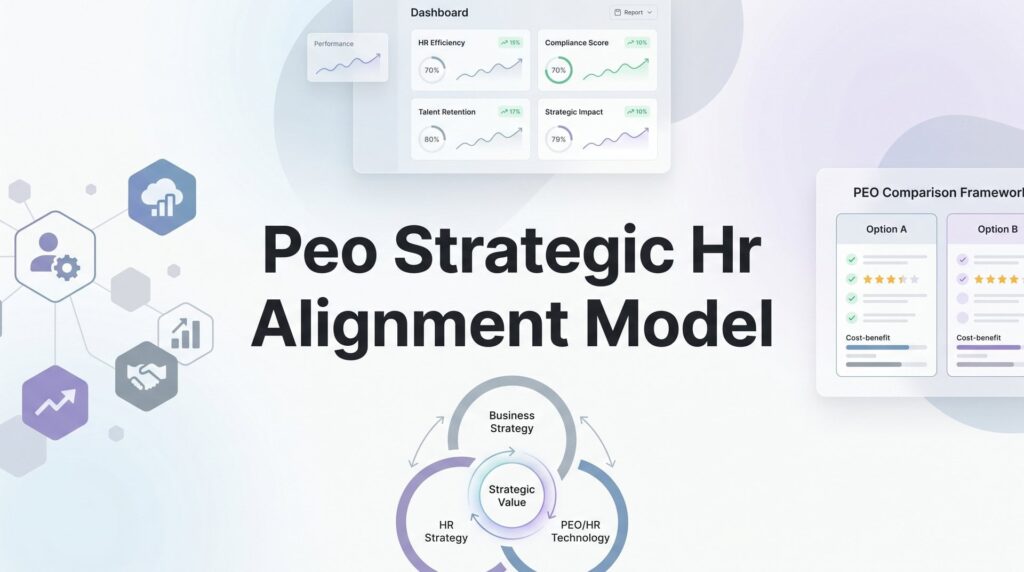
A strategic HR alignment model is the structured process you run before you engage any PEO sales team. It forces you to define your actual HR priorities, map your real risk exposure, and evaluate providers against your specific situation rather than their marketing materials. This article walks you through how to build one and why it changes the outcome of the PEO selection process entirely.
Why Most PEO Relationships Start Misaligned
The typical PEO selection process runs backwards. Most businesses start by gathering proposals, comparing price per employee, and checking whether the brand name is recognizable. They evaluate PEOs before they’ve clearly defined what they need a PEO to do. That sequence almost guarantees a mismatch.
It’s not a vendor problem. PEOs specialize. Some are genuinely built around compliance infrastructure for multi-state employers. Others have invested heavily in benefits purchasing power and carrier relationships. Some are optimized for payroll accuracy and administrative simplicity. The issue is that a business evaluating all three on price alone will likely select the cheapest option without knowing whether that option’s core competency lines up with their core vulnerability.
The misalignment patterns tend to cluster around a few common scenarios. A business with complex state-level compliance needs chooses a PEO that’s strong in payroll but thin on regulatory support. A company with high turnover in hourly roles selects a PEO whose benefits platform is designed for retention-focused salaried workforces. A growth-stage company at 20 employees signs with a PEO whose systems and service model start showing strain at 60. In each case, the mismatch was discoverable before signing. Nobody looked.
The financial cost of misalignment is easy to underestimate. It doesn’t always show up as a line item. It shows up as fees for services you never activate, gaps in coverage you assumed were included, and the slow accumulation of workarounds when the PEO can’t support something your business actually needs. Running a PEO cost variance analysis can help you quantify these hidden expenses before they compound.
The deeper issue is that the PEO sales process is designed to close deals, not to surface misalignment. Proposals are built to look comprehensive. Every PEO will tell you they handle compliance, benefits, and payroll. The question is how well, for what kind of business, at what scale, and under what conditions. Those answers require a framework on your side of the table before you start the conversation.
The Four Pillars of a Strategic HR Alignment Model
A practical alignment model rests on four pillars. Each one forces a different kind of clarity about what your business actually needs from a PEO relationship. Together, they give you a structured basis for evaluating providers instead of reacting to proposals.
Pillar 1: Operational Priority Mapping. Not all HR functions carry equal weight for every business. Payroll accuracy matters to everyone, but for some companies it’s table stakes. For others, multi-state compliance is the function that keeps the CFO up at night. Priority mapping means ranking your HR functions by actual business impact: compliance, benefits quality, risk management, payroll administration, talent acquisition support, and workforce analytics. The goal is to stop treating these as equal checkboxes and start understanding which two or three functions, if handled poorly, would cause the most damage to your operations.
A construction company with crews in four states and a serious OSHA exposure profile has a different top-three than a professional services firm with 30 employees in one state. Priority mapping makes that difference explicit before you start comparing providers.
Pillar 2: Risk Exposure Profile. This is where you get honest about where your business is actually vulnerable. Multi-state payroll creates compliance risk. Industry-specific regulations, whether OSHA, healthcare licensing requirements, or transportation rules, create enforcement risk. Employment litigation history creates liability risk. High seasonal turnover creates classification and wage-and-hour risk.
Your risk exposure profile should identify the top two or three areas where an HR failure would be most costly or disruptive. Then you weight your PEO selection toward providers with demonstrated strength in those specific areas. A PEO with a strong compliance team and dedicated regulatory specialists is worth more to a multi-state employer than one with a slicker benefits portal. Understanding PEO risk management and liability support is essential to evaluating this pillar effectively.
Pillar 3: Growth Trajectory Fit. PEOs are not interchangeable at different headcount levels. The platform, service model, and pricing structure that works well at 15 employees often creates friction at 80. Some PEOs are built for small, stable businesses. Others are designed to scale with companies moving through rapid growth phases. A few specialize in mid-market employers with complex organizational structures.
The mistake is selecting a PEO based on where you are today without modeling where you’ll be in two to three years. If your hiring plan calls for doubling headcount, entering new states, or adding benefit tiers, those factors need to be part of the evaluation now. Switching PEOs mid-growth is expensive and disruptive. The best PEOs for rapid growth companies are specifically built to handle that kind of scaling without service degradation.
Pillar 4: Cost Structure Compatibility. This pillar is less about finding the lowest price and more about understanding whether the PEO’s fee model aligns with how your costs actually behave. Percentage-of-payroll pricing creates predictable costs for stable headcount but can get expensive fast during growth phases. Flat per-employee-per-month models work differently under seasonal fluctuations. Bundled pricing hides whether you’re paying for services you’ll never use. Understanding your own cost structure before evaluating proposals lets you compare providers on an apples-to-apples basis rather than getting distracted by headline numbers.
Building Your Alignment Scorecard Before You Talk to Providers
The scorecard is where the model becomes actionable. The concept is straightforward: assign percentage weights to your key HR priorities based on their actual importance to your business, then score each PEO you evaluate against those weighted criteria. What makes it useful is that it shifts the evaluation from the PEO’s framing to yours.
Start by listing the HR functions that matter most to your business. Compliance and regulatory support. Benefits quality and carrier access. Payroll accuracy and processing. Risk management and workers’ comp. Administrative burden reduction. Talent acquisition support. Workforce analytics and reporting. You won’t weight all of these equally, and you shouldn’t pretend to.
Assign percentage weights that reflect your actual priorities. A manufacturing company with multi-state operations might weight compliance and risk management at 50% combined, with benefits quality at 20% and payroll at 20%. A professional services firm with a competitive talent market might flip that, weighting benefits quality at 35% and compliance at 25%. There’s no universal right answer. The right answer is the one that reflects your real pain points.
Here’s where most businesses skip a step that matters: pressure-test the scorecard before you finalize it. Interview your own team. Talk to your operations manager about where HR gaps are creating workflow friction. Ask your finance lead which HR costs feel unpredictable or hard to control. Building an enterprise HR cost baseline before this step gives your finance team concrete numbers to work with instead of gut feelings.
Once the scorecard is finalized, it becomes your provider evaluation tool. Every PEO you evaluate gets scored against your weighted criteria, not their sales deck. You’re asking specific questions: How do they handle multi-state compliance updates? What’s their workers’ comp claims process? Who handles regulatory questions when something unusual comes up? What does their benefits carrier network actually look like for your employee demographics? The answers get scored against your weights.
This flips the dynamic in the sales process. Instead of responding to what the PEO wants to show you, you’re driving the conversation toward what you need to know. Providers who can answer your specific questions with specificity are demonstrating fit. Reviewing PEO financial disclosure requirements before these conversations ensures you know what information you’re entitled to request.
The scorecard also makes the final decision defensible. You’re not choosing a PEO because the sales rep was likable or the proposal looked polished. You’re choosing based on a documented evaluation against your own weighted priorities. That matters when you’re explaining the decision to your CFO or your board.
Where Alignment Breaks Down After Signing
Getting alignment right at the start is necessary. Keeping it is a different challenge. Businesses change, and the PEO relationship needs to be reassessed when those changes are significant enough to shift your HR priorities or risk profile.
The most common triggers for alignment drift are entering new states, adding benefit tiers, going through M&A activity, or experiencing significant headcount shifts in either direction. Each of these changes the demands you’re placing on your PEO. A provider that was well-matched at 30 employees in one state may not have the compliance infrastructure to support you at 70 employees across three states. Companies navigating multi-state payroll compliance often discover this gap the hard way.
There are a few red flags that suggest your current PEO is drifting out of alignment. You’re paying for services you’ve never activated. Your dedicated rep can’t answer industry-specific compliance questions without escalating to someone else, and that someone else isn’t always responsive. Your cost per employee has been creeping up without a corresponding improvement in service quality or coverage. You’re handling more HR issues internally than you expected to when you signed. Any one of these is worth noting. Several together suggest a real misalignment problem.
The quarterly alignment check is a lightweight way to stay ahead of this. It doesn’t need to be a formal audit. Set aside 30 minutes every quarter to compare your current HR priorities against what your PEO is actually delivering. Are the services you’re using the ones you’re paying the most for? Are there gaps in coverage that have emerged since you signed? Has your risk profile changed in ways your PEO isn’t positioned to address?
When the gap between what you need and what you’re getting is small, renegotiation is usually the right move. When the gap is structural, meaning the PEO’s core capabilities genuinely don’t match your evolved priorities, switching becomes the more rational option despite the friction. A thorough PEO ROI and cost-benefit analysis at this stage helps you quantify whether staying or switching is the financially sound decision.
When the Model Points Away from a PEO Entirely
Not every alignment exercise ends with “find a better PEO.” Sometimes the model surfaces something more fundamental: that the co-employment structure itself isn’t the right fit for this business at this stage.
There are specific scenarios where alignment analysis tends to steer businesses in a different direction. Companies with highly specialized or customized benefit structures often find that PEO bundled benefits limit rather than enhance what they can offer employees. Businesses that compete heavily on employment brand and culture sometimes find that the co-employment model creates friction in how they recruit and onboard. Organizations that have accumulated complex HR policies over time occasionally discover that the PEO’s standardized processes create more legal complexity than they resolve, particularly around employment classification and handbook requirements.
In these cases, the alternatives worth evaluating include an ASO (Administrative Services Organization) arrangement, which handles HR administration without the co-employment relationship, an in-house HR function with targeted technology support, or a hybrid model that uses a PEO for specific functions like workers’ comp or benefits purchasing while keeping other HR functions internal. A detailed PEO vs internal HR cost modeling exercise can clarify which path makes the most financial sense for your situation.
The point isn’t that PEOs are wrong for these businesses. It’s that the alignment model is honest enough to surface the misfit rather than rationalize past it. That’s what makes it useful. A framework that always points toward the same answer isn’t a framework. It’s a sales tool.
A Practical Decision Sequence for Putting This to Work
If you want to run this process before your next PEO evaluation or renewal, here’s a sequence that works in practice.
Step 1: Complete your priority mapping. List your HR functions, rank them by business impact, and identify the two or three where a failure would be most costly. Be specific about why each one matters.
Step 2: Build your weighted scorecard. Assign percentage weights to your top priorities. Pressure-test the weights with your operations and finance teams before finalizing. The scorecard should reflect operational reality, not what you think you’re supposed to care about.
Step 3: Shortlist PEOs based on your top-weighted priorities. Don’t start with a broad list and narrow it by price. Start with a narrow list of providers who have demonstrated strength in your highest-weighted areas. That might mean asking your broker, checking industry-specific references, or reviewing a curated list of best PEO companies filtered by your specific criteria.
Step 4: Use side-by-side comparison data to validate fit. Marketing materials and proposals are not sufficient. You need detailed information about what each PEO actually delivers: their compliance team structure, their carrier relationships, their service model at your headcount, their fee structure under your specific payroll profile. The alignment model only works if the data you’re feeding it is accurate.
Step 5: Build alignment review triggers into the contract. Before you sign, establish the conditions that will prompt a formal reassessment: entering a new state, crossing a headcount threshold, adding a benefit tier. Understanding the nuances of your PEO employment agreement alignment upfront gives you a structured basis for renegotiation later rather than a contentious conversation about whether the relationship is still working.
The data side of this process matters more than most businesses realize. A well-built scorecard applied to inaccurate provider information produces a bad decision with extra steps. Getting reliable, detailed comparison data on what PEOs actually charge and deliver is where the model either succeeds or falls apart.
The Bottom Line on Alignment
Most businesses that end up unhappy with their PEO didn’t choose a bad provider. They chose the wrong provider for their specific situation. That’s a different problem with a different solution. The strategic HR alignment model is that solution. It’s not academic. It’s a practical filter that forces clarity before commitment, and it has real financial value because PEO switching costs are real.
Start with your own priority mapping before you engage any PEO sales process. Know what you need before anyone tells you what they offer. Build the scorecard. Pressure-test it with your team. Then evaluate providers against your criteria, not theirs.
And when you get to the comparison stage, make sure you’re working with accurate data. Proposals are designed to look favorable. Side-by-side comparisons built on detailed pricing, service structure, and contract terms give you a much clearer picture of actual fit.
Before you sign that PEO renewal, make sure you’re not leaving money on the table. Many businesses unknowingly overpay because of bundled fees, hidden administrative markups, and contracts designed to limit flexibility. PEO Metrics gives you a clear, side-by-side breakdown of pricing, services, and contract terms so you can see exactly what you’re paying for. Don’t auto-renew. Make an informed, confident decision.
