
You get the call at 10:42 AM. One of your warehouse guys hurt his back moving inventory. Now you’re looking at an injured employee who needs immediate care, a workers comp claim that needs filing, and a growing pile of paperwork you don’t fully understand. You call your PEO, expecting help. What you get next determines whether this becomes a manageable situation or a months-long nightmare that tanks your insurance premiums.
Some PEOs answer that call with a dedicated claims specialist who takes over—coordinating medical care, managing communication with the carrier, keeping your employee informed, and working toward getting them back to work safely. Others answer with a generic 800 number, hand you some forms, and leave you to figure out the rest while your claim sits in a queue somewhere.
That difference is the claims advocacy model. It’s not just about having workers comp coverage through your PEO—every PEO arrangement includes that. Claims advocacy means the PEO actively manages and advocates throughout the entire process, intervening at critical points to improve outcomes and reduce your long-term costs. The problem? Most PEOs claim to offer advocacy, but what they actually deliver varies wildly.
This article breaks down what genuine claims advocacy looks like in practice, how it affects your bottom line through experience modification rates and premium costs, and how to tell the difference between real advocacy and marketing fluff. Because when your next workplace injury happens—and statistically, it will—you need to know whether your PEO will actually step up or just shuffle paperwork.
What Real Claims Advocacy Looks Like When Someone Gets Hurt
Claims advocacy starts the moment an injury is reported. In a genuine advocacy model, you’re not calling a general PEO service line—you’re connected directly to a dedicated claims specialist who knows your company, your industry risks, and your claims history. That specialist becomes the single point of contact managing everything that follows.
Here’s what actually happens. Your employee reports the injury. Within hours—not days—a claims specialist contacts them directly to gather details, explain the process, and coordinate immediate medical care through the PEO’s provider network. They’re also filing the claim with the insurance carrier, ensuring documentation is complete and accurate from the start. You’re not stuck translating medical jargon or chasing down forms.
The specialist then manages ongoing communication with three parties simultaneously: the injured employee, the medical providers, and the insurance carrier. They’re scheduling follow-up appointments, reviewing medical reports to ensure treatment aligns with the injury, and keeping the carrier updated to prevent delays in approvals or payments. When questions arise about coverage or treatment plans, the specialist handles those conversations—not you.
This is where advocacy diverges sharply from passive administration. In a passive model, the PEO provides workers comp coverage through a master policy, but claims management falls to the insurance carrier’s adjusters. You’re dealing with the carrier directly, often through rotating adjusters who don’t know your business. The PEO is essentially just the policy administrator—they’re not intervening to improve outcomes.
Real advocacy includes proactive return-to-work coordination. The specialist works with you to identify modified duty options before the employee is fully healed. They’re communicating with treating physicians about work restrictions and capabilities. They’re helping design temporary roles that keep the employee productive without risking re-injury. This matters because every day an employee stays out on full disability increases claim costs and impacts your experience mod. A solid workers comp injury management protocol makes this coordination systematic rather than ad hoc.
Some advocacy models include nurse case management for serious injuries. A registered nurse reviews medical treatment plans, identifies potential complications early, and ensures care quality. If an employee is seeing multiple specialists or undergoing surgery, the nurse coordinates that care and catches issues before they become expensive problems. This level of clinical oversight doesn’t exist in standard PEO arrangements.
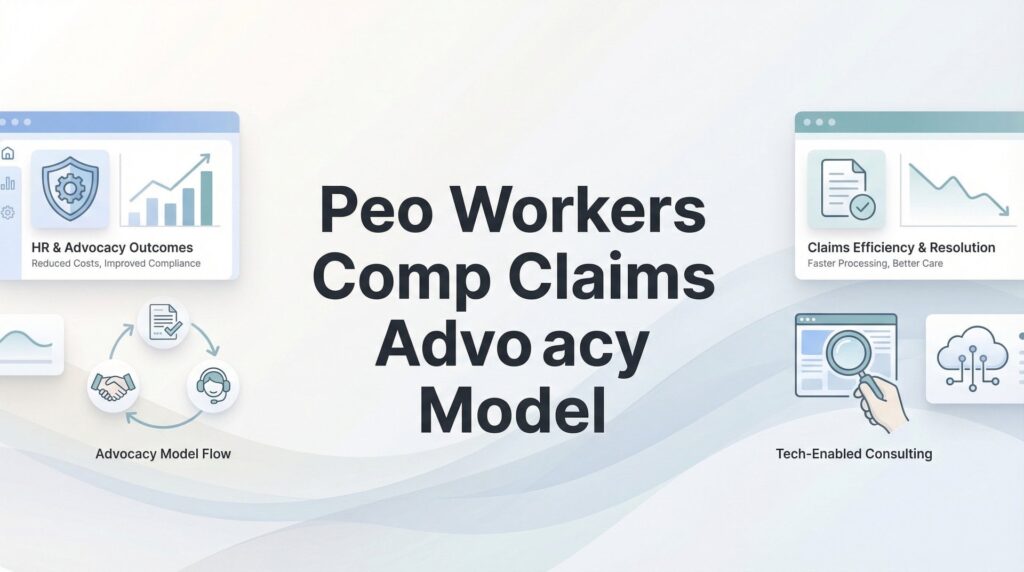
The workflow looks like this: injury report → immediate specialist contact → medical coordination and claim filing → ongoing treatment management → return-to-work planning → claim resolution and closure. At each stage, the specialist is actively managing the process rather than waiting for problems to surface. That’s the difference between advocacy and administration.
How Claims Advocacy Hits Your Wallet Through Experience Mods
Your experience modification rate is basically your workers comp report card. It compares your actual claims to what’s expected for a business your size in your industry. A 1.0 mod means you’re average. Below 1.0 means you’re safer than average and get a premium discount. Above 1.0 means you’re riskier and pay more. Claims advocacy directly affects this number.
Here’s the mechanism. Your mod calculation looks at both claim frequency and severity over a three-year period. A $50,000 claim that drags on for 18 months with ongoing medical costs hurts you far more than a $50,000 claim that resolves in six months with no complications. Advocacy models reduce both duration and total costs through faster medical coordination, better treatment oversight, and aggressive return-to-work programs. Understanding claims frequency analysis helps you see how these patterns affect your costs over time.
When an employee returns to modified duty within weeks instead of staying out for months, you’re cutting the indemnity portion of the claim dramatically. Those weekly disability payments add up fast. A warehouse worker earning $800 weekly who’s out for six months generates roughly $20,000 in indemnity costs alone—before medical expenses. Get them back in a modified role after six weeks, and you’ve potentially saved $15,000 on that single claim. Multiply that across several claims annually, and the mod impact becomes significant.
But here’s where PEO structures complicate things. Most PEOs use master policies where all clients are pooled under one large policy. Your individual claims affect the pool, but you’re also absorbing risk from other companies in that pool. If you’re a low-risk office operation grouped with high-risk construction firms, you might be subsidizing their claims through higher pooled rates.
Some PEOs offer loss-sensitive programs where your specific claims experience directly determines your costs. These arrangements work more like traditional workers comp—your mod is calculated based on your claims alone, not the pool. Strong claims advocacy matters even more here because poor outcomes directly hit your renewal premiums with no pooling to cushion the impact. A mod rate forecasting model can help you predict how current claims will affect future premiums.
The cost equation isn’t just about premiums, though. PEOs with robust advocacy models typically charge higher administrative fees. You might pay an extra $50-$100 per employee annually for access to dedicated claims specialists and nurse case management. That sounds expensive until you run the math on what a single poorly managed claim costs you over three years of elevated mods.
Let’s say you have 50 employees and pay $150,000 annually in workers comp premiums at a 1.0 mod. One serious claim mishandled could push your mod to 1.3 within two years. That’s an extra $45,000 annually in premium costs—$135,000 over three years before the mod resets. If strong advocacy prevents that mod increase by managing claims effectively, the $5,000 annual fee for premium advocacy services looks like a bargain.
The hidden cost most business owners miss is litigation. Disputed claims that end up in hearings or lawsuits can easily exceed $100,000 when you factor in legal costs, extended disability payments, and settlement amounts. Advocacy models with legal support and dispute intervention catch these situations early—before an employee lawyers up because they feel abandoned or confused by the process.
Premium savings from advocacy aren’t immediate. You’re playing a multi-year game where better claims outcomes gradually improve your mod and reduce renewal premiums. But the operational benefit—not personally managing every claim detail—has immediate value if your time is better spent running your business.
Spotting Fake Advocacy: Questions That Expose the Truth
Every PEO sales deck includes a slide about “comprehensive claims management” or “dedicated support.” The marketing language is identical. The actual service quality varies by a factor of ten. You need to ask specific questions that force honest answers about what you’re actually getting.
Start with staffing ratios. Ask: “What’s your claims specialist to client ratio?” A genuine advocacy model typically runs 1 specialist per 30-50 clients, depending on industry risk levels. If they’re vague or quote something like 1 per 200, you’re getting call center support, not dedicated advocacy. Follow up with: “Will I have a specific specialist assigned to my account, or do I call a general line?” If it’s a general line, it’s not real advocacy.
Ask about response time. “What’s your average time from injury report to first specialist contact with the employee?” Strong advocacy models make contact within 2-4 hours during business hours. If they’re quoting 24-48 hours or “within one business day,” that’s standard carrier-level service with PEO branding on top. The first few hours after an injury are critical for setting the tone and preventing confusion. A robust workers comp incident documentation system enables this rapid response.
Dig into return-to-work programs specifically. Don’t accept generic answers about “working with you to bring employees back.” Ask: “Do you have a formal return-to-work coordinator? What’s the process for identifying modified duty options? Can you share examples of how you’ve implemented this with similar companies?” If they can’t provide concrete process details, they’re winging it claim by claim.
Here’s a telling question: “Is claims management handled in-house by your staff, or do you outsource to a third-party administrator?” Many PEOs outsource claims to TPAs and call it advocacy. That’s not necessarily bad—some TPAs are excellent—but it’s not the same as having PEO staff who understand your business managing claims directly. Outsourced arrangements typically mean less customization and slower response.
Ask about nurse case management availability. “For what types of injuries do you assign a nurse case manager? Is this included in my admin fee or an additional cost?” If nurse case management is available only for catastrophic claims or costs extra, you’re not getting comprehensive advocacy. Premium models include nursing support for any claim that involves surgery, multiple specialists, or extended treatment.
Red flag phrases to watch for: “We partner with leading carriers to provide claims support” usually means the carrier handles everything. “Our online portal gives you 24/7 access to claims information” is describing technology, not advocacy. “We provide safety training to prevent claims” is loss control, which is valuable but different from claims advocacy.
Industry context matters here. If you’re running a construction company or manufacturing operation with regular injury risk, weak advocacy will cost you. You need dedicated specialists who understand OSHA requirements, work with orthopedic specialists regularly, and know how to navigate complex claims. If you’re operating a low-risk office environment with one claim every few years, premium advocacy might be overkill—but the PEO should be honest about that rather than selling you services you don’t need.
Test their knowledge with scenario questions. “Walk me through what happens if an employee disputes a claim denial” or “What’s your process if an injured employee isn’t improving after six weeks of treatment?” Their answers reveal whether they have experienced specialists managing these situations or just following carrier scripts.
What to Actually Compare When Evaluating PEO Claims Models
Comparing claims advocacy across PEOs requires looking past marketing materials to operational details. Start with organizational structure. Is claims management a dedicated department with experienced specialists, or is it handled by general HR reps who also manage payroll questions and benefits enrollment? Dedicated departments signal genuine investment in advocacy.
Ask whether claims staff are certified. Look for designations like ARM (Associate in Risk Management), AIC (Associate in Claims), or RN credentials for nurse case managers. These certifications indicate professional claims expertise rather than customer service reps reading scripts. It’s a proxy for whether the PEO takes claims seriously as a specialized function.
Request specific claims data during the evaluation process. You want to see: average claim duration by injury type, percentage of claims that return to work within 90 days, litigation rate (what percentage of claims end up in hearings or lawsuits), and average total claim costs compared to industry benchmarks. Reputable PEOs with strong advocacy models can produce this data. Vague responses suggest they’re not tracking outcomes closely. A comprehensive workers comp program evaluation checklist helps you structure these comparisons systematically.
Loss runs from their current clients (anonymized) are particularly revealing. These show claim frequency, severity, and how quickly claims close. If a PEO has been managing workers comp for manufacturing clients similar to your operation, their loss runs should show better-than-average outcomes. If their data looks identical to industry averages, their advocacy isn’t moving the needle.
Dig into medical provider networks. Ask: “Do you have preferred provider relationships with orthopedic specialists, physical therapy clinics, and occupational medicine practices in my area?” Strong networks mean faster appointments, better communication with the PEO, and often better treatment outcomes. Weak networks mean your injured employees are navigating the general healthcare system with all its delays and coordination failures.
Legal support structure matters for disputed claims. Ask: “At what point do you involve legal counsel in a disputed claim? Is legal support included or billed separately? Do you have staff attorneys or use outside firms?” Some PEOs have in-house legal teams that intervene early when disputes arise. Others wait until litigation is unavoidable and then hire outside counsel at your expense. The difference affects both costs and outcomes.
Contract provisions often reveal more than sales conversations. Look for these specifics: Who has final authority over return-to-work decisions—you or the PEO? What happens to open claims if you leave the PEO mid-year? Are you required to use specific medical providers, or do you have flexibility? How are claim disputes with the carrier escalated and resolved? Understanding the risk transfer framework clarifies where liability actually sits.
Some PEOs retain control over medical provider selection and return-to-work timing. That can be beneficial if they have expertise, but it can also create friction if you disagree about when an employee is ready to return or which doctor they should see. Make sure you understand where your authority ends and the PEO’s begins.
The mid-claim termination question is critical. If you switch PEOs or leave for standalone coverage while claims are still open, what happens? Some contracts specify that the original PEO continues managing those claims through resolution. Others transfer claims to the new carrier, which can create coordination nightmares. Understanding this before you sign prevents ugly surprises later.
Ask about transparency and reporting. “What claims reporting do I receive and how often? Can I access real-time claim status? Do I get alerts when claim costs are trending high?” You should have visibility into every open claim, current reserves, and cost trends. If the PEO treats claims data as proprietary information you can’t access, that’s a control issue that will frustrate you when you need answers. Tracking workers comp performance metrics gives you the data needed to hold your PEO accountable.
When You’re Better Off Without Premium Advocacy
Not every business needs or benefits from a premium claims advocacy model. If you’re running a professional services firm with 15 office employees and your last workers comp claim was three years ago for a sprained ankle, you’re probably paying for advocacy services you’ll rarely use. The admin fee premium doesn’t make sense when your annual claim frequency is near zero.
Low-risk industries with minimal claims history should run the math carefully. If you’re paying an extra $75 per employee annually for advocacy services across 20 employees, that’s $1,500 yearly. If your total workers comp premium is $5,000 and you file one minor claim every two years, the advocacy premium exceeds your likely benefit. You’d be better off with basic PEO coverage or standalone workers comp with a competent agent. A thorough cost modeling comparison helps you determine whether the premium services justify their price.
Businesses with strong internal HR capacity and safety programs may not need the PEO to manage claims actively. If you have an experienced HR director who understands workers comp, maintains relationships with medical providers, and has successfully managed claims before, paying for external advocacy duplicates capabilities you already have. Your HR person might actually do a better job because they know your employees and operations intimately.
Some companies prefer maintaining direct relationships with insurance carriers and brokers rather than adding the PEO as an intermediary layer. If you’ve worked with the same workers comp carrier for years and have established relationships with their adjusters, moving to a PEO master policy might disrupt those relationships without adding value. You lose direct carrier contact and gain a PEO middleman.
Alternative approaches exist that might fit better. Standalone workers comp through a quality broker, paired with a good third-party administrator for claims management, can deliver similar outcomes without the full PEO commitment. You maintain more control over policy terms, provider networks, and claims decisions. The tradeoff is you’re coordinating multiple vendors instead of one PEO relationship.
Some PEOs offer tiered workers comp options—basic coverage without advocacy, or premium coverage with full advocacy services. If your risk profile is moderate, the basic tier might be sufficient. You get the master policy benefits and pooled rates without paying for dedicated specialists you may not need. Just make sure the basic tier still provides competent claims administration, not complete neglect.
Geography plays a role too. Workers comp requirements and medical costs vary dramatically by state. In states with well-functioning workers comp systems and reasonable medical costs, claims tend to resolve more smoothly even without aggressive advocacy. In states with complex regulations, high medical costs, or litigious environments, advocacy becomes more valuable because the baseline system is harder to navigate. Companies operating across multiple jurisdictions face additional complexity that multi-state PEO arrangements can help address.
The honest answer is that advocacy is most valuable for businesses with regular claims activity in moderate-to-high-risk industries. If that’s not you, don’t pay for services that primarily benefit other companies in the PEO’s pool. Find an arrangement that matches your actual risk profile and claims frequency.
Making the Decision That Actually Fits Your Risk
Claims advocacy is a real differentiator when it’s genuine—dedicated specialists, proactive management, measurable outcomes. It’s expensive marketing fluff when it’s just carrier administration with a PEO logo on the portal. The difference matters because you’re making a multi-year commitment that affects both your immediate claim experience and your long-term insurance costs.
If you operate in construction, manufacturing, healthcare, transportation, or any industry where injuries happen regularly, strong claims advocacy should be a primary evaluation factor. Ask the hard questions about staffing, response times, and outcomes data. Request loss runs. Talk to current clients about their actual experience when claims occur. Don’t accept vague assurances about “comprehensive support.”
If you’re low-risk with minimal claims history, be honest about whether you’re paying for advocacy you’ll never use. A basic PEO arrangement or standalone coverage might serve you better at lower cost. The goal is matching the service level to your actual risk exposure, not buying the most comprehensive package because it sounds impressive.
Pay attention to contract terms around control and portability. Make sure you understand who makes key decisions, what happens to open claims if you leave, and how disputes get resolved. These provisions matter when situations get complicated, which is exactly when you need clarity.
The experience mod impact is real. Better claims management improves your mod over time, reducing premiums year after year. But that benefit only materializes if the advocacy is actually effective—not just present in the contract. Use comparison tools to evaluate workers comp arrangements alongside pricing, service quality, and contract flexibility.
Before you sign that PEO renewal, make sure you’re not leaving money on the table. Many businesses unknowingly overpay because of bundled fees, hidden administrative markups, and contracts designed to limit flexibility. We give you a clear, side-by-side breakdown of pricing, services, and contract terms—so you can see exactly what you’re paying for and choose the option that truly fits your business. Don’t auto-renew. Make an informed, confident decision.
