
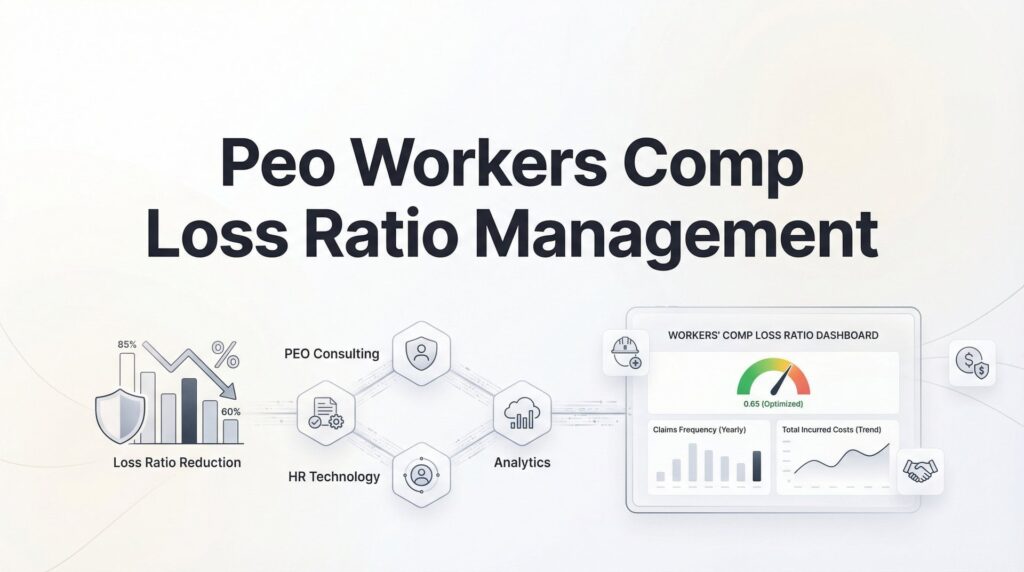
Your workers’ comp loss ratio directly impacts what you pay for coverage through your PEO—and most business owners have no idea they can influence it.
The loss ratio is simply the relationship between claims paid out and premiums collected. A high ratio means your workforce is generating more claims than expected, which eventually translates to higher costs, reduced PEO options, or both.
The good news: loss ratio management isn’t some mysterious actuarial black box. It’s a series of practical steps you can take to reduce workplace injuries, manage claims efficiently when they do happen, and position your company favorably during PEO negotiations.
This guide walks you through the process from understanding your current ratio to implementing changes that move the needle. Whether you’re dealing with a loss ratio that’s already problematic or trying to maintain a good one, these steps apply.
We’ll focus on what you can actually control—because while you can’t prevent every workplace injury, you can absolutely influence the frequency, severity, and cost trajectory of claims over time.
Step 1: Get Your Actual Loss Ratio Numbers from Your PEO
You can’t manage what you don’t measure. The first step is getting clear, specific data about your workers’ comp performance.
Most PEOs include loss ratio information in quarterly or annual reporting, but it’s not always labeled clearly. Look for documents called “loss runs,” “experience modification worksheets,” or “claims summary reports.” These typically show your incurred losses—the total of paid claims plus reserves set aside for open claims—and your earned premium for the same period.
If those reports don’t show up automatically, request them. Specifically ask for: incurred losses (broken down by paid and reserved amounts), earned premium for the measurement period, individual claim details including dates of injury and current status, and whether the numbers include IBNR (incurred but not reported) estimates.
The basic calculation is straightforward: divide your incurred losses by your earned premium, then multiply by 100. If you paid $100,000 in premium and incurred $65,000 in losses, your loss ratio is 65%. Understanding how PEO workers’ comp premiums are calculated helps you interpret these numbers more accurately.
That number matters. A loss ratio under 70% is generally considered favorable. Between 70% and 90% is average. Above 100% means your claims are exceeding the premium you’re paying, which is unsustainable and will eventually drive rate increases or limit your PEO options.
Watch for red flags in the data. If you see high reserves compared to paid amounts, your PEO may be over-reserving, which inflates your loss ratio artificially. A single large claim can skew everything—if one catastrophic injury represents 80% of your total incurred losses, that’s a different problem than ten smaller claims adding up to the same number.
Verify the time period the data covers. Loss ratios can shift significantly depending on whether you’re looking at 12 months, 24 months, or policy-year data. Make sure you’re comparing apples to apples.
Once you have this baseline, you’ll know whether you’re dealing with a problem that needs immediate attention or working to maintain something that’s already solid.
Step 2: Identify What’s Actually Driving Your Claims
Generic safety programs fail because they don’t address your specific problems. You need to know exactly where your claims are coming from.
Start by categorizing claims by injury type. Are you seeing mostly strains and sprains? Slips and falls? Repetitive motion injuries? Vehicle incidents? The pattern tells you where to focus prevention efforts.
Then break it down further. Analyze by department, specific job role, shift (day vs. night), and employee tenure. A pattern will emerge. Maybe your warehouse has twice the injury rate of your office. Maybe night shift workers get hurt more often. Maybe employees in their first 90 days account for 40% of your claims despite being 15% of your workforce.
This matters because frequency problems and severity problems require different solutions. Conducting a thorough workers’ comp claims frequency analysis helps you distinguish between these issues. If you have many small claims—lots of minor strains, cuts, or bruises—you have a frequency issue. Prevention and early intervention are your tools. If you have few claims but they’re expensive—major back injuries, surgical cases, long-term disabilities—you have a severity problem. Better safety equipment, job redesign, and aggressive return-to-work programs matter more.
Look at timing patterns too. Do injuries spike after holidays when people return rusty? During your busy season when everyone’s working overtime and cutting corners? In summer heat or winter cold? Seasonal patterns point to specific interventions.
Don’t skip the tenure analysis. New employee injuries are disproportionately common across most industries. If your data shows the same pattern, your onboarding and training process needs work—not your overall safety program.
Your success indicator here is simple: can you name your top three claim drivers with specific data backing each one? “We have a lot of injuries” isn’t useful. “We have twelve back strain claims in the warehouse, all among employees lifting without mechanical assists, concentrated in our peak shipping months” gives you something actionable.
This analysis doesn’t require sophisticated software. A spreadsheet and your loss run data will get you 90% of the way there.
Step 3: Implement Targeted Prevention Programs
Once you know what’s actually hurting people, you can stop wasting money on generic safety theater and focus resources where they’ll make a difference.
If your analysis showed back strains and lifting injuries as a top driver, your prevention program should focus there. Ergonomic assessments of workstations and lifting tasks. Job rotation to reduce repetitive strain. Mechanical lifting assists—dollies, hoists, pallet jacks—for anything over a reasonable weight threshold. Training that’s specific to your actual lifting scenarios, not a generic video everyone ignores.
If slips and falls dominate your claims, look at flooring conditions, lighting, housekeeping protocols, and footwear requirements. A flooring audit might reveal that your warehouse has uneven surfaces or poor drainage creating slip hazards. Requiring slip-resistant footwear and actually enforcing it can cut fall injuries significantly.
For new-hire injuries, extend your onboarding period. Pair new employees with experienced mentors for their first month. Consider physical conditioning programs if your work is physically demanding—people who aren’t used to the work get hurt more often. Slow down the ramp-up period even if it feels inefficient short-term.
Here’s the reality nobody likes to discuss: prevention programs cost money. You can’t do everything at once, and not every intervention delivers the same return. A well-structured PEO loss prevention program helps you prioritize interventions that deliver measurable results.
If you have ten small cut injuries and two catastrophic falls from height, preventing the falls matters more even though cuts are more frequent. The math is brutal but clear—one fall from height claim can cost more than fifty minor cuts.
Track whether your interventions work. If you implement mechanical lifting assists, your strain injury count should drop within six months. If it doesn’t, either compliance is poor or you misidentified the problem. Adjust accordingly.
Avoid the trap of implementing programs because they sound good or because another company does them. Your claim drivers are specific to your operation. Match your prevention efforts to your actual data, not someone else’s best practices.
Step 4: Establish a Return-to-Work Program That Actually Functions
Claim duration is the biggest cost driver in most workers’ comp cases. The longer someone stays out, the more expensive the claim becomes—and the less likely they are to return at all.
A functional return-to-work program reduces claim costs by getting injured employees back to productive work as soon as medically appropriate, even if they can’t perform their full duties yet. This requires planning before injuries happen, not scrambling after.
Create a menu of modified duty options across your operation. Light assembly work, administrative tasks, quality inspection, customer service support—anything that provides value while accommodating temporary restrictions. Document these options and make sure managers know they exist.
When an injury occurs, coordinate immediately with your PEO’s claims team. Following a structured workers’ comp injury management protocol ensures nothing falls through the cracks. They often have return-to-work resources, templates, and medical networks you’re not using. Ask what accommodations the treating physician recommends and match them to your available modified duty roles.
Here’s the common pitfall: modified duty that’s meaningless or humiliating. If you bring someone back to sit in a corner and count paper clips, they’ll find reasons to stay out longer. Modified duty needs to be real work that contributes to the business and maintains the employee’s dignity.
Stay in regular contact with injured employees. Weekly check-ins show you care about their recovery and keep return-to-work top of mind. Employees who feel abandoned or forgotten during injury recovery are less motivated to return quickly.
Measure your success by tracking average days to return for different injury types. Compare your numbers against industry benchmarks. If your average return time for back strains is 45 days and the industry average is 28 days, your program isn’t working well enough.
The financial impact is significant. Reducing average claim duration by even a week or two can move your loss ratio measurably, especially if you have multiple claims per year.
Step 5: Actively Manage Open Claims with Your PEO
Many business owners treat workers’ comp claims as something their PEO handles entirely. That’s a mistake that costs money.
Your PEO’s claims adjuster is managing dozens or hundreds of claims. You’re managing yours. Stay involved in treatment decisions, settlement discussions, and reserve adjustments. This doesn’t mean micromanaging every medical appointment, but it does mean regular oversight.
Request monthly claim reviews for any active claims and quarterly reviews of your overall claims portfolio. Ask about treatment plans, expected duration, settlement prospects, and reserve amounts. If something doesn’t make sense, ask questions.
Challenge excessive reserves when you see them. Reserves are estimates of what a claim will ultimately cost. PEOs sometimes over-reserve to be conservative, but those reserves inflate your loss ratio even if the claim settles for much less later. Understanding how to review reserve development helps you spot red flags before they impact your costs.
Understand when to push for settlement versus litigation. Settlement costs money upfront but closes the claim and stops the clock on ongoing medical and indemnity payments. Litigation can take years and rack up legal fees. The decision depends on the specific claim, but you should understand the cost implications of each path and have input into the strategy.
When claims involve attorney representation, costs typically increase and timelines extend. Sometimes attorney involvement is unavoidable, but early engagement and good communication with injured employees can reduce the likelihood they feel they need legal representation.
Document your involvement in claim management. Keep records of your communications with the PEO’s claims team, notes from claim review meetings, and any interventions you made that affected outcomes. This documentation matters during PEO renewals and when shopping for alternative providers—it shows you’re an engaged, low-maintenance client who actively manages risk.
The goal isn’t to become a claims expert yourself. It’s to ensure someone who cares about your specific loss ratio is paying attention to each claim’s trajectory.
Step 6: Use Loss Ratio Data in PEO Negotiations
A strong loss ratio is leverage. A improving loss ratio is a story. Either way, you should use this data strategically when dealing with your PEO.
Timing matters. Present loss ratio improvements during renewal discussions, before rates are set for the next period. Conducting a workers’ comp renewal risk analysis before your contract renews positions you to negotiate from strength. If you wait until after your PEO sends renewal terms, you’ve lost your best opportunity to influence pricing.
Come prepared with trend data showing improvement, documentation of prevention programs you’ve implemented, return-to-work metrics demonstrating reduced claim duration, and any other evidence that you’re actively managing workers’ comp risk. This positions you as a desirable client, not just another account.
Leverage comparison shopping. If your loss ratio is strong, you’re attractive to competing PEOs. Get quotes from alternatives and use them as negotiating leverage with your current provider. PEOs would rather keep a good client at a slightly lower margin than lose them entirely.
Understand how your PEO handles experience rating. Some PEOs fully pass through your individual claims experience in pricing. Others blend your experience with their master policy pool, which can help high-risk businesses but dilutes the benefit for low-risk ones. If your loss ratio is significantly better than average, a PEO that passes through individual experience will price you more favorably.
When your loss ratio is poor, don’t hide from it. Be upfront, but lead with corrective actions already underway. “Our loss ratio was 110% last year, but we’ve implemented these specific prevention programs, established a return-to-work protocol, and reduced new claims by 30% in the past six months” is a much better conversation than hoping they don’t notice.
PEOs make decisions about which clients to keep, which to price aggressively, and which to non-renew. Demonstrating that you treat workers’ comp as a manageable business function—not just a cost you complain about—puts you in the category they want to keep.
Putting It All Together
Managing your PEO workers’ comp loss ratio isn’t a one-time project. It’s an ongoing operational discipline that pays dividends every renewal cycle.
The steps above form a cycle: measure your current performance, analyze what’s driving claims, prevent injuries through targeted programs, manage claims actively when they occur, and leverage the results in your PEO relationship. Then repeat.
Here’s a quick checklist to confirm you’re on track:
☐ You have current loss ratio data and understand what it means
☐ You’ve identified your top 3 claim drivers with supporting data
☐ Prevention programs target your actual problems, not generic safety
☐ Return-to-work options exist and are actively used
☐ You’re involved in claim management, not just delegating to your PEO
☐ Loss ratio data informs your PEO negotiations
Most businesses leave significant money on the table by treating workers’ comp as a passive expense. The ones who treat it as manageable—because it is—consistently pay less over time.
The difference between a 65% loss ratio and a 95% loss ratio on $100,000 in annual premium is $30,000 in claims costs. Over three years, that’s $90,000. Those numbers compound when you consider how loss experience affects future pricing.
You don’t need to become a safety expert or claims adjuster to make progress here. You just need to pay attention, use the data your PEO already provides, and take deliberate action on the specific problems affecting your workforce.
Before you sign that PEO renewal, make sure you’re not leaving money on the table. Many businesses unknowingly overpay because of bundled fees, hidden administrative markups, and contracts designed to limit flexibility. We give you a clear, side-by-side breakdown of pricing, services, and contract terms—so you can see exactly what you’re paying for and choose the option that truly fits your business. Don’t auto-renew. Make an informed, confident decision.
